
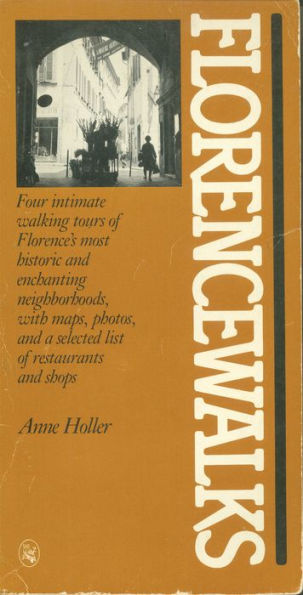
Much of Florence's art is not in her world-famous museums but in her streets, and those treasures can only be seen by those who explore this lovely, medieval city on foot. The four intimate walking tours in Florencewalks lead you through centuries of Italian history and architecture--around corners that hide marble gods and goddesses, down hushed alleys pervaded by the aroma of spices and pastas, out onto sun-washed piazzas flanked by churches and palazzos and open-air markets. Easily completed in a morning of afternoon, each walk includes plenty of spots along the way to sit and read, rest, or browse. In addition to maps of each walk, and more than thirty photographs, Florencewalks also contains a detailed section of visitor information and advice, a concise chronology of the city's history, an index, and a list of particularly special trattorias, wine bars, and shops.
Much of Florence's art is not in her world-famous museums but in her streets, and those treasures can only be seen by those who explore this lovely, medieval city on foot. The four intimate walking tours in Florencewalks lead you through centuries of Italian history and architecture--around corners that hide marble gods and goddesses, down hushed alleys pervaded by the aroma of spices and pastas, out onto sun-washed piazzas flanked by churches and palazzos and open-air markets. Easily completed in a morning of afternoon, each walk includes plenty of spots along the way to sit and read, rest, or browse. In addition to maps of each walk, and more than thirty photographs, Florencewalks also contains a detailed section of visitor information and advice, a concise chronology of the city's history, an index, and a list of particularly special trattorias, wine bars, and shops.

eBook
Available on Compatible NOOK devices, the free NOOK App and in My Digital Library.
Related collections and offers
Overview
Much of Florence's art is not in her world-famous museums but in her streets, and those treasures can only be seen by those who explore this lovely, medieval city on foot. The four intimate walking tours in Florencewalks lead you through centuries of Italian history and architecture--around corners that hide marble gods and goddesses, down hushed alleys pervaded by the aroma of spices and pastas, out onto sun-washed piazzas flanked by churches and palazzos and open-air markets. Easily completed in a morning of afternoon, each walk includes plenty of spots along the way to sit and read, rest, or browse. In addition to maps of each walk, and more than thirty photographs, Florencewalks also contains a detailed section of visitor information and advice, a concise chronology of the city's history, an index, and a list of particularly special trattorias, wine bars, and shops.

Product Details
| ISBN-13: | 9781466865884 |
|---|---|
| Publisher: | Holt Paperbacks |
| Publication date: | 03/11/2014 |
| Sold by: | OPEN ROAD INTEGRATED - EBKS |
| Format: | eBook |
| Pages: | 207 |
| File size: | 6 MB |
About the Author
Anne Holler is the author of the classic Italian guidebook, Florencewalks.
Read an Excerpt
Florencewalks
By Anne Holler, Daniel Boch
Henry Holt and Company
Copyright © 1982 Anne HollerAll rights reserved.
ISBN: 978-1-4668-6588-4
CHAPTER 1
Information and Advice
Before You Go
Any trip you're planning — to the next town or to a foreign port halfway around the world — will be more enjoyable if you do a little homework ahead of time. When it concerns Florence, the reward for such diligence is calm nerves. One of the most frequent complaints about Florence is that museums and virtually every store in town shut down at 1:00 or 2:00 in the afternoon for an unhurried lunch hour. The museums do not reopen until the following day; most of the stores will unlock their doors around 3:30 or 4:00. The smaller the store the less precise will be the hour of reopening. Often a proprietor will hang a cardboard, handwritten sign on his or her front door that gives an approximate time of return. Don't take the time too literally. There's always a leeway of about a half hour. The point here is that you should plan ahead if you want to take in galleries, museums, some shopping, and (I hope) a few walking tours on a tight schedule.
You'll want to enjoy leisurely hours in the art-filled galleries of the Uffizi Palace, the Pitti Palace, the Bargello, the Palazzo Vecchio, and the Accademia delle Belle Arti where Michelangelo's David is housed; and no trip to Florence would be complete without a visit to the famous churches that are themselves architectural works of art: the Cathedral of Santa Maria del Fiore ("the Duomo"), the Baptistery, Santa Croce with the celebrated Giotto frescoes, Santa Maria Novella where Michelangelo worked as an apprentice to Ghirlandaio, San Lorenzo and the Medici Chapels, and the convent of San Marco decorated with Fra Angelico's delicate paintings.
The more practical information you accumulate and think over beforehand, the happier you'll be about how you spend your time in Florence. Write to or call the Italian Government Travel Office at any of the following locations several weeks in advance of your trip:
630 Fifth Avenue
New York, New York 10020
212-245-4822
500 North Michigan Avenue
Chicago, Illinois 60611
312-644-0990
360 Post Street
San Francisco, California 94018
415-392-6206
Ask for all their information on Florence (plus any other Italian cities you plan to visit). You'll receive a travel packet of sights-to-see, the hours of opening, a list of hotels and restaurants, and a map of the city.
You'll be welcome to stay in Florence or anywhere else in Italy for three months with a valid American passport. If you think that you may want to stay longer, apply for a visa before you leave. (Contact any Italian consulate in the United States.) Visas are not always granted easily once you are inside the Italian border.
The summer months in Florence are warm, if not semitropical at times. June is hard to predict. The last few years have seen cooler-than-normal temperatures for this month, so you may want to pack more than the obligatory sweater if you'll be visiting then. A lightweight raincoat, sunglasses, and comfortable shoes are the right accessories for an Italian summer. Winters are very rainy, and occasionally snowy, cold, and damp. Heating systems in even the most elegant establishments are temperamental. Long underwear, plenty of wool socks, and a few layers of sweaters should see you through a less hectic but chillier tourist season. Although Florence has some of the most fashion-conscious citizens in the world, you'll still be well received in the fanciest restaurants in a simple skirt and blouse or trousers and a sports jacket. Members of the nobility are dressing down these days to fend off unwarranted attention; you too can be mistaken for a countess, a duke, or a Milanese television magnate in a simple pair of jeans (and minus your jewel collection). When you visit churches and galleries, don't wear anything outlandish or designed especially for the beach unless you want to attract a lot of stares. Woman wearing short skirts or women or men wearing "unconservative" clothing are occasionally refused entry to churches.
Try to read as much about Florence, its history, art, and architecture, as you are able before setting out on your trip. Browse through books on the painters and sculptors whose works you'll see in Florence. If there's one artist who particularly interests you, make yourself knowledgeable about his work. When you're actually standing in front of his canvas or statue in a Florentine gallery or chapel, you'll truly appreciate your scholarly efforts.
The following is a suggested, highly abbreviated reading list of works that will suffuse you with Italian culture while you're still in the armchair stage of your travels.
John Ciardi's translation of Dante's Divina Commedia (The Divine Comedy) is a clear, informative interpretation of the cornerstone of Italian literature and the first classic work written in the Italian vernacular that is still used today. Iris Origo's historical account of the millionaire but miserly Merchant of Prato is based on the life of the fourteenth-century textile trader Francesco di Marco Datini. Origo, a noted Renaissance scholar, went through five hundred ledgers and thousands of letters left behind by this Italian Horatio Alger. This is a little-recognized and highly readable record of Renaissance daily life right down to the smallest domestic details. (The reader will learn that Renaissance men and women seldom wore night-clothes but always donned little nightcaps!) Jacob Burckhardt's The Civilization of the Renaissance in Italy (1860) is a scholarly survey by one of the foremost writers about the period. For a contemporary look at Florence's art colony life during the Renaissance, read Vasari's Lives of the Artists. Just as entertaining and slightly more worthy of being "X-rated" is the Autobiography of sixteenth-century goldsmith and sculptor Benvenuto Cellini. Memories of his amatory and homicidal adventures may have a more lasting effect on your imagination than his sculptural masterpieces in Florence's Bargello Museum.
For much lighter reading, dip into Irving Stone's well-researched fictional account of Michelangelo's life, The Agony and the Ecstasy. An extensive bibliography, a glossary of Italian words and phrases, and a listing of where Michelangelo's works are to be found is included at the end. A Room with a View by E. M. Forster takes a lingering look at Florence through the slightly hazy eyes of a nineteenth-century English maiden, Lucy Honeychurch, as she daringly walks — without a chaperone — through the town under the spell of newly awakened feelings of love. Mary McCarthy's Stones of Florence is an irreverent twentieth-century look at the cradle of the Renaissance. Her critique of Michelangelo's "rubbery" statues in the Medici Chapel still raises the dander of all Florentines and art lovers.
For a juicy look at the life of international art connoisseur and indefatigable ladies' man Bernard Berenson, read Meryle Secrest's biography, Being Bernard Berenson.
General Information
If you arrive in Florence by way of the train station, the best first move you could make is to leave it quickly behind. Avoid cashing money and asking for information here because the lines are long and you'll only fray your nerves within the first half hour of your visit. Under no circumstances should you consider buying an international train ticket for the next leg of your trip at the station. The Italian system of waiting in three different (and often long) lines — for a reservation, an overnight berth, and a train ticket, respectively — is a test of patience no one should voluntarily undergo. For all information and travel reservations go directly to American Express. If this sounds small-minded and chauvinistic, you'll be happy for once that you were. There are two branches of American Express in Florence. The bank is at via della Vigna Nuova 8/r; it's closed on Saturdays and Sundays. All other services (mail, traveler's checks, travel information, and reservations) are in the smaller office called "Universaltourismo" at via degli Speziali 7/r, right off the Piazza della Repubblica in the center of Florence. It's open Monday through Friday, 9:00 A.M. to 12:30 P.M. and 3:00 to 7:00 P.M.; on Saturdays, 9:30 A.M. to 12:00 noon; and it's closed on Sundays (tel. 217.241). If you're a student and you want help with budget travel and accommodations, walk over to Student Travel (CGTS) at via delle Terme 53/r, which is just off Piazza Santa Trinità. They're open Monday through Friday from 9:00 A.M. to 12:30 P.M. and 3:00 to 6:00 P.M. and closed Saturday afternoons and all day Sunday (tel. 292.150).
In your travels around Florence, you'll notice that the street numbers are written in either black or red. Black numbers indicate residential buildings; red indicates commercial establishments such as stores, restaurants, and hotels. Whenever an address is followed by the letter r (for red), you'll know that the building is a place of business. To add to the confusion, the numbers of both colors do not correspond in any way to each other. A no. 3 (black) may be next door to a no. 37/r (red), so don't expect much logic when you're looking for an address. At least Florence is a small town, so you won't have to wander too far to find the right address.
Most Florentines, especially those who come into daily contact with visitors, do speak English. If you find yourself in a situation where this is not the case, don't be afraid to try and communicate with a mixture of Italian and English or even a dash of French, which is sometimes close enough. Remember that Florentines are cosmopolitan and they're used to speaking with non-Italians. Many merchants are quick to help a foreigner understand prices or bills for thousands of lire. They'll itemize or write your total bill down on a piece of paper if you really need to have that done.
For local excursions around Florence, drop in at the main office of the Compagnia Italiana Turismo (CIT), via de' Cerretani 57–59/r, near the center of Florence (tel. 294.306). This organization offers three-and-a-half- hour tours of the standard Florentine sights in the convenience of a modern air-conditioned bus. There's a morning tour and an afternoon tour. Theater and concert tickets can be purchased here also.
Tickets and information for plays and musical events can be procured also at the box offices of three of Florence's best-known theaters. Teatro Niccolini is at via Ricasoli 3; plays and concerts are held several times a week in this sumptuous seventeenth-century hall. A smaller, intimate theater with a wide selection of dramatic events is the Teatro dell'Oriuolo at via dell'Oriuolo 31. Across the Arno, at Borgo San Jacopo 36, is the more experimental theater group Teatro il Punto; their productions are often held in the open piazzas and cloisters of neighborhood medieval churches. Most of the theatrical events in Florence will be in Italian but any lack of understanding the language should not keep you away from the entertainment.
During the summer months Florence plays host to classical musicians, jazz ensembles, opera singers, country and western groups, and hard-rock bands. The famous music festival Maggio Musicale Fiorentino leans more toward the classical and is held during May and June. Most of the summer musical entertainment is held under the stars, in the open piazzas facing the grand Renaissance churches, and it's free. In December, movie buffs from all over Europe head for Florence's Festival of Documentary Films. The nearby Etruscan town of Fiesole also beckons to cultural enthusiasts while putting its Roman amphitheater to good use. Jazz and classical concerts are presented throughout the summer in this unmatched classical setting. Keep your eyes open for posters displayed on Florence's street corners: posters are the main source of communication for most of the entertainment offerings in the city. If some upcoming event interests you, jot down the time and place because the chances are slim that you will see the information printed elsewhere.
Movie listings are advertised in Florence's newspaper, La Nazione. (One movie theater, the Astro Cinema in Piazza San Simone, offers English and American films exclusively, but the management seems to take extended vacations during the summer months.) Other papers that are avidly read by the local citizens are the Corriere della Sera from Milan and La Città, which is fairly easy reading for the elementary student in Italian. English-reading visitors are always assured of the availability of the International Herald Tribune and another journal with less of a "hard news" approach, the Daily American. Founded in 1945, this paper is published and printed in Rome. If you're particularly homesick for the sight of the English language or in the mood for some light conversational news stories, then by all means buy it. These papers are sold in the many newsstands around the train station.
Swimming facilities in and around Florence can be crowded, so brace yourself for a lot of company if you venture out to the pools. Children will enjoy the playgrounds and swimming at Campo di Marte (take bus number 17 from the train station). Bus A also leaves from the station and goes to the Piscina le Pavoniere. Both pools are open from 10:00 A.M. until 7:00 P.M. throughout the summer. The admission charge is L1,500.
Accommodations
Make hotel reservations several months in advance. The Italian mail service is legendary for the slowness of its service, and it is entirely possible that your letter requesting a room will arrive in Florence many weeks after you do. The best insurance against hotel reservation problems is to make them through your travel agent.
To enjoy Florence in the "grand manner" you may want to consider staying at any of the following. The Grand Hotel Minerva, near the center of town, is an elegant establishment that overlooks Piazza Santa Maria Novella and the regal church of the same name. The Grand Hotel Majestic is located in the quiet via del Melarancio ("Street of the Pomegranate"). The Savoy is everything its name implies; it reigns over what once was the Roman Forum and medieval marketplace of Florence and is now Piazza della Repubblica. The Excelsior Italie is the last word in Florentine taste. This hotel, with a sweeping view of the Arno, started out in 1480 as the Palazzo Ricasoli. Much of the interior marble inlay work and carving was added in the sixteenth century. In the nineteenth century, this sumptuous residence turned into the Hotel New-York. Old photographs of this era show a stream of horse-and-buggies flowing down the boulevard along the Arno and around the Hotel New-York. Today, the Excelsior Italie is more likely to be the scene of dark-glassed limousines parked around the Piazza Goldoni and in front of the main entrance. On the other side of the Arno is the sleek and modern lungarno in Borgo San Jacopo. Built after the last war, this hotel has an unmatched view of the Arno, the fourteenth-century Ponte Vecchio, and the modest skyline of old Florence.
There are any number of moderately-priced, attractive hotels. A few possibilities that are near the center of Florence and the walks in this book are: Della Signoria in via delle Terme, Hotel City in via Sant' Antonino, Berchielli on lungarno Acciaiuoli, and Porta Rossa in via Porta Rossa. A quiet and charming hotel, Monna Lisa, is housed in a Renaissance palace along the old medieval street of Borgo Pinti. There are five comfortable living rooms to relax or entertain in, a flower-bedecked garden in the courtyard, and a resident "contessa" who is straight out of an Auntie Mame novel. On another literary note, you may want to stay at the relatively inexpensive Pensione Bartolini on lungarno Guicciardini. This is where E. M. Forster's characters sojourned in A Room with a View while they toured the town. Also on the economical side is the Hotel Santa Croce in via Bentaccordi. This lodging is popular with visiting art students and professors.
Across the river in the Oltr'arno are two pleasant hotels with modest rates: La Scaletta in via Guicciardini and, in Piazza Santo Spirito, the Pensione Bandini, another Renaissance-palace-turned-hotel.
Check with your travel agent about price ranges and special services or write to the Italian Government Travel Office (see here) for complete and up-to-date brochures on hotels.
Transportation
Walking is the sanest way to get around Florence. Driving is hazardous to your health — mental and physical — and there's no real reason to take to the wheel unless you are entering or leaving the city. If you find yourself in either situation, you should be forewarned that many intersections away from the center of the city are ambiguously managed by both pedestrians and motorists. Many corners have neither stop signs nor traffic lights, and there's a continuous game of Russian roulette to see who is going to get through the impasse without coming out looking like an accordion. Over the decades, Florentines have developed a sixth sense for surviving and even enjoying this test of intuition, endurance, and timing. If you're a pedestrian at one of these intersections, it's often best to stand back and wait for the flow of vehicles to go through their maneuvers before attempting to cross. Despite the seeming abundance of cars around Florence, this method of transportation is still a great luxury. Garages are expensive, gasoline is almost $4 a gallon these days, and mechanical service is virtually on a par with the cost of medical care. Motorcycles and motor-scooters are also relatively expensive ways of getting around Florence but they are easier to handle and park than cars. Bicycles and walking, for many Florentines, are still the cheapest and sometimes fastest ways to travel over bridges, through narrow stone-paved streets, and around traffic-clogged piazzas. Walking, for the unitiated, is the safest and, in many ways, the most pleasant way to get around the town.
(Continues...)
Excerpted from Florencewalks by Anne Holler, Daniel Boch. Copyright © 1982 Anne Holler. Excerpted by permission of Henry Holt and Company.
All rights reserved. No part of this excerpt may be reproduced or reprinted without permission in writing from the publisher.
Excerpts are provided by Dial-A-Book Inc. solely for the personal use of visitors to this web site.
Table of Contents
Contents
Title Page,Copyright Notice,
Dedication,
Map,
Acknowledgments,
Introduction,
Information and Advice Before You Go / General Information / Accommodations / Transportation / Food and Drink / Tipping / Telephone, Telegraph, Post Office / Money and Banking / Shopping / Emergencies / Worth a Detour /,
Chronology,
Walk 1: Dante's Florence,
Walk 2: Streets of the Renaissance Princes,
Walk 3: Markets, Bazaars, and Antiques,
Walk 4: The Artisans' Quarter,
Restaurants and Shops,
Index,
Other titles in this series,
Copyright,
To my father,