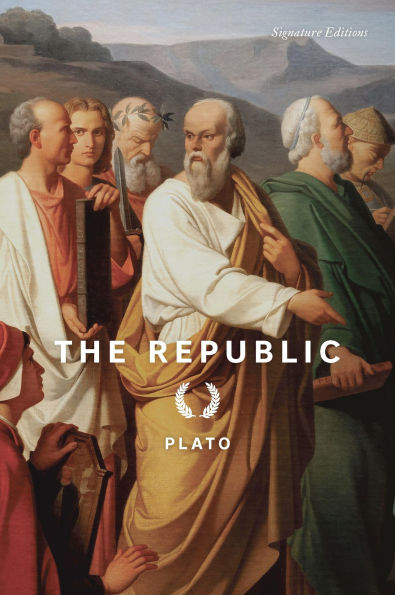
The Republic
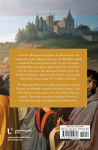
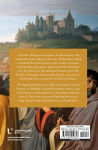
Presented in the form of a dialogue between Socrates and three different interlocutors, this classic text is an enquiry into the notion of a perfect community and the ideal individual within it. During the conversation, other questions are raised: what is goodness? What is reality? And what is knowledge? The Republic also addresses the purpose of education and the role of both women and men as guardians of the people. With remarkable lucidity and deft use of allegory, Plato arrives at a depiction of a state bound by harmony and ruled by philosopher kings. 
1116639897
The Republic
Presented in the form of a dialogue between Socrates and three different interlocutors, this classic text is an enquiry into the notion of a perfect community and the ideal individual within it. During the conversation, other questions are raised: what is goodness? What is reality? And what is knowledge? The Republic also addresses the purpose of education and the role of both women and men as guardians of the people. With remarkable lucidity and deft use of allegory, Plato arrives at a depiction of a state bound by harmony and ruled by philosopher kings. 
9.99 In Stock
The Republic

The Republic

by Plato
The Republic

The Republic

by Plato

Paperback

$9.99 
  • SHIP THIS ITEM
    In stock. Ships in 1-2 days.
  • PICK UP IN STORE

    Your local store may have stock of this item.

Related collections and offers


Overview

Presented in the form of a dialogue between Socrates and three different interlocutors, this classic text is an enquiry into the notion of a perfect community and the ideal individual within it. During the conversation, other questions are raised: what is goodness? What is reality? And what is knowledge? The Republic also addresses the purpose of education and the role of both women and men as guardians of the people. With remarkable lucidity and deft use of allegory, Plato arrives at a depiction of a state bound by harmony and ruled by philosopher kings. 

Product Details

ISBN-13: 9781454959847
Publisher: Union Square & Co.
Publication date: 06/17/2025
Series: Signature Editions Series
Pages: 368
Product dimensions: 5.30(w) x 8.00(h) x 1.10(d)

About the Author

About The Author
Plato (427–347 B.C.E.) was an ancient Greek philosopher born in Athens during the Classical period. In Athens, Plato founded the Academy, a philosophical school where he taught the doctrines that would later become known as Platonism. 

Read an Excerpt

Socrates: I went down yesterday to Piraeus with Glaucon, Ariston’s son, to pray to the goddess, wanting at the same time also to see the way they were going to hold the festival, since they were now conducting it for the first time. The parade of the local residents seemed to me to be beautiful, while the one that the Thracians put on looked no less appropriate. And having prayed and having seen, we went off toward the city. Spotting us from a distance then as we headed home, Polemarchus, Cephalus’s son, ordered his slave to run and order us to wait for him. And grabbing me from behind by my cloak, the slave said “Polemarchus orders you to wait.” And I turned around and asked him where the man himself was. “He’s coming along from behind,” he said. “Just wait.” “Certainly we’ll wait” said Glaucon.

Table of Contents

Preface and background to the Republic xiii

Introduction xxiii

Principal Dates xlvii

Current Opinions of Justice Refuted (Book 1) 1

Introductory Dialogue (Socrates and Cephalus, 328c-331d) 2

First Definition (Cephalus, 331a-d) 5

Refutation (332c-335d) 6

Third Definition (Thrasymachus, 338c-343a) 13

Refutation (339b-e) 14

Redefinition of Ruler (340d-341a) 15

Refutation (341c-343a) 16

New Argument (343a-348a) 18

Refutations of (a): i) 345b-348a) 20

Refutation of (b), 352d-354a 28

Conclusion (354a-c) 30

Justice Reexamined, in the State and in the Individual (Books 2-4) 31

Adeimantus (362d-367e) 35

The Problem Examined and Solved (368c-445e) 40

Second State of the State (372d-427c) 44

Elementary Education of the guardians (376c-415d) 48

Gymnastics (physical education), 403c-412b 73

Instilling and testing patriotism and leadership, 412c-415d 81

Living arrangements of guardians and auxiliaries (415d-427c) 85

Conclusion (427c-434d) 94

Wisdom = the knowledge of the guardians (428a-429a) 95

Courage = the auxiliaries’ opinion of “what is and is not to be feared” (429a-30c) 96

Temperance = agreement of all three classes about who should rule and be ruled (430d-432b) 97

Justice = each of the three classes “tending its own business” and not preempting the work of another (432b-434d) 99

Composition of the Soul (434d-441c) 101

Conclusion (441d-444e) 109

Degeneration Regimes and Souls, Interrupted (445b-449a) 113

Digression: The Best Regime and Men (Books 5-7) 114

Organization of the Best Regime (451c-461e) 116

Women and children will not be private possessions but common to all of the men. Marriage arrangements, eugenics (457c-461e) 122

The Superiority and Possibility of Such a City (462a-473e) 126

Excursus: regulations for warfare (466e-471c) 131

Such a city is not impossible (471e-473c) 136

Reminder that the best state is only a model, not completely realizable in practice (472b-473b). It is possible only if philosophers become kings or kings philosophers (473c-3), 138

The Best Men: Philosopher Kings (Guardians), Book 5, 474b-Book 7 139

The Philosophic Nature (485a-503e) 147

Higher Education of the Guardians (504a-535a) 165

The Simple of the Sun (506e-509b) 168

The Simile of the Divided Line (509d-511e) 171

The Simile of the Cave (514a-521b) 174

Curriculum (521c-535a) 181

Plane geometry, 526c-527c 186

Harmonics, 530d-531c 190

Selection of the Guardians (535a-540c) 195

Brief Excursus (540d-541b) 200

Degenerate Regimes and Souls, Resumed From Book 5 (Books 8 and 9) 201

Cause of Change or Decline in a State: Civil War (545c-547c) 203

Degenerate Regimes and Men, Described and Compared (547c-592b) 205

Oilgarchy (rule of the wealthy few) and the oligarchic man (550c-555b) 208

Democracy (rule of the people) and the democratic man (555b-562a) 213

Tyranny (dictatorship) and the tyrannical man (562a-580a) 220

The five types are judged for their goodness and happiness and ranked in the order in which they were presented: Aristocracy and the aristocratic man are the best and happiness; tyranny and the tyrant are the worst and most miserable (580a-588a) 237

Conclusion: The aristocrat is just, the tyrant unjust. Therefore justice makes a man happy, injustice makes him unhappy (588b-592b) 247

Denunciation of Imitative Poetry (Book 10, 595a-608b) 251

Imitative poetry appeals to the emotions rather than to the mind (602c-605c) 259

Imitative poetry deforms character (605c-608b) 263

Immortality and the Rewards of Justice (608b-End) 265

Rewards of Justice and Punishments of Injustice in This Life (612b-614a) 269

Rewards and Punishments After Death (614a-621d) 271

Appendix: The Spindle of Necessity 279

Bibliography 283

What People are Saying About This

John Cooper

"Its increased accessibility promises to make it the number-one choice for undergraduate courses."
Princeton University

Lloyd P. Gerson

"Loving attention to detail and deep familiarity with Plato's thought are evident on every page."
University of Toronto

Interviews


Joe Sachs's translation of Plato's Republic is for students studying philosophy at the college level, as well as for the general reader interested in the major works of western civilization.

From the B&N Reads Blog

Customer Reviews