When he was nine he moved away from his family to help another uncle who ran a post office. Whilst with him he was beaten and starved which manifested in a series of chronic nervous difficulties. The treatment endured for six years until he managed to escape back to Lom.
For some time he now took any job that was available to him, including store clerk, peddler, shoemaker's apprentice, sheriff's assistant, elementary-school teacher and ropemaker's apprentice. At about the same time, with the wealth of these gained experiences, he began to explore his literary talents.
In 1877 he published his first book `The Enigmatic Man: A Love Story from Northern Norway', others soon followed but real success only came in 1890 with `Hunger', an influential work for later novelists with its internal monologue and bizarre logic. His work is often associated with Pantheism; where nature and mankind are unified in a strong and often mystical bond.
His work was so influential that in 1920 he was awarded the Novel Prize for Literature.
Shortly after this point his works became fewer and his interests darker. During World War II he became a fervent admirer of the Nazi's, even meeting Hitler, even though German armies had overrun Norway. With the war's end he was detained on charges of treason. His old age was apparently the primary reason given for Hamsun receiving only a fine. Other reasons also sought to excuse his abhorrent behaviour but it was clear that whilst he was loved for his literature he was detested for his politics and morals.
His literary canon includes more than 20 novels, a poetry collection, short stories, plays, a travelogue, other works of non-fiction and essays.
Knut Hamsun died on the 19th February 1952 in Grimstad. He was 92.
When he was nine he moved away from his family to help another uncle who ran a post office. Whilst with him he was beaten and starved which manifested in a series of chronic nervous difficulties. The treatment endured for six years until he managed to escape back to Lom.
For some time he now took any job that was available to him, including store clerk, peddler, shoemaker's apprentice, sheriff's assistant, elementary-school teacher and ropemaker's apprentice. At about the same time, with the wealth of these gained experiences, he began to explore his literary talents.
In 1877 he published his first book `The Enigmatic Man: A Love Story from Northern Norway', others soon followed but real success only came in 1890 with `Hunger', an influential work for later novelists with its internal monologue and bizarre logic. His work is often associated with Pantheism; where nature and mankind are unified in a strong and often mystical bond.
His work was so influential that in 1920 he was awarded the Novel Prize for Literature.
Shortly after this point his works became fewer and his interests darker. During World War II he became a fervent admirer of the Nazi's, even meeting Hitler, even though German armies had overrun Norway. With the war's end he was detained on charges of treason. His old age was apparently the primary reason given for Hamsun receiving only a fine. Other reasons also sought to excuse his abhorrent behaviour but it was clear that whilst he was loved for his literature he was detested for his politics and morals.
His literary canon includes more than 20 novels, a poetry collection, short stories, plays, a travelogue, other works of non-fiction and essays.
Knut Hamsun died on the 19th February 1952 in Grimstad. He was 92.


Slaves of Love: A tale of unrequited love from a classic Norwegian author
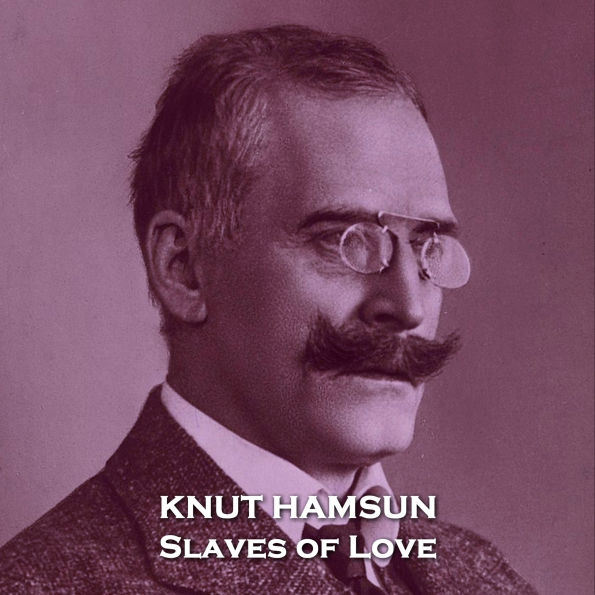
Slaves of Love: A tale of unrequited love from a classic Norwegian author
FREE
with a B&N Audiobooks Subscription

Product Details
| BN ID: | 2940195644192 |
|---|---|
| Publisher: | The Copyright Group |
| Publication date: | 06/25/2025 |
| Edition description: | Unabridged |
Videos