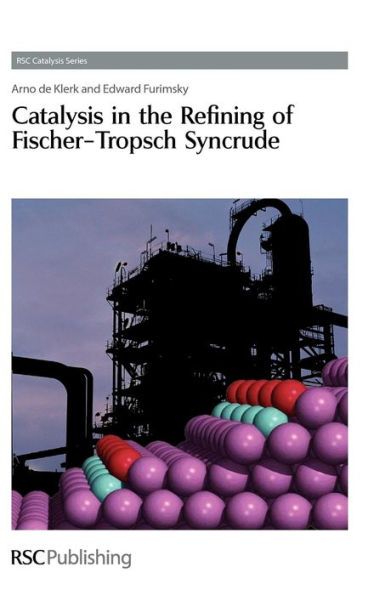
Catalysis in the Refining of Fischer-Tropsch Syncrude
Fischer-Tropsch Synthesis (FTS) has been used on a commercial scale for more than eighty years. It was initially developed for strategic reasons because it offered a source of transportation fuels that was independent from crude oil. Unlike crude, Fischer-Tropsch synthetic crude is rich in olefins and oxygenates, while being sulphur and nitrogen free. Consequently, the catalysis involved in refining it is significantly different and only a few catalysts have been developed for the purpose. Until now, an account of this topic has been missing from the literature, despite mounting interest in the technology. This is the first book to provide a review and analysis of the literature (journal and patent) on the catalysis needed to refine syncrude to transportation fuels. It specifically highlights the impact of oxygenates and how oxygenates affect selectivity and deactivation. This aspect is also related to the refining of biomass derived liquids. Topics covered include: dimerisation / oligomerisation, isomerisation / hydroisomerisation, catalytic cracking / hydrocracking and hydrogenation, catalytic reforming, aromatic alkylation, etherification, dehydration, and some oxygenate and wax specific conversions.

1101129916
Catalysis in the Refining of Fischer-Tropsch Syncrude
Fischer-Tropsch Synthesis (FTS) has been used on a commercial scale for more than eighty years. It was initially developed for strategic reasons because it offered a source of transportation fuels that was independent from crude oil. Unlike crude, Fischer-Tropsch synthetic crude is rich in olefins and oxygenates, while being sulphur and nitrogen free. Consequently, the catalysis involved in refining it is significantly different and only a few catalysts have been developed for the purpose. Until now, an account of this topic has been missing from the literature, despite mounting interest in the technology. This is the first book to provide a review and analysis of the literature (journal and patent) on the catalysis needed to refine syncrude to transportation fuels. It specifically highlights the impact of oxygenates and how oxygenates affect selectivity and deactivation. This aspect is also related to the refining of biomass derived liquids. Topics covered include: dimerisation / oligomerisation, isomerisation / hydroisomerisation, catalytic cracking / hydrocracking and hydrogenation, catalytic reforming, aromatic alkylation, etherification, dehydration, and some oxygenate and wax specific conversions.

171.0 In Stock
Catalysis in the Refining of Fischer-Tropsch Syncrude

Catalysis in the Refining of Fischer-Tropsch Syncrude

Catalysis in the Refining of Fischer-Tropsch Syncrude

Catalysis in the Refining of Fischer-Tropsch Syncrude

Hardcover

$171.00 
  • SHIP THIS ITEM
    In stock. Ships in 1-2 days.
  • PICK UP IN STORE

    Your local store may have stock of this item.

Related collections and offers


Overview

Fischer-Tropsch Synthesis (FTS) has been used on a commercial scale for more than eighty years. It was initially developed for strategic reasons because it offered a source of transportation fuels that was independent from crude oil. Unlike crude, Fischer-Tropsch synthetic crude is rich in olefins and oxygenates, while being sulphur and nitrogen free. Consequently, the catalysis involved in refining it is significantly different and only a few catalysts have been developed for the purpose. Until now, an account of this topic has been missing from the literature, despite mounting interest in the technology. This is the first book to provide a review and analysis of the literature (journal and patent) on the catalysis needed to refine syncrude to transportation fuels. It specifically highlights the impact of oxygenates and how oxygenates affect selectivity and deactivation. This aspect is also related to the refining of biomass derived liquids. Topics covered include: dimerisation / oligomerisation, isomerisation / hydroisomerisation, catalytic cracking / hydrocracking and hydrogenation, catalytic reforming, aromatic alkylation, etherification, dehydration, and some oxygenate and wax specific conversions.


Product Details

ISBN-13: 9781849730808
Publisher: RSC
Publication date: 12/15/2010
Series: Catalysis Series , #4
Pages: 294
Product dimensions: 6.10(w) x 9.20(h) x 0.90(d)

About the Author

Arno De Klerk obtained his formal qualifications at the University of Pretoria, South Africa and holds B. Eng., B. Eng. Hons. and Ph.D. degrees in Chemical Engineering, as well as an M.Sc. in Analytical Chemistry. He has been registered as a professional engineer in South Africa since 1999. His career started in forensic science before moving to industry in 1994 where his work was mainly in catalysis, catalyst evaluation and the refining of Fischer-Tropsch syncrude and coal liquids. He managed the Fischer-Tropsch refinery catalysis group of Sasol from 2001 until 2008 before moving to the University of Alberta Department of Chemical and Materials Engineering. He is author of around 50 scholarly papers, most of which dealt with Fischer-Tropsch refining and refining catalysis. Edward Furimsky has some forty years of research experience in the conversion of petroleum, coal and natural gas to various commercial products. His studies have included the upgrading of petroleum feeds, environmental and safety aspects, options for using spent refinery catalysts, quantification of emissions, and the optimization of refining schemes to lower overall emissions. He is also is also the author of two books, several book chapters, 130 journal articles, and a dozen reviews.

Table of Contents

INTRODUCTION;
PRODUCTION OF SYNTHESIS GAS;
FISCHER-TROPSCH SYNTHESIS;
PROPERTIES OF PRIMARY PRODUCTS FROM FT;
UPGRADING OF GASEOUS AND LIQUID PRODUCTS;
UPGRADING OF FTS WAX;
REACTIONS OF OXYGENATES;
COMMERCIAL PRODUCTS FROM FT HYDROCARBONS;
CATALYSIS OF FISCHER-TROPSCH REFINERIES;
PATENT LITERATURE;
FUTURE PERSPECTIVES;
REFERENCES

From the B&N Reads Blog

Customer Reviews