
A Higher Form of Killing: Six Weeks in World War I That Forever Changed the Nature of Warfare
In six weeks during April and May 1915, as World War I escalated, Germany forever altered the way war would be fought. On April 22, at Ypres, German canisters spewed poison gas at French and Canadian soldiers in their trenches; on May 7, the German submarine U-20, without warning, torpedoed the passenger liner Lusitania, killing 1,198 civilians; and on May 31, a German Zeppelin began the first aerial bombardment of London and its inhabitants. Each of these actions violated rules of war carefully agreed at the Hague Conventions of 1898 and 1907. Though Germany's attempts to quickly win the war failed, the psychological damage caused by these attacks far outweighed the casualties. The era of weapons of mass destruction had dawned.
While each of these momentous events has been chronicled in histories of the war, celebrated historian Diana Preston links them for the first time, revealing the dramatic stories behind each through the eyes of those who were there, whether making the decisions or experiencing their effect. She places the attacks in the context of the centuries-old debate over what constitutes “just war,” and shows how, in their aftermath, the other combatants felt the necessity to develop extreme weapons of their own. In our current time of terror, when weapons of mass destruction-imagined or real-are once again vilified, the story of their birth is of great relevance.
1120387893
While each of these momentous events has been chronicled in histories of the war, celebrated historian Diana Preston links them for the first time, revealing the dramatic stories behind each through the eyes of those who were there, whether making the decisions or experiencing their effect. She places the attacks in the context of the centuries-old debate over what constitutes “just war,” and shows how, in their aftermath, the other combatants felt the necessity to develop extreme weapons of their own. In our current time of terror, when weapons of mass destruction-imagined or real-are once again vilified, the story of their birth is of great relevance.
A Higher Form of Killing: Six Weeks in World War I That Forever Changed the Nature of Warfare
In six weeks during April and May 1915, as World War I escalated, Germany forever altered the way war would be fought. On April 22, at Ypres, German canisters spewed poison gas at French and Canadian soldiers in their trenches; on May 7, the German submarine U-20, without warning, torpedoed the passenger liner Lusitania, killing 1,198 civilians; and on May 31, a German Zeppelin began the first aerial bombardment of London and its inhabitants. Each of these actions violated rules of war carefully agreed at the Hague Conventions of 1898 and 1907. Though Germany's attempts to quickly win the war failed, the psychological damage caused by these attacks far outweighed the casualties. The era of weapons of mass destruction had dawned.
While each of these momentous events has been chronicled in histories of the war, celebrated historian Diana Preston links them for the first time, revealing the dramatic stories behind each through the eyes of those who were there, whether making the decisions or experiencing their effect. She places the attacks in the context of the centuries-old debate over what constitutes “just war,” and shows how, in their aftermath, the other combatants felt the necessity to develop extreme weapons of their own. In our current time of terror, when weapons of mass destruction-imagined or real-are once again vilified, the story of their birth is of great relevance.
While each of these momentous events has been chronicled in histories of the war, celebrated historian Diana Preston links them for the first time, revealing the dramatic stories behind each through the eyes of those who were there, whether making the decisions or experiencing their effect. She places the attacks in the context of the centuries-old debate over what constitutes “just war,” and shows how, in their aftermath, the other combatants felt the necessity to develop extreme weapons of their own. In our current time of terror, when weapons of mass destruction-imagined or real-are once again vilified, the story of their birth is of great relevance.
14.4
In Stock
5
1

A Higher Form of Killing: Six Weeks in World War I That Forever Changed the Nature of Warfare
352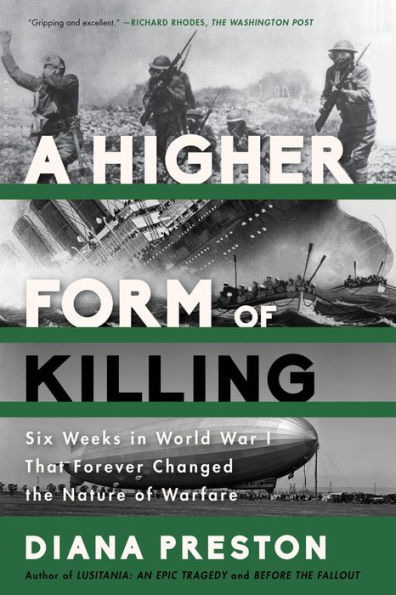
A Higher Form of Killing: Six Weeks in World War I That Forever Changed the Nature of Warfare
352
14.4
In Stock

Product Details
| ISBN-13: | 9781620402139 |
|---|---|
| Publisher: | Bloomsbury Publishing |
| Publication date: | 02/24/2015 |
| Sold by: | Barnes & Noble |
| Format: | eBook |
| Pages: | 352 |
| File size: | 2 MB |
About the Author
From the B&N Reads Blog