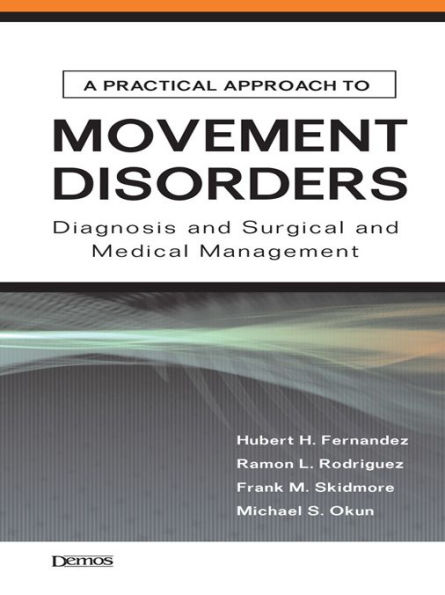
A Practical Approach to Movement Disorders: Diagnosis and Medical and Surgical Management
This book provides the busy clinician with a quick, symptom-based guide to the clinical presentation, diagnosis, work-up, and management of the most common types of movement disorders encountered in clinical practice, including Parkinson's disease, chorea, dystonia, myoclonus, and ataxia. Written in expanded outline format, with frequent diagnostic and therapeutic algorithms, tables, and scales, it is an essential guide for clinicians faced with patients with movement disorders.

A Practical Approach to Movement Disorders is a welcome departure from the typical lengthy, disease-based hardbound texts ill suited for the busy clinician. Practical yet authoritative, this fit-in-your-coat-pocket guide begins with a comprehensive description of the different presentations of movement disorders. It then details the medical, surgical, and non-pharmacological approaches, including speech and swallowing therapy and physical and occupational therapy.

Key features include:

  • Symptom-based, rather than disease-based, chapters
  • A focus on the most common movement disorders
  • A unique section on the neurological aspects of deep brain stimulation (DBS)
  • Dozens of diagnostic and management pearls
  • Suggested readings for each chapter

Handy and comprehensive, A Practical Approach to Movement Disorders is the only guide for busy clinicians needing quick information on movement disorders.
1140711177
A Practical Approach to Movement Disorders: Diagnosis and Medical and Surgical Management
This book provides the busy clinician with a quick, symptom-based guide to the clinical presentation, diagnosis, work-up, and management of the most common types of movement disorders encountered in clinical practice, including Parkinson's disease, chorea, dystonia, myoclonus, and ataxia. Written in expanded outline format, with frequent diagnostic and therapeutic algorithms, tables, and scales, it is an essential guide for clinicians faced with patients with movement disorders.

A Practical Approach to Movement Disorders is a welcome departure from the typical lengthy, disease-based hardbound texts ill suited for the busy clinician. Practical yet authoritative, this fit-in-your-coat-pocket guide begins with a comprehensive description of the different presentations of movement disorders. It then details the medical, surgical, and non-pharmacological approaches, including speech and swallowing therapy and physical and occupational therapy.

Key features include:

  • Symptom-based, rather than disease-based, chapters
  • A focus on the most common movement disorders
  • A unique section on the neurological aspects of deep brain stimulation (DBS)
  • Dozens of diagnostic and management pearls
  • Suggested readings for each chapter

Handy and comprehensive, A Practical Approach to Movement Disorders is the only guide for busy clinicians needing quick information on movement disorders.

74.99 In Stock
A Practical Approach to Movement Disorders: Diagnosis and Medical and Surgical Management

A Practical Approach to Movement Disorders: Diagnosis and Medical and Surgical Management

A Practical Approach to Movement Disorders: Diagnosis and Medical and Surgical Management

A Practical Approach to Movement Disorders: Diagnosis and Medical and Surgical Management

eBookFirst Edition (First Edition)

$74.99 

Available on Compatible NOOK devices, the free NOOK App and in My Digital Library.
WANT A NOOK?  Explore Now

Related collections and offers

LEND ME® See Details

Overview

This book provides the busy clinician with a quick, symptom-based guide to the clinical presentation, diagnosis, work-up, and management of the most common types of movement disorders encountered in clinical practice, including Parkinson's disease, chorea, dystonia, myoclonus, and ataxia. Written in expanded outline format, with frequent diagnostic and therapeutic algorithms, tables, and scales, it is an essential guide for clinicians faced with patients with movement disorders.

A Practical Approach to Movement Disorders is a welcome departure from the typical lengthy, disease-based hardbound texts ill suited for the busy clinician. Practical yet authoritative, this fit-in-your-coat-pocket guide begins with a comprehensive description of the different presentations of movement disorders. It then details the medical, surgical, and non-pharmacological approaches, including speech and swallowing therapy and physical and occupational therapy.

Key features include:

  • Symptom-based, rather than disease-based, chapters
  • A focus on the most common movement disorders
  • A unique section on the neurological aspects of deep brain stimulation (DBS)
  • Dozens of diagnostic and management pearls
  • Suggested readings for each chapter

Handy and comprehensive, A Practical Approach to Movement Disorders is the only guide for busy clinicians needing quick information on movement disorders.


Product Details

ISBN-13: 9781935281887
Publisher: Springer Publishing Company
Publication date: 06/14/2007
Sold by: Barnes & Noble
Format: eBook
Pages: 274
File size: 10 MB

About the Author

Dr. Hubert H. Fernandez, MD, Professor of Medicine (Neurology), Cleveland Clinic Lerner College of Medicine, Head of Movement Disorders, Center for Neurological Restoration, Cleveland Clinic, Cleveland, OH


Michael S. Okun, MD, is Adelaide Lackner Associate Professor and the current National Medical Director of the National Parkinson Foundation. He is the Co-Director of the Movement Disorders Center located within the McKnight Brain Institute and the University of Florida College of Medicine.


Ramon L. Rodriguez, MD, is a Clinical Assistant Professor, and Director of Clinical Services at the Movement Disorders Center, Department of Neurology, University of Florida College of Medicine, McKnight Brain Institute, Gainesville, FL


Frank M. Skidmore, MD, is an Assistant Professor, Department of Neurology, University of Florida College of Medicine, Gainesville, FL, and Director of the Movement Disorders Clinic at the North Florida/South Georgia VAMC.

Table of Contents

Preface; Getting Started: Phenomenology of Movement Disorders; Medical Approach to Movement Disorders; The Dancing Patient; The Jerky Patient; The Shaky Patient; The Shuffling Patient; The Twisted Patient; The Tic Patient; The Unsteady Patient; Surgical Approach to Movement Disorders; Key Concepts for Surgical Therapy for Parkinson's Disease and Movement Disorders; Non-Pharmacologic Approach to Movement Disorders; Speech and Swallowing Therapy; Physical and Occupational Therapy; Nutritional Considerations; Index.
From the B&N Reads Blog

Customer Reviews