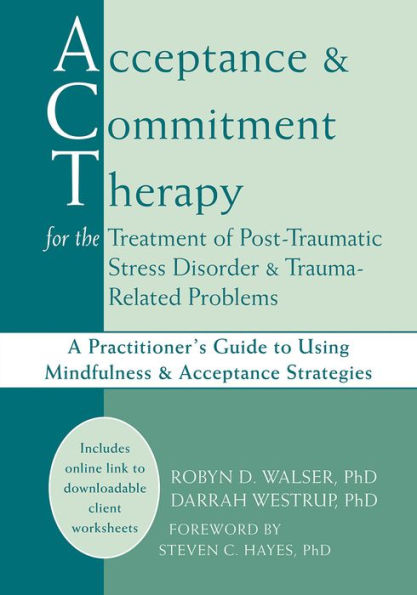
Acceptance and Commitment Therapy for the Treatment of Post-Traumatic Stress Disorder and Trauma-Related Problems: A Practitioner's Guide to Using Mindfulness and Acceptance Strategies

New Directions in the Treatment of PTSD

Acceptance and commitment therapy (ACT) offers a promising, empirically validated approach to the treatment of post-traumatic stress disorder (PTSD) and other trauma related problems. In this volume, you'll find a complete theoretical and practical guide to making this revolutionary new model work in your practice.

After a quick overview of PTSD, the first part of Acceptance and Commitment Therapy for the Treatment of Post-Traumatic Stress Disorder and Trauma-Related Problems explains the problem of experiential avoidance as it relates to trauma and explores the verbal nature of post-traumatic stress. You'll learn the importance of mindfulness and acceptance in the ACT model, find out how to structure sessions with your clients, and examine the problem of control. The section concludes by introducing you to the idea of creative hopelessness as the starting point for creating a new, workable life after trauma.

The book's second section offers a practical, step-by-step clinical guide to the six core ACT components in chronological order:

•Creative hopelessness
•The problem of control
•Willingness and defusion
•Self-as-context
•Valued living
•Committed action

Each chapter explains how to introduce these topics to clients suffering from PTSD, illustrates each with case examples, and offers homework for your clients to use between sessions.

1110792422
Acceptance and Commitment Therapy for the Treatment of Post-Traumatic Stress Disorder and Trauma-Related Problems: A Practitioner's Guide to Using Mindfulness and Acceptance Strategies

New Directions in the Treatment of PTSD

Acceptance and commitment therapy (ACT) offers a promising, empirically validated approach to the treatment of post-traumatic stress disorder (PTSD) and other trauma related problems. In this volume, you'll find a complete theoretical and practical guide to making this revolutionary new model work in your practice.

After a quick overview of PTSD, the first part of Acceptance and Commitment Therapy for the Treatment of Post-Traumatic Stress Disorder and Trauma-Related Problems explains the problem of experiential avoidance as it relates to trauma and explores the verbal nature of post-traumatic stress. You'll learn the importance of mindfulness and acceptance in the ACT model, find out how to structure sessions with your clients, and examine the problem of control. The section concludes by introducing you to the idea of creative hopelessness as the starting point for creating a new, workable life after trauma.

The book's second section offers a practical, step-by-step clinical guide to the six core ACT components in chronological order:

•Creative hopelessness
•The problem of control
•Willingness and defusion
•Self-as-context
•Valued living
•Committed action

Each chapter explains how to introduce these topics to clients suffering from PTSD, illustrates each with case examples, and offers homework for your clients to use between sessions.

47.15 In Stock
Acceptance and Commitment Therapy for the Treatment of Post-Traumatic Stress Disorder and Trauma-Related Problems: A Practitioner's Guide to Using Mindfulness and Acceptance Strategies

Acceptance and Commitment Therapy for the Treatment of Post-Traumatic Stress Disorder and Trauma-Related Problems: A Practitioner's Guide to Using Mindfulness and Acceptance Strategies

Acceptance and Commitment Therapy for the Treatment of Post-Traumatic Stress Disorder and Trauma-Related Problems: A Practitioner's Guide to Using Mindfulness and Acceptance Strategies

Acceptance and Commitment Therapy for the Treatment of Post-Traumatic Stress Disorder and Trauma-Related Problems: A Practitioner's Guide to Using Mindfulness and Acceptance Strategies

eBook

$47.15 

Available on Compatible NOOK devices, the free NOOK App and in My Digital Library.
WANT A NOOK?  Explore Now

Related collections and offers

LEND ME® See Details

Overview

New Directions in the Treatment of PTSD

Acceptance and commitment therapy (ACT) offers a promising, empirically validated approach to the treatment of post-traumatic stress disorder (PTSD) and other trauma related problems. In this volume, you'll find a complete theoretical and practical guide to making this revolutionary new model work in your practice.

After a quick overview of PTSD, the first part of Acceptance and Commitment Therapy for the Treatment of Post-Traumatic Stress Disorder and Trauma-Related Problems explains the problem of experiential avoidance as it relates to trauma and explores the verbal nature of post-traumatic stress. You'll learn the importance of mindfulness and acceptance in the ACT model, find out how to structure sessions with your clients, and examine the problem of control. The section concludes by introducing you to the idea of creative hopelessness as the starting point for creating a new, workable life after trauma.

The book's second section offers a practical, step-by-step clinical guide to the six core ACT components in chronological order:

•Creative hopelessness
•The problem of control
•Willingness and defusion
•Self-as-context
•Valued living
•Committed action

Each chapter explains how to introduce these topics to clients suffering from PTSD, illustrates each with case examples, and offers homework for your clients to use between sessions.


Product Details

ISBN-13: 9781608826469
Publisher: New Harbinger Publications
Publication date: 06/01/2007
Sold by: Barnes & Noble
Format: eBook
Pages: 272
File size: 2 MB

About the Author

Robyn D. Walser, PhD, is director of TL Consultation and Psychological Services, and codirector of Bay Area Trauma Recovery Clinical Services. She works at the National Center for PTSD, developing and disseminating innovative ways to translate science into practice; and serves as assistant clinical professor in the department of psychology at the University of California, Berkeley. As a licensed clinical psychologist, she maintains an international training, consulting, and therapy practice. Walser has authored and coauthored six books: The Heart of ACT, Learning ACT, The Mindful Couple, Acceptance and Commitment Therapy for the Treatment of Post-Traumatic Stress Disorder and Trauma-Related Problems, and ACT for Clergy and Pastoral Counselors.
Darrah Westrup, PhD, is a licensed clinical psychologist practicing in Colorado and California with an established reputation for her work as a therapist, program director, trainer, researcher, and consultant to practitioners at various firms and organizations. She is a recognized authority on post-traumatic stress disorder (PTSD) and acceptance and commitment therapy (ACT), and has conducted numerous presentations and trainings at international, national, and local conferences, seminars, and workshops. She served for over five years as an expert ACT consultant for the VA-wide evidence-based treatment rollout of ACT for depression, and is author of Advanced Acceptance and Commitment Therapy. Westrup has also coauthored two additional books on ACT: Acceptance and Commitment Therapy for the Treatment of Post-Traumatic Stress Disorder and Trauma-Related Problems and The Mindful Couple.

Steven C. Hayes, PhD, is Foundation Professor Emeritus at the University of Nevada, Reno; and president of the Institute for Better Health. Author of forty-eight books and more than 700 scientific articles, he has been president of numerous professional organizations and is among the most cited living psychologists. He has shown in his research on relational frame theory (RFT) how and why language and symbolic thought leads both to human achievement and to human suffering, and has guided the extension of RFT to ACT.

From the B&N Reads Blog

Customer Reviews