Adapting to Change: ESG and Alternative Finance in Shaping the Bank-Firm Relationship

This book examines the evolving dynamics between banks and firms within the context of alternative finance and Environmental, Social, and Governance (ESG) integration. The book contributes to understanding the bank-firm relationship in light of the changing financial landscape and its implications for sustainable development. The book employs an empirical analysis to examine the bank-firm relationship in the context of alternative finance and ESG performance to assess firms’ riskiness, access to funds and cost of capital.

The book addresses research gaps by comprehensively analysing the impact of alternative finance and ESG on the bank-firm relationship. It assists banks in adapting their financing practices and policies to align with emerging trends, and it offers insights for banks to evaluate and mitigate ESG-related risks effectively. It provides policy implications for promoting responsible lending, supporting the growth of alternative finance, and incentivising ESG integration in the financial sector. Ultimately, it contributes to formulating policies that foster a sustainable and inclusive financial system, and will be of interest to professionals and researchers in finance, alternative finance, and sustainable finance.
1144365680
Adapting to Change: ESG and Alternative Finance in Shaping the Bank-Firm Relationship
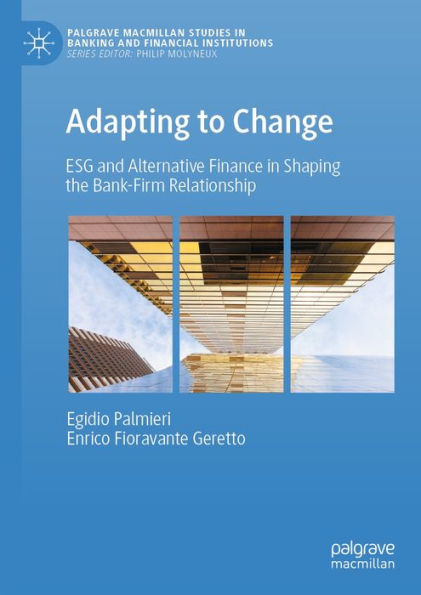
This book examines the evolving dynamics between banks and firms within the context of alternative finance and Environmental, Social, and Governance (ESG) integration. The book contributes to understanding the bank-firm relationship in light of the changing financial landscape and its implications for sustainable development. The book employs an empirical analysis to examine the bank-firm relationship in the context of alternative finance and ESG performance to assess firms’ riskiness, access to funds and cost of capital.

The book addresses research gaps by comprehensively analysing the impact of alternative finance and ESG on the bank-firm relationship. It assists banks in adapting their financing practices and policies to align with emerging trends, and it offers insights for banks to evaluate and mitigate ESG-related risks effectively. It provides policy implications for promoting responsible lending, supporting the growth of alternative finance, and incentivising ESG integration in the financial sector. Ultimately, it contributes to formulating policies that foster a sustainable and inclusive financial system, and will be of interest to professionals and researchers in finance, alternative finance, and sustainable finance.

149.0 In Stock
Adapting to Change: ESG and Alternative Finance in Shaping the Bank-Firm Relationship

Adapting to Change: ESG and Alternative Finance in Shaping the Bank-Firm Relationship

Adapting to Change: ESG and Alternative Finance in Shaping the Bank-Firm Relationship

Adapting to Change: ESG and Alternative Finance in Shaping the Bank-Firm Relationship

eBook1st ed. 2023 (1st ed. 2023)

$149.00 

Available on Compatible NOOK devices, the free NOOK App and in My Digital Library.
WANT A NOOK?  Explore Now

Related collections and offers


Overview

This book examines the evolving dynamics between banks and firms within the context of alternative finance and Environmental, Social, and Governance (ESG) integration. The book contributes to understanding the bank-firm relationship in light of the changing financial landscape and its implications for sustainable development. The book employs an empirical analysis to examine the bank-firm relationship in the context of alternative finance and ESG performance to assess firms’ riskiness, access to funds and cost of capital.

The book addresses research gaps by comprehensively analysing the impact of alternative finance and ESG on the bank-firm relationship. It assists banks in adapting their financing practices and policies to align with emerging trends, and it offers insights for banks to evaluate and mitigate ESG-related risks effectively. It provides policy implications for promoting responsible lending, supporting the growth of alternative finance, and incentivising ESG integration in the financial sector. Ultimately, it contributes to formulating policies that foster a sustainable and inclusive financial system, and will be of interest to professionals and researchers in finance, alternative finance, and sustainable finance.


Product Details

ISBN-13: 9783031502651
Publisher: Palgrave Macmillan
Publication date: 01/11/2024
Series: Palgrave Macmillan Studies in Banking and Financial Institutions
Sold by: Barnes & Noble
Format: eBook
File size: 586 KB

About the Author

Egidio Palmieri is a Research Fellow in Bank Risk Management at the University of Udine where his current focus is on the relationship between small and medium-sized enterprises (SMEs) and banks. He specializes in credit mechanisms and risk mitigation effects. Additionally, he has explored the impact of ESG performance on the credit scores of non-financial institutions. He is also a Visiting Researcher in ESG and Bank Risk Management at Bangor University, UK.

Enrico Fioravante Geretto is an Associate Professor at the University of Udine, Department of Economic Science and Statistics. In the past, he was a lecturer of banking operations techniques, insurance operations techniques, financial instruments techniques, asset management economics, intermediaries and financial markets.

Table of Contents

Chapter 1. Introduction.- Chapter 2. The Determinants of Bank-Firm Relationships: overview, evolution, and challenges.- Chapter 3. ESG Innovation in the Financial Industry.- Chapter 4. Empirical evidence on the trinomial Bank-Firm relationship, ESG, and Alternative Finance.- Chapter 5. From Theory to Practice: Discussion and Managerial Implications.- Chapter 6. Conclusion

What People are Saying About This

From the Publisher

'Bank firm-relationships have significantly changed over the last decades. In this interesting book, the authors analyse in depth two major forces that, interacting with each other, are shaping the way banks interact with firms. This timely and unique analysis sheds light on how the banking system can support the real economy in light of the recent technological advancements in the financial industry and of the increasing and legitimate stakeholders’ pressures towards higher levels of sustainability.'

Salvatore Polizzi, Ph.D., Assistant Professor in Banking & Finance, University of Palermo, Italy

From the B&N Reads Blog

Customer Reviews