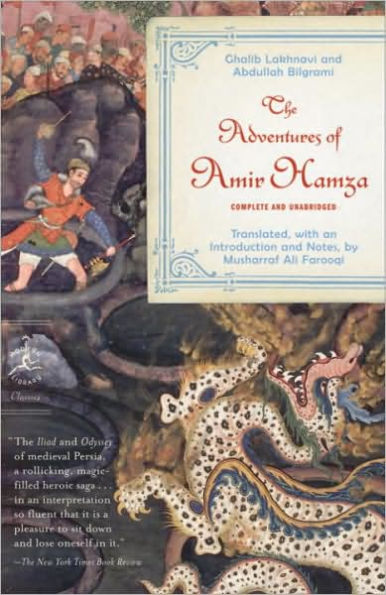

The Adventures of Amir Hamza

( 1 )

Overview

Here is the first unabridged English translation of a major Indo-Persian epic: a panoramic tale of magic and passion, a classic hero’s odyssey that has captivated much of the world. It is the spellbinding story of Amir Hamza, the adventurer who in the service of the Persian emperor defeats many enemies, loves many women, and converts hundreds of infidels to the True Faith before finding his way back to his first love. In Musharraf Ali Farooqi’s faithful rendition, this masterwork is captured with all its colorful...
See more details below
Paperback (Reprint)
$25.00
BN.com price

Pick Up In Store

Reserve and pick up in 60 minutes at your local store

Other sellers (Paperback)
  • All (14) from $5.40   
  • New (8) from $14.99   
  • Used (6) from $5.40   
Adventures of Amir Hamza

Available on NOOK devices and apps  
  • Nook Devices
  • NOOK HD/HD+ Tablet
  • NOOK
  • NOOK Color
  • NOOK Tablet
  • Tablet/Phone
  • NOOK for Windows 8 Tablet
  • NOOK for iOS
  • NOOK for Android
  • NOOK Kids for iPad
  • PC/Mac
  • NOOK for Windows 8
  • NOOK for PC
  • NOOK for Mac
  • NOOK Study
  • NOOK for Web

Want a NOOK? Explore Now

NOOK Book (eBook)
$12.99
BN.com price

Overview

Here is the first unabridged English translation of a major Indo-Persian epic: a panoramic tale of magic and passion, a classic hero’s odyssey that has captivated much of the world. It is the spellbinding story of Amir Hamza, the adventurer who in the service of the Persian emperor defeats many enemies, loves many women, and converts hundreds of infidels to the True Faith before finding his way back to his first love. In Musharraf Ali Farooqi’s faithful rendition, this masterwork is captured with all its colorful action and fantastic elements intact. Appreciated as the seminal Islamic epic or enjoyed as a sweeping tale as rich and inventive as Homer’s epic sagas, The Adventures of Amir Hamza is a true literary treasure.

Praise for The Adventures of Amir Hamza:

The Iliad and Odyssey of medieval Persia, a rollicking, magic-filled heroic saga... in an interpretation so fluent that it is a pleasure to sit down and lose oneself in it.”
–The New York Times Book Review

“A marvelous dovetailing of fantasy, history and religion . . . This sensitive new translation by Musharraf Ali Farooqi is filled with lyrical resonance. . . . [Readers] will love losing themselves in this complex yet ancient world of the imagination.”
–The Washington Post Book World

“It’s hard to think of an epic more dazzlingly splendid . . . Farooqi has given world literature a gift.”
–Time

“With prose as embroidered as the tales themselves, the book should be savored under the covers like a secret lover.”
–The Austin Chronicle

“[A] revelatory translation of a masterpiece of world literature . . . unequivocally an amazing piece of publishing history.”
–The Buffalo News

Read More Show Less

Editorial Reviews

Diana Abu-Jaber
This sensitive new translation by Musharraf Ali Farooqi is filled with lyrical resonance, reflecting the fluidity of the spoken word, and delivers the 900-plus pages of the ancient story in all its flamboyant glory…A true marvel of literary and intellectual engineering, The Adventures of Amir Hamza marks the passage of oral narrative into print and synthesizes translation, varying editions and genres into one coherent work. It comes with extensive notes and a very helpful list of characters, among other useful extras. Readers who prefer their heroes to be unequivocally heroic and who are ready to enjoy special effects on the page will love losing themselves in this complex yet ancient world of the imagination.
—The Washington Post
William Dalrymple
Even in translation, The Adventures of Amir Hamza is a wonder and a revelation—a classic of epic literature in an interpretation so fluent that it is a pleasure to sit down and lose oneself in it. The story line itself is endlessly diverting and inventive, and the prose of the translation is beautifully rendered…the Hamza epic, with its mixed Hindu and Muslim idiom, its tales of love and seduction, its anti-clericalism (mullahs are a running joke throughout the book), its stories of powerful and resourceful women, and its mocking of male misogyny, is a reminder of an Islamic world the West seems to have forgotten: one that is imaginative and heterodox…
—The New York Times
Library Journal

Slap on your scimitar and join the adventure! The Indo-Islamic Dastan-e Amir Hamzais a rip-roaring, bawdy, magical journey into the fantastic life and exploits of Amir Hamza, the paternal uncle of the prophet Muhammad. Originally a series of oral tales dating from the medieval period, this epic relates Hamza's love of the emperor Naushervan's daughter, Mehr-Nigar, and his struggle to win her hand, serve his emperor, and convert the infidels to the True Faith. Filled with fantastic beasts, fairies, giants, tricksters, warriors, kings, and mythical creatures of all stripes, the story is reminiscent of the tales of Homer and King Arthur and The Arabian Nights. Farooqi's unexpurgated and unabridged English translation from the Urdu is masterful, incorporating the elements and rhythms of the oral tradition and maintaining the wit and verbal style of the original. It is impossible to dislike a book that declares, "Some consume the eggplant and some are by the eggplant consumed." Destined to become a classic; highly recommended for all academic and public libraries.
—Amanda Sprochi

The Barnes & Noble Review
Imagine that Homer's great epics weren't transcribed until the 19th century and continued to live as oral performances over the years. As they circulated around the Mediterranean, they no doubt would absorb much of the local custom and color; enriched by various traditions, they'd even pick up bits of new verse. Well, that's exactly the history of this magnificent compendium of fantastical storytelling, an Urdu-Persian adventure narrative that's every bit as compelling as the best the West has to offer. The tales of the super-heroic Amir Hamza have entertained listeners in Arabic, Turkish, and Indonesian languages (among others) ever since the 9th century and have come to great prominence, especially in Muslim India, where in the 19th century these tales of conquest and conversion were written down in the form here translated for the first time into English. Reading this huge and never-ending story, you're likely to recall Arthurian romance as much as ancient Greece. At the core is the legendary Hamza ("the Conqueror of the World, the Quake of Qaf, the Latter-day Suleiman, and Uncle of the Last Prophet of Times"): as defender of the One True Faith and warrior of chivalric principle, he crosses the subcontinent, defeating all those who refuse to renounce fire worship or threaten the kingdom of Emperor Naushervan. He even contends with evil spirits during a long sojourn in the spirit world. Separated from his true love for 18 years, Hamza brings justice everywhere he goes, often accompanied by his loyal Ayyar, who's part trickster and part magician, an Asiatic Merlin. Highly moral in outlook, these tales of Islamic triumph also revel in much merrymaking -- Hamza enjoys his many wives, all of them quite powerful women in their own right, and their lovemaking is always stimulated by "flagons of roseate wine." No fundamentalism here, but a wonderful reminder of Islam at its most magnanimous, and as inspiration to a great work of world literature. --Thomas De Pietro
Read More Show Less

Product Details

  • ISBN-13: 9780812977431
  • Publisher: Random House Publishing Group
  • Publication date: 10/14/2008
  • Series: Modern Library Classics Series
  • Edition description: Reprint
  • Pages: 992
  • Sales rank: 949,655
  • Product dimensions: 5.10 (w) x 7.90 (h) x 1.70 (d)

Meet the Author

Ghalib Lakhnavi was a writer and poet who worked in India in the nineteenth century. His only known work is the one-volume Dastan-e Amir Hamza (1855).

Abdullah Bilgrami taught Arabic in Kanpur, India. His only known work is his enlargement of Ghalib Lakhnavi’s Dastan-e Amir Hamza (1871).

Musharraf Ali Farooqi is an author and translator. He has translated works by the contemporary Urdu poet Afzal Ahmed Syed and is currently working on the Urdu Project (www.urduproject.com), an online resource for the study of Urdu language and literature.

Hamid Dabashi is the Hagop Kevorkian Professor of Iranian Studies and Comparative Literature at Columbia University and a prolific author and editor.

From the Hardcover edition.

Read More Show Less

Read an Excerpt

The Adventures of Amir Hamza
By Ghalib Lakhnavi Modern Library Copyright © 2008 Ghalib Lakhnavi
All right reserved.

ISBN: 9780812977431

Chapter 1

The florid news writers, the sweet-lipped historians, revivers of old tales and renewers of past legends, relate that there ruled at Ctesiphon1 in Persia (image of Heaven!) Emperor Qubad Kamran, who cherished his subjects and was a succor to the impecunious in their distress. He was unsurpassed in dispensing justice, and so rigorous in this exercise that the best justice appeared an injustice compared to his decree. Prosperity and affluence thrived in his dominions while wrong and inequity slumbered in death, and, rara avis–like, mendicants and the destitute were extinct in his lands. The wealthy were at a loss to find an object for their charity. The weak and the powerful were equals, and the hawk and the sparrow roosted in the same nest. The young and the old sought one another’s pleasure, neither ever deeming himself the sole benefactor. The portals of houses remained open day and night like the eyes of the vigil, for if someone stole even the color of henna from the palm,2 he was ground in the mill of justice. The thief therefore did not even dream of thieving, and if perchance a wayfarer should come upon someone’s property on the road, he took it upon himself to restore it to its owner. Compared with Qubad Kamran’s fearlessness, might, and valor, Rustam was the sameas a hag most decrepit and cowardly. This imperious monarch had forty viziers,3 who were the epitomes of learning, wisdom, and prudence; and seven hundred wise men before whom even the likes of Plato and Aristotle were abecedarians.4 All these viziers were peerless in intellect and cognition, and so accomplished in physics, arithmetic, ramal, jafar,5 and astrology that they did not consider the likes of Galen and Euclid and Pythagoras fit company for themselves, let alone their equals. The emperor had seven hundred privy counselors, each more adept than ancient masters in arts and letters and in the decorum of assembly. And at the emperor’s command were four thousand champion warriors, to whom Sam and Nariman and Rustam and Zal would alike present the sword of humility in combat and accept from their hands the badge of slavery. Three hundred sovereigns who reigned over vast tracts paid tribute to Emperor Qubad Kamran, and bowed their heads in vassalage and obeisance before him. And one million mounted warriors, intrepid and fierce, and forty troops of slaves, clad in gold and finery, waited, deft and adroit, upon the emperor at his court—the envy of Heaven, the adornment of Paradise! In the same city there also resided a savant by the name of Khvaja6 Bakht Jamal, who traced his lineage to the prophet Danyal (God’s favors and mercies be upon his soul!). He was unrivaled in learning and the sciences of hikmat,7 ramal, astrology, and jafar, and was truly a successor beyond compare of the ancient philosophers. Malik8 Alqash, the emperor’s vizier who had often made use of the divinations of this sage, offered himself as a pupil to Khvaja Bakht Jamal, and became so attached and devoted to him that he would not hear of parting even for a moment from his master. Before long, Alqash, too, became adept at ramal. His fame spread far and wide, and he proved himself such a consummate practitioner of the art, that he was deservedly labeled Khvaja’s distinguished disciple, second only to his master. One day Alqash said to Khvaja Bakht Jamal, “The other night as idleness weighed on my heart, I decided to cast lots in your name. Reading the pattern, I discovered that your star is in the descendent, and some vicissitude of fortune will befall you. Your star shall remain in the same house for forty days. Thus it would not bode well for you to step out of the house during this period, or trust anyone. Even I must suffer under this burden of separation, and not see you!” Following Alqash’s advice, Bakht Jamal secluded himself from the world, declining to receive either visitors or friends. Of the foretold days of ill-boding, thirty-nine had passed without mishap. On the fortieth day, Khvaja felt wretched to be shut inside his house, and set out carrying his staff to see vizier Alqash, to bring his only faithful and affectionate friend the news of his health and welfare. By chance, instead of the thoroughfare, he followed a deserted road to the riverside. As it was summer he took refuge from the burning sun under a tree’s shade. While he sat there, his eyes suddenly beheld a building most imposing, save for its outer walls that had fallen to ruin. Some curiosity led him toward it, and as he drew near, he found most of the apartments inside in a state of decay, and the vestibules in ruins, but for one that had survived ravaging and still stood—in desolation and disarray like a lover’s heart. In that vestibule there was an antechamber whose entrance was bricked up. Removing the bricks he found to his right a door with a padlock. Khvaja thought of forcing it open with a brick or stone, but when he held the padlock in his hand, it came open of its own accord and fell to the floor. Stepping inside Khvaja discovered a cellar. There he found buried Shaddad’s seven boundless treasures of gold and jewels. Seized by fright, Khvaja was unable to take anything, and retraced his steps out of the cellar, then hastened to Alqash’s house to give him the propitious news. Alqash’s face brightened at the sight of Khvaja. He made room for him on his throne, and after expressing joy at seeing his friend, said, “Today was the fortieth day. Why did you take such trouble and inconvenience yourself? Come tomorrow, I had intended to present myself at your door and receive great joy from the grace of your genial company.” After making small talk Khvaja mentioned the seven treasures to Alqash, and recounted the windfall, saying, “Though I was blessed in my stars to have come upon such an untold fortune, it was found on royal land, and lowly me, I cannot lay claim to it, nor is it indeed my station! I resolved in my heart that since you are the emperor’s vizier, and an excellent patron and friend to me, I should inform you of this bountiful treasure. Then, if you saw fit to confer a little something upon your humble servant, then that bit only would I consider—like my mother’s milk— warranted and rightful!” Alqash was beside himself with joy when he heard of the seven treasures, and ordered two horses to be saddled forthwith; then he mounted one, and Khvaja the other, and they galloped off in the direction of the wasteland. By and by, they arrived at their destination. Alqash became greatly agitated and ecstatic the moment he set eyes on the seven hoards, and so violent indeed were his raptures of delight on the occasion, that he was almost carried away from this world. While murmuring gratitude to his Creator for bestowing such a windfall on him, the thought suddenly flashed across Alqash’s mind that Khvaja Bakht Jamal was privy to this secret, and all that had come about. Alqash reasoned that if some day Khvaja Bakht Jamal chose to betray him to the emperor in order to gain influence at the court, the vizier would find himself in a sorry plight. That would indeed put his life in great peril, and not only would he have to wash his hands of this God-given bounty, but also the emperor might declare him an embezzler and depose him. It would be small wonder if at that point the contents of his house were confiscated and the building razed; he himself would be thrown into the dungeon, and his family exposed to humiliation and ruin, with all traces of his honorable name forever erased from the face of the earth. It would be by far the lesser evil, Alqash thought, to kill Khvaja right there, and then lay claim to the boundless treasure without the least anxiety that the secret would some day come to light, or that someone might one day reveal the secret. Once resolved, he immediately bore down upon Khvaja and put the dagger to his throat. Confounded by this turn of events, Khvaja cried out, “What has got into your head, Alqash? Does a good deed deserve evil? Is that how a favor is returned? What injury have I done you that you resolve to punish me thus?” And much did the poor old man groan in the same vein, and seek compassion, but to no avail. The heart of that villain did not soften, and his sympathy remained unstirred. When the frail man saw that there was no escape from the clutches of this blackguard, and that it was only a matter of a few breaths before the candle of his life would be snuffed out by those hands, he entreated in despair: Advertise well how I was laid low by your hand, That no one shall consider being faithful again. “O Alqash! I see that you are bent upon my murder, and on dyeing your villainous hands with my innocent blood. But if you could find it in your heart to act upon my last words, I shall entrust them to you and die with at least this debt toward you.” The ungrateful wretch shouted back, “Make haste! For the cup of your life is now ready to overflow, and the thirst of my inclement dagger is ordained to be quenched in your blood!” The poor man spoke: Such was my lot that friend proves a foe And the guide waylays me on the trail.9 “There is hardly any money in my house to last my family beyond tomorrow,” Khvaja continued, “and even less food. I would to God that you might send them enough to survive. And inform my wife, who is expecting, that if a boy is born to her, she must name him Buzurjmehr, and if a girl is born, she may follow her own counsel.” After saying this he closed his eyes and began reciting the kalma,10 seeking divine absolution, as he was to die an innocent man. Whereupon that heartless villain cut off Khvaja’s head with his unrelenting dagger, destroyed his horse, too, and interred the two of them in the same vault where the treasures were buried. After sealing the door, Alqash went to the river to cleanse the blood from his hands and the dagger, and also to wash his hands of the faith that he had forfeited in exchange for short-lived riches. Then he rode away to his house, glad in his heart and thrilled. The next day, he returned to the place with great pomp, and after surveying it, ordered the prefect to build a garden for him on the site, bound by walls of marble, and a turquoise chamber erected over the vestibule, where he would give audience, and to have this heavenly abode furnished with rarities and wondrous curiosities. As soon as the order was given, the prefect sent for masons, laborers, and sculptors from the city, and began the construction. In a matter of days, the garden, the marble walls, and the turquoise chamber were ready, all of which delighted Alqash greatly, and he named the place Bagh-e Bedad. Then he called at Khvaja Bakht Jamal’s house, and told the family that he had sent Khvaja off to China to conduct trade, and he should soon return after turning a profit. He then communicated to them Khvaja’s wishes. He consoled and comforted the family, and bestowed on them a rich purse, mentioning that more would be available whenever there was need, and that they ought not entertain any fears of adversity. Then Alqash returned home, with the grim truth buried in his heart. My life passed as passeth the wind on the plains; Alike with bitterness and joy, coarseness and beauty All the harm the tyrant inflicted on us Passeth over us, and resides with him.11h


From the Hardcover edition.

Continues...

Excerpted from The Adventures of Amir Hamza by Ghalib Lakhnavi Copyright © 2008 by Ghalib Lakhnavi. Excerpted by permission.
All rights reserved. No part of this excerpt may be reproduced or reprinted without permission in writing from the publisher.
Excerpts are provided by Dial-A-Book Inc. solely for the personal use of visitors to this web site.

Read More Show Less

Table of Contents

Introduction Musharraf Ali Faronqi Faronqi, Musharraf Ali

The Advnetures of Amir Hamza 1

The History of the Legend 909

List of Characters, Historic Figures, Deities, and Mythical Beings 915

Selected Sources 931

Notes 935

Read More Show Less

Customer Reviews

Average Rating 4
( 1 )
Rating Distribution

5 Star

(0)

4 Star

(1)

3 Star

(0)

2 Star

(0)

1 Star

(0)

Your Rating:

Your Name: Create a Pen Name or

Barnes & Noble.com Review Rules

Our reader reviews allow you to share your comments on titles you liked, or didn't, with others. By submitting an online review, you are representing to Barnes & Noble.com that all information contained in your review is original and accurate in all respects, and that the submission of such content by you and the posting of such content by Barnes & Noble.com does not and will not violate the rights of any third party. Please follow the rules below to help ensure that your review can be posted.

Reviews by Our Customers Under the Age of 13

We highly value and respect everyone's opinion concerning the titles we offer. However, we cannot allow persons under the age of 13 to have accounts at BN.com or to post customer reviews. Please see our Terms of Use for more details.

What to exclude from your review:

Please do not write about reviews, commentary, or information posted on the product page. If you see any errors in the information on the product page, please send us an email.

Reviews should not contain any of the following:

  • - HTML tags, profanity, obscenities, vulgarities, or comments that defame anyone
  • - Time-sensitive information such as tour dates, signings, lectures, etc.
  • - Single-word reviews. Other people will read your review to discover why you liked or didn't like the title. Be descriptive.
  • - Comments focusing on the author or that may ruin the ending for others
  • - Phone numbers, addresses, URLs
  • - Pricing and availability information or alternative ordering information
  • - Advertisements or commercial solicitation

Reminder:

  • - By submitting a review, you grant to Barnes & Noble.com and its sublicensees the royalty-free, perpetual, irrevocable right and license to use the review in accordance with the Barnes & Noble.com Terms of Use.
  • - Barnes & Noble.com reserves the right not to post any review -- particularly those that do not follow the terms and conditions of these Rules. Barnes & Noble.com also reserves the right to remove any review at any time without notice.
  • - See Terms of Use for other conditions and disclaimers.
Search for Products You'd Like to Recommend

Recommend other products that relate to your review. Just search for them below and share!

Create a Pen Name

Your Pen Name is your unique identity on BN.com. It will appear on the reviews you write and other website activities. Your Pen Name cannot be edited, changed or deleted once submitted.

 
Your Pen Name can be any combination of alphanumeric characters (plus - and _), and must be at least two characters long.

Continue Anonymously
Sort by: Showing 1 Customer Review
  • Anonymous

    Posted February 23, 2012

    No text was provided for this review.

Sort by: Showing 1 Customer Review

If you find inappropriate content, please report it to Barnes & Noble
Why is this product inappropriate?
Comments (optional)