American Rust [NOOK Book]

NOOK Book (eBook)
$11.99
BN.com price

Available on NOOK devices and apps

  • Nook Devices
  • NOOK
  • NOOK Color
  • NOOK Tablet
  • Tablet/Phone
  • NOOK for iPad
  • NOOK for iPhone
  • NOOK for Android
  • NOOK for Android (Tablet)
  • NOOK Kids for iPad
  • PC/Mac
  • NOOK Study
  • NOOK for PC
  • NOOK for Mac

Need a NOOK? Explore Now

Overview

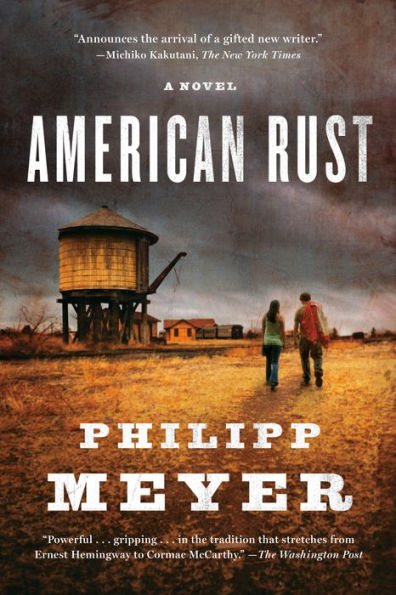
Set in a beautiful but economically devastated Pennsylvania steel town, American Rust is a novel of the lost American dream and the desperation—as well as the acts of friendship, loyalty, and love—that arise from its loss. From local bars to trainyards to prison, it is the story of two young men, bound to the town by family, responsibility, inertia, and the beauty around them, who dream of a future beyond the factories and abandoned homes.

Left alone to care for his aging father after his mother commits suicide and his sister escapes to Yale, Isaac English longs for a life beyond his hometown. But when he finally sets out to leave for good, accompanied by his temperamental best friend, ...

See more details below

Overview

Set in a beautiful but economically devastated Pennsylvania steel town, American Rust is a novel of the lost American dream and the desperation—as well as the acts of friendship, loyalty, and love—that arise from its loss. From local bars to trainyards to prison, it is the story of two young men, bound to the town by family, responsibility, inertia, and the beauty around them, who dream of a future beyond the factories and abandoned homes.

Left alone to care for his aging father after his mother commits suicide and his sister escapes to Yale, Isaac English longs for a life beyond his hometown. But when he finally sets out to leave for good, accompanied by his temperamental best friend, former high school football star Billy Poe, they are caught up in a terrible act of violence that changes their lives forever.

Evoking John Steinbeck’s novels of restless lives during the Great Depression, American Rust takes us into the contemporary American heartland at a moment of profound unrest and uncertainty about the future. It is a dark but lucid vision, a moving novel about the bleak realities that battle our desire for transcendence and the power of love and friendship to redeem us.

Newsweek's list of "Best. Books. Ever"
Amazon Top 100 book of 2009
A Washington Post Top Ten Book of 2009
A New York Times Notable Book of 2009
An Economist Best Book of 2009
A Kansas City Star Top 100 book of 2009
Pittsburgh Post-Gazette's Best Books of 2009
Idaho Statesman's Best Books of 2009

Editorial Reviews

Lewis Robinson
Within just a few pages of meeting the central players, we're allowed such intimate access to the rhythm of their thoughts that it becomes easy to fathom—even relate to—their blunders. We hope they will not fail, and this hope makes their failures good reading…American Rust is a bold, absorbing novel with a keen interest in how communities falter. Meyer knows that reductive explanations aren't sufficient, and he moves deftly from the panoramic to the microscopic—from sweeping views of a dying valley to the quiet ruminations of a mind behind bars.
—The New York Times Book Review
From The Critics
Mr. Meyer…conjures up this blue-collar Rust Belt town with the same sort of social detail and emotional verisimilitude that Richard Russo has brought to his depictions of upstate New York and Russell Banks has brought to downstate New Hampshire. He writes about his characters' lives in Buell with sympathy and unsentimental clarity…American Rust announces the arrival of a gifted new writer—a writer who understands how place and personality and circumstance can converge to create the perfect storm of tragedy.
—The New York Times
The Barnes & Noble Review
It is always interesting to see how a novelist tackles the long tradition of reinventing an iconic character. But in his ambitious debut, American Rust, Philipp Meyer not only carries the suggestion of a contemporary Huckleberry Finn to new dimensions, he pushes his narrative to further explore another familiar theme: what it means to be a working-class American man, trying to do the right thing despite being ravaged by economics and anger.

Meet Isaac English, a skinny, socially awkward 20-year-old who can see the answers to complex mathematical equations without the benefit of calculations. He's also got a great pitching arm, but more on that later. Like Huck, he's got an abusive father. While the elder English heaps praise on Isaac's older sister, Lee, for her success at Yale, he's verbally knocking Isaac down. Isaac in turn, refers to his father as "Little Hitler."

Lee ruminates on the vagaries of such intellect. "She knew he would make a much larger contribution than she ever would -- he cared only about things much bigger than his own life. Ideas, truths, the reasons things were. At Yale, her friends had accepted him immediately -- Isaac was a personality type everyone was familiar with. But not here."

It would be easy to peg Isaac as the archetypal nerd who doesn't fit comfortably into the insular working class of the decaying steel town of Buell, Pennsylvania. However, he is, like the rest of Meyer's characters, more complex and contradictory. Unlike Huck, Isaac made a conscious commitment to care for his old man, who has been confined to a wheelchair after an industrial fire. Trapped as a full-time nursemaid, Isaac turns over the course of events. "The three of them, Isaac, Lee, and his mother, had been like a family within the family. Then their mother had killed herself. Then Lee went off to Yale." Overwhelmed by his inability to cope alone, Isaac attempted to drown himself in the Mon River just like his mother, but was saved by his friend, Billy Poe.

After that, he's left to contemplate luck and fate -- the larger forces at work in his life and those around him. "Except eventually the luck runs out -- your sun turns into a red giant and the earth is burned whole. Giveth and taketh away. Of course by then he'd be long dead. But at least he'd have made his contribution. Being dead didn't excuse your responsibility to the ones still alive. If there was anything he was sure of, it was that."

But even luck and fate have their limits in Buell. Haunted by the ghost of an industry that took 150,000 jobs when it shipped out, punctuated by a dismantled mill standing "like some ancient ruin, its buildings grown over with bittersweet vine, devil's tear thumb and tree of heaven," it boasts nothing more than a downtown full of boarded-up, historic stone buildings and a remaining population passively waiting for something to happen.

Poe, once the star of their high school football team with a promising future, doesn't apply to college. He gives in to the pervasive stagnation by losing menial jobs, drinking beer, and barely keeping up the wood fire to heat his trailer. His mother, Grace, is only 41 years old but sees herself in the mirror this way: "Hair had gone entirely gray. Even her eyes were going dull, burning down like old headlights."

Among these malcontents, Isaac constructs an inner fortress of anger and resentment, swipes $4,000 of his father's savings, shoulders a backpack (and a heavier burden -- the contents of his active mind and struggling heart), and heads west. He's got a shred of a plan to ride the trains to California and apply to an astrophysics program after establishing residence.

In spite of his prescient warning, "Wherever you go, you still wake up and see the same face in the mirror," Poe comes along for the journey. They don't get far before an encounter at an abandoned machine shop with a group of transients goes terribly awry. To defend Poe, Isaac uses his skillful aim and strikes one of the men directly in the skull with an industrial ball bearing, killing him instantly.

Now the two are even -- each has saved the other's life. They return to their homes with Isaac accepting this as just a delay of plans. Poe sinks under the weight of his own vulnerability. On the second attempt to escape, Isaac leaves Poe and a potential murder charge behind.

The story turns even darker as it navigates through a landscape of filthy trains and squatter camps populated with vagrant con artists. The constant fear for his money and his life fill Isaac's days. Poe is arrested, having never once considered giving Isaac's name to the authorities. The harsh flourescent lights of prison throw his defenselessness into high relief; a football swagger no longer relevant or able to protect him in this tribal society of convicted criminals.

For all of these gritty realities, Meyer's work has already invited comparisons to Cormac McCarthy, whose finely crafted tales pit good against evil -- with the latter the champion -- in Outer Dark and Blood Meridian. But neither good nor evil is victorious in American Rust. Rather, Meyer chronicles a paradigm shift as Lee notes, "There was something particularly American about it -- blaming yourself for bad luck -- that resistance to seeing your life as affected by social forces, a tendency to blame larger problems on individual behavior. The ugly reverse of the American Dream."

However ugly or bleak it may be, a small seed does grow and bloom organically in place of societal blight, cultivated by a chorus of voices that drive the feverish plot to its crescendo. This is perhaps Meyer's greatest accomplishment with American Rust. In the tradition of Twain and other authors who write in the plainsong of the disenfranchised, Meyer's narrative draws us fully in. By completely inhabiting his fictional world we can see hope as vividly, or vaguely, as the characters do themselves. It allows us to understand how rust and decay can give way to an optimism that, however fragile, keeps us going -- even in spite of ourselves. --Lydia Dishman

Lydia Dishman is an award-winning writer and editor based in the Southeast.

Product Details

  • ISBN-13: 9780385529686
  • Publisher: Random House Publishing Group
  • Publication date: 2/24/2009
  • Sold by: Random House
  • Format: eBook
  • Pages: 368
  • Sales rank: 98,430
  • File size: 2 MB
  • Items ship to U.S, APO/FPO and U.S. Protectorate addresses.

Meet the Author

Philipp Meyer grew up in Baltimore, dropped out of high school, and got his GED when he was sixteen. After spending several years volunteering at a trauma center in downtown Baltimore, he attended Cornell University, where he studied English. Since graduating, Meyer has worked as a derivatives trader at UBS, a construction worker, and an EMT, among other jobs. His writing has been published in McSweeney's, The Iowa Review, Salon.com, and New Stories from the South. From 2005 to 2008 Meyer was a fellow at the Michener Center for Writers in Austin, Texas. He splits his time between Texas and upstate New York.

Read an Excerpt

Book One
1.

Isaac's mother was dead five years but he hadn't stopped thinking about her. He lived alone in the house with the old man, twenty, small for his age, easily mistaken for a boy. Late morning and he walked quickly through the woods toward town--a small thin figure with a backpack, trying hard to keep out of sight. He'd taken four thousand dollars from the old man's desk; Stolen, he corrected himself. The nuthouse prisonbreak. Anyone sees you and it's Silas get the dogs.
Soon he reached the overlook: green rolling hills, a muddy winding river, an expanse of forest unbroken except for the town of Buell and its steelmill. The mill itself had been like a small city, but they had closed it in 1987, partially dismantled it ten years later; it now stood like an ancient ruin, its buildings grown over with bittersweet vine, devil's tear thumb, and tree of heaven. The footprints of deer and coyotes crisscrossed the grounds; there was only the occasional human squatter.
Still, it was a quaint town: neat rows of white houses wrapping the hillside, church steeples and cobblestone streets, the tall silver domes of an Orthodox cathedral. A place that had recently been well-off, its downtown full of historic stone buildings, mostly boarded now. On certain blocks there was still a pretense of keeping the trash picked up, but others had been abandoned completely. Buell, Fayette County, Pennsylvania. Fayette-nam, as it was often called.
Isaac walked the railroad tracks to avoid being seen, though there weren't many people out anyway. He could remember the streets at shiftchange, the traffic stopped, the flood of men emerging from the billet mill coated with steeldust and flickering in the sunlight; his father, tall and shimmering, reaching down to lift him. That was before the accident. Before he became the old man.
It was forty miles to Pittsburgh and the best way was to follow the tracks along the river--it was easy to jump a coal train and ride as long as you wanted. Once he made the city, he'd jump another train to California. He'd been planning this for a month. A long time overdue. Think Poe will come along? Probably not.

On the river he watched barges and a towboat pass, engines droning. It was pushing coal. Once the boat was gone the air got quiet and the water was slow and muddy and the forests ran down to the edge and it could have been anywhere, the Amazon, a picture from National Geographic. A bluegill jumped in the shallows--you weren't supposed to eat the fish but everyone did. Mercury and PCB. He couldn't remember what the letters stood for but it was poison.
In school he'd tutored Poe in math, though even now he wasn't sure why Poe was friends with him--Isaac English and his older sister were the two smartest kids in town, the whole Valley, probably; the sister had gone to Yale. A rising tide, Isaac had hoped, that might lift him as well. He'd looked up to his sister most of his life, but she had found a new place, had a husband in Connecticut that neither Isaac nor his father had met. You're doing fine alone, he thought. The kid needs to be less bitter. Soon he'll hit California--easy winters and the warmth of his own desert. A year to get residency and apply to school: astrophysics. Lawrence Livermore. Keck Observatory and the Very Large Array. Listen to yourself--does any of that still make sense?
Outside the town it got rural again and he decided to walk the trails to Poe's house instead of taking the road. He climbed steadily along. He knew the woods as well as an old poacher, kept notebooks of drawings he'd made of birds and other animals, though mostly it was birds. Half the weight of his pack was notebooks. He liked being outside. He wondered if that was because there were no people, but he hoped not. It was lucky growing up in a place like this because in a city, he didn't know, his mind was like a train where you couldn't control the speed. Give it a track and direction or it cracks up. The human condition put names to everything: bloodroot rockflower whip-poor-will, tulip bitternut hackberry. Shagbark and pin oak. Locust and king_nut. Plenty to keep your mind busy.
Meanwhile, right over your head, a thin blue sky, see clear to outer space: the last great mystery. Same distance to Pittsburgh--couple miles of air and then four hundred below zero, a fragile blanket. Pure luck. Odds are you shouldn't be alive--think about that, Watson. Can't say it in public or they'll put you in a straitjacket.

Except eventually the luck runs out--your sun turns into a red giant and the earth is burned whole. Giveth and taketh away. The entire human race would have to move before that happened and only the physicists could figure out how, they were the ones who would save people. Of course by then he'd be long dead. But at least he'd have made his contribution. Being dead didn't excuse your responsibility to the ones still alive. If there was anything he was sure of, it was that.

Poe lived at the top of a dirt road in a doublewide trailer that sat, like many houses outside town, on a large tract of woodland. Eighty acres, in this case, a frontier sort of feeling, a feeling of being the last man on earth, protected by all the green hills and hollows.
There was a muddy four-wheeler sitting in the yard near Poe's old Camaro, its three-thousand-dollar paintjob and blown transmission. Metal sheds in various states of collapse, a Number 3 Dale Earnhardt flag pinned across one of them, a wooden game pole for hanging deer. Poe was sitting at the top of the hill, looking out toward the river from his folding chair. If you could find a way to pay your mortgage, people always said, it was like living on God's back acre.
The whole town thought Poe would go to college to keep playing ball, not exactly Big Ten material but good enough for somewhere, only two years later here he was, living in his mother's trailer, sitting in the yard and looking like he intended to cut firewood. This week or maybe next. A year older than Isaac, his glory days already past, a dozen empty beer cans at his feet. He was tall and broad and squareheaded and at two hundred forty pounds, more than twice the size of Isaac. When he saw him, Poe said:

"Getting rid of you for good, huh?"
"Hide your tears," Isaac told him. He looked around. "Where's your bag?" It was a relief to see Poe, a distraction from the stolen money in his pocket.
Poe grinned and sipped his beer. He hadn't showered in days--he'd been laid off when the town hardware store cut its hours and was putting off applying to Wal-Mart as long as possible.
"As far as coming along, you know I've got all this stuff to take care of." He waved his arm generally at the rolling hills and woods in the distance. "No time for your little caper."
"You really are a coward, aren't you?"
"Christ, Mental, you can't seriously want me to come with you."
"I don't care either way," Isaac told him.
"Looking at it from my own selfish point of view, I'm still on goddamn probation. I'm better off robbing gas stations."
"Sure you are."
"You ain't gonna make me feel guilty. Drink a beer and sit down a minute."
"I don't have time," said Isaac.
Poe glanced around the yard in exasperation, but finally he stood up. He finished the rest of his drink and crumpled the can. "Alright," he said. "I'll ride with you up to the Conrail yard in the city. But after that, you're on your own."

From a distance, from the size of them, they might have been father and son. Poe with his big jaw and his small eyes and even now, two years out of school, a nylon football jacket, his name and player number on the front and buell eagles on the back. Isaac short and skinny, his eyes too large for his face, his clothes too large for him as well, his old backpack stuffed with his sleeping bag, a change of clothes, his notebooks. They went down the narrow dirt road toward the river, mostly it was woods and meadows, green and beautiful in the first weeks of spring. They passed an old house that had tipped face-first into a sinkhole--the ground in the Mid-Mon Valley was riddled with old coal mines, some properly stabilized, others not. Isaac winged a rock and knocked a ventstack off the roof. He'd always had a good arm, better than Poe's even, though of course Poe would never admit it.

Just before the river they came to the Cultrap farm with its cows sitting in the sun, heard a pig squeal for a long time in one of the outbuildings.

"Wish I hadn't heard that."
"Shit," said Poe. "Cultrap makes the best bacon around."
"It's still something dying."
"Maybe you should stop analyzing it."
"You know they use pig hearts to fix human hearts. The valves are basically the same."
"I'm gonna miss your factoids."
"Sure you will."
"I was exaggerating," said Poe. "I was being ironic."
They continued to walk.
"You know I would seriously owe you if you came with."
"Me and Jack Kerouac Junior. Who stole four grand from his old man and doesn't even know where the money came from."
"He's a cheap bastard with a steelworker's pension. He's got plenty of money now that he's not sending it all to my sister."
"Who probably needed it."
"Who graduated from Yale with about ten scholarships while I stayed back and looked after Little Hitler."
Poe sighed. "Poor angry Isaac."
"Who wouldn't be?"
"Well to share some wisdom from my own father, wherever you go, you still wake up and see the same face in the mirror."
"Words to live by."
"The old man's been around some."
"You're right about that."
"Come on now, Mental."

They turned north along the river, toward Pittsburgh; to the south it was state forest and coal mines. The coal was the reason for steel. They passed another old plant and its smokestack, it wasn't just steel, there were dozens of smaller industries that supported the mills and were supported by them: tool and die, specialty coating, mining equipment, the list went on. It had been an intricate system and when the mills shut down, the entire Valley had collapsed. Steel had been the heart. He wondered how long it would be before it all rusted away to nothing and the Valley returned to a primitive state. Only the stone would last.

For a hundred years the Valley had been the center of steel production in the country, in the entire world, technically, but in the time since Poe and Isaac were born, the area had lost 150,000 jobs--most of the towns could no longer afford basic services; many no longer had any police. As Isaac had overheard his sister tell someone from college: half the people went on welfare and the other half went back to hunting and gathering. Which was an exaggeration, but not by much.
There was no sign of any train and Poe was walking a step ahead, there was only the sound of the wind coming off the river and the gravel crunching under their feet. Isaac hoped for a long one, which all the bends in the river would keep slow. The shorter trains ran a lot faster; it was dangerous to try to catch them.

He looked out over the river, the muddiness of it, the things buried underneath. Different layers and all kinds of old crap buried in the muck, tractor parts and dinosaur bones. You aren't at the bottom but you aren't exactly at the surface, either. You are having a hard time seeing things. Hence the February swim. Hence the ripping off the old man. Feels like days since you've been home but it has probably only been two or three hours; you can still go back. No. Plenty of things worse than stealing, lying to yourself for example, your sister and the old man being champions in that. Acting like the last living souls.

Whereas you yourself take after your mother. Stick around and you're bound for the nuthouse. Embalming table. Stroll on the ice in February, the cold like being shocked. So cold you could barely breathe but you stayed until it stopped hurting, that was how she slipped in. Take it for a minute and you start to go warm. A life lesson. You would not have risen until now--April--the river gets warmer and the things that live inside you, quietly without you knowing it, it is them that make you rise. The teacher taught you that. Dead deer in winter look like bones, though in summer they swell their skins. Bacteria. Cold keeps them down but they get you in the end.
You're doing fine, he thought. Snap out of it.

But of course he could remember Poe dragging him out of the water, telling Poe I wanted to see what it felt like is all. Simple experiment. Then he was under the trees, it was dark and he was running, mud-covered, crashing through deadfall and fernbeds, there was a rushing in his ears and he came out in someone's field. Dead leaves crackling; he'd been cold so long he no longer felt cold at all. He knew he was at the end. But Poe had caught up to him again.

"Sorry what I said about your dad," he told Poe now.
"I don't give a shit," said Poe.
"We gonna keep walking like this?"
"Like what?"
"Not talking."
"Maybe I'm just being sad."
"Maybe you need to man up a little." Isaac grinned but Poe stayed serious.
"Some of us have their whole lives ahead of them. Others--"
"You can do whatever you want."
"Lay off it," said Poe.
Isaac let him walk ahead. The wind was picking up and snapping their clothes.
"You good to keep going if this storm comes in?"
"Not really," said Poe.
"There's an old plant up there once we get out of these woods. We can find a place to wait it out in there."
From the Hardcover edition.

Foreward

1. In what ways does seeing the novel through the eyes of six dif - ferent characters affect your experience of the book? How would the book be different if seen through the eyes of only one char - acter? Which characters would be more or less likable if the reader saw them only from the outside? If you had to choose one char acter, whom would you choose to narrate the novel? Why?

 2. Does your opinion of various characters change throughout the book? How and why? 

3. Isaac, Poe, Lee, Grace, and Harris are all faced with important decisions that will affect not only their own lives but the lives of their loved ones. Discuss their various choices and what is at stake. Does each character make the right decision, in your opinion? 

4. One of Isaac’s obsessions is the question of what differentiates humans from other animals. What does he ultimately conclude, and why? Do you agree with him? 

5. When the book begins, Poe, despite his athleticism, considers himself a coward. Do you agree with his assessment? Does he change by the book’s end? 

6. Harris, by most conventional measures, is a good man at the book’s beginning. Does he change by the book’s end? Is he still a good man? Would society agree with you? 

7. Lee, according to her own words at the beginning of the novel, abandoned her family to save herself. Do you agree with this selfassessment? Does your opinion of her change between the beginning and the end of the book? What would you do in her shoes? 

8. Many of the charactersin American Rust believe that they are not doing as well as their parents did—that their lives are less stable and their quality of life and job security are much worse than what their parents enjoyed. Is there any possibility of hope for these characters in the novel? Do you view the novel as ultimately grim or do you see it as hopeful? 

9. Isaac’s plans change after a chance encounter with a group of indigents. What do you imagine his future might have been had he made it out of town? How much does fate determine Isaac’s future, and how responsible is Isaac for his own fate? How does the novel address the theme of fate? 

10. Discuss the role of friendship in American Rust. Though Isaac and Poe seem to have little in common, they feel a strong sense of loyalty to each other. What kinds of sacrifices do they make for each other? How would you compare their relationship, which is based on a deep sense of fidelity, to other relationships in the novel? 

Reading Group Guide

1. In what ways does seeing the novel through the eyes of six dif - ferent characters affect your experience of the book? How would the book be different if seen through the eyes of only one char - acter? Which characters would be more or less likable if the reader saw them only from the outside? If you had to choose one char acter, whom would you choose to narrate the novel? Why?

 2. Does your opinion of various characters change throughout the book? How and why? 

3. Isaac, Poe, Lee, Grace, and Harris are all faced with important decisions that will affect not only their own lives but the lives of their loved ones. Discuss their various choices and what is at stake. Does each character make the right decision, in your opinion? 

4. One of Isaac’s obsessions is the question of what differentiates humans from other animals. What does he ultimately conclude, and why? Do you agree with him? 

5. When the book begins, Poe, despite his athleticism, considers himself a coward. Do you agree with his assessment? Does he change by the book’s end? 

6. Harris, by most conventional measures, is a good man at the book’s beginning. Does he change by the book’s end? Is he still a good man? Would society agree with you? 

7. Lee, according to her own words at the beginning of the novel, abandoned her family to save herself. Do you agree with this selfassessment? Does your opinion of her change between the beginning and the end of the book? What would you do in her shoes? 

8. Many of the characters in American Rust believe that they are not doing as well as their parents did—that their lives are less stable and their quality of life and job security are much worse than what their parents enjoyed. Is there any possibility of hope for these characters in the novel? Do you view the novel as ultimately grim or do you see it as hopeful? 

9. Isaac’s plans change after a chance encounter with a group of indigents. What do you imagine his future might have been had he made it out of town? How much does fate determine Isaac’s future, and how responsible is Isaac for his own fate? How does the novel address the theme of fate? 

10. Discuss the role of friendship in American Rust. Though Isaac and Poe seem to have little in common, they feel a strong sense of loyalty to each other. What kinds of sacrifices do they make for each other? How would you compare their relationship, which is based on a deep sense of fidelity, to other relationships in the novel? 

Customer Reviews
Average Rating 3.5
( 27 )

Rating Distribution

  • ( 9 )
  • ( 8 )
  • ( 4 )
  • ( 3 )
  • ( 3 )
If you've bought this product, tell the world how you liked it.
Write a Review
See All Sort by: Showing 1 – 20 of 27 Customer Reviews
  • Posted February 26, 2009

    more from this reviewer

    great book!

    I really enjoyed this book. It was a really quick read and I liked how the book was divided into 6 books and was broken down, each chapter a few pages. I liked how the various viewpoints were captured this way. It is kinda like a snowball effect, from the actions of Issac, Poe, Grace, Harris, and Lee. This book has the small town flair to it, everybody knowing everybody else. An excellent character study!

    1 out of 1 people found this review helpful.

    Was this review helpful? Yes  No   Report this review
  • Posted February 26, 2009

    more from this reviewer

    Very Good.

    Reading this book was like taking a wonderful but sad journey through the life of people you have just met. The book starts off with Isaac English and Billy Poe, two young men who are a well of lost and wasted opportunities. Isaac has just stolen $4,000 from his father and is leaving town to chase a better life for himself. Poe decides to walk him a short distance but intends to return home shortly. Unfortunately, nothing turns out as planned for both boys and a man ends up dead.

    Isaac possesses the intellect of a genius and everyone in town expects that he will end up in a great college and excel even higher than his older sister who attended Yale. But his mother dies, his father is crippled by a job related accident and his sister leaves for college. For reasons which seem unfathomable, he chooses to remain at home rather than go to college. Billy was once a star athlete with scholarship offers from top universities. But he squanders all these opportunities by choosing to remain in his small town doing practically nothing with his life. He seems to spend the rest if his time unemployed, getting into fights and being a source of worry to his mother. But as different as both boys seem from each other, they form a friendship. And though Billy seems from the aforementioned description to be a bad seed, there is something about this character that is intensely sympathetic. Billy like the rest of the characters in the book all make bad choices and tries to make the best of what the town and its surroundings has dealt them.

    The town had once been a giant of the manufacture and sale of steel. But like many of such towns in America's rust belt, the factories had not been properly updated and had become less competitive in the market place. A vast majority of the men in the town had once worked in one of the many steel plants only to have their source of income taken away when most the jobs went overseas. The town is now a shell of its former self and half the population seem to be recipients of section 8, welfare benefits and other forms of government assistance. In addition, there is a good part of the population that is involved in ingesting Meth or cooking it for sale or private use.

    The author is amazing at describing the physical decay of the town amidst the natural beauty that surrounds. You feel the breakdown of the town and the despair that its inhabitants experience as they try to just make it from day to day. Their psyches are broken and he is able to capture it in a very palpable way. He discusses contemporary American life and its problems without it sounding like he is preaching to you or fulfilling an agenda. His style is slow without being boring and detailed without meandering. I will say that his writing does take a bit of getting used to but I believe that the effort expended is repaid in full. There were parts of it that I felt were randomly thrown in without any real purpose but the substance of the novel makes you forgive this. The story will transport you from your chair to an economically devastated landscape whose inhabitants' dramatic lives will entertain, horrify and sadden you. I would highly recommend this book.

    1 out of 1 people found this review helpful.

    Was this review helpful? Yes  No   Report this review
  • Posted July 11, 2011

    more from this reviewer

    Like an old friend who you want to finally get things right after seeing them make some bad choices

    The characters choices were at times annoying but this made the book feel all the more real. Who of us hasn't watched a friend or loved one make a bad decision and not felt annoyed at their indescretion? This is what makes this book a piece of literature: you start to think of the characters as friends or family and sometimes you want to turn away (or yell at them and tell them what they should be doing) when they're making a mistake. Phillip Meyer got the feeling of the dillapidated ex-steeltown pretty much dead on, and he captured the wanderlust of the youths growing up there and the dispare that goes along with it. Think of this book as a friend who has made some annoyingly stupid decions. If you know this going into reading it, you won't be disappointed.

    Was this review helpful? Yes  No   Report this review
  • Posted April 6, 2010

    more from this reviewer

    Entertaining but bogs down midway

    I thought Meyer's story, setting and key characters were all quite original in American Rust. It is well-written and Meyer's depictions of the landscape were image-provoking. On the negative side, Meyer spends too much time in the heads of his characters for my taste, and I thought this caused the story to bog down a bit halfway through. But the pace picks up in the last third and I thought the ending was clever.

    Was this review helpful? Yes  No   Report this review
  • Posted May 20, 2009

    An incredible new novel by a remarkable writer

    American Rust is the story of the lives of ordinary people who deal with extraordinary situations and who make difficult decisions. The book is a page-turner. Once it gets going, you'll have a problem putting it down. It is a remarkable portrait of contemporary America, written by a young writer whose talent is already established. One issue it focuses on is dealing what is legal, as opposed to what is moral. No easy answers to this one and the author, Philipp Meyer, ensures that the reader gets involved. The characters are well-drawn. I believe that years from now this book will be established as a classic. Go for it!

    Was this review helpful? Yes  No   Report this review
  • Posted May 12, 2009

    more from this reviewer

    Very Disappointing!

    I ordered this book based on some of the reviewers comparing it to Steinbeck (one of my favorite writers) with anticipation of a great read. I was extremely disappointed!

    The book starts out well where we meet the two main characters Isaac and Poe, who are both bored with there current lives in a Pennsylvania town and decide to go off together to seek a better life. Inclement weather causes them to seek shelter. While in the shelter they are confronted by a couple of transients. Trying to defend Poe, Isaac kills one of the transients, dashing Isaac and Poes plans for escaping the town to a better life.

    The book goes downhill from there as Harris, the local policeman has evidence implicating Isaac and Poe in the transient's murder but be decides to cover it up. We meet Isaac's sister Lee, who Poe has a kind of "buddy" love affair with and Poe's mom who has been relegated to living in a trailer without heat. The book moves incredibly slow from there and I had a hard time caring for any of the characters. This is unlike a Steinbeck novel where all the characters are well developed and interesting. It was very difficult for me to get through the rest of the book and I definately cannot recommend it.

    0 out of 1 people found this review helpful.

    Was this review helpful? Yes  No   Report this review
  • Posted May 9, 2009

    Good Initial Effort

    A tightly composed and realistic read. Kinda dark, kinda brooding. Well written and a great initial effort. Made me know the characters.

    Was this review helpful? Yes  No   Report this review
  • Posted April 25, 2009

    more from this reviewer

    gritty and tough lives

    I originally picked AMERICAN RUST because I was intrigued by the cover. After reading the synopsis, I knew that I had to read this book. With today's economy, many can relate to the hardships of a dying town and its people. This novel revolves around a murder and the connection of those involved. Philipp Meyer has written such an intense story where each chapter is seen from the eyes of one of the characters. This made me want to learn what happens with each and every person as they were interesting characters and therefore I couldn't put the book down. This is a story of depressing lives, but not ones without hope and dreams.

    Was this review helpful? Yes  No   Report this review
  • Posted April 13, 2009

    American Rust

    I am not sure why the author thought this story was worth telling.

    Was this review helpful? Yes  No   Report this review
  • Anonymous

    Posted April 2, 2009

    AMAZING!

    I could not put this book down! I'll be honest I don't have a lot of time so it's not too often I can finish a book in a few days (It sadly some times takes me a couple months). But once I started this book I had no other choice but to finish it. If I wasn't reading it, I was thinking about reading it! I recomend this book to anyone looking for something new and great to read!!!!!!

    Was this review helpful? Yes  No   Report this review
  • Posted March 24, 2009

    more from this reviewer

    I Also Recommend:

    American Rust by Philipp Meyer

    A really magnificent first novel. From the opening scenes Meyer created a world where lives hovered on a knife's edge of disaster. Poor choices and bad decisions land his characters in nasty situations any of us would have difficulty confronting. Readers have a sense of the big picture only because the author told his story from so many points of view. But he doesn't tell us the future before he is ready and it is with a sense of impending doom that we watch the story unfold to what we fully expect will be its dreadful conclusion.

    This novel did not get nearly the attention it deserved when it was published in February this year. If I have any complaints at all it is merely that it contained more words than it needed. The characters are drawn with sensitivity and depth and the scenes have added details that crank up the reader's sense of foreboding to high. I hope and expect that the author will get more attention from future work, though I hope his publisher puts this work up front for promotion.

    It is said that men don't really read novels. If all novels were as good as this one, I think we'd see a lot more men among the converted. This should appeal to those lovers of the Palahniuk oeuvre, though I hate to limit his appeal. It is a man's novel like Black Flies (Shannon Burke, 2008) was a man's novel. It is firmly from a man's point of view. Introspective, but not internal.

    Was this review helpful? Yes  No   Report this review
  • Posted March 18, 2009

    more from this reviewer

    Ecellent book!

    This book is simply excellent. The author does a great job describing the socioeconomic challenges of small town America today while respecting his characters and going b7ack & forth between their inner thoughts and spoken dialog. The story is very captivating in itself, but the characters and insight they demonstrate towards their lives is very well done. At times these characters are borderline crazy and at times as mentioned deomonstrate insight & intelligence. Probably like most of us. It gives me new repsect for individuals living & understanding the detioration of the small town American dream in the coal & steel towns of yesterday but of course it is also important and relevent for us all as we are turned upside down by this changing economy. Read this book!

    Was this review helpful? Yes  No   Report this review
  • Posted March 10, 2009

    Meyer is NO KEROUAC

    The lack of writing talent in the United States these days is not surprising, given the fact that during the last thirty years millions of people have worshiped at the alter of the almighty dollar. Meyer is no Kerouac and his writing is not even of publishable quality. I suggest Meyer attempt to create computer games; he may have more luck. Kerouac would not be impressed with this book. Of that I am certain. Yuck!

    0 out of 5 people found this review helpful.

    Was this review helpful? Yes  No   Report this review
  • Posted March 3, 2009

    more from this reviewer

    American Rust

    American Rust is a story about two your men, Poe and Issac who are coming
    of age in a blue collar Pennsylvania steel town. Times are hard, the steel mills have shut down, the older residents are giving up and giving in to just surviving. The younger people accept their fate or not and some leave without looking back. This story deals with what happens to us when our dreams are shattered, when all that is left is the people that we really are without the comfort of daily routine and the promise of a paycheck.
    Something happens in this story, someone is killed, it is an act of self defense but neither boy sees it that way. Immaturity leads them to try and hide the evidence when a small act of courage could have saved a whole lot of worry and regret. Will Issac and Poe rise above their situation? This is their story of what is true friendship is.

    Was this review helpful? Yes  No   Report this review
  • Anonymous

    Posted April 2, 2009

    No text was provided for this review.

  • Anonymous

    Posted February 14, 2011

    No text was provided for this review.

  • Anonymous

    Posted February 3, 2011

    No text was provided for this review.

  • Anonymous

    Posted December 10, 2009

    No text was provided for this review.

  • Anonymous

    Posted May 8, 2011

    No text was provided for this review.

  • Anonymous

    Posted January 13, 2011

    No text was provided for this review.

See All Sort by: Showing 1 – 20 of 27 Customer Reviews

If you find inappropriate content, please report it to Barnes & Noble
Why is this product inappropriate?
Comments (optional)
500 character limit