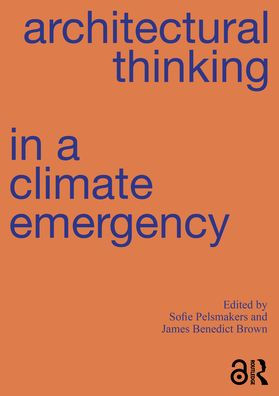
Architectural Thinking in a Climate Emergency

What is the role of architecture – and the architect – in the Anthropocene?

It’s an immutable fact: human activity is driving the climate and biodiversity crises that now threaten all life. The damage we inflict on the planet undermines basic human rights, displaces millions, and intensifies structural racism, sexism and segregation, with the greatest burden falling on the most vulnerable people and ecosystems.

Architects must act.

The design and construction of most buildings and urban environments today are rooted in an economic model that pursues infinite growth. Our profession is embedded in a paradigm that favours individual gain over collective benefit. We are rewarded for overlooking the interdependence between people and the natural world. Architecture contributes directly to environmental degradation and social injustice.

Architects agree that the profession must change. But we lack the tools and knowledge to undertake the transformations that are urgently needed. This book aims to address that need through 15 chapters illustrating how we can act collectively to make a difference.

Architectural Thinking in a Climate Emergency

brings together writers, researchers, educators, students and practitioners working at the forefront of this transformation. Contributors come from fourteen countries across Africa, Asia, Europe, North and South America and Oceania. Many are leading voices in their fields; others are emerging thinkers introducing fresh perspectives from both academia and practice.

Above all, they each affirm the architect’s responsibility to help transition toward carbon-neutral, sustainable practices that advance social and environmental justice.

The Open Access version of this book, available at http://www.taylorfrancis.com, has been made available under a Creative Commons Attribution-Non Commercial-No Derivatives (CC BY-NC-ND) 4.0 license.
1147395722
Architectural Thinking in a Climate Emergency

What is the role of architecture – and the architect – in the Anthropocene?

It’s an immutable fact: human activity is driving the climate and biodiversity crises that now threaten all life. The damage we inflict on the planet undermines basic human rights, displaces millions, and intensifies structural racism, sexism and segregation, with the greatest burden falling on the most vulnerable people and ecosystems.

Architects must act.

The design and construction of most buildings and urban environments today are rooted in an economic model that pursues infinite growth. Our profession is embedded in a paradigm that favours individual gain over collective benefit. We are rewarded for overlooking the interdependence between people and the natural world. Architecture contributes directly to environmental degradation and social injustice.

Architects agree that the profession must change. But we lack the tools and knowledge to undertake the transformations that are urgently needed. This book aims to address that need through 15 chapters illustrating how we can act collectively to make a difference.

Architectural Thinking in a Climate Emergency

brings together writers, researchers, educators, students and practitioners working at the forefront of this transformation. Contributors come from fourteen countries across Africa, Asia, Europe, North and South America and Oceania. Many are leading voices in their fields; others are emerging thinkers introducing fresh perspectives from both academia and practice.

Above all, they each affirm the architect’s responsibility to help transition toward carbon-neutral, sustainable practices that advance social and environmental justice.

The Open Access version of this book, available at http://www.taylorfrancis.com, has been made available under a Creative Commons Attribution-Non Commercial-No Derivatives (CC BY-NC-ND) 4.0 license.

54.99 In Stock
Architectural Thinking in a Climate Emergency

Architectural Thinking in a Climate Emergency

Architectural Thinking in a Climate Emergency

Architectural Thinking in a Climate Emergency

Paperback

$54.99 
  • SHIP THIS ITEM
    In stock. Ships in 3-7 days. Typically arrives in 3 weeks.
  • PICK UP IN STORE

    Your local store may have stock of this item.

Related collections and offers


Overview

What is the role of architecture – and the architect – in the Anthropocene?

It’s an immutable fact: human activity is driving the climate and biodiversity crises that now threaten all life. The damage we inflict on the planet undermines basic human rights, displaces millions, and intensifies structural racism, sexism and segregation, with the greatest burden falling on the most vulnerable people and ecosystems.

Architects must act.

The design and construction of most buildings and urban environments today are rooted in an economic model that pursues infinite growth. Our profession is embedded in a paradigm that favours individual gain over collective benefit. We are rewarded for overlooking the interdependence between people and the natural world. Architecture contributes directly to environmental degradation and social injustice.

Architects agree that the profession must change. But we lack the tools and knowledge to undertake the transformations that are urgently needed. This book aims to address that need through 15 chapters illustrating how we can act collectively to make a difference.

Architectural Thinking in a Climate Emergency

brings together writers, researchers, educators, students and practitioners working at the forefront of this transformation. Contributors come from fourteen countries across Africa, Asia, Europe, North and South America and Oceania. Many are leading voices in their fields; others are emerging thinkers introducing fresh perspectives from both academia and practice.

Above all, they each affirm the architect’s responsibility to help transition toward carbon-neutral, sustainable practices that advance social and environmental justice.

The Open Access version of this book, available at http://www.taylorfrancis.com, has been made available under a Creative Commons Attribution-Non Commercial-No Derivatives (CC BY-NC-ND) 4.0 license.


Product Details

ISBN-13: 9781032277486
Publisher: Taylor & Francis
Publication date: 09/22/2025
Pages: 294
Product dimensions: 6.88(w) x 9.69(h) x (d)

About the Author

Sofie Pelsmakers (she/her) is Professor of Sustainable Housing Design at Tampere University, Finland. She is a chartered architect (UK), author of several books and has dedicated the past two decades to teaching, designing and researching sustainable architecture. She brings experience from Denmark (the Aarhus School of Architecture) and the UK (Sheffield School of Architecture, The Bartlett, University of East London). Her collaborative work connects research, teaching and practice for the training of the architects of the future.

James Benedict Brown is an Associate Professor of Architecture at Umea University in Sweden. He teaches architectural history and theory and researches the relationship between architectural education, practice, values and materials.

Table of Contents

1. Setting the scene: architectural thinking in a time of climate emergency  PART 1: Architectural philosophies to address the climate emergency: injustice, circularity, radical inclusivity, spatial insurgence  2. Architects and climate justice  3. The new aesthetics of circular architecture  4. Who do we create architecture for, and why?  5. Enacted utopias: learning from insurgent spatial practices  PART 2: Architectural pedagogies to address the climate emergency: creaturely pedagogy, collaboration and communities of equity, empathy and interdisciplinarity  6. Everyday, equity and ease  7. Responding to embodied injustices: introducing critical thinking and empathy in architectural education  8. Changing cultures: sustainability in architectural education and design teaching  9. Preparing architects to serve as change agents  10. Changing paradigms: educating for the climate emergency  PART 3: Architectural practices to address the climate emergency: justice, interdisciplinarity, co-design, decolonisation  11. Planning for climate justice: digital mapping as an interdisciplinary tool for alleviating inequalities  12. Decolonising resilient architecture  13. Situating the concept of sustainable design in Africa  14. Boundaries and bonds in a boundless world: the relationship of place and community to landscape  15. An architecture of paying attention: scenarios for rehearsing climate futures otherwise

From the B&N Reads Blog

Customer Reviews