
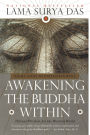
The radical and compelling message of Buddhism tells us that each of us has the wisdom, awareness, love, and power of the Buddha within; yet most of us are too often like sleeping Buddhas. In Awakening the Buddha Within, Surya Das shows how we can awaken to who we really are in order to lead a more compassionate, enlightened, and balanced life. It illuminates the guidelines and key principles embodied in the noble Eight-Fold Path and the traditional Three Enlightenment Trainings common to all schools of Buddhism:
Wisdom Training: Developing clear vision, insight, and inner understanding—seeing reality and ourselves as we really are.
Ethics Training: Cultivating virtue, self-discipline, and compassion in what we say and do.
Meditation Training: Practicing mindfulness, concentration, and awareness of the present moment.
With lively stories, meditations, and spiritual practices, Awakening the Buddha Within is an invaluable text for the novice and experienced student of Buddhism alike.
The radical and compelling message of Buddhism tells us that each of us has the wisdom, awareness, love, and power of the Buddha within; yet most of us are too often like sleeping Buddhas. In Awakening the Buddha Within, Surya Das shows how we can awaken to who we really are in order to lead a more compassionate, enlightened, and balanced life. It illuminates the guidelines and key principles embodied in the noble Eight-Fold Path and the traditional Three Enlightenment Trainings common to all schools of Buddhism:
Wisdom Training: Developing clear vision, insight, and inner understanding—seeing reality and ourselves as we really are.
Ethics Training: Cultivating virtue, self-discipline, and compassion in what we say and do.
Meditation Training: Practicing mindfulness, concentration, and awareness of the present moment.
With lively stories, meditations, and spiritual practices, Awakening the Buddha Within is an invaluable text for the novice and experienced student of Buddhism alike.


Paperback(Reprint)
-
SHIP THIS ITEMIn stock. Ships in 1-2 days.PICK UP IN STORE
Your local store may have stock of this item.
Available within 2 business hours
Related collections and offers
Overview
The radical and compelling message of Buddhism tells us that each of us has the wisdom, awareness, love, and power of the Buddha within; yet most of us are too often like sleeping Buddhas. In Awakening the Buddha Within, Surya Das shows how we can awaken to who we really are in order to lead a more compassionate, enlightened, and balanced life. It illuminates the guidelines and key principles embodied in the noble Eight-Fold Path and the traditional Three Enlightenment Trainings common to all schools of Buddhism:
Wisdom Training: Developing clear vision, insight, and inner understanding—seeing reality and ourselves as we really are.
Ethics Training: Cultivating virtue, self-discipline, and compassion in what we say and do.
Meditation Training: Practicing mindfulness, concentration, and awareness of the present moment.
With lively stories, meditations, and spiritual practices, Awakening the Buddha Within is an invaluable text for the novice and experienced student of Buddhism alike.

Product Details
| ISBN-13: | 9780767901574 |
|---|---|
| Publisher: | Harmony/Rodale/Convergent |
| Publication date: | 06/15/1998 |
| Edition description: | Reprint |
| Pages: | 432 |
| Product dimensions: | 5.44(w) x 8.15(h) x 0.89(d) |
About the Author
Read an Excerpt
Once the holy Hasidic master Baal Shem sent Yacov Yosef, his second-greatest pupil, an outstanding scholar and Kabbalist, to test the learning of Yechiel, a prospective son-in-law for Baal Shem's daughter, Udel. Yechiel, like the holy master, came from a simple German Jewish family.
When Yacov Yosef returned from his mission, he reported back to the Baal Shem Tov:
"Yechiel answered, 'I don't know' to everything I asked him. I wonder about this guy..."
The Baal Shem Tov replied, "Oh God, I'd love to have such a man as my son-in-law."
The young man told the simple truth, which is sometimes easier said than done, and the old rabbi recognized his wisdom. Words can be gifts, words can be weapons, words can be magic; words can be prayer, poetry, or song. What is traditionally known as Right Speech is the third touchstone on the Eight-Fold Path. So speak your truth. Tell it like it is. There is no reason to do otherwise.
Everything You Say Can Express Your Buddha-Nature
In a world of exaggerated advertising campaigns, exploitative talk shows, hate radio, and political spin doctors, Right Speech and impeccable expression may seem to be a rather tall order. Yet if we are sincere about embodying the Dharma, our words ideally will become a reflection of our desire to help others. Think kindly; speak gently and clearly. The wisdom of cause and effect—or karma—teaches us that everything matters—every breath, every syllable, every sentence. As we walk the path to enlightenment, nothing is meaningless, and it all counts. Imagine that all the thoughts and fragmented sentences that are just now swirling through your head were printed out on a giant chalkboard—like the daily menu in some restaurants. Which thoughts do you sincerely want to express? It's a choice we make—sometimes hundreds of times every day. With your words you confirm to the world, and yourself, what you think is important. Words help concretize our thoughts and concepts; they define our priorities, reify our ideas and opinions, and express our worldview and intentions. Words have power; to be specific, your words have power. We can use speech patterns to help us communicate with others in a more considered, conscious way, or we can be careless and create trouble with our words—trouble for ourselves as well as others.
In the context of Dharma, speech is a particularly compelling issue because to reflect upon speech is to think about self, non-self, and others. Don't most of us use speech as an expression of ego and the need to hang on to and confirm our illusory self? Don't we use speech to communicate that we exist? "I'm here," we say, confirming and marking out our territorial space. To some extent, we all habitually use words to express ego and a false self. By putting forth our views, we use speech to shore up the concrete citadel of ego and the notion of "me" and "mine." We tell ourselves and others stories about ourselves and our lives. We speak to others; we speak to ourselves. What do we say? And why do we say it?
When the Buddha talked about Right Speech or impeccable speech, what he meant was excellent speech that reflected inner wisdom, clear vision, and Buddha-nature. The instructions that come down to us from the Buddha concerning everyday speech are simple yet profound. On a mundane level, we are instructed as follows:
Speak the Truth, Tell No Lies
On this point, the Buddha's advice was remarkably straightforward. He said: "If he is called to tell what he knows, he answers if he knows nothing: 'I know nothing.' And if he knows, he answers, 'I know.' If he has seen nothing, he answers: 'I have seen nothing.' And if he has seen, he answers: 'I have seen.' Thus, he never knowingly speaks a lie, neither for the sake of his own advantage, nor for the sake of another person's advantage, nor for the sake of any advantage whatsoever."
Words articulated without guile, masked ego needs, conflict, or hidden agendas—wouldn't it be wonderful to be able to speak with such clarity and simplicity, all the time? Haven't there been times in your life when you are so centered and clear that your words, like the Buddha's, ring with truth and sanity? Don't we all sometimes have these breakthrough moments, times when we are in touch with who we are and what we know? These are precious moments, minutes, or hours when each of us is able to speak his or her own truth, honestly and fearlessly. But these breakthroughs are difficult to sustain.
As a seeker, you have probably already wrestled with the problems connected to outright lying; in all likelihood, you've made an appropriate decision not to be evasive or indulge in direct falsehoods or deceitful, manipulative statements. We all agree that outright lying is counterproductive. But as we walk further along the spiritual path, chances are we will each arrive at checkpoints where the subtleties of truth come into play. We may discover time after time that it's difficult to be clear and forthright in everything we say, and we may find ourselves compromising and shading the truth. Instead of saying what we know is true, for example, we say things that others want to hear. Or we say things that we want to hear—and believe.
When we don't want to appear weak or vulnerable, we say things that make us look strong and powerful. When we don't want others to think we are out of control, we use words to control what others do. It's very easy to spot the manipulations of the spin doctors from Madison Avenue or Washington, D.C.; it's more complex when we create our own egotistical advertising campaigns. Yet this is what we do all the time by presenting ourselves as we would like to appear and hiding behind the stories we tell ourselves and others to get what we think we want. All this only serves to create false personas that leave us feeling incomplete and alienated from our authentic selves.
Don't you sometimes use words to distance others and protect your true feelings? Haven't you ever told people that you were feeling "fine" even when you were depressed and sad? We don't always use words to communicate from our hearts and then we expect others to be mind readers. Sometimes we even tell ourselves stories. "I don't eat so many sweets," we say to ourselves as we reach again into the bag of cookies. "I'm not really lying to Miranda," we think as we make up a plausible excuse to break an appointment. "It doesn't really matter," we reassure ourselves, even when we know it matters a great deal.
Everyone says that communication and mutual understanding is the essence of good relationships. And nowhere are the subtleties of honest speech more apparent than in our personal relationships. However, as much as we may want to express ourselves authentically with words that reflect love, warmth, and openness, we don't always manage to do it. Our expectations get in the way and distort the picture; so do our desires, fears, illusions, and projections. That's why we all regularly need to stop and ask ourselves if we are moving in the direction of more honesty, or not.
I often speak to people who tell me they are unhappy because their loved ones don't seem to be listening to what they have to say. They feel invalidated and as though their opinions are being disregarded. But when these people delve a little bit deeper below the surface of their complaints, they often realize they are failing to express their feelings and wishes in a clear and direct manner. When we withhold our true feelings, protect our emotions, and construct false personas to present to the world, we become part of the problem.
Reality—seeing things just as they are—is a central issue of Buddhist practice. Pure attention, unclouded by distortion or delusion, knows things exactly as they are, in the present moment. We bring Right Speech into our relationships by trying always to be honest and forthright and by letting go of our intricate defense systems and being truthful and open about who we are and how we feel.
As part of awareness practice involving Right Speech, try listening to yourself so you can hear how you sound from a different perspective, as if being outside of yourself as an objective listener. Speaking the truth is a very present-moment activity; truth-telling begins by becoming aware of what you tell yourself. Then try listening to the way you sound to others. Do you sound tentative, confused, angry, rattled, tense? Are you using speech to manipulate feelings or emotions, yours or someone else's? Do you use speech, or even silence, as a way of hiding who you are? Are you communicating what you think you're communicating? Are you able to recognize and acknowledge reality? Are you able to speak your truth in your own authentic voice, unflinchingly and without hesitation?
Use Words to Help, Not Harm
Right Speech Reminds Us To Refrain From Causing Trouble With Speech That Is Hurtful Or Unnecessarily Disruptive Have you ever had the experience of saying something and regretting it later? Perhaps something sarcastic that you thought was funny? Of course. We all have. When I began teaching, I quickly realized that if I made what I thought was a little ironic or facetious joke, some sensitive soul might end up feeling hurt, ridiculed, exposed, or betrayed.
One of Atisha's mind-training Lo-jong Slogans is Don't Talk About Injured Limbs It's a good slogan to remember because what we describe as a joke may in reality be pointing out another being's defects and weaknesses—not unlike staring or pointing a finger. It can be hurtful even though we are backing into it through a joke. And yet how hard it is to walk this talk. What a temptation it sometimes is to poke fun or show how funny and clever we can be with our quick tongues and caustic wit. Hurtful words reinforce personal alienation and a dualistic view. Slander sows discord; sensitive gentle speech can bring about peace and reconciliation.
The Dharma also reminds us that a judgmental point of view will obscure our higher view and distort our direct appreciation of how things are. In the New Testament, Jesus points out that we tend to notice the small imperfection in someone else's eye while overlooking the log sticking out of our own. A Tibetan proverb says: "Don't notice the tiny flea in the other person's hair and overlook the lumbering yak on your own nose." Judgmental words and self-righteous tones fail to help any situation.
Some people seem to be particularly gifted at using words to help others. They are so constructive, positive, and empathetic that they make you feel good whenever you talk to them. "How great for you," they say. "Tell me about it; I want to hear what you have to say." You can feel their intention to give support and encouragement. These communicative geniuses seem to have a special gift—they are able to truly see and hear others. Open and sensitive to what others are experiencing, these gifted listeners are real healers. Listening with a nonjudgmental and open heart is a way to bring bodhicitta and loving-kindness into your communication with others. The Dharma tells us that if we listen carefully, we will be able to hear the natural Buddha in everyone.
Interviews
On Monday, January 5th, barnesandnoble.com welcomed Lama Surya Das to discuss AWAKENING THE BUDDHA WITHIN.
Moderator: Welcome to barnesandnoble.com, Lama Surya Das. We are pleased you could join us.
Lama Surya Das: Thanks very much. It is a pleasure to be here, and I hope this talk tonight awakens the Buddha within all of you.
Lauren from Cleveland, OH: Can you please explain to me what the Dzogchen Foundation is?
Lama Surya Das: The Dzogchen Foundation is our congregration. It is an international nonprofit, but it is also a warm and spiritual family within Europe and North America at which we teach and practice Dzogchen Tibetan Meditations and Teachings, which is a way to practically and spiritually awaken the Buddha within each of us.
Alex from Ft. Collins, CO: Were you born a Buddhist? How did you come about to the position you are at today?
Lama Surya Das: You can read about that in the first dozens of pages in my book. I was born Jewish, I am Jewish on my parents' side but Buddhist by training and inclination. Perhaps Buddhist from past life, who knows. I became a lama through training in monasteries and retreat centers over 25 years.
Karyn from Oakland: Lama Surya Das, I am thoroughly enjoying your book, which I purchased a few days ago. In addition to your Steps to Enlightenment, what would you recommend for someone who is eager to learn more about Buddhism and is a complete beginner -- are there classes or seminars or temples anyone can go to? Recommendations for the East Bay area would be greatly appreciated. Thank you for your enlightenment! Keep up the inspirational work.
Lama Surya Das: Oakland and the East Bay is one of the hotbeds of Buddhism. There are plenty of temples and meditation centers to go to. I would especially recommend that you try a lecture, workshop, or evening meditation class at an insight meditation group, or Zen meditation group in Oakland or Berkeley, which can easily be found by looking at a bulletin board or asking people in any spiritual food store or bookstore. I teach in northern California regularly and will be there in March. My schedule can be found at www.dzogchen.org, or search for my name and you will find my home pages and itinerary, and you are very welcome to come for yourself.
Paul from Morris Plains, NJ: What is your impression of what is currently happening in mainland China?
Lama Surya Das: China is a great and vast country, and there is a lot going on there. I have been there two or three times in the last 15 years, and things are definitely changing. I think it is an exciting time, and we will see what is happening. The Old Guard is currently out, and the new leaders are coming in. The world is shrinking. China can't resist that trend, and hopefully it's a trend for the better -- freedom of religion as well as a better standard of living.
Nicole from Austin, TX: Why did you decide to write this book?
Lama Surya Das: The preface says why I wrote this.... Wherever I teach around the world, people ask me similar questions, which I try to to answer in this book. Answering questions about meditation, rebirth, wisdom, how to cultivate compassion and experience more love in our lives, find happinesss, how to serve and contribute to the world, etc.
John from Philadelphia, PA: Do you think this book is good for those who are interested in the basics involved in Buddhism?
Lama Surya Das: I have read almost all the books about Buddhism, and I must say this is the best and most comprehensive (if I may so myself), and the readers have agreed. It contains everything a beginner needs to know, and it includes plenty of spiritual anecdotes, tales of the masters, and so on.... It is a lot of fun. I tried to write it so even my mother and cousins in New Jersey could read it, and they said they enjoyed it, and they aren't at all Buddhist.
Arlauda from Bogotá, Colombia: Is there a relation between Lama Surya Das teaching and Zen? Thank you for your answer.
Lama Surya Das: My teaching is basically Buddhist Spirituality wisdom, and that includes Zen. I explain the Heart Sutra, which all Zen students practice, and I talk about the common grounds and the different schools of Buddhism, such as Zen, insight meditation, etc. One of my friends introduces me as the "dogzen," as a pun on "Dzogchen."
Max from Great Meadows, NJ: Hello, Lama Surya Das. Have you ever met the Dalai Lama? What was that experience like?
Lama Surya Das: I have met him many times since my first meeting in 1972, which I have written about in my book. Personally I think he is everything he is supposed to be and more. It is quite amazing. He is one of the humblest, most loving, equal-to-all elders that I have met (and I have met many).
Sally from Dallas, TX: Does becoming a Buddhist preclude the observance of any other religion? Can you be Buddhist and Jewish or Buddhist and Quaker? Thank you for taking my question.
Lama Surya Das: My short answer is it doesn't preclude the observance of other religions, but there is plenty of discussion and opinion about this. Certainly the Quaker faith is the most compatible; they are very interested in Buddhist spirituality. As a Buddhist teacher I like to say we try to contribute to others, not convert others, and there are many rabbis and priests who come to learn and practice self-inquiry in a Buddhist way. It deepens their life within their own traditions. It certainly doesn't contradict those traditions.
Sharon from Long Island: Why do you think Westerners are seeking Eastern enlightenment at the end of the 20th century?
Lama Surya Das: I have written about this quite a bit in my book, especially at the end, talking about modern trends and contemporary dharma. It is my own experience as a fellow Long Islander that I didn't find profound wisdom in the churches and temples I grew up in, and I sought it farther afield. We had questions, and many enlightened masters appeared in the West as well as in Asia. They were well qualified in helping us find the answers. So many people went down that road.
Jim from Merced, CA: Would you describe how the experience of grieving for loved ones who have died is understood in the Tibetan Buddhist culture?
Lama Surya Das: There is a lot of teaching or reflection about our own mortality and the impermanence of everything that lives in the Buddhist faith, and that does not preclude grieving for those we love. Yet we would say that we could also learn a great deal through this grieving process, how everything eventually passes, and that realization can help us prioritize things right now and make us appreciate what we have right now, because the future is uncertain at best. The Buddhist understanding of equanimity and inner detachment does not preclude experiencing authentic feelings of grief or sadness, or for that matter joy and love. The fact is that the more mentally balanced we are, the better we can fully experience such authentic feelings and live a full, loving life.
Jonathon Withers from Atlanta: Could you please compare and contrast the dzogchen/mahamudra teachings as you know them with the "radical" and controversial teachings, and teaching styles, of Adi Da and Chogyam Trungpa?
Lama Surya Das: The radical non-dual teachings of Adi Da and Chogyam Trungpa are very much the teachings of mahamudra and dzogchen. The somewhat iconoclastic and radical teachings are not original to them. Adi Da and Chogyam Trungpa are part of an ancient lineage of enlightened masters that comes down to us through their mouths, proclaiming this timeless, profound wisdom.
Ben from Shrewsbury, MA: What future do you see Buddhism taking in America?
Lama Surya Das: I have written about this in my epilogue. I think Buddhism is being adopted by Americans more and more. Buddhist meditations, not necessarily beliefs. It is also adapting itself as it moves from East to West. It takes on new forms, although the essence remains the same. We will probably see at least two kinds of Buddhism in America in a while -- the traditional and the new American Buddhism, sort of the French wine and the California wine, from the same vine, but with a slightly different flavor, but hopefully the same effect.
Soraya from West Palm Beach: What exactly is Tibetan Buddhism compared to other forms of Buddhism, like Zen Buddhism? What are the principles of Tibetan Buddhism that distinguish it?
Lama Surya Das: Very broad question, but generally Zen Buddhism is much more simple, formless, and black and white. Tibetan Buddhism is more like color photography, much more rich, complex, visual, and so on.... For example, Tibetan Buddhism has a lot more rituals, texts, and commentaries and different visualizations and mantras, as well as formless meditation, while Zen is more simple, emphasizing formless meditation with just a little chanting involved and very little study. Of course, the purpose is the same: finding nirvanic peace, freedom, and enlightenment.
Audrey K. Mochel from Canisteo, NY: What is the role of women in Tibetan Buddhism in the United States? All lamas seem to be men.
Lama Surya Das: There are quite a few female lamas, teachers, nuns, and scholars. Especially in the U.S., more than in the patriarchal old countries of Asia. There are female Buddhists and well as male Buddhists, although in reality there is no gender in innate Buddha nature.
Michael Hodges from Miami, FL: How do you distinguish between the study and significance of the dharma, and the study and significance of Buddhism? Which is more relevant to modern life in the U.S.? How important are the schismatic differences in U.S. Buddhism to the future of the dharma in this world?
Lama Surya Das: Buddhist teachings are known as "dharma." It is a rich Sanskrit word that has many levels of meaning, including truth, teaching, universal law, reality, and so on.... Hindu teachings are also known as dharma; in fact, all spiritual teachings can be called dharma. Buddhism is less important than dharma, which is the spiritual essence of it, larger than Buddhism alone. Therefore, many of us consider ourselves to be more dharma teachers than Buddhist teachers, because we are teaching spirituality, not just Buddhism.
David Golden from Eagle, WI: I have studied Tibetan Buddhism on my own for more than five years. I have also been able to attend a handful of classes. But I am finding it very hard to take all this study to the next stage, developing a personal practice. Any suggestions?
Lama Surya Das: Developing a personal practice is a very big step. Theory and practice go hand in hand. It is difficult to develop a personal practice alone. Perhaps a group retreat or going to a meditation meeting could help provide the support and encouragement necessary to get over the hump and to really carry on a daily practice more naturally. But don't be too hard on yourself. Studying dharma is a practice itself -- what we call the spiritual practice of mind training -- so you already have an established spiritual practice that can be further developed through deepening experience.
Marc from Boston: Have you ever met Zen Master Seung Sahn?
Lama Surya Das: Yes, I have met him many times. He is a good traditional Asian patriarch Zen master.
Mark Fisher from North Little Rock: What does Buddhism offer for the modern person in today's rushed society?
Lama Surya Das: This is really one of the main contributions Buddhism can make (which I have written about quite extensively in terms of practical exercises). Dharma practices such as cultivating mindfulness as well as through meditation and action (eating meditation, work meditation, etc.) can help us be much more present and effective, more centered and sane and balanced amid the hectic pace of modern life. Cultivating meditative awareness that we can apply or integrate helps create a spaciousness, joy, and lightness as well as seemingly more time and a richer appreciation of the most pedestrian of daily activities, so than even washing the dishes becomes a part of our spiritual life.
Daniel from Sacramento, CA: What is next for Lama Surya Das?
Lama Surya Das: Answering this question...and in a longer picture, more meditation, writing more books and poems, etc....
Jim from California: Is sexual practice a part of the Vajrayana teachings? (I heard that Kalu Rinpoche has affirmed this.)
Lama Surya Das: Yes, sexual practice can definitely be part of Vajrayana practice. It can also be a rationalization for all kinds of less high-minded behavior.
Grega St. John from Hinesville, GA: I just finished your book yesterday. This was my first read, and I plan to reread and get even more out of it. I cannot begin to tell you how much I enjoyed this book. Nor can I tell you why I even bought it in the first place. I was basically raised agnostic; lately, just out of curiosity for what others believe, I have started reading about different beliefs. I have always had a problem believing that I was inferior because I am female. I also had a problem in thinking that something had control of my life. However, I have always felt that there was something that was within, something that told me I should do the right thing, things that are beneficial to more than just myself. I thank you for this book -- it is the first step for me to look into in much greater detail. Like I said, my next step is to reread, then see where I go from there. I do have one question. I truly believe that most people do have this good inner self. However, isn't it also possible for someone to not have it? You can see it in the eyes, or feel it in the hug (actually a lack of feeling in the hug). Do you think these people are actually missing a part?
Lama Surya Das: They may be missing a part, but they have the whole. We are all Buddhas by nature. All beings are endowed innately with this Buddha nature or spirit, even the worst criminals.
Ernesto from San Juan, Puerto Rico: Greetings. What is the method of meditation most widely practiced in Buddhism? And are you aware of any medical doctors in the U.S.A. who have adopted Buddhist principles and beliefs in their treatment of patients?
Lama Surya Das: The most common practice in Buddhism, or shall I say dharma, is cultivating mindfulness and awareness, or simply put, presence of mind. This helps us develop more wisdom and loving compassion. Many medical professionals have taken up such practices and have used them in numerous clinics and HMOs, etc. Dr. Herbert Benson has done a lot of research on the power of healing and meditation and meditation response. Jon Cavet-Zin has brought in mindfulness and basic meditation (without a religious aspect) as treatments for chronic pain and other infirmities. Dr. Larry Dossey has also done much work in this area, and there are many more.
Mary from Texas: Is Buddhism a good practice for children?
Lama Surya Das: There are a lot of Buddhist practices for children, such as giving alms, bowing and smiling, chanting and singing, and even some walking or meditation or martial arts practices. I don't recommend silent sitting for children, but I have found that meditation and breathing exercises are beneficial for children, sharpening their focus and increasing their attention span and even proving effective in treating attention disorders. There are great exercises, easy to learn, for these attention disorders. However, I think we need to teach children by example.
Moderator: Thank you for joining us, Lama Surya Das! Any closing comments?
Lama Surya Das: It is a pleasure to be online like this. We are all interconnected, and the Internet is an international web that links us quickly and directly and can lead to deeper, more personal connections. I hope that our virtual gathering has been fruitful, enlightening, and helps us to lighten up a little.