Basics Of Bead Stringing And Attaching Clasps: Design And Assemble Your Own Jewelry, The Complete Insider's Guide
Learning Bead Stringing Is More Than Putting Beads On A String And Tying On A Clasp


There is an art and skill to stringing beads. First, of course, is the selection of beads for a design, and the selection of the appropriate stringing material. Then is the selection of a clasp or closure, appropriate to the design and use of the piece.


You want your pieces to be appealing. You want them to wear well.  You want someone to wear them or buy them.   This means understanding the basic techniques, not only in terms of craft and art, but also with considerations about architecture, mechanics, and some sociology, anthropology and psychology.   


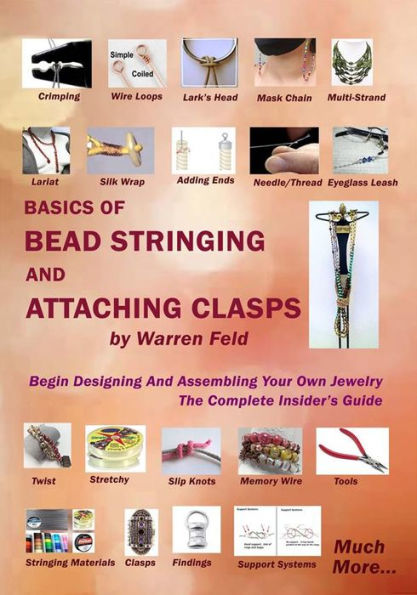
In this book, I go into depth about: (1) Choosing stringing materials, and the pros and cons of each type, (2) Choosing clasps, and the pros and cons of different clasps, (3) All about the different jewelry findings and how you use them, (4) Architectural considerations and how to build these into your pieces, (5) How better designers use cable wires and crimp, as well as, use needle and thread to string beads, (6) How best to make stretchy bracelets, (7) How to make adjustable slip knots, coiled wire loops, and silk wraps, (8) How to finish off the ends of thicker cords or ropes, so that you can attach a clasp, (9) How to construct such projects as eyeglass leashes, mask chains, lariats, multi-strand pieces, twist multi-strand pieces, and memory wire bracelets, (10)  How different teaching paradigms - craft vs. art vs. design - might influence the types of choices you make.
1143286395
Basics Of Bead Stringing And Attaching Clasps: Design And Assemble Your Own Jewelry, The Complete Insider's Guide
Learning Bead Stringing Is More Than Putting Beads On A String And Tying On A Clasp


There is an art and skill to stringing beads. First, of course, is the selection of beads for a design, and the selection of the appropriate stringing material. Then is the selection of a clasp or closure, appropriate to the design and use of the piece.


You want your pieces to be appealing. You want them to wear well.  You want someone to wear them or buy them.   This means understanding the basic techniques, not only in terms of craft and art, but also with considerations about architecture, mechanics, and some sociology, anthropology and psychology.   


In this book, I go into depth about: (1) Choosing stringing materials, and the pros and cons of each type, (2) Choosing clasps, and the pros and cons of different clasps, (3) All about the different jewelry findings and how you use them, (4) Architectural considerations and how to build these into your pieces, (5) How better designers use cable wires and crimp, as well as, use needle and thread to string beads, (6) How best to make stretchy bracelets, (7) How to make adjustable slip knots, coiled wire loops, and silk wraps, (8) How to finish off the ends of thicker cords or ropes, so that you can attach a clasp, (9) How to construct such projects as eyeglass leashes, mask chains, lariats, multi-strand pieces, twist multi-strand pieces, and memory wire bracelets, (10)  How different teaching paradigms - craft vs. art vs. design - might influence the types of choices you make.

9.99 In Stock
Basics Of Bead Stringing And Attaching Clasps: Design And Assemble Your Own Jewelry, The Complete Insider's Guide

Basics Of Bead Stringing And Attaching Clasps: Design And Assemble Your Own Jewelry, The Complete Insider's Guide

by Warren Feld
Basics Of Bead Stringing And Attaching Clasps: Design And Assemble Your Own Jewelry, The Complete Insider's Guide

Basics Of Bead Stringing And Attaching Clasps: Design And Assemble Your Own Jewelry, The Complete Insider's Guide

by Warren Feld

eBook

$9.99 

Available on Compatible NOOK devices, the free NOOK App and in My Digital Library.
WANT A NOOK?  Explore Now

Related collections and offers


Overview

Learning Bead Stringing Is More Than Putting Beads On A String And Tying On A Clasp


There is an art and skill to stringing beads. First, of course, is the selection of beads for a design, and the selection of the appropriate stringing material. Then is the selection of a clasp or closure, appropriate to the design and use of the piece.


You want your pieces to be appealing. You want them to wear well.  You want someone to wear them or buy them.   This means understanding the basic techniques, not only in terms of craft and art, but also with considerations about architecture, mechanics, and some sociology, anthropology and psychology.   


In this book, I go into depth about: (1) Choosing stringing materials, and the pros and cons of each type, (2) Choosing clasps, and the pros and cons of different clasps, (3) All about the different jewelry findings and how you use them, (4) Architectural considerations and how to build these into your pieces, (5) How better designers use cable wires and crimp, as well as, use needle and thread to string beads, (6) How best to make stretchy bracelets, (7) How to make adjustable slip knots, coiled wire loops, and silk wraps, (8) How to finish off the ends of thicker cords or ropes, so that you can attach a clasp, (9) How to construct such projects as eyeglass leashes, mask chains, lariats, multi-strand pieces, twist multi-strand pieces, and memory wire bracelets, (10)  How different teaching paradigms - craft vs. art vs. design - might influence the types of choices you make.


Product Details

ISBN-13: 9798986535432
Publisher: Warren Feld Jewelry
Publication date: 04/03/2023
Sold by: Barnes & Noble
Format: eBook
Pages: 452
File size: 79 MB
Note: This product may take a few minutes to download.

About the Author

For Warren Feld, Jewelry Designer, (www.warrenfeldjewelry.com), beading and jewelry making have been wonderful adventures. These adventures have taken Warren from the basics of bead stringing and bead weaving, to pearl knotting, micro-macrame, wire working, wire weaving and silversmithing, and onward to more complex jewelry designs which build on the strengths of a full range of technical skills and experiences.

Table of Contents

TABLE OF CONTENTS


ACKNOWLEDGEMENTS

1. INTRODUCTION

2. MATERIALS AND TOOLS

3. WORKSPACE

4. THREE TEACHING APPROACHES

5. THE DESIGN PROCESS

6. CHOOSING CLASPS

7. CHOOSING STRINGING MATERIALS

8. TWO COGNITIVE PHENOMENA

9. TYPES OF CLASPS

10. TYPES OF STRINGING MATERIALS

11. JEWELRY FINDINGS

12. HOW TO CRIMP

13. STRINGING WITH NEEDLE AND THREAD

14. ELASTIC STRING AND STRETCHY BRACELETS

15. MAKING SIMPLE AND COILED WIRE LOOPS

16. ATTACHING END PIECES TO THICKER CORDS

17. MAKING SIMPLE AND FANCY ADJUSTABLE SLIP KNOTS

18. SILK WRAP

19. EYEGLASS LEASH AND MASK CHAIN

20. LARIAT

21. MULTI-STRAND PIECES

22. TWIST MULTI-STRAND PIECES

23. MEMORY WIRE

24. FINAL WORDS OF ADVICE

THANK YOU AND REQUEST FOR REVIEWS

ABOUT WARREN FELD

ARTICLES AND PUBLICATIONS

From the B&N Reads Blog

Customer Reviews