
Safeguarding collective wisdom is a powerful tool for civilization to overcome the major upheavals ahead.
Climate change, civil unrest, wars: How will we make it through the tough times looming ahead of us? By remembering, Mary Soderstrom argues.
Our time is the first in history that catastrophe has threatened societies, and, using examples from China, the Roman Empire, and North American Indigenous cultures, Soderstrom shows how memory can lead the way toward the future. Before We Forget examines how memory works in people and then details how we store our collective memories in libraries and archives, as well as in the vastness of the electronic universe.
In part an entertaining history of knowledge and where we keep it, Before We Forget allays fears and encourages people to develop strategies for safeguarding collective and individual wisdom, which we will need to meet the challenges ahead.
1147487878
Climate change, civil unrest, wars: How will we make it through the tough times looming ahead of us? By remembering, Mary Soderstrom argues.
Our time is the first in history that catastrophe has threatened societies, and, using examples from China, the Roman Empire, and North American Indigenous cultures, Soderstrom shows how memory can lead the way toward the future. Before We Forget examines how memory works in people and then details how we store our collective memories in libraries and archives, as well as in the vastness of the electronic universe.
In part an entertaining history of knowledge and where we keep it, Before We Forget allays fears and encourages people to develop strategies for safeguarding collective and individual wisdom, which we will need to meet the challenges ahead.
Before We Forget: How Remembering Will Get Us Through the Next 75 Years
Safeguarding collective wisdom is a powerful tool for civilization to overcome the major upheavals ahead.
Climate change, civil unrest, wars: How will we make it through the tough times looming ahead of us? By remembering, Mary Soderstrom argues.
Our time is the first in history that catastrophe has threatened societies, and, using examples from China, the Roman Empire, and North American Indigenous cultures, Soderstrom shows how memory can lead the way toward the future. Before We Forget examines how memory works in people and then details how we store our collective memories in libraries and archives, as well as in the vastness of the electronic universe.
In part an entertaining history of knowledge and where we keep it, Before We Forget allays fears and encourages people to develop strategies for safeguarding collective and individual wisdom, which we will need to meet the challenges ahead.
Climate change, civil unrest, wars: How will we make it through the tough times looming ahead of us? By remembering, Mary Soderstrom argues.
Our time is the first in history that catastrophe has threatened societies, and, using examples from China, the Roman Empire, and North American Indigenous cultures, Soderstrom shows how memory can lead the way toward the future. Before We Forget examines how memory works in people and then details how we store our collective memories in libraries and archives, as well as in the vastness of the electronic universe.
In part an entertaining history of knowledge and where we keep it, Before We Forget allays fears and encourages people to develop strategies for safeguarding collective and individual wisdom, which we will need to meet the challenges ahead.
13.99
Pre Order
5
1


Before We Forget: How Remembering Will Get Us Through the Next 75 Years
264
by Mary Soderstrom
Mary Soderstrom
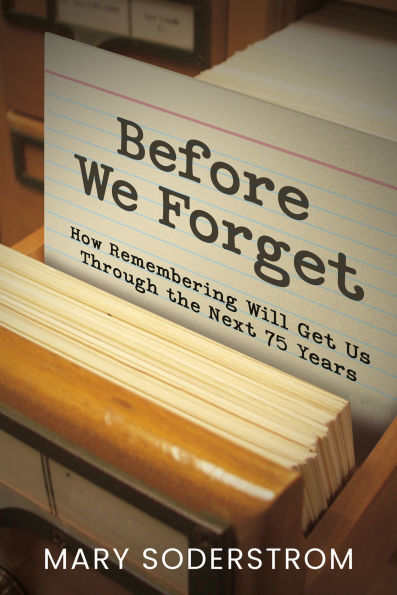
Before We Forget: How Remembering Will Get Us Through the Next 75 Years
264
by Mary Soderstrom
Mary Soderstrom
eBook
$13.99
Available for Pre-Order.
This item will be released on March 3, 2026
Available on Compatible NOOK devices, the free NOOK App and in My Digital Library.
WANT A NOOK?
Explore Now
Related collections and offers
13.99
Pre Order
Overview
Safeguarding collective wisdom is a powerful tool for civilization to overcome the major upheavals ahead.
Climate change, civil unrest, wars: How will we make it through the tough times looming ahead of us? By remembering, Mary Soderstrom argues.
Our time is the first in history that catastrophe has threatened societies, and, using examples from China, the Roman Empire, and North American Indigenous cultures, Soderstrom shows how memory can lead the way toward the future. Before We Forget examines how memory works in people and then details how we store our collective memories in libraries and archives, as well as in the vastness of the electronic universe.
In part an entertaining history of knowledge and where we keep it, Before We Forget allays fears and encourages people to develop strategies for safeguarding collective and individual wisdom, which we will need to meet the challenges ahead.
Climate change, civil unrest, wars: How will we make it through the tough times looming ahead of us? By remembering, Mary Soderstrom argues.
Our time is the first in history that catastrophe has threatened societies, and, using examples from China, the Roman Empire, and North American Indigenous cultures, Soderstrom shows how memory can lead the way toward the future. Before We Forget examines how memory works in people and then details how we store our collective memories in libraries and archives, as well as in the vastness of the electronic universe.
In part an entertaining history of knowledge and where we keep it, Before We Forget allays fears and encourages people to develop strategies for safeguarding collective and individual wisdom, which we will need to meet the challenges ahead.

Product Details
| ISBN-13: | 9781459755871 |
|---|---|
| Publisher: | Dundurn Press |
| Publication date: | 03/03/2026 |
| Sold by: | Barnes & Noble |
| Format: | eBook |
| Pages: | 264 |
About the Author
Mary Soderstrom is a writer with eight works of non-fiction, three short story collections, six novels, and one children’s book to her credit. Before We Forget: How Remembering Will Get Us Through the Next 75 Years is her nineteenth book. She lives in Montreal.
Mary Soderstrom is a writer with eight works of non-fiction, three short story collections, six novels, and one children’s book to her credit. Before We Forget: How Remembering Will Get Us Through the Next 75 Years is her nineteenth book. She lives in Montreal.
Read an Excerpt
Chapter 1: What Is Memory? And How Did George Do It?
George was born in 1786 in what is now Sorel-Tracy, Quebec, which was then called William Henry, Lower Canada. His father was an Englishman who ran a school where he educated the sons of the English officers stationed at the garrison, as well as the scions of other anglophones in the region. Among his students were, of course, his own sons, three of whom became doctors. George was not headed for a medical career, however, even though he was no dunce. He wrote a good hand, knew a bit of Latin, was well acquainted with some of the greats of the literary canon, and had more than a passing acquaintance with Greek and Roman mythology and philosophy. Yet he apparently chafed under the parental yoke, and in February 1802, when he was fifteen, he jumped at an offer to become a clerk in a fur trading company after a chance meeting with a representative of the XY Company in Montreal.
As he wrote more than thirty years later, the prospect of adventure and fortune was very appealing:
"In May each year we would see numbers of young men, each one with his bag, containing a few of the most necessary articles of clothing, on his back, with a paddle and a “setting pole” in his hand, bidding “Farewell” (alas! how many forever) embarking in their bark Canoes with tears in their eyes and singing as if going to a banquet! These were easily distinguished by their gay & lofty mien and jaunty air, as men who had faced dangers & conquered difficulties they only were capable of. The free and thoughtless way in which they squandered money was not the least of wonders to those who unacquainted with influence of example & the habit of thoughtlessness so natural to a roving life…. The example was infectious, the Stories thrilling, and I was in that period of life remarkable for thoughtless- ness & anxious to be engaged in a busy life — I was seized with the delirium."
In short order, he was indentured for five years as an apprentice clerk, with a salary of fifteen pounds a year and the “promise of a Share in the Company at the expiration of the indentures, or one hundred pounds a year.”
In 2025, fifteen pounds would be worth about $3,310, and the sum probably seemed a fortune to the boy from William Henry who was just days shy of his sixteenth birthday. George’s experiences on those late spring days when he started his career in the fur trade are recorded in at least two places, and this is where his story doubles back to the bigger story about memory that we are considering here. First, all clerks in the fur trade were expected to keep a daily journal, and it is known that he did so for nearly twenty years. He also wrote several letters to family members, detailing his observations about the Indigenous people among whom he was living and frequently drawing parallels between their belief systems and those of Christians and the Greek and Roman worlds.
He thought that most of these documents had been destroyed when he came back to Lower Canada, but the friend he had asked to do the task hadn’t done it. For a long time, it wasn’t clear how these documents ended up in the Toronto Public Library. It appeared that they simply sat on the shelves for decades before being “discovered” by scholars in the mid-twentieth century, more than a hundred years after they were written. But more about that later. What is important about George’s story is that his experience in the fur trade didn’t become a case of out of sight, out of mind after he left it.
He retired or was pushed out In the late 1820s and returned to William Henry with his wife, Mary Ann, a member of the Ojibwa Loon clan, and their children. He worked at one thing or another, and then, in 1836, he had a chance meeting with one of his friends from so long ago, and the memories came tumbling out of him: “I last saw him at Bas de la rivière Winnipick, in the spring of 1806. What a length of time! & yet to my memory fresh, pleasing & new as but one month back! What a variety of circumstances have occurred since …”
And so he began to write down what he remembered, perhaps for his own pleasure, but also possibly with the idea that others would find his interesting. It should be emphasized that he did not know that his earliest journals still existed; at this point he doesn’t appear to have consulted the other text that he had written, fifteen years before. No, what he relied on was his memory, both for what happened and for what he felt about it.
Historians Laura Peers and Theresa Schenck, who prepared some of Nelson’s texts for publication, underline just how acute his memory was by placing excerpts from this later work beside sections of the earlier journals that so surprisingly survived. In many cases, he fleshes out incidents, and sometimes there is a slight shift in emphasis, particularly in regard to his relations with his family back on the St. Lawrence. One of the most poignant differences is in the way he recounts his “marriage” at the age of seventeen to the daughter of his guide, one of the Indigenous men he was trading with in the Folle Avoine area of what is now Wisconsin. In the earlier account, he carefully says he was very against the idea of taking the girl as a wife “after the custom of the country” — that is, entering into a common-law relationship without a civil or religious ceremony as recognized by “civilized” authorities. Such alliances were forbidden by the XY Company (unlike the Hudson’s Bay Company) and, he says, would also be against the strict morals of his parents. He was only convinced to go along with the idea — the phrase he uses is “prevailed upon” to take her — after his guide threatened to leave George far from the place where he was to winter.
But years later, he wrote much more positively about the situation:
"A whelp, not yet 18 to marry! Whatever might have been my own bent, which, to tell the truth, was far from averse to it, yet the respect for my father’s injunction, the awe I was impressed of for his authority & the dread of [his superior’s] censure were so powerful as to effectually curb & humble my own dear Passions. Fear prevailed for a long time. The old father became restless, impatient, frequently menaced me to leave me & at last did go off. I sent out my Interpreter to procure me another guide. In vain — my provisions being very scanty, my men so long retarded, fear of not reaching my destination and, above all the secret pleasure/satisfaction I felt in being compelled (what an agreeable word when it accords with our desires) to marry for my safety made me post off for the old man. The poor old creature came back…. I think I still see the satisfaction, the pleasure the poor man felt. He gave me his daughter! He thought no doubt that it would be the means of rendering him happy & comfortable in his old days. What a cruel disappointment. It is strange how our passions, our desires, do blind our reason and pervert our understanding."
The idyll was not to last, however, because George really did get into hot water when his superiors learned of the attachment. In later years, he suspected that it weighed heavily against him when he came up for advancement. Certainly, there was a rupture with the girl at some point, which gave him some heartache. A few years later, however, he married Mary Ann, also “after the custom of the country,” and the union was formalized some ten years later at the Anglican church in William Henry. Unlike many other men in the fur trade, he brought his “country wife” home with him.
His story, whether told as an old man, a middle-aged one, or a young clerk through his diary entries, is fascinating, made all the more so by the fact that he appears to have remembered so much so well. The question that most of us — who sometimes don’t remember where we left our keys — will feel compelled to ask when we hear it is, How did he do it? Would writing journals and keeping the missives we write to others make a difference in what we remember and, just as importantly, in ensuring that what we remember is correct? In the following part, we’ll address this somewhat mysterious process.
But the question of George’s amazing memory prompts another one: What is the link between individual and collective memory? In this case, it’s obvious. What he remembered is now an important record of a civilization that was being fundamentally changed by the incursion of outsiders. As such, it and other memories written down or passed on orally provide two important things: a testimony of a heritage in which to take pride and hints of ways to rebuild a rich and nurturing culture. In addition, as we’ll see, there are analogies between the way memory is stored and accessed in our brains and the grand network of physical and digital artifacts and documents stored in our libraries and archives and on the web. This long- lasting memory is essential to any plan for safeguarding civilization should our worlds be turned upside down by climate change or another catastrophe.
• • •
Straight off the top, though, we should consider an obvious question: Where do our individual memories reside? The brain?
That certainly is the accepted answer now, but that wasn’t the case in the past. Not all societies made a connection between the brain, memory, and thinking in general. The Egyptians seemed to consider the heart as central to the intellect, even though they knew well the presence of the brain; a papyrus from the seventeenth century BCE includes a detailed description of the brain as seen through a hole in a living man’s skull that had been created during a battle. When embalming a body, the Egyptians were careful to save the heart, but they were much less respectful of the brain, removing it and considering it mere “cranial stuffing.” For the ancient Chinese, the heart was linked with the soul as well as the mind and spirit; indeed, “heart” and “mind” have the same character in Chinese. Aristotle in the fourth century BCE thought that the heart was the seat of intelligence and that the brain was a mechanism for cooling the blood. Not long after, however, the early Greek physician Erasistratus (304–250 BCE) was one of the first to dissect the human brain and to record his findings. These led him to consider that thoughts, reasoning, and other functions that we understand now to be parts of the whole mind were governed and elaborated in the folds of the brain. He suspected that there were at least two sorts of nerves, those of motion and those of sensation, attached to the brain and its membranes. But he had no idea how these nerves could communicate with the brain or what might actually go on inside it.
Some of this uncertainty about which organ matters more in our intellectual and emotional life remains in popular culture; after all, we speak of “learning something by heart” and the desire of some folks to “follow their heart.” Indeed, whether the mind really was housed in one specific part of the body was a question that philosophers pondered for millennia.3 The consensus of neuroscientists and most philosophers today is that mind and consciousness are the result of myriad intricate interactions of parts of the body. Nevertheless, the real show is — and has been since the development of sentient beings — in the brain.
What do I mean? Well, it might be helpful to take a look at how scientists now think the nervous system evolved. Communication between parts of an organism can be as simple as cells responding to chemicals pumped into the water by other cells. That is the way cells in some sponges respond when their internal passages are clogged by sediment. However, a message sent by this liquid route can take a few seconds before it is received by the cells that are supposed to dislodge the sediment. A quicker, better way of communicating is by electric impulses, that is, through changes in the electrical potential of cells. In time, some cells evolved that specialized in carrying messages by electrical impulse. (Remember, by the way, that all this occurred through natural selection. When by accident a small genetic change created a trait that was helpful, the bearer of it had an advantage over others who didn’t and therefore left more offspring. Over time, these small changes added up, but there definitely was no grand plan for creating the human brain. As we’ll see, this almost haphazard way of instituting change has meant some curious developments in our physiology.)
Over an immensely long stretch of time, some nerves — composed of cells called neurons — developed long, thin extensions. We call these axons, and they run all over the body. An electrical charge flows down them, and when an axon meets another at what are called synapses, the axons release a chemical message that conveys information. This chemical step clearly resembles the way that the lowly sponge passes on information, but the time that it takes for a message to be received via the nerves is orders of magnitude shorter. (Note that electrical impulses play as important a role here as electricity does in the function of computers.)
This two-step transmission of information was only the beginning, however. Early in the history of life, neurons in organisms made connections with each other, forming the sort of nerve net that is still found in jellyfish and sea anemones. Then some animals developed groups of neurons that permitted information to be processed more efficiently, which allowed the animal to move and respond in elaborate ways; this, in effect, was a rudimentary brain. One of the first to do so was probably similar to a jawless fish that is still around called a lancelet. It has a simple brain that nevertheless is divided into specialized parts; for example, the hind brain controls swimming while the front of the brain processes vision.
This plan, Linda Holland of the University of California, San Diego, told The New Scientist, is essentially what exists today in more evolved animals. The lancelets “are to vertebrates what a small country church is to Notre Dame cathedral — the basic architecture is there though they lack a lot of the complexity.”
It took hundreds of millions of years of evolution before our ancestors colonized land and even longer before some animals developed the characteristics that we now call mammalian — bearing live young, feeding the young through milk produced in mammary glands, controlling body temperature, and having a fur covering. During much of that time, the brains of the animals that were around — reptiles, dinosaurs, and amphibians — remained relatively small when compared to their body size. In fact, in most cases, their brains barely filled their brain cases, and so the fossils of their skulls contain no imprint of what was inside. That means that we have no record of how brains might have been growing and changing. We can only glimpse what might have been happening by looking at the brain cases of a few animals from that time, like lungfish, that still live today.
Clearly, life on land brought new challenges, and meeting them meant that increased visual capacity would be an advantage. After the age of the dinosaurs ended (probably with a huge crash as an asteroid or other heavenly body slammed into the earth), the way was clear for early mammals, most of which had been slipping around in the half-dark of forests or at night, to come out and live in daylight. That’s when a more developed visual cortex would have been an advantage, because seeing things, not smelling them, would have provided more protection. Later, some of these mammals took to the trees and began living in groups, where the parts of the brain that dealt with social interactions would have become more important. Some research shows that there is a strong relationship between the size of groups and the size of the frontal part of the brain called the neocortex. That means, in a sense, that being around other beings like yourself paves the way for you to become smarter.
There’s no doubt that the advantages afforded by these developing brain functions led to more success for many species and also to increases in connections between the brain and other parts of the body. But how to fit all those growing connections into the skull? One way was to favour brains where grooves and ridges allowed for a larger surface area, where connections could be made. In human ancestors, another was a small change in the architecture of the skull: A fortuitous mutation removed a constraint on the size of the brain case itself. In other primates, the muscle that controls the jaws’ biting exerts such a force that the brain case can’t be much larger. But in our ancestors, it appears that a single small change weakened the muscle and allowed the skull to expand. The fact that the ancestor in question was able to thrive after this change suggests that it and its fellows had found a way to get more nutrition from their food, perhaps by cooking, and so did not have to chew so much. Developing tools to kill and butcher other animals would have provided a much richer diet and so offered greater energy to the bigger brains. Once fire was introduced into the equation, the payoff was even greater. Cooked food is easier to digest, freeing up more nutrition for the brain.
And let us be clear: The brain requires a lot of energy. One researcher, Simon Laughlin of the University of Cambridge, compares it to “a sports car, which burns ever more fuel the faster it goes.”
The broad outlines of the history of the brain can be seen in the anatomy of your brain (and mine) today. At the bottom, connected directly to the spinal cord, is the brain stem, the direct descendant of those pathways in early creatures that passed messages through the body. It is responsible for the basic bodily functions that keep us going, like breathing, the beating of the heart, and digestion, and for reflexes that respond to certain stimuli, like sneezing, swallowing, and coughing. The more sophisticated functions of the brain occur in the parts at the top.
The average adult brain itself is about the size of large grapefruit and weighs something like 1.4 kilograms. It’s sort of squishy, with furrows that make it look like a large pinky-grey walnut. Some make a distinction between the brain’s grey matter, which is mostly the centres of neurons, and the white matter, which is mostly made of axons, those long stems that connect neurons together. The grey matter is primarily responsible for processing and interpreting information, while the white matter contains the pathways that send that information to other parts of the body.
Neurons are the functional units of information processing in the brain in any animal. How many there are makes an enormous difference in what scientists call the cognitive function of an animal. Cows and chimps have brains of about the same size, but chimps clearly have the edge by almost any indicator of intelligence you might come up with, simply be- cause chimps have more neurons packed into their brains. This is not to say that cows aren’t successful animals, because they are. It’s just that their brain is perfectly adjusted to their size and way of life; their brains have evolved — with a bit of help from our selective breeding of them — to be just right for them.
Compared to the brains of other mammals, human brains are more complicated, and they are significantly larger than those of our nearest relatives, the other primates. In addition, we’ve developed a much greater surface area by increasing the “foldability” of the brain. Just as you can fold paper accordion-style so that it takes up less space, so the furrows in our brains allow more surface where neurons can connect with other neurons. Moreover, this folding has allowed for the development of specialized areas that we now know control certain functions.
But where in all this does our memory live? Over the last eighty years, maps have been developed that show, sometimes with great precision, where information about the world is stored and where thinking takes place. Recently, techniques that rely on the way that oxygenated blood rushes to places where brain activity is happening have been able to produce images of what is going on in the brain. This has revealed in real time the way neurons are stimulated and information is transmitted and stored. Or to put it another way, the way things are remembered.
Remembering has been essential for life since its beginning. They may not have full-fledged brains, but even those primitive sponges and jellyfish need to remember where food is good, what is dangerous, how to react to danger, what works, and what doesn’t. Therefore, it probably shouldn’t be surprising that the anteroom of memory, the section perhaps the most important to the recording, consolidating, and retrieving of information, lies at the lowest level of our brains, in the parts that were developed long, long ago.
Nestled in the interior of the brain is the hippocampus, called that because it resembles in a way a seahorse, whose name in turn is derived from the ancient Greek words hippos, meaning “horse,” and kámpos, meaning “sea monster” or “sea animal.” For a long time, the function of the brain’s hippocampus wasn’t obvious, and even today, when it has become the object of much study, its whys and wherefores are far from clear. That it has something to do with memory had long been suspected, but its importance to remembering didn’t become evident until the middle of the twentieth century. That’s when a patient, commonly called by his initials H.M., had his hippocampus and some surrounding tissue removed in a desperate attempt to conquer his epileptic seizures. The doctors who operated on him were delighted when the seizures became a thing of the past. But there was a terrible downside: While the man’s memory for things that occurred before the operation remained intact — for example, he could use all the skills he’d learned up to then and he remembered his childhood — he formed no memories of what was happening in the here and now that lasted for longer than a few moments. Indeed, he worked for years with the Canadian psychologist and neuroscientist Brenda Milner, but he did not recognize her from one session to the next. It was as if the hippocampus, like an old-fashioned telephone switchboard, was needed to direct the memories to where they could be stored. Without it, the calls, in effect, were never sent through.
Which poses a question: Just where in the brain are the “calls,” so to speak, supposed to end up? It’s complicated. A short answer might be this: both in one specific place and everywhere. That is because our memories actually are of two sorts: long term and short term. This should not be surprising to anyone who has dealt with someone who is descending into one of the various forms of dementia. A conversation with a person losing their memory can be disconcerting because they can somehow pull out in vivid detail an event that occurred decades ago but completely forget what happened an hour ago. It seems that the information we receive is first stored in the hippocampus and surrounding structures for a short time, where it is processed for storage elsewhere in the brain. This is usually in the regions concerned with the information’s specific domain. For example, an image will probably be stored in the part of the brain primarily concerned with vision. The electrical message carrying that information runs along neurons, and because of the way that the electrical impulse changes the magnetic field of the neuron through which it passes, the impulse’s path can be seen clearly in a functional magnetic resonance imaging (fMRI) machine.
A network of linked neurons carrying information is called an engram. Rather like the way that letters can be used to form many words in a game of Scrabble or in a crossword puzzle, a particular neuron can be used for storing more than one memory, and therefore be part of more than one engram, one memory. The links between neurons seem to be strengthened each time the memory is recalled, much like the way a path through the grass becomes clearer each time someone walks along it.
Stop there and consider George Nelson and his memories. One of the striking things about them is the way he suddenly remembered a mass of details from his life thirty years previous, the way he was able to summon up so much even though he asserts he hadn’t thought of any of it in years. It is possible that his surviving journals may actually have been copies — making a “fair copy” of a document was something that he appears to have done frequently when he was a young clerk. Therefore, the neural connections — the paths to memory — had become quite robust and so were more easily able to rise to the surface as full-blown memories when nudged into action. Whatever the case may be, we should be glad he recorded them because it gives us another glimpse of the civilizations he was living in.
• • •
But what do our individual memories and the way they are stored have to do with what will be needed to get humanity through the next seventy-five years? Understanding the process of remembering in our brains can help us understand the process of remembering in society. The analogies are many.
Somewhat like the hippocampus, our institutions — libraries, archives, the universe of data on the web — are the holding pens of raw information, storehouses of everything we’ll need to go forward, even if we don’t know at this moment what will be useful during the time of trials ahead.
This will be valuable to us when we face the two kinds of possible catastrophes that lie before us. One kind of catastrophe is short term, even though individual crises may seem to go on forever when you’re living through them. Examples are ice storms, floods, explosions, and wildfires. The other kind of catastrophe, the long-term kind, is composed of many smaller disasters occurring over a considerable period of time; these elicit a much broader range of reactions. War and extreme civil unrest can be seen as this kind of catastrophe. So can climate change, which it appears the United States under President Donald J. Trump has decided is not a problem. But even if the Trump administration has opened up the American Arctic to more drilling for fossil fuel and has done away with incentives to use renewable energy, the rest of us must do as much as we can to moderate climate change. In addition, over the long term, we are going to have to adjust to the havoc it wreaks. This may mean fundamental changes in how and where we live.
One thing is certain, though: Whether the challenges we face are short or long term, many things that we remember as individuals and as societies will come in handy. They may even make the difference between survival or … well, to speak euphemistically, its opposite.
Table of Contents
Preface: Why Memory Is ImportantPart 1: Memories Are Made of This
- 1 What Is Memory And How Did George Do It?
- 2 Memory Is the Highway of Life
- 3 Where We Keep Our Memories: Libraries and Other Places
- 4 Cyber Memories
- 5 When Memory Departs: Dementia, Gaslighting, and Cultural Extinction
- 6 China: A History of Forgetting and Remembering
- 7 Rome: Memory Lost but the Heritage Lasts
- 8 The Indigenous Peoples of North America: A Tale of Loss and Recovery
- 9 The Gathering Darkness and What to Do About It
- 10 The Things to Carry
From the B&N Reads Blog
Page 1 of