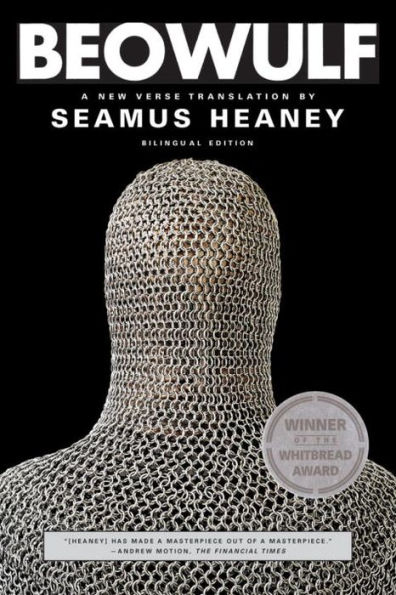
Beowulf: A New Verse Translation

( 59 )

Pick Up in Store

Reserve and pick up in 60 minutes at your local store

Paperback (Bilingual Edition)
$10.98
BN.com price
$13.95 List Price (Save 21%)
Marketplace (New and Used)
from
$2.98
$13.95 List Price (Save 79%)
Usually ships within 1-2 business days
All (87)  
Used (69)  
New (18)  
Close
Sort by
Page 1 of 9
Showing 1 – 10 of 87 (9 pages)
$2.98
(Save 79%)
Seller since 2009

Feedback rating:

(4400)

Condition:

New — never opened or used in original packaging.

Like New — packaging may have been opened. A "Like New" item is suitable to give as a gift.

Very Good — may have minor signs of wear on packaging but item works perfectly and has no damage.

Good — item is in good condition but packaging may have signs of shelf wear/aging or torn packaging. All specific defects should be noted in the Comments section associated with each item.

Acceptable — item is in working order but may show signs of wear such as scratches or torn packaging. All specific defects should be noted in the Comments section associated with each item.

Used — An item that has been opened and may show signs of wear. All specific defects should be noted in the Comments section associated with each item.

Refurbished — A used item that has been renewed or updated and verified to be in proper working condition. Not necessarily completed by the original manufacturer.

Good
Has some writing. Markings inside cover. Slight cover wear. Ships the next business day, with tracking and delivery confirmation sent to your email.

Ships from: Beaverton, OR

Usually ships in 1-2 business days

  • Standard, 48 States
  • Standard (AK, HI)
  • Express, 48 States
  • Express (AK, HI)
$2.99
(Save 79%)
Seller since 2009

Feedback rating:

(2166)

Condition: Good
SOME HIGHLIGHTING AND PRICE STICKER

Ships from: Columbia, MO

Usually ships in 1-2 business days

  • Standard, 48 States
  • Standard (AK, HI)
  • Express, 48 States
  • Express (AK, HI)
$3.45
(Save 75%)
Seller since 2002

Feedback rating:

(10019)

Condition: Good
May include moderately worn cover, writing, markings or slight discoloration. SKU:9780393320978-4-0

Ships from: Salem, OR

Usually ships in 1-2 business days

  • Canadian
  • International
  • Standard, 48 States
  • Standard (AK, HI)
  • Express, 48 States
  • Express (AK, HI)
$3.60
(Save 74%)
Seller since 2002

Feedback rating:

(10019)

Condition: Very Good
Has minor wear and/or markings. SKU:9780393320978-3-0

Ships from: Salem, OR

Usually ships in 1-2 business days

  • Canadian
  • International
  • Standard, 48 States
  • Standard (AK, HI)
  • Express, 48 States
  • Express (AK, HI)
$3.62
(Save 74%)
Seller since 2008

Feedback rating:

(672)

Condition: Acceptable
0393320979 This is a used item.

Ships from: Cortland, NY

Usually ships in 1-2 business days

  • Standard, 48 States
  • Standard (AK, HI)
  • Express, 48 States
  • Express (AK, HI)
$3.68
(Save 74%)
Seller since 2012

Feedback rating:

(159)

Condition: Good
Ships within 24 hrs of your order. Open Mon - Fri. Good condition books have minimal highlighting, minimal wear and tear.

Ships from: Downingtown, PA

Usually ships in 1-2 business days

  • Standard, 48 States
  • Standard (AK, HI)
  • Express, 48 States
  • Express (AK, HI)
$3.68
(Save 74%)
Seller since 2012

Feedback rating:

(159)

Condition: Very Good
Ships within 24 hrs of your order. Open Mon - Fri. Very Good book. 95% clean with no wear and tear.

Ships from: Downingtown, PA

Usually ships in 1-2 business days

  • Standard, 48 States
  • Standard (AK, HI)
  • Express, 48 States
  • Express (AK, HI)
$3.96
(Save 72%)
Seller since 2009

Feedback rating:

(22263)

Condition: Good
Giving great service since 2004: Buy from the Best! 4,000,000 items shipped to delighted customers. We have 1,000,000 unique items ready to ship! Find your Great Buy today!

Ships from: Lakewood, WA

Usually ships in 1-2 business days

  • Canadian
  • International
  • Standard, 48 States
  • Standard (AK, HI)
  • Express, 48 States
  • Express (AK, HI)
$3.99
(Save 71%)
Seller since 2007

Feedback rating:

(6610)

Condition: Good
Good 0393320979 Visible shelf wear--may have some notes/markings on pages.

Ships from: San Leandro, CA

Usually ships in 1-2 business days

  • Canadian
  • International
  • Standard, 48 States
  • Standard (AK, HI)
  • Express, 48 States
  • Express (AK, HI)
$3.99
(Save 71%)
Seller since 2009

Feedback rating:

(227)

Condition: Good
2001 Paperback Good Used book with normal wear and tear and may contain writing. Stock photo may be different from actual book cover.

Ships from: Englewood, CO

Usually ships in 1-2 business days

  • Canadian
  • International
  • Standard, 48 States
  • Standard (AK, HI)
  • Express, 48 States
  • Express (AK, HI)
Page 1 of 9
Showing 1 – 10 of 87 (9 pages)
Close
Sort by
NOOK Book (eBook - Bilingual Edition)
$9.99
BN.com price
$13.95 List Price (Save 28%)

Available on NOOK devices and apps

  • Nook Devices
  • NOOK
  • NOOK Color
  • NOOK Tablet
  • Tablet/Phone
  • NOOK for iPad
  • NOOK for iPhone
  • NOOK for Android
  • NOOK for Android (Tablet)
  • NOOK Kids for iPad
  • PC/Mac
  • NOOK Study
  • NOOK for PC
  • NOOK for Mac

Need a NOOK? Explore Now

Overview

A brilliant and faithful rendering of the Anglo-Saxon epic from the Nobel laureate.

Composed toward the end of the first millennium of our era, Beowulf is the elegiac narrative of the adventures of Beowulf, a Scandinavian hero who saves the Danes from the seemingly invincible monster Grendel and, later, from Grendel's mother. He then returns to his own country and dies in old age in a vivid fight against a dragon. The poem is about encountering the monstrous, defeating it, and then having to live on in the exhausted aftermath. In the contours of this story, at once remote and uncannily familiar at the end of the twentieth century, Seamus Heaney finds a resonance that summons power to the poetry from deep beneath its surface.

Drawn to what he has called the "four-squareness of the utterance" in Beowulf and its immense emotional credibility, Heaney gives these epic qualities new and convincing reality for the contemporary reader.

Voted the Whitbread book of the year.

Editorial Reviews

From Barnes & Noble
Who's Afraid of Beowulf?

Seamus Heaney, recipient of the Nobel Prize in Literature and considered by many to be the greatest living poet writing in English, has produced a new work that will be one of the most significant literary events of the year. This meditation on fame, blood feuds, and the culture of war, already awarded the Whitbread Prize for poetry and named the Whitbread Book of the Year, addresses some of the most important issues of our world at the turn of the millennium. The trouble is, it was written in the first millennium, more than a thousand years ago: Heaney's latest offering is not a collection of original poems or essays, but a modern English verse translation of that greatest of heroic epics, Beowulf.

Heaney's project is to save Beowulf and what he calls its status as a work of "the greatest imaginative vitality" from the tedium of required English courses in high schools and universities. Because of its arcane language, this gripping and beautifully wrought story is largely impenetrable to modern audiences. What's more, just as Beowulf's language and structure paved the way for modern English and its literary devices, its themes of fame and warrior cultures can tell us a lot about the world we now inhabit, where fame is viewed as perhaps the only thing worth achieving, and intractable ethnic conflicts wreak havoc on humankind. Some things never change -- or, as Heaney puts it, BEOWULF "lives in its own continuous present, equal to our knowledge of reality in the present time."

The tale is simple, and yet complex in its telling. It is composed of three main sections that center on a mortal battle: Beowulf's fight with Grendel the monster in the hall of a Danish king; his underwater battle with Grendel's mother, who is bent on revenge; and, finally, 50 years later, Beowulf's death at the hands of a third monster, a dragon accidentally awakened in Beowulf's own kingdom. Each sequence, narrated by an anonymous speaker who is familiar with the customs and laws of the Scandinavian people who make up the epic's characters, follows a similar pattern. First, there is a suspense-producing buildup in which the monster makes its presence known and begins its rampage; then, Beowulf's arrival on the scene and the ensuing battle to the death; and lastly a taking of stock -- in the first two cases, a celebration of the monster's defeat, and in the final sequence, in which the dragon is killed at the cost of Beowulf's life, a period of mourning. Interwoven with these main tales are many diversionary stories, and a series of pronouncements that define the role of the hero and the ethics of war, friendship, and death.

As in Homer, certain powerful phrases and titles, such as "Hrothgar the ring-giver," recur throughout the epic, lending it a comforting and rhythmic certainty. Heaney has divined an odd and mannered lyricism in the Old English and reproduced it in a fresh and compelling way in our own familiar tongue. In his introduction, Heaney speaks of the respect he had as a child for the plain and solemn voices of his father's Northern Irish relatives and how he wanted his translation "to be speakable by one of those relatives." It is filled with simple and direct turns of phrase, such as the final sentence of a list of the virtues of Shield Sheafson, a Danish warrior-king: "That was one good king."

Heaney's next accomplishment is that he remains faithful to Beowulf's confusing structure without losing the thread of the story. The main narrator often gives way to speeches by his characters, who will tell similar (but unrelated) stories of other great warriors. Through these digressions the setting develops, as do its surrounding ethical framework and dramatizing rituals, lending a deeper symbolic meaning to the archetypal actions of its great hero. Poets and bards occasionally appear to sing of more heroic deeds, and, in another instance of this ancient tale's surprising relevance for modern readers, the speaker argues for the descriptive powers of these poets in a self-referential manner that seems positively postmodern.

Heaney has provided a rich and original translation of Beowulf that should dispel once and for all the "rumor" that it is a boring, repetitive tale filled with unpronounceable names. His new offering is vivid and at times breathtaking; it renews the timeless drama of an often-misunderstood epic.

—Jake Kreilkamp

Keith Phipps
It's strange and unexpected, but also appropriate and heartening, that Beowulf ground zero for literature in English--would become a bestseller at the dawn of the 21st century. Why becomes less of a mystery after even a quick glance at this extraordinary translation by Seamus Heaney. A work of great grace, Heaney's translation captures the sense of Old English poetry without adhering slavishly to its rules; when possible, he retains the alliteration and caesuras but never bends his voice to suit them. The result is a Beowulf of rough elegance and emotional directness rendered in a voice both ancient and familiar. Heaney needs these qualities: Anyone who takes up the task of translating Beowulf inherits not just Grendel and the dragon, but also long, occasionally cryptic passages of more mundane activities. James Joyce once said of Ulysses that if Dublin were ever destroyed, he hoped it could be rebuilt from his descriptions. So it is with Beowulf, not in a physical sense but a cultural one. Heaney understands and is consistently capable of conveying the subtle ideals and ethical codes embedded in the poem alongside its famous blood and gore. But, aside from Heaney's skill as a translator, why is Beowulf striking a chord now? The threat of a demon at the door may no longer have the immediacy it did for Beowulf's original audience, but if the past century proved anything, it's that the fabric of civilization, however tightly bound by honor and blood, can be torn asunder at any moment. As a slathering beast of flesh and blood, Grendel may seem a relic of centuries past, but as a symbol, he hasn't lost a bit of power. Heaney writes in his introduction that part of what allowed him, as an Irishman, to overcome the inherent Englishness of the poem was its overwhelming, universal melancholy, which also can't be factored out when calculating Beowulf's continued appeal: The inescapability of death and the transience of all things permeates it from its first lines to its conclusion. The work of a culture deeply concerned with these issues, rewritten by a poet working within a culture caught up in immediate pleasures and uncomfortable reflecting on final things, Heaney's Beowulf has an added resonance. In his hands, the past becomes immediate, and what it knew reads as inherited wisdom. From a famous early passage detailing the funeral of a king set adrift at sea: "No man can tell / no wise man in hall or weathered veteran / knows for certain who salvaged that load".
The Onion A.V. Club
From The Critics
When the great monster Grendel comes to Denmark and dashes its warriors' hopes, installing himself in their great hall and eating alive the valiant lords, the hero Beowulf arrives from over the ocean to wrestle the beast. He saves the Danes, who sing of his triumphs, but soon the monster's mother turns up to take him hostage: having killed her, our hero goes home to the land of the Geats, acquires the kingship, and fights to the death an enormous dragon. That's the plot of this narrative poem, composed more than a millennium ago in the Germanic language that gave birth (eventually) to our version of English. Long a thing for professors to gloss, the poem includes battles, aggressive boasts, glorious funerals, frightening creatures and a much-studied alliterative meter; earlier versions in current vernacular have pleased lay readers and helped hard-pressed students. Nobel laureate Heaney has brought forth a finely wrought, controversial (for having won a prize over a children's book) modern English version, one which retains, even recommends, the archaic strengths of its warrior world, where "The Spear-Danes in days gone by/ and the kings who ruled them had courage and greatness." Well-known digressions--a detailed dirge, the tale-within-a-tale of Hengest, "homesick and helpless" in ancient Friesland--find their ways into Heaney's English, which holds to the spirit (not always the letter) of the en face Anglo-Saxon, fusing swift story and seamless description, numinous adjectives and earthy nouns: in one swift scene of difficult swimming, "Shoulder to shoulder, we struggled on/ for five nights, until the long flow/ and pitch of the waves, the perishing cold drove us apart. The deep boiled up/ and its wallowing sent the sea-brutes wild." Heaney's evocative introduction voices his long-felt attraction to the poem's "melancholy fortitude," describing the decades his rendering took and the use he discovered for dialect terms. It extends in dramatic fashion Heaney's long-term archeological delvings, his dig into the origins of his beloved, conflicted--by politics and place--English language. (Feb.) Copyright 2000 Cahners Business Information.|

Product Details

  • ISBN-13: 9780393320978
  • Publisher: Norton, W. W. & Company, Inc.
  • Publication date: 2/28/2001
  • Edition description: Bilingual Edition
  • Pages: 256
  • Sales rank: 1,433
  • Lexile: 1090L (what's this?)
  • Series: Critical Editions Series
  • Product dimensions: 6.10 (w) x 8.30 (h) x 0.70 (d)

Meet the Author

Seamus Heaney lives in Dublin and teaches at Harvard University. He received the Nobel Prize in Literature in 1995. His most recent book of poems is Opened Ground (FSG, 1998).

Read an Excerpt


Chapter One

So. The Spear-Danes in days gone by
and the kings who ruled them had courage and greatness.
We have heard of those princes' heroic campaigns.
There was Shield Sheafson, scourge of many tribes,
a wrecker of mead-benches, rampaging among foes.
This terror of the hall-troops had come far.
A foundling to start with, he would flourish later on
as his powers waxed and his worth was proved.
In the end each clan on the outlying coasts
beyond the whale-road had to yield to him
and begin to pay tribute. That was one good king.
Afterwards a boy-child was born to Shield,
a cub in the yard, a comfort sent
by God to that nation. He knew what they had tholed,
the long times and troubles they'd come through
without a leader; so the Lord of Life,
the glorious Almighty, made this man renowned.
Shield had fathered a famous son:
Beow's name was known through the north.
And a young prince must be prudent like that,
giving freely while his father lives
so that afterwards in age when fighting starts
steadfast companions will stand by him
and hold the line. Behaviour that's admired
is the path to power among people everywhere.
Shield was still thriving when his time came
and he crossed over into the Lord's keeping.
His warrior band did what he bade them
when he laid down the law among the Danes:
they shouldered him out to the sea's flood,
the chief they revered who had long ruled them.
A ring-whorled prow rode in theharbour,
ice-clad, outbound, a craft for a prince.
They stretched their beloved lord in his boat,
laid out by the mast, amidships,
the great ring-giver. Far-fetched treasures
were piled upon him, and precious gear
I never heard before of a ship so well furbished
with battle tackle, bladed weapons
and coats of mail. The massed treasure
was loaded on top of him: it would travel far
on out into the ocean's sway.
They decked his body no less bountifully
with offerings than those first ones did
who cast him away when he was a child
and launched him alone out over the waves.
And they set a gold standard up
high above his head and let him drift
to wind and tide, bewailing him
and mourning their loss. No man can tell,
no wise man in hall or weathered veteran
knows for certain who salvaged that load.
Then it fell to Beow to keep the forts.
He was well regarded and ruled the Danes
for a long time after his father took leave
of his life on earth. And then his heir,
the great Halfdane, held sway
for as long as he lived, their elder and warlord.
He was four times a father, this fighter prince:
one by one they entered the world,
Heorogar, Hrothgar, the good Halga
and a daughter, I have heard, who was Onela's queen,
a balm in bed to the battle-scarred Swede.
The fortunes of war favoured Hrothgar.
Friends and kinsmen flocked to his ranks,
young followers, a force that grew
to be a mighty army. So his mind turned
to hall-building: he handed down orders
for men to work on a great mead-hall
meant to be a wonder of the world forever;
it would be his throne-room and there he would dispense
his God-given goods to young and old—but
not the common land or people's lives.
Far and wide through the world, I have heard,
orders for work to adorn that wallstead
were sent to many peoples. And soon it stood there,
finished and ready, in full view,
the hall of halls. Heorot was the name
he had settled on it, whose utterance was law.
Nor did he renege, but doled out rings
and torques at the table. The hall towered,
its gables wide and high and awaiting
a barbarous burning. That doom abided,
but in time it would come: the killer instinct
unleashed among in-laws, the blood-lust rampant.

(Continues...)

Table of Contents

Introduction ix
A Note on Names xxxi
Beowulf 2
Family Trees 217
Acknowledgements 219
Customer Reviews
Average Rating 4
( 59 )

Rating Distribution

If you've bought this product, tell the world how you liked it.
Write a Review
See All Sort by: Showing 1 – 20 of 68 Customer Reviews
  • Anonymous

    Posted September 17, 2004

    Finally!

    Ok, as an English Lit. major in school, I've had my share of Beowulf, most of which are horridly translated drivel. The fine line with Anglo-Saxon poetry (and any translated poetry for that matter) is there requires a balance between fidelity to the text, and fidelity to the ideas of the text; that is to say, where literal translation may be more 'accurate' in a completely logical and scientific sense, the poetic beauty and proper notions behind the text must also be upheld. Heaney finds the middle ground so commonly lost in modern translations. The Anglo-Saxon poetry of Beowulf is so beautiful and easy on the ears when read in the original Anglo-Saxon--a sense of bold and strong verse, but with the grace and beauty--reflected in Beowulf and especially in the Wurm. This is frequently translated into modern english as grossly (what I would call) 'harsh' and 'grating' verse, with all the punch that it requires, but without the languid fluiditiy required to fully appreciate the epic. Seamus Heaney finds the perfect balance between the two, not addressing the 'bone-crunching Beowulf' as a solely heartless character, but finding the section of the modern english language (that lost area right in the middle of form and function) and giving us this gift. A MUST have for anyone wishing to appreicate the beauty of Germanic poetry. My recomendation: have someone read it aloud to you; it adds SO much to the experience!

    2 out of 2 people found this review helpful.

    Was this review helpful? Yes  No   Report this review
  • Posted September 21, 2011

    Confused

    Me and my friend Taylor both bought this book on our nook colors and it says it only has 102 pages. We both know it has more pages so we are completely confused. Can anyonne helps us out with this dillema?!?!

    1 out of 2 people found this review helpful.

    Was this review helpful? Yes  No   Report this review
  • Anonymous

    Posted August 7, 2011

    Smart Read! It'd be horrible not to check it out!!

    From a town living in fear to a hero saving the day in less than a week, Beowulf was a novel of much action and excitement. This is a wonderful read and something that people will be reading for years to come and it will never lose its popularity because of the writing style and literature to remember. Beowulf is a story in which the town of Heorot is threatened by this horrible creature Grendel who wreaks havoc on innocent people when the sun goes down. Then this hero Beowulf, son of Ecgtheow, hears about the cries for help from Heorot and decides to rake up his men and drive their boat over there to defeat this malevolent villain. When they get to the town and spend a night there they hear Grendel in the castle. Through a battle between two opposing forces Beowulf defeats the hated monster so the town can live in peace. During this part of the book the author, Seamus Heaney, does a wonderful job of giving imagery of the fight so the reader can actually feel apart of what is going on and how Beowulf is feeling throughout all this. Heaney also does a good job of getting into the character's minds to show how they are feeling. Then when everyone thinks his or her hometown will be happy once again the mother of Grendel comes to avenge her son. Beowulf and the angered mother face an even more difficult battle when Beowulf emerges his powers and wins for Heorot once again, but this time beheading the hated Grendel as a trophy for the town to praise. I think this was the most important part of the book because it gave great peace to the town living in torture once and for all and everyone was granted the serenity of feeling safe. When Beowulf returns to his home of Geatland the people hear of his leadership and victory that they make him king when the old king Hygelac passes away. Beowulf made the land full of prosper and safety until he is old and faced with another challenge. A thief has come to his home of Geatland and hordes treasure protected by a frightening dragon. The rest of the book is just as amazing as the first parts and anyone would be wrong to not read this. In my opinion this book was highly entertaining. I also thought that for this being such an old book that it is impeccable to be so popular and liked that people are even wanting to read it in today's day and age of technology taking over.

    1 out of 1 people found this review helpful.

    Was this review helpful? Yes  No   Report this review
  • Posted October 28, 2008

    more from this reviewer

    I Also Recommend:

    Anglo Saxon Literature

    In my class on Anglo-Saxon (the language), we basically translated this the whole semester. It wais such a hard class! I was one of two undergraduates, the rest were grad students. My biggest problem with the language is that it was never standardized. So even with a big Anglo-Saxon dictionary there's no telling if you'll find what you're looking for due to all the spelling variations.

    Anyway, I've read Beowulf (in Modern English) many times, starting in 8th grade advanced english. It is a great epic, originally pagan though there are interpolations from Christian editors. It gives one a really great glimpse at the society it depicts, and if you compare it to the archaeological evidence you a nearly complete picture. Highly reccomended for anyone who likes epic poetry, modern fantasy genre, and of course, pre-literate germanic and scandinavian peoples.

    1 out of 1 people found this review helpful.

    Was this review helpful? Yes  No   Report this review
  • Anonymous

    Posted May 3, 2006

    Awesome

    'I was asked to read this book in 7th grade and it didn't sound at all interesting to me but when I started reading the book I loved it so much, I couldn't put the book down.

    1 out of 1 people found this review helpful.

    Was this review helpful? Yes  No   Report this review
  • Anonymous

    Posted October 3, 2005

    Wonderfully Written

    I had to read this book for school, and it sounded really uninteresting to me. But as I began to read it, I could not put it down. It is so captivating. This is by far the best epic I've ever read. It has such a good story line.

    1 out of 1 people found this review helpful.

    Was this review helpful? Yes  No   Report this review
  • Anonymous

    Posted February 18, 2002

    It's epic

    I like the way this book was produced. It maded the story move faster since all you have to do is read the right pages. The pages on the right side, of course. All joking aside, this is the Epic Beowulf in it's entire form.

    1 out of 1 people found this review helpful.

    Was this review helpful? Yes  No   Report this review
  • Anonymous

    Posted November 24, 2001

    Beowulfs Adventures

    This book was outstanding and brilliant. i loved it. the choice of words that Hearney used are just beautiful and so insiteful. i have read many versions of Beowulf but this one was the best!

    1 out of 1 people found this review helpful.

    Was this review helpful? Yes  No   Report this review
  • Anonymous

    Posted January 6, 2012

    Good

    I enjoyed this work of art. It is considered an epic poem. I enjoyed the action and that it was set in olden days. I had to read this for Literature and now I enjoy just reading it for pleasure.

    Was this review helpful? Yes  No   Report this review
  • Anonymous

    Posted October 30, 2011

    Excellent

    Wonderful translation

    Was this review helpful? Yes  No   Report this review
  • Anonymous

    Posted October 28, 2011

    Best Epic Poem ever written

    Beowulf is a story that will never be forgotten and will last forever. Not one person could read it and not be in awe of the power of one man. The author of this book is unknown still to this day but it is known that it was written by an Anglo-Saxon in medieval English times. This book is an epic poem and Beowulf himself is the epic hero in that poem. The main theme of Beowulf is good vs. evil. Beowulf battles many powerful enemies whom are all evil.
    The main point of the story is Beowulf battling many powerful foes with his awesome strength. The book starts with Grendel, the spawn of Cain, killing people in the hall of Herot. Beowulf, wanting glory, hears this and travels to the land of the Danes to battle Grendel. He two battle and Beowulf is victorious. The Danes applaud and praise Beowulf for his strength and bravery. After Beowulf leaves back to the land of the Geats, Grendel's mother begins to terrorize Herot once again. Beowulf returns to defeat her and once again emerges victorious. Herot is now safe once again. Beowulf returns to his homeland and rules as its king for 50 years. A dragon appears and begins to wreak havoc among Beowulf's people and he fights for glory one last time. The dragon is slain with the help of Wyglaf, one of Beowulf's men. Beowulf, however, was mortally wounded and passes. The story ends with Beowulf's funeral pyre.
    This was one of the best books I have ever read. The detail and action in this book is astounding. Reading it puts you right in the middle of all the action and keeps you reading to see what will happen next. I recommend this book to anyone who likes stories of great heroes.

    Was this review helpful? Yes  No   Report this review
  • Posted October 16, 2011

    Awesome

    This book is way easier to understand than the Barnes and Noble edition. Great translator!

    Was this review helpful? Yes  No   Report this review
  • Posted September 17, 2011

    good news

    Get a free $5.00 discount code in BN Books! Get in website: loveBN.tk

    Was this review helpful? Yes  No   Report this review
  • Posted June 29, 2011

    more from this reviewer

    Amazing

    "They said that of all the kings upon the earth/he was the man most gracious and fair-minded,/kindest to his people and keenest to win fame." Ending Lines 3180 - 3182

    Awesome. Absolutely Unequalled in its excellence.

    Was this review helpful? Yes  No   Report this review
  • Posted January 31, 2011

    great.

    if only it had verse #.

    Was this review helpful? Yes  No   Report this review
  • Posted January 30, 2011

    more from this reviewer

    Beowulf

    The heroic tale of the warrior Beowulf and his fights against three monters. A "modern" translation of the Old English poem, it was very easy to understand. The translation flowed smoothly for the most part, and was easy to follow and really get into the story. The only complaint I have, is that there were times the rhythm seemed a bit off and it pulled me out of the story.

    4/5

    Was this review helpful? Yes  No   Report this review
  • Posted September 21, 2009

    more from this reviewer

    Beowulf.

    I wouldn't recommend this book to an indivudal, but rather to and English class. The language was good, and so was the plot, but the endless list of characters and their histories can be overwhleming at times.

    0 out of 1 people found this review helpful.

    Was this review helpful? Yes  No   Report this review
  • Posted September 15, 2009

    more from this reviewer

    English class 12

    I had to read this for English class...and it is what it is. It's a story about a hero, one we all can predict. The fact that it's such an old tale is fascinating, but I prefer newer literature, because we've grown as a culture, so it's good to mature as we move on...not live in the past stories of yesterday. It's a good read because of its name, but other than that...blah.

    0 out of 3 people found this review helpful.

    Was this review helpful? Yes  No   Report this review
  • Anonymous

    Posted September 5, 2005

    Who'd a thought...

    So it was summer before my senior year and I was asked to read this book as an assignment. Little did I know that I would deep down admire it! The epic poem has like a saga of its own as well as an awesome backstory!!

    Was this review helpful? Yes  No   Report this review
  • Anonymous

    Posted October 13, 2003

    A masterpiece

    A poetic word-wrenching piece that captivates you from the first page. Gives the heros view on the struggle with his monster. The book is catching the readers interest with a well written language. By the way has the danish king´s court been found(earliest remains from year 0)with a chalice from the 500 c. The king is residing in Scedenige or Scedeland. The oldest reconstructed name for Skåne is *Skadin-aujo(damage-island). Around 600 c it was probably Skadiney, in the viking-age Skáney. That Skadiney, Skadinland becomes Scedenige or Scedeland are matching the difference between west-germanic and ancient scandinavian in re-sound and sch-sound. The danes are called 'dene' and the anglians 'engle'. The countryside around Gullåkra has long been haunted until 19th c by a ghost woman who appeared in a fur cape. Once upon a time she had been beheaded for a crime she had committed. See more on: http://www.expage.com/uppakra

    0 out of 1 people found this review helpful.

    Was this review helpful? Yes  No   Report this review
See All Sort by: Showing 1 – 20 of 68 Customer Reviews

If you find inappropriate content, please report it to Barnes & Noble
Why is this product inappropriate?
Comments (optional)
500 character limit