- Shopping Bag ( 0 items )
-
All (114) from $1.99
-
New (26) from $5.97
-
Used (88) from $1.99
More About This Textbook
Overview
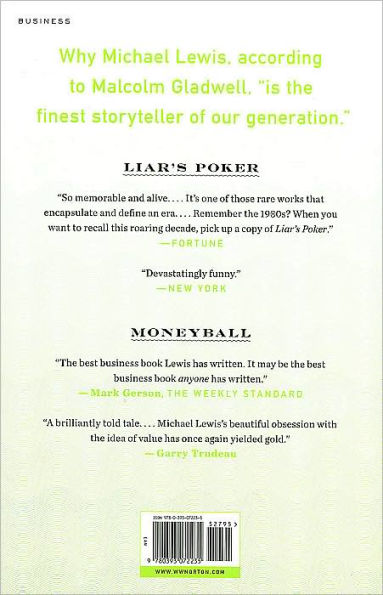
Why Michael Lewis, according to Malcolm Gladwell, “is the finest storyteller of our generation”:
Liar’s Poker
“So memorable and alive. . . . It’s one of those rare works that encapsulate and define an era. . . . Remember the 1980s? When you want to recall this roaring decade, pick up a copy of Liar’s Poker.” —Fortune
“Devastatingly funny.” —New York
Moneyball
“The best business book Lewis has written. It may be the best business book anyone has written.” —Mark Gerson, The Weekly Standard
“A brilliantly told tale. . . . Michael Lewis’s beautiful obsession with the idea of value has once again yielded gold.” —Garry Trudeau
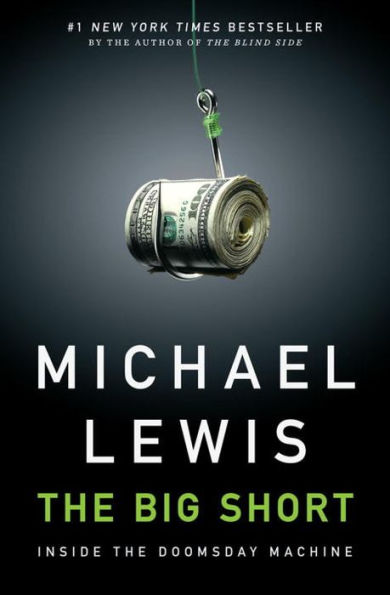
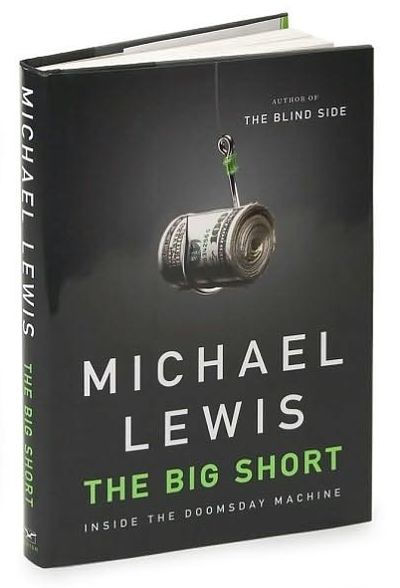
The Big Short
Editorial Reviews
From Barnes & Noble
Unfortunately, truth frequently outflanks fiction. The most glaring recent of that is, of course, the Recession of 2007-2008, a catastrophic domino-fall set in motion by the actions (and conspicuous inactions) of an embarrassing number of players and regulators. In The Big Short, Moneyball author Michael Lewis tracks these long-festering events with precise details and macabre wit, revealing how self-serving myopia and naked greed fueled the most catastrophic economic crisis since the Great Depression. A Barnes & Noble Bestseller in hardcover; now in paperback and NOOKbook.
Salon.com
Superb: Michael Lewis doing what he does best, illuminating the idiocy, madness and greed of modern finance. . . . Lewis achieves what I previously imagined impossible: He makes subprime sexy all over again.— Andrew LeonardThe New York Times
No one writes with more narrative panache about money and finance than Mr. Lewis....[he] does a nimble job of using his subjects’ stories to explicate the greed, idiocies and hypocrisies of a system notably lacking in grown-up supervision....Writing in faintly Tom Wolfe-ian prose, Mr. Lewis does a colorful job of introducing the lay reader to the Darwinian world of the bond market.— Michiko KakutaniVanity Fair
It is the work of our greatest financial journalist, at the top of his game. And it's essential reading.— Graydon CarterThe New York Times Book Review
[A] strikingly original take that offers an enhanced understanding of the debacle....Since his first book, Liar's Poker, Lewis has tackled big, engaging stories...by finding and developing characters whose personal narratives reveal a larger truth. He's done it again.— Daniel GrossLibrary Journal
Versatile best-selling author Lewis (Panic) gives a different take on the 2007-08 credit crisis as he chronicles how a handful of investment managers detected early on the growing bubble in the mortgage bond market and made fortunes betting against it. Lewis is a storyteller, and he weaves the personal stories of these renegades against the inner workings of Wall Street's mortgage-backed securities money machine. He explains in plain language how the industry obscured credit risk by packaging and repackaging low-quality subprime mortgages into complicated securities that could receive high credit ratings in a process he calls the financial alchemy equivalent of turning lead into gold. He says investors then looked at little more than the ratings as they bought billions of dollars' worth of these supposedly safe bonds. Lewis turns the crisis into a true financial thriller that screams of Wall Street's greed, recklessness, deceit, incompetence, and hubris. VERDICT Readers from generalists through specialists will find this fast-paced, engaging account both illuminating and disturbing. Highly recommended. [See Prepub Alert, LJ 11/1/09.]—Lawrence Maxted, Gannon Univ. Lib., Erie, PAMichiko Kakutani
No one writes with more narrative panache about money and finance than Mr. Lewis, the author of Liar's Poker, that now classic portrait of 1980s Wall Street. His entertaining new book does not attempt a macro view of the financial crisis, but instead proposes to open a small window on the calamities by recounting the stories of some savvy renegades who cashed in on their conviction that the system was rotten…Mr. Lewis does a nimble job of using his subjects' stories to explicate the greed, idiocies and hypocrisies of a system notably lacking in grown-up supervision, a system filled with firms that "disdained the need for government regulation in good times" but "insisted on being rescued by government in bad times."—The New York Times
Steven Pearlstein
If you read only one book about the causes of the recent financial crisis, let it be Michael Lewis's, The Big Short…What's so delightful about Lewis's writing is how deftly he explains and demystifies how things really work on Wall Street, even while creating a compelling narrative and introducing us to a cast of fascinating, all-too-human characters…The Big Short manages to give us the truest picture yet of what went wrong on Wall Street—and why. At times, it reads like a morality play, at other times like a modern-day farce. But as with any good play, its value lies in the way it reveals character and motive and explores the cultural context in which the plot unfolds.—The Washington Post
Daniel Gross
Since his first book, the autobiographical Liar’s Poker, Lewis has tackled big, engaging stories…by finding and developing characters whose personal narratives reveal a larger truth. He's done it again. The story of the crash is, overwhelmingly, a tale of failure. But Lewis managed to find quirky investors who minted fortunes by making unpopular, calculated bets on a financial meltdown. Ditching the aloof irony of his earliest works, he constructs a story that is funny, incisive, profanity-laced and illuminating—full of difficult-to-like underdogs whose vindication and enrichment we end up cheering.—The New York Times Book Review
Publishers Weekly
Although Lewis is perhaps best known for his sports-related nonfiction (including The Blind Side), his first book was the autobiographical Liar's Poker, in which he chronicled his disillusionment as a young gun on Wall Street in the “greed is good” 1980s. He returns to his financial roots to excavate the crisis of 2007-2008, employing his trademark technique of casting a microcosmic lens on the personal histories of several Wall Street outsiders who were betting against the grain—to shed light on the macrocosmic tale of greed and fear. Although Lewis reads the book's introduction, narration duties are assumed by Jesse Boggs, a veteran narrator of business titles (including Lewis's own 2008 book Panic!). Boggs's rich baritone is well suited to the task and trips lightly through a maze of financial jargon (CDOs, derivatives, mid-prime lending) and a dizzying cast of characters. Lewis returns on the final disc for a 10-minute interview about the crisis's aftermath, including a savvy assessment of the wisdom of the financial bailout and where-are-they-now updates on the book's various heroes and villains. A Norton hardcover. (Mar.)The Barnes & Noble Review
On January 30, 2007, Jamie Mai wrote an email to his partners Charlie Ledley and Ben Hockett. "If a broad range of CDO spreads starts to widen," he said, "it means that a material global financial clusterfuck is likely occurring."
On January 31, 2007, a broad range of CDO spreads started to widen, dramatically. The long-feared meltdown was upon us all -- not that most of us knew it, at the time -- and a very small number of investors was about to get paid out on the trade of their lifetimes. Mai, Ledley, and Hockett were part of that select group, whose tale is grippingly told by Michael Lewis in The Big Short.
The Big Short is not the story of the crisis, as the crisis is commonly understood. The failure of Lehman brothers and of Fannie Mae and Freddie Mac; the stock-market crash; the bail-out of Detroit; the fevered all-nighters pulled at Treasury and the New York Fed; the fears that the entire global financial system was on the brink of collapse -- little if any of that is in this book.
Instead, Lewis has found a different story -- one which he started mining for a spectacular cover story in the December 2007 issue of Portfolio magazine, and which has culminated in this book, over two years later. It's the story of what used to be called the "subprime crisis" before it metastasized into something much larger and more dangerous than that. And it's also, like all Michael Lewis tales, a human story, which takes us deep inside unique characters like Steve Eisman and Mike Burry.
On the face of it, there's almost nothing sympathetic about these men. Their social skills are all but nonexistent; they live in a world of arcane financial analysis which might as well be a different planet for all that it has any bearing on the way that most of us live our lives; and they made their outsize profits by wagering hundreds of millions of dollars on the proposition that Americans across the country would end up being thrown out of their homes after they found themselves unable to make their mortgage payments.
What these men did was not "socially useless," to quote the chairman of the UK's Financial Services Authority, Lord Turner. It was worse than that: it was actively harmful, since they provided the fuel which kept the subprime mortgage furnace burning even when the country was running out of new junk mortgages to write. In most financial markets, bearish bets act as a dampener; in this one, they were a necessary part of the subprime-mortgage machine, and a Deutsche Bank mortgage trader named Greg Lippmann ended up making billions of dollars for his employer -- not to mention a $50 million bonus for himself -- by aggressively going out and finding fund managers to put on the short bets needed to keep the market ticking. (This is the same Lippmann who, when accused of being a "Chicken Little" responded by saying "Fuck you, I'm short your house.")
But Lewis has a soft spot for these misfits -- fund managers who stumbled into the bond market from careers making bets on stocks, who suffered ridicule and ostracism even from their own investors before their bets paid off, and who he has now chosen to immortalize in print as the few clear-eyed men in a world of deluded bankers and investors.
At the same time, Lewis aims both barrels at the ratings agencies, happily quoting someone describing the staff there as "basically like brain-dead." He also sets up a hapless fund manager named Wing Chau as a major villain for taking the long side of the bet and making millions of dollars by doing so, despite being spectacularly wrong.
The result is a rollicking narrative: a tale of beleaguered little guys betting against monster banks and fund managers, and, in the end, winning. (Lewis barely mentions the biggest and most famous of the shorts, John Paulson and Andrew Lahde, perhaps because they were too rich and successful to begin with.)
Amazingly, despite the fact that the book is so one-sided, it also functions as a peerless guide to exactly what went so very wrong in the credit markets generally, and the mortgage markets in particular, over the course of the last decade. It's not easy to explain synthetic subprime-backed collateralized debt obligations, but Lewis does an excellent job on both the micro level -- what these thing are, and how they worked -- and the macro level -- how the market in such exotica helped to destabilize the entire financial system.
Most impressively, Lewis has backed up his story with an enormous amount of old-fashioned reporting, spending a lot of time with the characters in his book and their families, as well as getting the important complex financial details correct. (Not everybody will understand the grittiest of the details, of course: that's inevitable. But everybody will be gripped by the book's narrative, all the same.) The Portfolio story on which this book is based was a great tale which was sometimes a bit fuzzy on the finance; the book is an even greater tale with the facts nailed down.
The result is that rarest of beasts in a world drowning in financial-crisis books: a new book which actually breaks news. For instance, Lewis uncovers what could possibly be the single greatest trade that any Wall Street banker ever made: in December 2006 and January 2007, Deutsche's Greg Lippmann paid an insurance premium of 0.28 percentage points to take out insurance on $4 billion of triple-A-rated bonds from Morgan Stanley's Howie Hubler. Less than a year later, that $11 million bet paid off to the tune of a whopping $3.7 billion. I'll save you the math: that's an annual return of more than 33,000%.
There's lots more where that came from: this is an assiduously-reported and beautifully-written book. There aren't many reasons to be happy about the global financial crisis, but here's one: that it brought Michael Lewis back to his roots, to produce what is probably the single best piece of financial journalism ever written.
-Felix Salmon
Product Details
Related Subjects
Meet the Author
Michael Lewis, the best-selling author of Liar’s Poker, The Money Culture, The New New Thing, Moneyball, The Blind Side, Panic, Home Game, The Big Short, and Boomerang, among other works, lives in Berkeley, California, with his wife and three children.
Biography
Twenty-four year-old Princeton graduate Michael Lewis had recently received his master's degree from the London School of Economics when Salomon Brothers hired him as a bond salesman in 1985. He moved to New York for training and witnessed firsthand the cutthroat, scruple-free culture that was Wall Street in the 1980s. Several months later, armed only with what he'd learned in training, Lewis returned to London and spent the next three years dispensing investment advice to Salomon's well-heeled clientele. He earned hundreds of thousands of dollars and survived a 1987 hostile takeover attempt at the firm. Nonetheless, he grew disillusioned with his job and left Salomon to write an account of his experiences in the industry. Published in 1989, Liar's Poker remains one of the best written and most perceptive chronicles of investment banking and the appalling excesses of an era.Since then, Lewis has found great success as a financial journalist and bestselling author. His nonfiction ranges over a variety of topics, including U.S./Japanese business relations (Pacific Rift), the 1996 presidential campaign (Trail Fever), Silicon Valley (The New New Thing), and the Internet boom (Next: The Future Just Happened). He investigated the economics of professional sports in Moneyball (2003) and The Blind Side (2006); and, in 2008, he edited Panic, an anthology of essays about the major financial crises of 1990s and early "oughts."
Good To Know
Michael Lewis attended Isidore Newman School in his native New Orleans, LA -- a private college prep school that counts among its more distinguished alumni historian Walter Isaacson, children's book author Mo Willems, singer Harry Connick, Jr., and famous pro-football siblings Peyton and Eli Manning.Table of Contents
Prologue Poltergeist xiii
Chapter 1 A Secret Origin Story 1
Chapter 2 In the Land of the Blind 26
Chapter 3 "How Can a Guy Who Can't Speak English Lie?" 61
Chapter 4 How to Harvest a Migrant Worker 85
Chapter 5 Accidental Capitalists 104
Chapter 6 Spider-Man at The Venetian 136
Chapter 7 The Great Treasure Hunt 160
Chapter 8 The Long Quiet 179
Chapter 9 A Death of Interest 200
Chapter 10 Two Men in a Boat 226
Epilogue Everything Is Correlated 253
Afterword 265
Acknowledgments 269
Index 271