Read an Excerpt
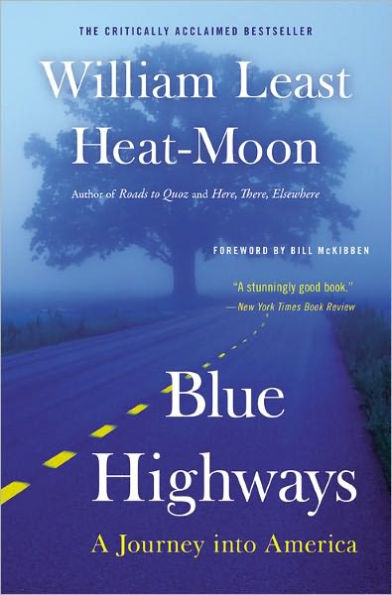
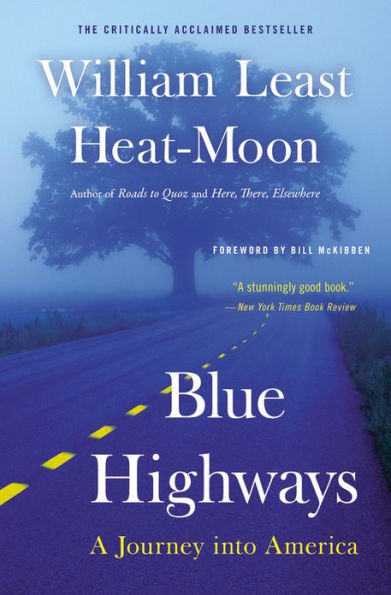
Blue Highways
A Journey into America
By William Least Heat-Moon, Bill McKibben Little, Brown and Company
Copyright © 1999 William Least Heat-Moon Bill McKibben
All rights reserved.
ISBN: 978-0-316-35329-8
CHAPTER 1
Eastward
1
Beware thoughts that come in the night. They aren't turned properly; they come in askew, free of sense and restriction, deriving from the most remote of sources. Take the idea of February 17, a day of canceled expectations, the day I learned my job teaching English was finished because of declining enrollment at the college, the day I called my wife from whom I'd been separated for nine months to give her the news, the day she let slip about her "friend"—Rick or Dick or Chick. Something like that.
That morning, before all the news started hitting the fan, Eddie Short Leaf, who worked a bottomland section of the Missouri River and plowed snow off campus sidewalks, told me if the deep cold didn't break soon the trees would freeze straight through and explode. Indeed.
That night, as I lay wondering whether I would get sleep or explosion, I got the idea instead. A man who couldn't make things go right could at least go. He could quit trying to get out of the way of life. Chuck routine. Live the real jeopardy of circumstance. It was a question of dignity.
The result: on March 19, the last night of winter, I again lay awake in the tangled bed, this time doubting the madness of just walking out on things, doubting the whole plan that would begin at daybreak—to set out on a long (equivalent to half the circumference of the earth), circular trip over the back roads of the United States. Following a circle would give a purpose—to come around again—where taking a straight line would not. And I was going to do it by living out of the back end of a truck. But how to begin a beginning?
A strange sound interrupted my tossing. I went to the window, the cold air against my eyes. At first I saw only starlight. Then they were there. Up in the March blackness, two entwined skeins of snow and blue geese honking north, an undulating W-shaped configuration across the deep sky, white bellies glowing eerily with the reflected light from town, necks stretched northward. Then another flock pulled by who knows what out of the south to breed and remake itself. A new season. Answer: begin by following spring as they did—darkly, with neck stuck out.
2
The vernal equinox came on gray and quiet, a curiously still morning not winter and not spring, as if the cycle paused. Because things go their own way, my daybreak departure turned to a morning departure, then to an afternoon departure. Finally, I climbed into the van, rolled down the window, looked a last time at the rented apartment. From a dead elm sparrow hawks used each year came a high whee as the nestlings squealed for more grub. I started the engine. When I returned a season from now—if I did return—those squabs would be gone from the nest.
Accompanied only by a small, gray spider crawling the dashboard (kill a spider and it will rain), I drove into the street, around the corner, through the intersection, over the bridge, onto the highway. I was heading toward those little towns that get on the map—if they get on at all—only because some cartographer has a blank space to fill: Remote, Oregon; Simplicity, Virginia; New Freedom, Pennsylvania; New Hope, Tennessee; Why, Arizona; Whynot, Mississippi. Igo, California (just down the road from Ono), here I come.
3
A pledge: I give this chapter to myself. When done with it, I will shut up about that topic.
Call me Least Heat-Moon. My father calls himself Heat-Moon, my elder brother Little Heat-Moon. I, coming last, am therefore Least. It has been a long lesson of a name to learn.
To the Siouan peoples, the Moon of Heat is the seventh month, a time also known as the Blood Moon—I think because of its dusky midsummer color.
I have other names: Buck, once a slur—never mind the predominant Anglo features. Also Bill Trogdon. The Christian names come from a grandfather eight generations back, one William Trogdon, an immigrant Lancashireman living in North Carolina, who was killed by the Tories for providing food to rebel patriots and thereby got his name in volume four of Makers of America. Yet to the red way of thinking, a man who makes peace with the new by destroying the old is not to be honored. So I hear.
One summer when Heat-Moon and I were walking the ancestral grounds of the Osage near the river of that name in western Missouri, we talked about bloodlines. He said, "Each of the people from anywhere, when you see in them far enough, you find red blood and a red heart. There's a hope."
Nevertheless, a mixed-blood—let his heart be where it may—is a contaminated man who will be trusted by neither red nor white. The attitude goes back to a long history of "perfidious" half-breeds, men who, by their nature, had to choose against one of their bloodlines. As for me, I will choose for heart, for spirit, but never will I choose for blood.
One last word about bloodlines. My wife, a woman of striking mixed-blood features, came from the Cherokee. Our battles, my Cherokee and I, we called the "Indian wars."
For these reasons I named my truck Ghost Dancing, a heavy-handed symbol alluding to ceremonies of the 1890s in which the Plains Indians, wearing cloth shirts they believed rendered them indestructible, danced for the return of warriors, bison, and the fervor of the old life that would sweep away the new. Ghost dances, desperate resurrection rituals, were the dying rattles of a people whose last defense was delusion—about all that remained to them in their futility.
A final detail: on the morning of my departure, I had seen thirty-eight Blood Moons, an age that carries its own madness and futility. With a nearly desperate sense of isolation and a growing suspicion that I lived in an alien land, I took to the open road in search of places where change did not mean ruin and where time and men and deeds connected.
4
The first highway: Interstate 70 eastbound out of Columbia, Missouri. The road here follows, more or less, the Booneslick Trail, the initial leg of the Oregon Trail; it also parallels both the southern latitude of the last great glacier in central Missouri as well as the northern boundary of the Osage Nation. The Cherokee and I had skirmished its length in Missouri and Illinois for ten years, and memory made for hard driving that first day of spring. But it was the fastest route east out of the homeland. When memory is too much, turn to the eye. So I watched particularities.
Item: a green and grainy and corrupted ice over the ponds.
Item: blackbirds, passing like storm-borne leaves, sweeping just above the treetops, moving as if invisibly tethered to one will.
Item: barn roofs painted VISIT ROCK CITY—SEE SEVEN STATES. Seven at one fell swoop. People loved it.
Item: uprooted fencerows of Osage orange (so-called hedge apples although they are in the mulberry family). The Osage made bows and war clubs from the limbs; the trunks, with a natural fungicide, carried the first telegraph lines; and roots furnished dye to make doughboy uniforms olive drab. Now the Osage orange were going so bigger tractors could work longer rows.
At High Hill, two boys were flying gaudy butterfly kites that pulled hard against their leashes. No strings, no flight. A town of surprising flatness on a single main street of turn-of-the-century buildings paralleling the interstate, High Hill sat golden in a piece of sunlight that broke through. No one moved along the street, and things held so still and old, the town looked like a museum diorama.
Eighty miles out, rain started popping the windshield, and the road became blobby headlights and green interstate signs for this exit, that exit. LAST EXIT TO ELSEWHERE. I crossed the Missouri River not far upstream from where Lewis and Clark on another wet spring afternoon set out for Mr. Jefferson's "terra incognita." Then, to the southeast under a glowing skullcap of fouled sky, lay St. Louis. I crossed the Mississippi as it carried its forty hourly tons of topsoil to the Louisiana delta.
The tumult of St. Louis behind, the Illinois superwide quiet but for the rain, I turned south onto state 4, a shortcut to I-64. After that, the 42,500 miles of straight and wide could lead to hell for all I cared; I was going to stay on the three million miles of bent and narrow rural American two-lane, the roads to Podunk and Toonerville. Into the sticks, the boondocks, the burgs, backwaters, jerkwaters, the wide-spots-in-the-road, the don't-blink-or-you'll-miss-it towns. Into those places where you say, "My god! What if you lived here!" The Middle of Nowhere.
The early darkness came on. My headlamps cut only a forty-foot trail through the rain, and the dashboard lights cast a spectral glowing. Sheet lightning behind the horizon of trees made the sky look like a great faded orange cloth being blown about; then darkness soaked up the light, and, for a moment, I was blinder than before.
In the approaching car beams, raindrops spattering the road became little beacons. I bent over the wheel to steer along the divider stripes. A frog, long-leggedy and green, belly-flopped across the road to the side where the puddles would be better. The land, still cold and wintery, was alive with creatures that trusted in the coming of spring.
On through Lebanon, a brick-street village where Charles Dickens spent a night in the Mermaid Inn; on down the Illinois roads—roads that leave you ill and annoyed, the joke went—all the way dodging chuckholes that Time magazine said Americans would spend 626 million dollars in extra fuel swerving around. Then onto I-64, a new interstate that cuts across southern Illinois and Indiana without going through a single town. If a world lay out there, it was far from me. On and on. Behind, only a red wash of taillights.
At Grayville, Illinois, on the Wabash River, I pulled up for the night on North Street and parked in front of the old picture show. The marquee said TRAVELOGUE TODAY, or it would have if the O's had been there. I should have gone to a cafe and struck up a conversation; instead I stumbled to the bunk in the back of my rig, undressed, zipped into the sleeping bag, and watched things go dark. I fought desolation and wrestled memories of the Indian wars.
First night on the road. I've read that fawns have no scent so that predators cannot track them down. For me, I heard the past snuffling about somewhere close.
5
The rain came again in the night and moved on east to leave a morning of cool overcast. In Well's Restaurant I said to a man whose cap told me what fertilizer he used, "You've got a clean little town here."
"Grayville's bigger than a whale, but the oil riggers get us a mite dirty around the ears," he said. "I've got no oil myself, not that I haven't drilled up a sieve." He jerked his thumb heavenward. "Gave me beans, but if I'da got my rightful druthers, I'da took oil." He adjusted his cap. "So what's your line?"
"Don't have one."
"How's that work?"
"It doesn't and isn't."
He grunted and went back to his coffee. The man took me for a bindlestiff. Next time I'd say I sold ventilated aluminum awnings or repaired long-rinse cycles on Whirlpools. Now my presence disturbed him. After the third tilt of his empty cup, he tried to make sense of me by asking where I was from and why I was so far from home. I hadn't traveled even three hundred miles yet. I told him I planned to drive around the country on the smallest roads I could find.
"Goddamn," he said, "if screwball things don't happen every day even in this town. The country's all alike now." On that second day of the new season, I guess I was his screwball thing.
Along the road: old snow hidden from the sun lay in sooty heaps, but the interstate ran clear of cinders and salt deposits, the culverts gushed with splash and slosh, and the streams, covering the low cornfields, filled the old soil with richness gathered in their meanderings.
Driving through the washed land in my small self-propelled box—a "wheel estate," a mechanic had called it—I felt clean and almost disentangled. I had what I needed for now, much of it stowed under the wooden bunk:
• 1 sleeping bag and blanket;
• 1 Coleman cooler (empty but for a can of chopped liver a friend had given me so there would always be something to eat);
• 1 Rubbermaid basin and a plastic gallon jug (the sink);
• 1 Sears, Roebuck portable toilet;
• 1 Optimus 8R white gas cook stove (hardly bigger than a can of beans);
• 1 knapsack of utensils, a pot, a skillet;
• 1 U.S. Navy seabag of clothes;
• 1 tool kit;
• 1 satchel of notebooks, pens, road atlas, and a microcassette recorder;
• 2 Nikon F2 35mm cameras and five lenses;
• 2 vade mecums: Whitman's Leaves of Grass and Neihardt's Black Elk Speaks.
In my billfold were four gasoline credit cards and twenty-six dollars. Hidden under the dash were the remnants of my savings account: $428.
Ghost Dancing, a 1975 half-ton Econoline (the smallest van Ford then made), rode self-contained but not self-containing. So I hoped. It had two worn rear tires and an ominous knocking in the waterpump. I had converted the van from a clangy tin box into a place at once a six-by-ten bedroom, kitchen, bathroom, parlor. Everything simple and lightweight—no crushed velvet upholstery, no wine racks, no built-in television. It came equipped with power nothing and drove like what it was: a truck. Your basic plumber's model.
The Wabash divides southern Illinois from Indiana. East of the fluvial flood plain, a sense of the unknown, the addiction of the traveler, began seeping in. Abruptly, Pokeberry Creek came and went before I could see it. The interstate afforded easy passage over the Hoosierland, so easy it gave no sense of the up and down of the country; worse, it hid away the people. Life doesn't happen along interstates. It's against the law.
At the Huntingburg exit, I turned off and headed for the Ohio River. Indiana 66, a road so crooked it could run for the legislature, took me into the hilly fields of CHEW MAIL POUCH barns, past Christ-of-the-Ohio Catholic Church, through the Swiss town of Tell City with its statue of William and his crossbow and nervous son. On past the old stone riverfront houses in Cannelton, on up along the Ohio, the muddy banks sometimes not ten feet from the road. The brown water rolled and roiled. Under wooded bluffs I stopped to stretch among the periwinkle. At the edge of a field, Sulphur Spring bubbled up beneath a cover of dead leaves. Shawnees once believed in the curative power of the water, and settlers even bottled it. I cleared the small spring for a taste. Bad enough to cure something.
I crossed into the Eastern Time Zone and then over the Blue River, which was a brown creek. Blue, Green, Red: yes—yet who ever heard of a Brown River? For some reason, the farther west the river and the scarcer the water, the more honest the names become: Stinking Water Branch, Dead Horse Fork, Cutthroat Gulch, Damnation Creek. Perhaps the old trailmen and prospectors figured settlers would be slower to build along a river named Calamity.
On through what was left of White Cloud, through the old statehouse town of Corydon, I drove to get the miles between me and home. Daniel Boone moved on at the sight of smoke from a new neighbor's chimney; I was moving from the sight of my own. Although the past may not repeat itself, it does rhyme, Mark Twain said. As soon as my worries became only the old immediate worries of the road—When's the rain going to stop? Who can you trust to fix a waterpump around here? Where's the best pie in town?—then I would slow down.
I took the nearest Ohio River bridge at Louisville and whipped around the city and went into Pewee Valley and on to La Grange, where seven daily Louisville & Nashville freight trains ran right down Main Street. Then southeast.
(Continues...)
Excerpted from Blue Highways by William Least Heat-Moon, Bill McKibben. Copyright © 1999 William Least Heat-Moon Bill McKibben. Excerpted by permission of Little, Brown and Company.
All rights reserved. No part of this excerpt may be reproduced or reprinted without permission in writing from the publisher.
Excerpts are provided by Dial-A-Book Inc. solely for the personal use of visitors to this web site.