- Shopping Bag ( 0 items )
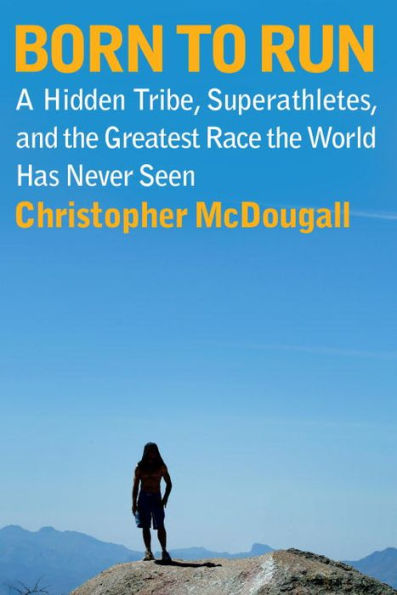
Born to Run: A Hidden Tribe, Superathletes, and the Greatest Race the World Has Never Seen [NOOK Book]
Available on NOOK devices and apps
Want a NOOK? Explore Now
To live with ghosts requires solitude.
—Anne Michaels, Fugitive Pieces
FOR DAYS, I’d been searching Mexico’s Sierra Madre for the phantom known as Caballo Blanco—the White Horse. I’d finally arrived at the end of the trail, in the last place I expected to find him—not deep in the wilderness he was said to haunt, but in the dim lobby of an old hotel on the edge of a dusty desert town. “Sí, El Caballo está,” the desk clerk said, nodding. Yes, the Horse is here.
“For real?” After hearing that I’d just missed him so many times, in so many bizarre locations, I’d begun to suspect that Caballo Blanco was nothing more than a fairy tale, a local Loch Ness mons - truo dreamed up to spook the kids and fool gullible gringos.
“He’s always back by five,” the clerk added. “It’s like a ritual.” I didn’t know whether to hug her in relief or high- five her in triumph. I checked my watch. That meant I’d actually lay eyes on the ghost in less than . . . hang on.
“But it’s already after six.”
The clerk shrugged. “Maybe he’s gone away.”
I sagged into an ancient sofa. I was filthy, famished, and defeated. I was exhausted, and so were my leads.
Some said Caballo Blanco was a fugitive; others heard he was a boxer who’d run off to punish himself after beating a man to death in the ring. No one knew his name, or age, or where he was from. He was like some Old West gunslinger whose only traces were tall tales and a whiff of cigarillo smoke. Descriptions and sightings were all over the map; villagers who lived impossible distances apart swore they’d seen him traveling on foot on the same day, and described him on a scale that swung wildly from “funny and simpático” to “freaky and gigantic.”
But in all versions of the Caballo Blanco legend, certain basic details were always the same: He’d come to Mexico years ago and trekked deep into the wild, impenetrable Barrancas del Cobre—the Copper Canyons—to live among the Tarahumara, a near- mythical tribe of Stone Age superathletes. The Tarahumara (pronounced Spanish- style by swallowing the “h”: Tara- oo- mara) may be the healthiest and most serene people on earth, and the greatest runners of all time.
When it comes to ultradistances, nothing can beat a Tarahumara runner—not a racehorse, not a cheetah, not an Olympic marathoner.
Very few outsiders have ever seen the Tarahumara in action, but amazing stories of their superhuman toughness and tranquillity have drifted out of the canyons for centuries. One explorer swore he saw a Tarahumara catch a deer with his bare hands, chasing the bounding animal until it finally dropped dead from exhaustion, “its hoofs falling off.” Another adventurer spent ten hours climbing up and over a Copper Canyon mountain by mule; a Tarahumara runner made the same trip in ninety minutes.
“Try this,” a Tarahumara woman once told an exhausted explorer who’d collapsed at the base of a mountain. She handed him a gourd full of a murky liquid. He swallowed a few gulps, and was amazed to feel new energy pulsing in his veins. He got to his feet and scaled the peak like an overcaffeinated Sherpa. The Tarahumara, the explorer would later report, also guarded the recipe to a special energy food that leaves them trim, powerful, and unstoppable: a few mouthfuls packed enough nutritional punch to let them run all day without rest.
But whatever secrets the Tarahumara are hiding, they’ve hidden them well. To this day, the Tarahumara live in the side of cliffs higher than a hawk’s nest in a land few have ever seen. The Barrancas are a lost world in the most remote wilderness in North America, a sort of a shorebound Bermuda Triangle known for swallowing the misfits and desperadoes who stray inside. Lots of bad things can happen down there, and probably will; survive the man- eating jaguars, deadly snakes, and blistering heat, and you’ve still got to deal with “canyon fever,” a potentially fatal freak- out brought on by the Barrancas’ desolate eeriness. The deeper you penetrate into the Barrancas, the more it feels like a crypt sliding shut around you. The walls tighten, shadows spread, phantom echoes whisper; every route out seems to end in sheer rock. Lost prospectors would be gripped by such madness and despair, they’d slash their own throats or hurl themselves off cliffs. Little surprise that few strangers have ever seen the Tarahumara’s homeland—let alone the Tarahumara.
But somehow the White Horse had made his way to the depths of the Barrancas. And there, it’s said, he was adopted by the Tarahumara as a friend and kindred spirit; a ghost among ghosts. He’d certainly mastered two Tarahumara skills—invisibility and extraordinary endurance—because even though he was spotted all over the canyons, no one seemed to know where he lived or when he might appear next. If anyone could translate the ancient secrets of the Tarahumara, I was told, it was this lone wanderer of the High Sierras.
I’d become so obsessed with finding Caballo Blanco that as I dozed on the hotel sofa, I could even imagine the sound of his voice.
“Probably like Yogi Bear ordering burritos at Taco Bell,” I mused. A guy like that, a wanderer who’d go anywhere but fit in nowhere, must live inside his own head and rarely hear his own voice. He’d make weird jokes and crack himself up. He’d have a booming laugh and atrocious Spanish. He’d be loud and chatty and . . . and . . .
Wait. I was hearing him. My eyes popped open to see a dusty cadaver in a tattered straw hat bantering with the desk clerk. Trail dust streaked his gaunt face like fading war paint, and the shocks of sun- bleached hair sticking out from under the hat could have been trimmed with a hunting knife. He looked like a castaway on a desert island, even to the way he seemed hungry for conversation with the bored clerk.
“Caballo?” I croaked.
The cadaver turned, smiling, and I felt like an idiot. He didn’t look wary; he looked confused, as any tourist would when confronted by a deranged man on a sofa suddenly hollering “Horse!”
This wasn’t Caballo. There was no Caballo. The whole thing was a hoax, and I’d fallen for it.
Then the cadaver spoke. “You know me?”
“Man!” I exploded, scrambling to my feet. “Am I glad to see you!”
The smile vanished. The cadaver’s eyes darted toward the door, making it clear that in another second, he would as well.
It all began with a simple question that no one in the world could answer.
That five-word puzzle led me to a photo of a very fast man in a very short skirt, and from there it only got stranger. Soon, I was dealing with a murder, drug guerrillas and a one-armed man with a cream-cheese cup strapped to his head. I met a beautiful, blonde forest ranger who slipped out of her clothes and found salvation by running naked in the Idaho forests, and a young surf babe in pigtails who ran straight toward her death in the desert. A talented young runner would die. Two others would barely escape with their lives.
I kept looking, and stumbled across the Barefoot Batman ... Naked Guy … Kalahari Bushmen ... the Toenail Amputee... a cult devoted to distance running and sex parties ... the Wild Man of the Blue Ridge Mountains ... and ultimately, the ancient tribe of the Tarahumara and their shadowy disciple, Caballo Blanco.
In the end, I got my answer, but only after I found myself in the middle of the greatest race the world would never see: the Ultimate Fighting Competition of footraces, an underground showdown pitting some of the best ultra-distance runners of our time against the best ultrarunners of all time, in a 50-mile race on hidden trails only Tarahumara feet had ever touched. I’d be startled to discover that the ancient saying of the Tao Te Ching — “The best runner leaves no trace” — wasn’t some gossamer koan, but real, concrete, how-to, training advice.
And all because in January, 2001, I asked my doctor this:
“How come my foot hurts?”
I’d gone to see one of the top sports-medicine specialists in the country because an invisible ice-pick was driving straight up through the sole of my foot. The week before, I’d been out for an easy, three-mile jog on a snowy farm road when I suddenly whinnied in pain, grabbing my right foot and screaming curses as I toppled over in the snow. When I got a grip on myself, I checked to see how badly I was bleeding. I must have impaled my foot on a sharp rock, I figured, or an old nail wedged in the ice. But there wasn’t a drop of blood, or even a hole in my shoe.
“Running is your problem,” Dr. Joe Torg confirmed when I limped into his Philadelphia examining room a few days later. He should know; Dr. Torg had not only helped create the entire field of sports medicine, but he also co-authored The Running Athlete, the definitive radiographic analysis of every conceivable running injury. He ran me through an X-Ray and watched me hobble around, then determined I’d aggravated my cuboid, a cluster of bones parallel to the arch which I hadn’t even known existed until it re-engineered itself into an internal Taser.
“But I’m barely running at all,” I said. “I’m doing, like, two or three miles every other day. And not even on asphalt. Mostly dirt roads.”
Didn’t matter. “The human body is not designed for that kind of abuse,” Dr. Torg replied.
But why? Antelope don’t get shin splints. Wolves don’t ice-pack their knees. I doubt that 80% of all wild mustangs are annually disabled with impact injuries. It reminded me of a proverb attributed to Roger Bannister, who, while simultaneously studying medicine, working as a clinical researcher and minting pithy parables, became the first man to break the 4-minute mile: "Every morning in Africa, a gazelle wakes up,” Bannister said. “It knows it must outrun the fastest lion or it will be killed. Every morning in Africa, a lion wakes up. It knows it must run faster than the slowest gazelle, or it will starve. It doesn't matter whether you're a lion or a gazelle - when the sun comes up, you'd better be running."
So why should every other mammal on the planet be able to depend on its legs except us? Come to think of it, how could a guy like Bannister charge out of the lab every day, pound around a hard cinder track in thin leather slippers, and not only get faster, but never get hurt? How come some of us can be out there running all lion-like and Bannister-ish every morning when the sun comes up, while the rest of us need a fistful of Ibuprofen before we can put our feet on the floor?
But maybe there was a path back in time, a way to flip the internal switch that changes us all back into the Natural Born Runners we once were. Not just in history, but in our own lifetimes. Remember? Back when you were a kid and you had to be yelled at to slow down? Every game you played, you played at top-speed, sprinting like crazy as you kicked cans, freed-all and attacked jungle outposts in your neighbors’ backyards. Half the fun of doing anything was doing it at record pace, making it probably the last time in your life you’d ever be hassled for going too fast.
That was the real secret of the Tarahumara: they’d never forgotten what it felt like to love running. They remembered that running was mankind’s first fine art, our original act of inspired creation. Way before we were scratching pictures on caves or beating rhythms on hollow trees, we were perfecting the art of combining our breath and mind and muscles into fluid self-propulsion over wild terrain. And when our ancestors finally did make their first cave paintings, what were the first designs? A downward slash, lightning bolts through the bottom and middle — behold, the Running Man.
Distance running was revered because it was indispensable; it was the way we survived and thrived and spread across the planet. You ran to eat and to avoid being eaten; you ran to find a mate and impress her, and with her you ran off to start a new life together. You had to love running, or you wouldn’t live to love anything else. And like everything else we love — everything we sentimentally call our “passions” and “desires” — it’s really an encoded ancestral necessity. We were born to run; we were born because we run. We’re all Running People, as the Tarahumara have always known.
Soon, I was setting off in search of the lost tribe of the Tarahumara and Caballo Blanco -- who, I would discover, had a secret mission of his own.
From the Hardcover edition.
This is an extremely well written book. I bought this while travelling in Dublin and was impressed with every line. This is a must read for anyone who is serious about running or understanding runners. This is the sort of book that readily inspires young and old alike to rethink everything they have been taught and to just "get out there and run for the joy of the running". What a novel concept.
11 out of 14 people found this review helpful.
Was this review helpful? Yes NoThank you for your feedback. Report this reviewThank you, this review has been flagged.Anonymous
Posted April 17, 2010
Although I am 71 and NOT a runner, I couldn't put this book down and have already given it as a gift. Having talked to many young runners about it, I have the feeling it has become a "bible" to them. The Indian tribe in the Copper Canyon that inspired the author and others run barefooted and win all their races. It was SO inspiring that I almost felt like putting on my walking shoes and getting out onto a track to actually run. Alas, that was not to be; however, as I read, I could feel the sun beating down on my head, the wind in my hair and my bare feet no longer in pain!
The book also points how how the Running Shoe Industry has conned everyone into buying more and more expensive and complicated shoes in their pursuit of running faster. As a result, feet have suffered. This reminded me of the cigarette industry and how they duped the public.
6 out of 16 people found this review helpful.
Was this review helpful? Yes NoThank you for your feedback. Report this reviewThank you, this review has been flagged.I couldn't put this book down. This surprised me because not only am I not a runner, I rarely am inspired to read a book all the way to the end. After hearing an interview with the author on the radio, I felt that I had to give this book a try. I am glad that I did and I am telling just about everyone I know that they should, too. The main story, the people and their stories , and the theories proposed, were all fascinating. It was an enjoyable read that I wanted to continue after the last page. Satisfying in many ways.
5 out of 8 people found this review helpful.
Was this review helpful? Yes NoThank you for your feedback. Report this reviewThank you, this review has been flagged.Ever since I first read an article by McDougall in Men's Health about the Tarahumara, I have been fascinated with finding out more about these amazing people. With Born to Run, my appetite for knowledge of their running prowess has been kicked into overdrive.
In Born to Run, McDougall weaves a Tolstoy-esque cast of characters, from running icons like Bill Bowerman to a virtually unknown and enigmatic gringo named Micah True, aka Caballo Blanco.
Upon receiving this book, I was a bit wary of the pitfalls that many books of this type can fall into, yet somehow McDougall weaves a story of epic proportions while still filling your mind with the truly simple science behind why barefoot is better. Not only does McDougall come to this realization because of his extensive research, but by putting into practice all the techniques that he learns along the way.
Every time I put this book down, I couldn't help but want to pick it up again, if only for one more page. The real joy and pleasure of this book, which is exactly the overriding message that lies within, is the joy of running that we have somehow managed to lose. Born to Run, through the wonderful words of Christopher McDougall made me want to put down this masterpiece only to go outside to run, like the Tarahumara, with a smile on my face
4 out of 7 people found this review helpful.
Was this review helpful? Yes NoThank you for your feedback. Report this reviewThank you, this review has been flagged.kwrunner
Posted February 6, 2010
A great overall read! McDougall carefully introduces a revolutionary running technique woven through the true stories of runners who prove it works. Both entertaining and inspiring to a wide range of runners and adds sparkle and interest to an otherwise mundane topic. Only disappointment is a few unnecessary f-words sprinkled throughout (which I find even more offensive to read than to hear.)
3 out of 6 people found this review helpful.
Was this review helpful? Yes NoThank you for your feedback. Report this reviewThank you, this review has been flagged.WildwomanPB
Posted January 10, 2010
Very well written and inspirational as well as informative. I'd highly recommend to either an athlete looking for inspiration and information as well as someone looking for a good read.
3 out of 6 people found this review helpful.
Was this review helpful? Yes NoThank you for your feedback. Report this reviewThank you, this review has been flagged.Anonymous
Posted September 21, 2009
I would recommend this book as an intriguing selection for anyone interested in anthropology, running or the quirks of human nature. McDougall's narrative cooks right along and keeps you turning pages to find out how the race turns out. His treatment of the characters is respectful and insightful and creates a desire in the reader to go out and push your body to it's limits just to see what you are capable of. A truly enjoyable story!
3 out of 6 people found this review helpful.
Was this review helpful? Yes NoThank you for your feedback. Report this reviewThank you, this review has been flagged.This book is great on so many levels: writing style, humor, research, a quest for self-awareness, what makes humans unique, sports, marketing, spiritual, physiology, even anthropology. It's all wrapped in this engaging ball of a ture yarn. The most engaging part is the cast of characters: from the mysterious to the eccentric to college kids gone wild. This book should be on every bestseller's list. Hunter S. Thompson's biographer should be Christopher McDougall. The only thing missing: illustrations of THE race. But even there, the cover entices the imagination and the author paints vivid images of people, races and our past. Even a nonrunner like myself (a contradiction based on the title alone) thinks this should be on everyone's list of must-reads.
3 out of 6 people found this review helpful.
Was this review helpful? Yes NoThank you for your feedback. Report this reviewThank you, this review has been flagged.Runners who have plantar fasciitis that interferes with their running might also be interested in "The 5-Minute Plantar Fasciitis Solution."
2 out of 3 people found this review helpful.
Was this review helpful? Yes NoThank you for your feedback. Report this reviewThank you, this review has been flagged.calnokaoi
Posted May 15, 2010
I was 14 years old when I first wore shoes for my 8th grade elementary school graduation. Until then I went barefoot or wore flip-flops. Every day after elementary school, I ran home barefoot. (In the mornings, we were bussed to school.)
"Born to run" does not have technical foot or barefoot running information, rather it has general data about running barefoot. It combines a very interesting story about running barefoot, 100 mile marathons and the Tarahumara indians.
I don't run barefoot now but I do all my current karate exercises barefoot. "Barefoot Is Better."
1 out of 6 people found this review helpful.
Was this review helpful? Yes NoThank you for your feedback. Report this reviewThank you, this review has been flagged.BillPilgrim
Posted May 14, 2010
The author is a writer for out-doorsy-type magazines. This book covers a lot of territory, none very thoroughly: The sport of ultramarathoning, and the men and women who participate in it; the Tarahumara, a reclusive, native American tribe living an isolated existence in the Copper Canyon in Mexico, a canyon larger than the Grand Canyon, who were persuaded to participate in a few ultramarathons in Colorado in the 90's; the history of running, describing scientific inquiry into whether man evolved to run long distances; and, also the science of running, techniques particularly whether running shoes hurt or help the modern runner.
The book focusses on and the climax of the book describes a race in the Copper Canyon between Tarahumara runners and a few Americans who made the trek there to participate. The race was conceived and primarily organized by a man known as Caballo Blanco, the "White Horse", a real odd-ball, long distance runner and former boxer, who has been living in the Copper Canyon among the Tarahumara was many years.
I found the book to be very entertaining, even if it left me wanting alot more information on all of the topics that are touched on. If you were not already a runner, this book will convince you to try it, or nothing ever will. I already run. Not the distances described in the book, but more than the average.
1 out of 3 people found this review helpful.
Was this review helpful? Yes NoThank you for your feedback. Report this reviewThank you, this review has been flagged.Anonymous
Posted April 20, 2010
"Born to Run" is a fun read. It is better as entertainment than true research material, but that's okay. The books starts out as a the story of the author as he tries to find a cure for the pain he get in his back when he runs a few steps. His journey takes him to a remote canyon in Mexico, where he meets the Tarahumara Indians and a legendary figure known as the Caballo Blanco. The Tarahumara Indians live in true isolation by choice and run everywhere within their territory on thin sandals made of tires. The author comes to the conclusion that the solution to everyone's running injuries is to not wear shoes, or to wear the shoes that are mimic barefoot running as closely as possible. He goes on to talk to experts in archaeology and other fields who feel the same way about the natural way to run. Definitely an inspiring book for a runner, as it makes it seem like almost anybody can run 50 miles in the hot desert sun. The science behind his claims may be questionable, but as long as they are taken with a grain of salt, this book is enjoyable, light read.
1 out of 3 people found this review helpful.
Was this review helpful? Yes NoThank you for your feedback. Report this reviewThank you, this review has been flagged.Stories about elite runners called "ultra-runners" who go 50-100 miles through cross-country terrain, such as native Tarahumaras of obscure Mexican mountains, beat poetry loving party animals, a hermetic loner philosopher, and abarefoot runner. The author Christopher McDougal, similar to the trails and switchbacks through the mountians, leads us on tangents about human endurance, running injuries, running physiology, running injuries attributed to super-cushioned shoes from a certian giant footwear company.
I am not a runner, but have been inspired to get outside and running.
1 out of 3 people found this review helpful.
Was this review helpful? Yes NoThank you for your feedback. Report this reviewThank you, this review has been flagged.Bleedin' great readin'. I guess the big thing about this book is that it doesn't matter if you run or not--it's still fascinating. I mean, especially if you don't run, you probably never hear of the Leadville 100, a 100-mile race through the mountains in Colorado. It's interesting to know about it, but then you add the characters that participate in it. It's a scream. Literally.
I missed my subway stops on Chapter 28, which is about the evolutionary science behind long distance running and why some animals do better than others. Now, you may think, how interesting can this be? Try it and see for yourself. The part about training in the Kalahari with the Bushmen had me enthralled.
I am not a runner, but I wish I was after this. In fact, I may just try it again, especially after knowing I don't have to be able to afford those expensive shoes. I do think there are some among us that are 'built' for running and the rest of us may be built for some other kind of sport, but there usually running can be incorporated into the cross training.
The final race is a vision: 100 degrees in the shade, 6000 foot peaks, the Tarahumara with their white, embroidered skirts, the "pretty little witch", big-mouth Ted with his green, toed socks, and a Mexican town dressed to party...it's engrossing.
1 out of 3 people found this review helpful.
Was this review helpful? Yes NoThank you for your feedback. Report this reviewThank you, this review has been flagged.YaYaFL
Posted April 8, 2010
My husband and I (who are not long distance runners) both loved this book and I've given several as gifts to both running and non-running friends. It is more about a philosophy of life than a sports book. It provides insight and education about a couple of little known cultures. One is the Mexican tribe of long distance runners, the other is the culture of extreme endurance sports in in the US. Both are fascinatingly foreign. The book also has a good dose of humor and suspense. Highly recommend this very fast read.
1 out of 2 people found this review helpful.
Was this review helpful? Yes NoThank you for your feedback. Report this reviewThank you, this review has been flagged.Anonymous
Posted April 8, 2010
I picked up Born To Run after hearing several people in my tri club talking about the Tarahumara and their epic trail racing lifestyle. I truly was looking for some inspiration prior to running my first trail marathon and from the first page I was not disappointed. Inspiration is where you find it - and Born To Run is a must read before your next race!
1 out of 2 people found this review helpful.
Was this review helpful? Yes NoThank you for your feedback. Report this reviewThank you, this review has been flagged.Like a few others, I don't know what drew me to read this book. I'm not particularly athletic, and I'm not a runner much less a marathoner so...
The book tells many stories that weave together into one fun ride (read). You learn of a 'lost' Mexican indian tribe the Tarahumara, or more correctly The Raramuri. Living peacefully in the Copper Canyon area of the Mexican desert they seem to be able to run forever. They don't have the latest running shoes, or coaches or specialized nutrition. But when they run they seem to be just gliding over the ground, with an almost blissful expression on their faces. So why do we, with all the 'advantages' continually get hurt and wind up hating running so much?
You explore the 'running man' theory, how we humans were put together to run. For food, travel, but most of all survival. What role does nutrition play? Or is running more in our heads, our state of mind? What about running shoes? Helpful? The answers may surprise you. Certainly they seem to run contrary to what we're currently being told. Makes you think!
We learn about the Tarahumari, who ran a few races here in the USA only to reject our competitive ways, preferring a simpler, more cooperative life of their own. What secrets might they help us uncover and allow us to enjoy running more and become healthier in the process.
Caballo Blanco (The White Horse) a near mythic figure who forsook modern life to live among the Tarahumari, accepted as family, careful to preserve an almost lost way of living has a dream. What if there was a race on the Tarahumari home turf that included some of the running world's true elite performers along? A race, competitive for sure, but also a communal sharing spirit. Could it ever happen? Would it?
I was very glad I read this book. I won't go so far as to say it inspired me to start jogging (or at least exercise) but it made me think in some different directions than I expected. You may as well.
1 out of 2 people found this review helpful.
Was this review helpful? Yes NoThank you for your feedback. Report this reviewThank you, this review has been flagged.Torrents
Posted March 25, 2010
I recommend all runners and nonrunners alike read this book. It's amazing. The story is fantastic and so is the way it is presented. I feel like I understand the history of ultramarathons and almost see why someone would be crazy enough to try it. Fantastic book. I'm giving a copy to everyone I know.
1 out of 1 people found this review helpful.
Was this review helpful? Yes NoThank you for your feedback. Report this reviewThank you, this review has been flagged.Motlei
Posted March 13, 2010
Christopher McDougall set out to discover why runners overwhelmingly get injured or hurt every year even though we have shoes with the highest technology we can afford. Along the way he discovered the statistical outliers of the ultramarathon runners and especially the Tarahumara people of the Copper Canyon - people who run in thin sandals as a way of life and do not suffer the frequent aches and ailments of the "better shod".
I picked up this book because I had been turned on to the concept of barefoot running as a possible solution to my constant knee pain when running. The book conversationally describes the author's search for an answer woven into the story of his introduction to a man named Caballo Blanco and an ultramarathon race with the "Running People" of Copper Canyon.
I found the book to be an interesting, entertaining, and inspiring read and I encourage others that found themselves no longer enjoying their regular runs because of an ache or two that seems to nag at them to read this book and think about exchanging your running style instead of exchanging running for a different sport.
1 out of 1 people found this review helpful.
Was this review helpful? Yes NoThank you for your feedback. Report this reviewThank you, this review has been flagged.springfieldHI
Posted January 6, 2010
really, really helped with my running mechanics, and inspiration
1 out of 1 people found this review helpful.
Was this review helpful? Yes NoThank you for your feedback. Report this reviewThank you, this review has been flagged.
Overview
An epic adventure that began with one simple question: Why does my foot hurt?Isolated by Mexico's deadly Copper Canyons, the blissful Tarahumara Indians have honed the ability to run hundreds of miles without rest or injury. In a riveting narrative, award-winning journalist and often-injured runner Christopher McDougall sets out to discover their secrets. In the process, he takes his readers from science labs at Harvard to the sun-baked valleys and freezing peaks across North America, where ever-growing numbers of ultra-runners are pushing their bodies to the limit, and, finally, to a climactic race in the Copper Canyons that pits America’s best ...