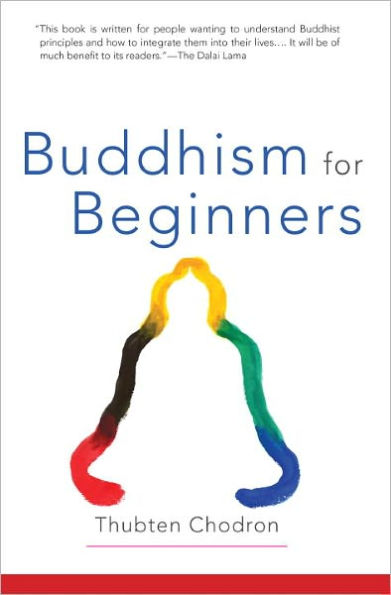
Buddhism for Beginners

( 10 )

Pick Up in Store

Reserve and pick up in 60 minutes at your local store

Paperback (New Edition)
$9.93
BN.com price
$12.95 List Price (Save 23%)
Marketplace (New and Used)
from
$5.35
$12.95 List Price (Save 59%)
All (47)  
Used (27)  
New (20)  
Close
Sort by
Page 1 of 5
Showing 1 – 10 of 47 (5 pages)
$5.35
(Save 59%)
Seller since 2002

Feedback rating:

(10215)

Condition:

New — never opened or used in original packaging.

Like New — packaging may have been opened. A "Like New" item is suitable to give as a gift.

Very Good — may have minor signs of wear on packaging but item works perfectly and has no damage.

Good — item is in good condition but packaging may have signs of shelf wear/aging or torn packaging. All specific defects should be noted in the Comments section associated with each item.

Acceptable — item is in working order but may show signs of wear such as scratches or torn packaging. All specific defects should be noted in the Comments section associated with each item.

Used — An item that has been opened and may show signs of wear. All specific defects should be noted in the Comments section associated with each item.

Refurbished — A used item that has been renewed or updated and verified to be in proper working condition. Not necessarily completed by the original manufacturer.

Good
May include moderately worn cover, writing, markings or slight discoloration. SKU:9781559391535-4-0

Ships from: Salem, OR

Usually ships in 1-2 business days

  • Canadian
  • International
  • Standard, 48 States
  • Standard (AK, HI)
  • Express, 48 States
  • Express (AK, HI)
$5.42
(Save 58%)
Seller since 2012

Feedback rating:

(60)

Condition: Acceptable
A readable copy. All pages and cover are intact. Dust jacket is torn or missing. The book has moderate to heavy wear. Edges and/or cover are dirty. Writing on some pages.

Ships from: Vancouver, WA

Usually ships in 1-2 business days

  • Standard, 48 States
  • Express, 48 States
$5.44
(Save 58%)
Seller since 2009

Feedback rating:

(4873)

Condition: Very Good
Appearance of only slight previous use. Cover and binding show a little wear. All pages are undamaged with potentially only a few, small markings. Help save a tree. Buy all ... your used books from Green Earth Books. Read. Recycle and Reuse! Read more Show Less

Ships from: Portland, OR

Usually ships in 1-2 business days

  • Canadian
  • International
  • Standard, 48 States
  • Standard (AK, HI)
  • Express, 48 States
  • Express (AK, HI)
$5.72
(Save 56%)
Seller since 2009

Feedback rating:

(552)

Condition: Good
Good

Ships from: Astoria, NY

Usually ships in 1-2 business days

  • Canadian
  • International
  • Standard, 48 States
  • Standard (AK, HI)
  • Express, 48 States
  • Express (AK, HI)
$5.73
(Save 56%)
Seller since 2010

Feedback rating:

(3274)

Condition: Good

Ships from: Lakewood, WA

Usually ships in 1-2 business days

  • Canadian
  • International
  • Standard, 48 States
  • Standard (AK, HI)
  • Express, 48 States
  • Express (AK, HI)
$5.95
(Save 54%)
Seller since 2008

Feedback rating:

(174)

Condition: Very Good
2001 Trade paperback Very good. Trade paperback (US). Glued binding. 160 p. Audience: General/trade.

Ships from: Berkeley, CA

Usually ships in 1-2 business days

  • Canadian
  • International
  • Standard, 48 States
  • Standard (AK, HI)
  • Express, 48 States
  • Express (AK, HI)
$5.98
(Save 54%)
Seller since 2011

Feedback rating:

(61)

Condition: Acceptable
PAPERBACK Fair 1559391537 Readable condition, all page intact, has wear, highlighting and writing inside. shelf#: IE1.

Ships from: Elverta, CA

Usually ships in 1-2 business days

  • Canadian
  • International
  • Standard, 48 States
  • Standard (AK, HI)
  • Express, 48 States
  • Express (AK, HI)
$6.78
(Save 48%)
Seller since 2007

Feedback rating:

(1252)

Condition: Good
2001-01-22 Paperback Book Good. No dust jacket as issued. Trade Paperback. X-Library Book with usual markings/attachments. Normal shelf and display wear. Minor cover wear...

Ships from: Des Moines, IA

Usually ships in 1-2 business days

  • Canadian
  • International
  • Standard, 48 States
  • Standard (AK, HI)
  • Express, 48 States
  • Express (AK, HI)
$7.00
(Save 46%)
Seller since 2012

Feedback rating:

(275)

Condition: Like New
1559391537 Virtually new: But for a pencil price on the flyleaf, the pages are clean and unmarked, and the binding is tight, appearing unread. Not ex-library, Not a remainder.

Ships from: Paramus, NJ

Usually ships in 1-2 business days

  • Standard, 48 States
  • Standard (AK, HI)
  • Express, 48 States
  • Express (AK, HI)
$7.00
(Save 46%)
Seller since 2012

Feedback rating:

(275)

Condition: Like New
1559391537 Virtually new: But for a pencil price on the flyleaf, the pages are clean and unmarked, and the binding is tight, appearing unread. Not ex-library, Not a remainder.

Ships from: Paramus, NJ

Usually ships in 1-2 business days

  • Standard, 48 States
  • Standard (AK, HI)
  • Express, 48 States
  • Express (AK, HI)
Page 1 of 5
Showing 1 – 10 of 47 (5 pages)
Close
Sort by

Overview

Answers fundamental questions and issues that arise in the minds of modern Western individuals who are beginning this tradition of practical spirituality.

See more details below
Sending request ...

Overview

Answers fundamental questions and issues that arise in the minds of modern Western individuals who are beginning this tradition of practical spirituality.

Product Details

  • ISBN-13: 9781559391535
  • Publisher: Snow Lion Publications, Incorporated
  • Publication date: 1/28/2001
  • Edition description: New Edition
  • Edition number: 1
  • Pages: 157
  • Sales rank: 126,005
  • Product dimensions: 6.33 (w) x 9.13 (h) x 0.45 (d)

Meet the Author

Thubten Chodron is an American Buddhist nun in the Tibetan tradition. A student of His Holiness the Dalai Lama and other Tibetan masters, she became a nun in 1977. She has been resident teacher at Amitabha Buddhist Centre in Singapore and at Dharma Friendship Foundation in Seattle. Active in interfaith dialogue, she also does Dharma outreach in prisons and teaches the Dharma worldwide. She is abbess of Sravasti Abbey, a Buddhist monastery in eastern Washington State. She is the author of several books, including Open Heart, Clear Mind; Buddhism for Beginners; Taming the Mind; Working with Anger; and How to Free Your Mind: Tara the Liberator. Ven. Chodron emphasizes the practical application of Buddha's teachings in our daily lives and is especially skilled at explaining them in ways easily understood and practiced by Westerners.

Read an Excerpt


Chapter One

THE ESSENCE OF BUDDHISM


What is the essence of the Buddha's teachings?


Simply speaking, it is to avoid harming others and to help them as much as possible. Another way of expressing this is the oft-quoted verse:


Abandon negative action;
Create perfect virtue;
Subdue your own mind.
This is the teaching of the Buddha.


    By abandoning negative actions, such as hurting others, and destructive motivations, such as anger, attachment, and closed-mindedness, we stop harming ourselves and others. By creating perfect virtue, we develop beneficial attitudes, such as equanimity, love, compassion, and joy, and act constructively. By subduing our minds and understanding reality, we leave behind all false projections, thus making ourselves calm and peaceful.

    We can also speak of the essence of the Buddha's teachings as they are explained in the Four Noble Truths: the truth of suffering, the cause of suffering, the cessation of suffering and its causes, and the path to that cessation. When Buddha spoke about suffering, he meant that we have unsatisfactory experiences. Even the happiness we have does not last forever, and that situation is unsatisfactory. The causes of our problems lie not in the external environment and those inhabiting it, but in our own mind. The disturbing attitudes and negative emotions, such as clinging attachment, anger, and ignorance are the real source of our unhappiness. Since these are based on misconceptions about the nature of reality, they can be removed from ourmindstream. We then abide in the blissful state of nirvana, which is the absence of all unsatisfactory experiences and their causes. A path exists to realize reality and increase our good qualities. The Buddha described this path, and we have the ability to actualize it.

    The path is often described by the Three Higher Trainings: Ethical Discipline, Meditative Stabilization, and Wisdom. First, we must become a good human being who functions well in society and lives harmoniously with others. The Higher Training of Ethical Discipline enables us to do this. Because our actions and speech are now calmer, we can proceed to tame the mind by developing single-pointed concentration or the Higher Training of Meditative Stabilization. This leads us to cut the root of suffering, the ignorance grasping at inherent existence, and for this we develop the Higher Training in Wisdom, so that we can perceive reality as it is.

    The Three Higher Trainings can be subdivided into the Noble Eight-fold Path. Ethical Discipline includes: 1) right speech: true, kind, and appropriate speech; 2) right activity: actions which do not harm others; and 3) right livelihood: obtaining our subsistence food, clothing, and so forth—by non-harmful and honest means. The Higher Training of Meditative Stabilization includes: 4) right effort: effort to counteract the disturbing attitudes and negative emotions by meditating on the path; 5) right mindfulness: counteracting laxity and excitement in our meditation; and 6) right samadhi: the mind that can remain fixed one-pointedly upon virtuous objects. The Higher Training of Wisdom includes: 7) right view: the wisdom realizing emptiness, and 8) right thought: the mind that can explain the path clearly to others and is motivated by the wish for them to be free from suffering.

    The essence of the Buddhist path is also contained in the three principal aspects of the path: the determination to be free, the altruistic intention (bodhicitta), and the wisdom realizing reality. Initially, we must have the determination to be free from the confusion of our problems and their causes. Then, seeing that other people also have problems, with love and compassion we will develop an altruistic intention to become a Buddha so that we will be capable of helping others most effectively. To do this, we must develop the wisdom that understands the true nature of ourselves and other phenomena and thus eliminates all false projections.


What is the goal of the Buddhist path?


The Buddhist path leads us to discover a state of lasting happiness for both ourselves and others by freeing ourselves from cyclic existence, the cycle of constantly recurring problems that we experience at present. We are born and die under the influence of ignorance, disturbing attitudes, and contaminated actions (karma). Although all of us want to be happy, and we try hard to get the things that will make us happy, no one is totally satisfied with his or her life. And although we all want to be free from difficulties, problems come our way without our even trying. People may have many good things going for them in their lives, but when we talk with them for more than five minutes, they start telling us their problems. Those of us who are in this situation, who are not yet Buddhas, are called "sentient beings."

    The root cause of cyclic existence is ignorance: we do not understand who we are, how we exist or how other phenomena exist. Unaware of our own ignorance, we project fantasized ways of existing onto ourselves and others, thinking that everyone and everything has some inherent nature and exists independently, in and of itself. This gives rise to attachment, an attitude that exaggerates the good qualifies of people and things or superimposes good qualities that are not there and then clings to those people or things, thinking they will bring us real happiness. When things do not work out as we expected or wished they would, or when something interferes with our happiness, we become angry. These three basic disturbing attitudes—ignorance, attachment, and anger—give rise to a host of other ones, such as jealousy, pride, and resentment. These attitudes then motivate us to act, speak, or think. Such actions leave imprints on our mindstreams, and these imprints then influence what we will experience in the future.

    We are liberated from the cycle of rebirth by generating the wisdom realizing emptiness or selflessness. This wisdom is a profound realization of the lack of a solid, independent essence in ourselves, others, and everything that exists. It eliminates all ignorance, wrong conceptions, disturbing attitudes, and negative emotions, thus putting a stop to all misinformed or contaminated actions. The state of being liberated is called nirvana or liberation. All beings have the potential to attain liberation, a state of lasting happiness.


What are the Three Jewels? How do we relate to them? What does it mean to take refuge in the Three Jewels?


The Three Jewels are the Buddha, Dharma and Sangha. A Buddha is one who has purified all the defilements of the mind—the disturbing attitudes, negative emotions and their seeds, the imprints of the actions motivated by them, and the stains of these disturbing attitudes and negative emotions. A Buddha has also developed all good qualities, such as impartial love and compassion, profound wisdom, and skillful means of guiding others. The Dharma is the preventive measures that keep us from problems and suffering. This includes the teachings of the Buddha and the beneficial mental states that practicing the teachings leads to. The Sangha are those beings who have direct nonconceptual understanding of reality. Sangha can also refer to the community of ordained people who practice Buddha's teachings, but this sangha is the conventional representation of the Sangha Jewel, and is not the one we take refuge in.

    Our relationship to the Three Jewels is analogous to a sick person who seeks help from a doctor, medicine, and nurses. We suffer from various unsatisfactory circumstances in our lives. The Buddha is like a doctor who correctly diagnoses the cause of our problems and prescribes the appropriate medicine. The Dharma is our real refuge, the medicine that cures our problems and their causes. By helping us along the path, the Sangha is like the nurse who assists us in taking the medicine.

    Taking refuge means relying wholeheartedly on the Three Jewels to inspire and guide us toward a constructive and beneficial direction in our lives. Taking refuge does not mean passively hiding under the protection of the Buddha, Dharma, and Sangha. Rather, it is an active process of moving in the direction that they show us and thus improving the quality of our life.

    When people take refuge, they clarify to themselves what direction they are taking in life, who is guiding them, and who their companions are on the path. This eliminates the indecision and confusion arising from uncertainty about their spiritual path. Some people window-shop for spirituality: Monday they use crystals, Tuesday they do channeling, Wednesday they do Hindu meditation, Thursday they do Hatha Yoga, Friday they have holistic healing, Saturday they do Buddhist meditation, and Sunday they use Tarot cards. They learn a lot about many things, but their attachment, anger, and closed-mindedness don't change much. Taking refuge is making a clear decision about what our principal path is. Nevertheless, it is possible to practice the Buddha's teachings and to benefit from them without taking refuge or becoming a Buddhist.


Must we be a Buddhist to practice what the Buddha taught?


No. The Buddha gave a wide variety of instructions, and if some of them help us live to better, to solve our problems and become kinder, then we are free to practice them. There is no need to call ourselves Buddhists. The purpose of the Buddha's teachings is to benefit us, and if putting some of them into practice helps us live more peacefully with ourselves and others, that is what's important.

Customer Reviews

Average Rating 4
( 10 )

Rating Distribution

5 Star

(6)

4 Star

(1)

3 Star

(1)

2 Star

(1)

1 Star

(1)

Your Rating:

Your Name: Create a Pen Name or Leave Anonymously

Barnes & Noble.com Review Rules

Our reader reviews allow you to share your comments on titles you liked, or didn't, with others. By submitting an online review, you are representing to Barnes & Noble.com that all information contained in your review is original and accurate in all respects, and that the submission of such content by you and the posting of such content by Barnes & Noble.com does not and will not violate the rights of any third party. Please follow the rules below to help ensure that your review can be posted.

Reviews by Our Customers Under the Age of 13

We highly value and respect everyone's opinion concerning the titles we offer. However, we cannot allow persons under the age of 13 to have accounts at BN.com or to post customer reviews. Please see our Terms of Use for more details.

What to exclude from your review:

Please do not write about reviews, commentary, or information posted on the product page. If you see any errors in the information on the product page, please send us an email.

Reviews should not contain any of the following:

  • - HTML tags, profanity, obscenities, vulgarities, or comments that defame anyone
  • - Time-sensitive information such as tour dates, signings, lectures, etc.
  • - Single-word reviews. Other people will read your review to discover why you liked or didn't like the title. Be descriptive.
  • - Comments focusing on the author or that may ruin the ending for others
  • - Phone numbers, addresses, URLs
  • - Pricing and availability information or alternative ordering information
  • - Advertisements or commercial solicitation

Reminder:

  • - By submitting a review, you grant to Barnes & Noble.com and its sublicensees the royalty-free, perpetual, irrevocable right and license to use the review in accordance with the Barnes & Noble.com Terms of Use.
  • - Barnes & Noble.com reserves the right not to post any review -- particularly those that do not follow the terms and conditions of these Rules. Barnes & Noble.com also reserves the right to remove any review at any time without notice.
  • - See Terms of Use for other conditions and disclaimers.
Search for Products You'd Like to Recommend

Recommend other products that relate to your review. Just search for them below and share!

Create a Pen Name

Your Pen Name is your unique identiy on BN.com. It will appear on the reviews you write and other website activities. Your Pen Name cannot be edited, changed or deleted once submitted.

Your Pen Name can be any combination of alphanumeric characters (plus - and _), and must be at least two characters long.

Continue Anonymously

We're sorry, but penname is already taken.

Please select one of the following:
Your Pen Name can be any combination of alphanumeric characters (plus - and _), and must be at least two characters long.

Continue Anonymously

penname is available!

By visiting the BN.com website or marking a purchase on BN.com, a User is deemed to have accepted the Terms of Use.

Continue Anonymously

Welcome, penname

You have successfully created your Pen Name. Start enjoying the benefits of the BN.com Community today.

Sort by: Showing all of 10 Customer Reviews
  • Posted June 25, 2011

    Fantastic First look into Buddhism

    I fell on this book by pure chance. I wanted to read about Buddhism and the title stood out. Was it all by chance, who knows. This book was my the start of my long journey into Buddhism. It answers alot of peoples modern, western-influenced questions about certain aspects of Buddhism. Great first read into the path of enlightment.

    Was this review helpful? Yes  No   Report this review
  • Anonymous

    Posted November 9, 2004

    Excellent starting point

    This book is an excellent starting point for people who are interested in Buddhism. Thubten Chodron doesn't use mystifying language, and obscure terms. She makes a confusing maze into a straight path. Excellent read.

    0 out of 1 people found this review helpful.

    Was this review helpful? Yes  No   Report this review
  • Anonymous

    Posted July 31, 2001

    good

    Basics about this practice, and easy to understand. You should read this book before you start reading other books about Buddhism because this book will introduce you to this practice, so later on you can ready any kind of book about Buddhism.

    0 out of 1 people found this review helpful.

    Was this review helpful? Yes  No   Report this review
  • Anonymous

    Posted February 6, 2001

    Reccomended reading.

    A simple, yet informative book about Buddhism without all the mystic and confusing metaphors. It's written in clean and precise words and allows the reader to judge for themselves what Buddhism and the Dharma is about.

    0 out of 1 people found this review helpful.

    Was this review helpful? Yes  No   Report this review
  • Anonymous

    Posted June 4, 2010

    No text was provided for this review.

  • Anonymous

    Posted January 18, 2011

    No text was provided for this review.

  • Anonymous

    Posted December 1, 2010

    No text was provided for this review.

  • Anonymous

    Posted December 13, 2009

    No text was provided for this review.

  • Anonymous

    Posted April 3, 2009

    No text was provided for this review.

  • Anonymous

    Posted February 2, 2012

    No text was provided for this review.

Sort by: Showing all of 10 Customer Reviews

If you find inappropriate content, please report it to Barnes & Noble
Why is this product inappropriate?
Comments (optional)
500 character limit