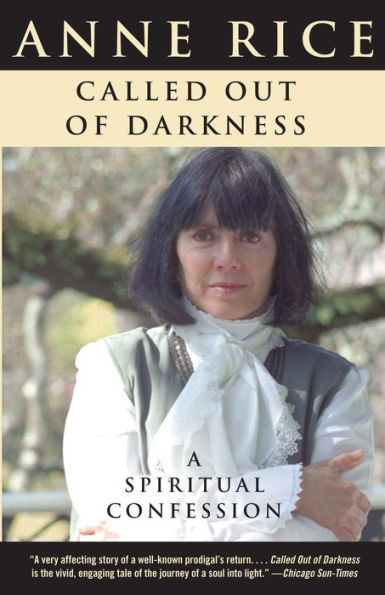
Called Out of Darkness: A Spiritual Confession [NOOK Book]

NOOK Book (eBook)
$12.99
BN.com price

Available on NOOK devices and apps

  • Nook Devices
  • NOOK
  • NOOK Color
  • NOOK Tablet
  • Tablet/Phone
  • NOOK for iPad
  • NOOK for iPhone
  • NOOK for Android
  • NOOK for Android (Tablet)
  • NOOK Kids for iPad
  • PC/Mac
  • NOOK Study
  • NOOK for PC
  • NOOK for Mac

Want a NOOK? Explore Now

Overview

Anne Rice’s first work of nonfiction—a powerful and haunting memoir that explores her continuing spiritual transformation.
 
Anne Rice was raised in New Orleans as the devout child in a deeply religious Irish Catholic family. Here, she describes how, as she grew up, she lost her belief in God, but not her desire for a meaningful life.  She used her novels—beginning with Interview with a Vampire—to wrestle with otherworldly themes while in her own life, she experienced both loss (the death of her daughter and, later, her beloved husband, Stan Rice) and joys (the birth of her son, Christopher).  And she writes about how, finally, after years...
See more details below

Overview

Anne Rice’s first work of nonfiction—a powerful and haunting memoir that explores her continuing spiritual transformation.
 
Anne Rice was raised in New Orleans as the devout child in a deeply religious Irish Catholic family. Here, she describes how, as she grew up, she lost her belief in God, but not her desire for a meaningful life.  She used her novels—beginning with Interview with a Vampire—to wrestle with otherworldly themes while in her own life, she experienced both loss (the death of her daughter and, later, her beloved husband, Stan Rice) and joys (the birth of her son, Christopher).  And she writes about how, finally, after years of questioning, she experienced the intense conversion and re-embracing of her faith that lie behind her most recent novels about the life of Christ.


From the Trade Paperback edition.

Editorial Reviews

Publishers Weekly

Rice’s long-awaited spiritual memoir details growing up Catholic in New Orleans in the 1940s and ’50s, her 38-year absence from the Church as an adult and her slow but steady return to faith in the late 1990s. Kirsten Potter has a beautifully modulated voice, but seems too young for the autobiographical musings of Rice, who was born more than a generation earlier. It would also have been lovely if the audio version offered musical chanting and singing of the Latin cadences Rice discusses in the memoir as being so instrumental in forming her faith, instead of just spoken recitations of them. However, the audio does offer a welcome bonus: more than 20 minutes of an intimate interview with Rice, conducted by a friend who is a Catholic priest. She discusses her childhood faith, love of Saint Francis and new desire to write a Christian fantasy series. A Knopf hardcover (Reviews, Sept. 15). (Oct.)

Copyright © Reed Business Information, a division of Reed Elsevier Inc. All rights reserved.
Library Journal

The best-selling novelist writes here about her return to her New Orleans roots and her Catholic faith. Fans of Rice's novels Christ the Lord: Out of Egypt(2005) and Christ the Lord: The Road to Cana(2008) will likely find this memoir interesting. The narration by Kirsten Potter (Red Helmet) is appropriate for the subject matter-lively and subdued as necessary. [The Knopf hc was called "a must," Xpress Review 9/16/08; bonus interview with the author.-Ed.]
—Pam Kingsbury

Kirkus Reviews
In her first work of nonfiction, Rice (Christ the Lord: The Road to Cana, 2008, etc.) tells the story of her departure from, and return to, her Creator. This spiritual autobiography focuses on the author's youth in New Orleans and her reconciliation with Catholicism during the past decade. Growing up in the Crescent City during the '40s and '50s, Rice was surrounded by an entirely Catholic world in which she reveled. Drawn to church history, the lives of the saints and the beauty of the liturgy, she maintained an unquestioning faith and a deep desire to live a heroic life for God. Late in her teenage years, after her mother's death from alcoholism, Rice moved with her father and sister to Dallas. The change in lifestyle was so complete, she remarks, that "we might as well have been entering America for the first time." It wouldn't be long before she began questioning everything she once believed, and by the time she graduated from college she was an atheist. That change, she now realizes, was prompted by her distaste for the rigid, restrictive Catholicism of the time (circa 1960): "I could not separate my personal relationship with God, and with Jesus Christ, from my relationship with the church." After several years of bohemian existence in San Francisco, Rice hit it big in the literary world with her fiction about Lestat and his fellow vampires. Throughout the nearly four decades of her atheism, however, she longed for her lost faith. Collecting sculptures of saints and visiting holy sites across the world, she struggled with her desire to believe. Finally, in 1998, she reconciled herself to the Catholic Church and found that its character had altered greatly since her youth. In 2002,she made a further personal decision to commit her writing from then on to God. Rice's rather banal prose doesn't do justice to the anguished content, but her story is honest and moving nonetheless. First printing of 200,000. Book-of-the-Month Club/Literary Guild featured selection

Product Details

  • ISBN-13: 9780307270474
  • Publisher: Knopf Doubleday Publishing Group
  • Publication date: 10/13/2009
  • Sold by: Random House
  • Format: eBook
  • Sales rank: 75,713
  • File size: 2 MB

Meet the Author

Anne Rice
Anne Rice
Anne Rice is the author of twenty-nine books. She lives in Rancho Mirage, California.


From the Trade Paperback edition.

Biography

In 1976, nearly 80 years after Bram Stoker published Dracula, Anne Rice's bestselling first novel, Interview with the Vampire, reinvented the vampire myth. Rice recast the undead as a secret society of decadent aesthetes, alternately entranced by the world's beauty and haunted by spiritual despair. Set largely in the author's home city of New Orleans, the book created a fantasy underworld rich and compelling enough to sustain its writer and readers through nine sequels, known collectively as The Vampire Chronicles.

Rice wrote Interview with the Vampire, she said later, "without ever realizing I was writing about loss. I was writing about my daughter's loss [Rice's daughter died in 1972]. And I was writing about my loss of Catholic faith long before that, because I had lost my faith in the year 1960, when I first went to college."

After her first book, Rice continued to write about loss -- and about vampires, witches and demons -- for more than 25 years. She also wrote, under the pen name A.N. Roquelaure, the Beauty series, an erotic retelling of the story of Sleeping Beauty; writing as Anne Rampling, she published two other novels, Exit to Eden and Belinda.

But it is as the queen of gothic fiction that Anne Rice's fans know her best. Her fans are passionate about her, and she returns the sentiment, e-mailing tirelessly with them and occasionally posting on their blogs. She also adores communing with them in person on book tours: "They give me personal, priceless and unforgettable feedback and verification of what I have achieved for them in my books," she once explained in a Salon interview.

After Blood Canticle was released in 1993, her readers, accustomed to an output of one book a year, kept asking her what was coming next. "And I've told them, 'You may not want what I'm doing next'," she said in a Newsweek interview.

They were in for a surprise. In 1998, Rice had returned to the Roman Catholic Church, and in 2005 she published Christ the Lord: Out of Egypt, a novel about the childhood of Jesus, narrated by himself.

"It's the most startling public turnaround since Bob Dylan's Slow Train Coming announced that he'd been born again," wrote David Gates in Newsweek.

But as Rice sees it, Christ the Lord represents the fulfillment of a longing that has been in her books, and in her soul, all along.

"This subject is in no way a departure from that of my previous works; no one who knows my work could possibly think so," she said in a Q&A on her publisher's Web site. "The whole theme of Interview with the Vampire was Louis's quest for meaning in a godless world. He searched to find the oldest existing ‘immortal' simply to ask ‘What is the meaning of what we are?' I was always compelled to seek the ‘big answers.'"

Christ the Lord received mixed reviews, but many critics were as impressed with the book's style as its ambitious subject matter. "Rice's book is a triumph of tone -- her prose lean, lyrical, vivid -- and character," noted Kirkus Reviews. Janet Maslin wrote in The New York Times Book Review: "Even in biblical times and in the Holy Land, Rice retains her obsessions with ritual and purification, with lavish detail and gaudy decor. But she writes this book in a simpler, leaner style, giving it the slow but inexorable rhythm of an incantation. The restraint and prayerful beauty of Christ the Lord is apt to surprise her usual readers and attract new ones."

Some of those usual readers, of course, are now wondering whether she will write any more vampire novels. Will the vampire Lestat ever return?

Anne's response, from her publisher's Web site: "I can't see myself doing that. My vampires were metaphors for the outsiders, the lost, the wanderers in the darkness who remembered the warmth of God's light but couldn't find it. My wish to explore that is gone now. I want to meet a much bigger challenge."

Good To Know

In our exlusive interview, Rice shared some fascinating stories with us:

"My first job was as a cafeteria waitress at a Walgreen's cafeteria over the drugstore on Canal and Baronne Street in New Orleans when I was sixteen years old. What a plunge into reality. Canal Street was then the only downtown in town. And I was in fact a boarding school student and unbeknownst to the principal, Sr. Felix, took this job on weekends. When she found out, she did not approve of a St. Joseph's Academy girl being a waitress. I was undeterred. I had discovered that I could turn time into money. I never forgot that lesson. The crashing boredom of childhood was over!"

"I was employed from then on a shocking variety of low level jobs, including grill cook at a huge downtown cafeteria in San Francisco. I had to be there at 5:00 a.m., and once while I was en route on a bus, a drunken man fell asleep against me. The conductor had to wake him up for me to get off, poor guy. I think he'd staggered out of an after hours club. I was a crack waitress, a receptionist, a claims examiner, a theatre usherette in a big Cinerama house, and must have seen It's Mad, Mad, Mad, Mad World over one hundred times while standing there with a flashlight. My last job in the straight world -- after motherhood -- was that of proofreader for a law book company. I hated it. Then my devoted husband Stan, who was already teaching and had been for some time, said, 'Stay home and write, I believe in you.' And I wrote Interview with the Vampire."

"I was a painfully slow reader. Never really read a novel for pure pleasure until I was 35. It was Ordinary People by Judith Guest. Thought it very good."

"How do I unwind? There are different levels to unwind. The primo way for me is to read history or some form of involving scholarship. A good book on an obscure subject. The recent bestseller Krakatoa by Simon Winchester was a wonderful example! That's a delicious unwind book. And there are others out there like that. The British writers seem especially good at it. But I can't get enough on how or why the Roman Empire fell. That's my idea of a good evening. To be in Florida with the deck door open to the roar of the waves, and a good book open to pages on the decline of paganism."

"But! There is another kind of unwind. The gripping fiction bestseller that takes two days. The Da Vinci Code is a good example. Every now and then I have time for that. I was smiling all the way through it. At one time in my life, I had read everything I could find on the Knights Templar (see First Way to Unwind, above), and on Opus Dei, and Holy Blood, Holy Grail, and so I was just tickled by what the author did with the material. And of course, I couldn't stop reading. Such cleverness, such a puzzle and right up to the last page."

"Interest and hobbies: well, my interests are pretty much literary, except for maintaining two pre-Civil War houses in New Orleans (both family homes, one used for Mardi Gras season entertaining), and then I do devote some attention to my doll collection, which includes a small assortment of French antique dolls -- but this part of my life is drawing to a close. I am divesting myself of possessions rather than acquiring them. I am decorating, yes, and redecorating, but cutting down on the area, and the amount of things I have to maintain. I've let go of my huge property, St. Elizabeth's Orphanage -- a monster building which used to house my doll collection and so many other things. It was the fulfillment of dreams for about 10 years for me and so many other people. Weddings, book signings, book parties, benefits, fundraisers -- all kinds of events were held there. We even hosted President Clinton there. But that chapter of my life is over. For those ten years I asked 'what if?' many times. And I found out and as the result I am a satisfied person and a happy one. But it's over."

"I guess you could call my cats a hobby. I have five of them, all Siberians and very lovable and demanding and sweet. They are keepers certainly. Other than that, I don't know that I have hobbies so much as passions, and my passions center around my writing."

"My only other diversion of late is seeing that The Witching Hour will soon be made into a television limited series -- that is, a mini-series that will extend over 10 hours. The scripts that have been written by writer-producer John Wilder are very simply wonderful -- profoundly faithful to the material and the characters. Our producer, Mark Wolper, is extraordinarily dedicated and we have the network behind us. It looks very good."

"Other news looming is that Elton John and Rob Roth are making a musical based on the Vampire Chronicles for Broadway. I've talked to Elton John several times. He's absolutely charming. I've heard the first five songs, performed by him, and they were great. Bernie Taupin wrote the lyrics, and will write the lyrics for all. The other people involved have top credits. The treatment I read was a wonder -- very true to the books, quite terrific. My conversation with Rob Roth was very exciting."

"What I've learned from both these experiences so far -- the television series and the Broadway production -- is that the passion of people makes all the difference in the world. And sometimes it is the passion of a few key people that moves a project forward. Sometimes one person alone goes to the hard work of getting everybody else together, and making the studio that owns the underlying rights respond. People who love the work, who want to make something of it, can be brought together by that one key person. That one key person has to believe that past disappointments or failed connections don't mean anything. When you have that sort of person, something can happen."

"I've also learned that the author of the books usually can't do it. Not unless she wants to stop being an author altogether and move to L.A. or N.Y. and become a producer."

    1. Also Known As:
      A. N. Roquelaure, Anne Rampling , Howard Allen O'Brien (birth name)
    2. Hometown:
      Rancho Mirage, California
    1. Date of Birth:
      October 4, 1941
    2. Place of Birth:
      Rancho Mirage, California
    1. Education:
      B.A., San Francisco State University, 1964; M.A., 1971
    2. Website:

Read an Excerpt

1

This book is about faith in God.

For more than twenty centuries, Christianity has given us dazzling works of theology, yet it remains a religion in which the heart is absolutely essential to faith.

The appeal of Jesus Christ was first and foremost to the heart.

The man knocked on his back on the Road to Damascus experienced a transformation of the heart. St. Francis of Assisi, giving away all of his clothes as he turned to follow Christ, was reflecting a decision of the heart. Mother Teresa founded her world-famous order of nuns because of a decision of the heart.

The immensity of these figures finds an imperfect student in me, but not an inattentive one.

I want to tell, as simply as I can—and nothing with me as a writer has ever really been simple—the story of how I made my decision of the heart.

So here is the story of one path to God.

The story has a happy ending because I have found the Transcendent God both intellectually and emotionally. And complete belief in Him and devotion to Him, no matter how interwoven with occasional fear and constant personal failure and imperfection, has become the true story of my life.

If this path to God is an illusion, then the story is worthless. If the path is real, then we have something here that may matter to you as well as to me.


2

Before I can describe how I returned to faith, at the age of fifty-seven, I want to describe how I learned about God as a child.

What strikes me now as most important about this experience is that it preceded reading books. Christians are People of the Book, and our religion is often described as a Religion of the Book. And for two thousand years, all that we believe has been handed down in texts.

But no doubt many children learned about God as I did—from my mother and from the experience of church which had little or nothing directly to do with knowing how to read.

Over the years, I turned out to be a consistently poor reader, and I don’t think I ever read a novel for pleasure until I was in the sixth grade. Even in my college years, I was a poor reader and, in fact, couldn’t major in English because I could not read the amounts of Chaucer or Shakespeare assigned in the classes. I graduated with a bachelor of arts degree in political science, principally because I could understand the historic background I received for political ideas through good lectures.

I was twenty-seven before I began to make up an undergraduate degree in English, and thirty-one before I received a master’s in English. Even then I read so slowly and poorly that I took my master’s orals on three authors, Shakespeare, Virginia Woolf, and Ernest Hemingway, without having read all of their works. I couldn’t possibly read all of their works.

The reason I’m emphasizing this is because I believe that what we learn through reading is essentially different from what we learn in other ways. And my concept of God came through the spoken words of my mother, and also the intensely beautiful experiences I had in church.

It’s important to stress here that my earliest experiences involved beauty; my strongest memories are of beautiful things I saw, things which evoked such profound feeling in me that I often felt pain.

In fact I remember my early childhood as full of beauty, and no ugly moment from that time has any reality for me. The beauty is the song of those days.

I vividly remember knowing about God, that He loved us, made us, took care of us, that we belonged to Him; and I remember loving Jesus as God; and praying to Him and to His Blessed Mother, the Virgin Mary, when I was very small.

I can’t really associate any one image with Jesus because there were so many around me, from small highly sentimental holy pictures, which we treasured at home, to magnificent images of Jesus in St. Alphonsus Church.

I’ll describe the church in a minute, as it takes considerable describing, but first I want to mention a small place where we went often to pray. This was the Chapel of Our Mother of Perpetual Help on Third and Prytania streets, a consecrated Catholic chapel with a tabernacle and an altar, in which Mass was celebrated every day. The chapel was a huge room inside an old Garden District mansion, set in spacious gardens, that was also a high school.

My mother had graduated from this high school many years before, and I recall going to a garden party on the grounds when I was a little child. The building itself was impressive, with a central doorway, floor-length windows on the front and on both sides, and colonnettes along the front porch that held up the porch above.

Much later in life—during the 1990s—when I was a well-known author, I actually bought this building, as it had tremendous meaning for me. Not only had my mother gone to school there, but my aunts and cousins had gone to school there as well. Some cousins had been married in the chapel. And my strongest religious memories were centered on this place. The story of that purchase and what it meant requires a book, and indeed I wrote a novel using the building as a key backdrop, but that is not my concern just now.

This is what it was like in the 1940s to go to the Chapel of Our Mother of Perpetual Help.

We left our house at St. Charles and Philip, and walked up the avenue, under the oaks, and almost always to the slow roar of the passing streetcars, and rumble of traffic, then crossed over into the Garden District, a very special neighborhood filled with immense Greek Revival–style homes, many of which had been built before the Civil War. This was an immediate plunge into a form of quiet, because though traffic did move steadily on Prytania Street, it was nothing as loud as the traffic of the avenue. The oaks were bigger and more ancient, and the enormous houses with their Corinthian or Doric columns were monuments in themselves. Everywhere there were flowers. Purple lantana and ice blue plumbago burst through the pickets of black iron fences, and beyond in the more groomed gardens grew the flowers I associated with rich people: multi-petaled camellias and gorgeously defined roses in black beds. It was fine to pick the soft fragrant lantana, and the bunches of plumbago. The finer flowers one left alone.

It was often evening when we made this short walk, and I remember the pavements as clearly as I remember the cicadas singing in the trees. The pavements varied; some were herringbone brick, very dark, uneven, and often trimmed in velvet green moss. Other sidewalks were purple flagstone, just like the purple flagstones of our own front yard. Even the rare stretches of raw cement were interesting because the cement had broken and buckled in so many places over the roots of the giant magnolias and the oaks.

The walk was two and a half blocks.

The chapel stood behind a high black picket fence with its gate permanently open, and a short flight of white marble steps led up to the white marble porch. I don’t recall the chapel ever being locked.

The sky during these trips was often bloodred, or purple, and the trees were so thick that one could only see hundreds of fragments of the sky amid clusters of darkening leaves. The color of the sky seemed to me to be connected with the song of the cicadas, and the drowsy shadows playing everywhere on the margins of what was visible, and the distinct feel of the humid air. Even in winter the air was moist, so that the world itself seemed to be pulsing around us, enfolding us, holding us as we moved through it.

The chapel had an immense and ornate doorway.

Immediately on entering, one smelled the wax of the flickering candles, and the lingering incense from the Tuesday night benediction service and from the daily or Sun- day Mass.

These fragrances were associated in my mind with the utter quiet of the chapel, the glow of the candlelight, and the faces of the tall plaster saints that surrounded us as we moved up the aisle.

We went right past the many rows of dark wooden pews on either side, up to the Communion railing, which I think was white marble, and there we knelt on the leather-cushioned step as we said our prayers. We laid down there the flowers we’d picked on our walk. I think my mother told us that Mr. Charlie, who took care of the chapel, would put these flowers in some proper place.

The great altar against the back wall, just beyond us, was a masterpiece of white and gilt plasterwork, and the altar proper, the place where Mass was said, was always covered with an ornate lace-bordered white cloth.

In a long horizontal glass case in the lower body of the altar, there sat a long series of small plaster statues around a table making up the Last Supper, with Our Lord in the center, and six Apostles on either side. I knew this was Jesus there at the table, facing us. And in later years, I came to realize the figures were arranged in imitation of Da Vinci’s Last Supper. It was detailed and artful and complete.

The Body and Blood of Jesus were in the golden tabernacle on the altar above. This was the Blessed Sacrament. A candle burning in a red glass lamp nearby told us that the Blessed Sacrament was there. This was called the sanctuary light.

On account of this Presence of Our Lord in the chapel, we moved with reverence, whispering if we had to speak, and kneeling as was proper. This chapel required all the same respect as any large Catholic church.

I remember the gold tabernacle had a concave front, and carved doors. The tabernacle was set in a lavish plaster edifice that included small white columns, but the details are now gone from my mind.

We said our prayers as we knelt there. We paid our “visit.” And we left as quietly as we had come.

I don’t remember being particularly puzzled by these truths, that Our Lord was in the tabernacle, in the form of bread, which was in fact His Body and Blood. I just remember knowing it. He was most definitely there. He was splendidly and miraculously there. He was also completely accessible. We talked to Him. We told Him our prayers and our thoughts.

I was accustomed to all this before I could talk or ask a question, and I was as certain that Jesus was there as I was that the streetcars passed our house. I was nourished on the complexity of this, and I suppose I felt quite gently filled with these ideas.

Above the tabernacle, in an ornate frame, was an exotic and dark golden picture of Our Mother of Perpetual Help—the Virgin with the Boy Jesus in her lap. This was indeed a distinct image, quite different from anything else in the chapel, and I don’t recall ever asking why.

Years later I discovered it was a Russian icon, and that was the reason for its unusual style. What I remember knowing when I was little was that Mary was our Mother as well as the Mother of Jesus, and that in this picture, the Boy Jesus had come to her with a broken sandal, seeking her help.

A long time later, I learned the story of the picture—that the Boy Jesus had run to His Mother in fear. Angels on either side of Him, quite visible in the icon, had frightened Him by revealing to Him the cross on which He would one day die, and the nails that would be driven through His hands. These angels hovered in the air with these terrible instruments. Being only a boy, Jesus had run to His Mother for comfort, and with a sorrowful face she embraced Him and sought to give Him the solace He so badly needed.

As a little child, I saw all these elements and I understood them in a less narrative way. There was the Child leaning tenderly on His Mother, and there was she, His eternal comfort, and, yes, there were the angels holding the emblems of what Jesus would one day undergo.

That Jesus had been crucified, had died, and had risen from the dead was completely understood. One had to look no farther than the Stations of the Cross along the walls to see that story acted out step by step.

These Stations, which were square paintings, each richly colored and detailed, were vivid and realistic in style, as was every other image in the church.

To me they looked interesting and were irresistibly pretty. There was nothing exotic or abstract about them as there was with the icon.

In each picture, Our Lord was serene and infinitely patient, a tall handsome man with long soft brown hair. We felt an immediate sadness when we thought about what Jesus had suffered. But Jesus was now quite beyond all suffering, and what He had suffered, He had suffered on earth among people, and He had suffered it for us.

The other important elements in the chapel were the life-size statues, each painted in vivid color. They stood on pedestals along the walls.


From the Hardcover edition.

Customer Reviews

Average Rating 3.5
( 49 )

Rating Distribution

5 Star

(12)

4 Star

(15)

3 Star

(6)

2 Star

(8)

1 Star

(8)

Your Rating:

Your Name: Create a Pen Name or Leave Anonymously

Barnes & Noble.com Review Rules

Our reader reviews allow you to share your comments on titles you liked, or didn't, with others. By submitting an online review, you are representing to Barnes & Noble.com that all information contained in your review is original and accurate in all respects, and that the submission of such content by you and the posting of such content by Barnes & Noble.com does not and will not violate the rights of any third party. Please follow the rules below to help ensure that your review can be posted.

Reviews by Our Customers Under the Age of 13

We highly value and respect everyone's opinion concerning the titles we offer. However, we cannot allow persons under the age of 13 to have accounts at BN.com or to post customer reviews. Please see our Terms of Use for more details.

What to exclude from your review:

Please do not write about reviews, commentary, or information posted on the product page. If you see any errors in the information on the product page, please send us an email.

Reviews should not contain any of the following:

  • - HTML tags, profanity, obscenities, vulgarities, or comments that defame anyone
  • - Time-sensitive information such as tour dates, signings, lectures, etc.
  • - Single-word reviews. Other people will read your review to discover why you liked or didn't like the title. Be descriptive.
  • - Comments focusing on the author or that may ruin the ending for others
  • - Phone numbers, addresses, URLs
  • - Pricing and availability information or alternative ordering information
  • - Advertisements or commercial solicitation

Reminder:

  • - By submitting a review, you grant to Barnes & Noble.com and its sublicensees the royalty-free, perpetual, irrevocable right and license to use the review in accordance with the Barnes & Noble.com Terms of Use.
  • - Barnes & Noble.com reserves the right not to post any review -- particularly those that do not follow the terms and conditions of these Rules. Barnes & Noble.com also reserves the right to remove any review at any time without notice.
  • - See Terms of Use for other conditions and disclaimers.
Search for Products You'd Like to Recommend

Recommend other products that relate to your review. Just search for them below and share!

Create a Pen Name

Your Pen Name is your unique identiy on BN.com. It will appear on the reviews you write and other website activities. Your Pen Name cannot be edited, changed or deleted once submitted.

Your Pen Name can be any combination of alphanumeric characters (plus - and _), and must be at least two characters long.

Continue Anonymously

We're sorry, but penname is already taken.

Please select one of the following:
Your Pen Name can be any combination of alphanumeric characters (plus - and _), and must be at least two characters long.

Continue Anonymously

penname is available!

By visiting the BN.com website or marking a purchase on BN.com, a User is deemed to have accepted the Terms of Use.

Continue Anonymously

Welcome, penname

You have successfully created your Pen Name. Start enjoying the benefits of the BN.com Community today.

See All Sort by: Showing 1 – 20 of 49 Customer Reviews
  • Posted October 27, 2008

    a superb, moving memoir

    I was eagerly awaiting Anne Rice's first memoir and my expectations weren't only met, they were greatly surpassed. This is a wonderfully detailed and elegiac account of Rice's loss of faith, her more than thirty years of athiesism, and her eventual re-embrace of faith. I've read Rice's books for more than thirty years now, and have witnessed the outsider searching for light, for meaning throughout her many, many great books on vampires and witches, among others, books which will be read and admired for generations to come. The explorer finally found what she was looking for, and her readers are the fortunate beneficiaries of the lessons learned from her journey. Read. Enjoy. Share. This is a terrific book!

    9 out of 10 people found this review helpful.

    Was this review helpful? Yes  No   Report this review
  • Anonymous

    Posted October 27, 2008

    Tears of Truth

    When her truth touched my heart, tears ran down my face.

    3 out of 5 people found this review helpful.

    Was this review helpful? Yes  No   Report this review
  • Posted July 8, 2009

    Thought provoking yet an easy read

    A great exploration of the author's life faith-experience from her childhood through adult rejection and eventual return to her faith. The book creates a challenge on the part reader to explore his/her faith beliefs and how these beliefs formed and are a part of his/her individual personality. I applaud the author's openness and honesty in describing her beliefs. I thoroughly enjoyed this book and will probably re-read it in the future.

    2 out of 3 people found this review helpful.

    Was this review helpful? Yes  No   Report this review
  • Posted March 18, 2009

    The Spiritual Metamorphosis of Anne Rice

    Anne Rice has once again produced a clear, concise easy read that is well worth reading. I found this book to be a strong, compelling report of one person's return to Christianity. I have always felt that Ms. Rice had a very deep spiritual center and that it came through in the Vampire series. "Called Out of Darkness: A Spiritual Confession" represents a turn away from fiction to reality. Her writing is honest and direct and gives one a lot of food for thought. This book held my interest and showed me that it is never to late.

    2 out of 3 people found this review helpful.

    Was this review helpful? Yes  No   Report this review
  • Posted March 9, 2009

    This is what it means to be a Catholic.

    In a world where ridiculing the Bride of Christ is considered not only okay but almost mandatory, it is refreshing to see that Ms. Rice truly did find her way out of the darkness, called by her heart and the Holy Spirit. This is why, in the age of secular humanism, so many Catholics remain Catholics...because they know and understand truth. Kudos to Anne Rice, a captivating read, for even the most fervent Vampire Chronicler!

    2 out of 3 people found this review helpful.

    Was this review helpful? Yes  No   Report this review
  • Anonymous

    Posted January 26, 2012

    Don't even bother...shite

    Dull

    1 out of 1 people found this review helpful.

    Was this review helpful? Yes  No   Report this review
  • Posted May 20, 2010

    conceived in the mist and not in the crystal

    At first this memoir seems too much of a ramble for those of us accustomed to the plot and pace of Anne Rice's formidable novels. The scenes of childhood would be especially unclear to those without a bit of Catholicism or awareness of its rites and rituals. She resists the urge to tell the tale of her mother's drinking. Rice says she never really read books as a child - huh? We are treated to cloudy images of processions and novenas, to hints of childhood activities, but we never get a really clear picture.
    For those who persevere, the book begins to coalesce around the end of chapter 5. As Anne emerges as an adult, we can more easily recognize the beginning, middle, and end of a story. And with that story, loyal readers are treated to a few brief but insightful paragraphs about her fantastic stories, and the author's concise reports of their essential truths.
    Rice's return to Catholic devotion should not be a surprise to those familiar with her work; however, most of us would not have thought it to be the difficult journey which she describes it as. Eventually it is a tale of how she evolved, how the Church has evolved, and yet how both have retained a sameness that is assuring and magical.

    1 out of 3 people found this review helpful.

    Was this review helpful? Yes  No   Report this review
  • Posted December 20, 2009

    I Also Recommend:

    Coming home-Called out of Darkness

    Ms. Rice's journey away from and back to her faith is the story of so many of us in the same generation. Who hasn't questioned their own faith? The fact that she is able to put down in words what so many of us feel.
    Kudos.

    1 out of 2 people found this review helpful.

    Was this review helpful? Yes  No   Report this review
  • Anonymous

    Posted October 20, 2009

    A Must Read for All

    Enjoyed the book. Brought back many memories of my own Catholic upbringing. Thanks for sharing your journey.

    1 out of 2 people found this review helpful.

    Was this review helpful? Yes  No   Report this review
  • Posted June 1, 2011

    Great Read!

    Anne Rice's memoir, Called out of Darkness, is a unique way to see the personal life of a famous American author. Rice makes connections with people of every age in what she calls her "spiritual confession." She describes her loving connection with God and Catholicism in an interesting and unique narrative style while simultaneously creating an intimate atmosphere. Readers feel as though they are part of Rice's life as she details her childhood experiences and their connection to her religion. Readers similarly see the ways and reasons behind Rice's loss of faith as she chronicles her college years and the influence of the modern world on her traditional beliefs. Her return to faith creates a memoir with coherent connection from beginning to end.
    The first five chapters of Rice's novel describe her childhood experiences with God and Catholicism. Rice makes a connection with her audience in this section as she describes how her religion impacted her life before she could even read. The world she portrays in her description of the chapel she went to as a child is full of beautiful imagery and meaning. Her argument in this first portion of her book is that, "as scientists tell us, what we learn through pictures or icons is strikingly different from what we learn through the written word" (Rice 14-15). Since a large portion of Christianity (and especially Catholicism) is taught from the Bible, this point shows Rice's unique connection and devotion to God before she even got into the bulk of what her religion was comprised. This fragment of the novel makes connections with an older crowd, reliving the days without washing machines and dryers, refrigeration, or television. The descriptions of the past create a unique imagery that may be difficult for a younger crowd to mentally create, but her descriptions of the feelings and activities of this time are easy for a younger crowd to connect to.
    The next section of the memoir is only one chapter long, but catalogues Rice's college years and the different reasons why Rice left the church. This section connects strongly with a college crowd because students at this age are currently experiencing the same trials and tribulations that Rice discusses. Rice talks about her struggles to remain faithful to the Catholic church while being a young woman, "hungry for knowledge, hungry for information, hungry for facts" (Rice 120). Rice attributes her choice to leave the church not to sexuality or pressure to abandon her morals, but to the influence of the modern world on her traditional values and their constant strain on her daily life. Readers can connect with Rice as she chronicles her peer education in college and the influence of her classmates on her views of Catholicism. She tells of her loss of faith and the experiences that followed, including her introduction into the literary world and the writing of her first novel, Interview with the Vampire.
    The last section of the book discusses Rice's abandonment of atheism and her decision to return to a new and reformed Catholic church. While Rice discusses her atheism in this section, she also comments that it was never really existent. Even in her novels that supposedly upheld the concept of a Godless society, there was a strong religious undertone. In the ending portion of the memoir, Rice discusses her experience in returning to faith, using excerpts from her diary and the themes that she intended in her more famous novels as proof to this p

    0 out of 2 people found this review helpful.

    Was this review helpful? Yes  No   Report this review
  • Posted August 2, 2010

    more from this reviewer

    Not quite what I expected.

    I had bougth this book expecting a book about her spirituality mostly, and was disappointed by the first half being mostly descriptions of places of her childhood. I have read all the Vampire Chronicles and was very curious about her decision to write books on the life of Christ and as such I was intrigued to read this book. It was kind of boring, and that alone was a little but of a letdown.

    0 out of 1 people found this review helpful.

    Was this review helpful? Yes  No   Report this review
  • Posted July 16, 2009

    more from this reviewer

    I was thrilled

    This book is thrilling for anyone who loves Jesus Christ and longs to see his light shine into an lost, and darkened soul, reviving and bringing her to joyous life, to read this book was to feel that light and Joy, that is shining so brightly through her spirit, I was touched and challenged by her story. This story and her life was truly inspired by God, for his ultimate greatness.
    early in life ,I read the first two vampire chronicles and felt so overwhelmed with a feeling of despair and a darkened spirit. a friend and I mutualy agreed to put them down at that time even though we were drawn to them. later I realized that to be my own conviction of the holy Spirit, I never thought I would be able to read Anne Rice again!
    Im thrilled

    0 out of 1 people found this review helpful.

    Was this review helpful? Yes  No   Report this review
  • Posted December 26, 2008

    more from this reviewer

    It had it"s Moments

    Being Catholic, the author provided some renewed education in the religion that we sometimes forget.
    At times, her accounts were humorous regarding the saints & their lives. Overall-rather boring. I am glad I had the audio version because I would never had finished the book.

    0 out of 2 people found this review helpful.

    Was this review helpful? Yes  No   Report this review
  • Anonymous

    Posted November 1, 2008

    No text was provided for this review.

  • Anonymous

    Posted October 19, 2011

    No text was provided for this review.

  • Anonymous

    Posted March 28, 2011

    No text was provided for this review.

  • Anonymous

    Posted January 23, 2010

    No text was provided for this review.

  • Anonymous

    Posted December 16, 2009

    No text was provided for this review.

  • Anonymous

    Posted December 7, 2010

    No text was provided for this review.

  • Anonymous

    Posted January 9, 2011

    No text was provided for this review.

See All Sort by: Showing 1 – 20 of 49 Customer Reviews

If you find inappropriate content, please report it to Barnes & Noble
Why is this product inappropriate?
Comments (optional)
500 character limit