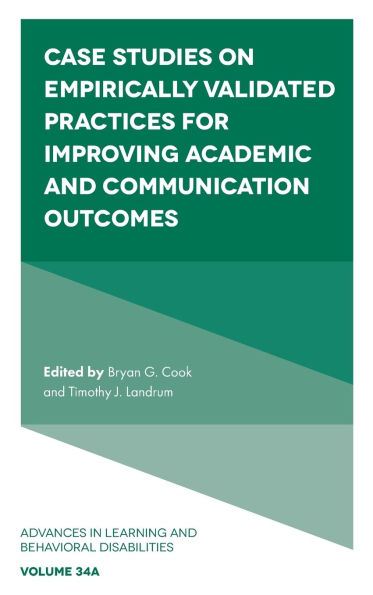
Case Studies on Empirically Validated Practices for Improving Academic and Communication Outcomes
Although there is broad agreement that research should inform the instruction of students with learning and behavioral disabilities, implementation of research—based practices in real schools and classrooms is a nuanced endeavor, fraught with challenges. This volume of case studies illuminates the realities and complexities of implementing research—based instructional programs and practices targeting improved behavioral outcomes in real—world settings. The case studies featured in each chapter are authored or co—authored by educators who are or who have recently been in the classroom and highlights their experiences in critical stages of implementing evidence—based practices, such as selection of the practice (e.g., evaluation of evidence, alignment with learner needs and characteristics, consideration of resources), implementation of the practices (e.g., training and supports, challenges/difficulties, fidelity and adaptations), evaluation of effects, and long—term implementation and impacts.

Recommendations for implementing the targeted practice are suggested, and collectively the case studies in this volume provide educators of students with learning and behavioral disabilities with lessons to inform the implementation of research—based practices.

1147488283
Case Studies on Empirically Validated Practices for Improving Academic and Communication Outcomes
Although there is broad agreement that research should inform the instruction of students with learning and behavioral disabilities, implementation of research—based practices in real schools and classrooms is a nuanced endeavor, fraught with challenges. This volume of case studies illuminates the realities and complexities of implementing research—based instructional programs and practices targeting improved behavioral outcomes in real—world settings. The case studies featured in each chapter are authored or co—authored by educators who are or who have recently been in the classroom and highlights their experiences in critical stages of implementing evidence—based practices, such as selection of the practice (e.g., evaluation of evidence, alignment with learner needs and characteristics, consideration of resources), implementation of the practices (e.g., training and supports, challenges/difficulties, fidelity and adaptations), evaluation of effects, and long—term implementation and impacts.

Recommendations for implementing the targeted practice are suggested, and collectively the case studies in this volume provide educators of students with learning and behavioral disabilities with lessons to inform the implementation of research—based practices.

124.0 In Stock
Case Studies on Empirically Validated Practices for Improving Academic and Communication Outcomes

Case Studies on Empirically Validated Practices for Improving Academic and Communication Outcomes

Case Studies on Empirically Validated Practices for Improving Academic and Communication Outcomes

Case Studies on Empirically Validated Practices for Improving Academic and Communication Outcomes

Hardcover

$124.00 
  • SHIP THIS ITEM
    In stock. Ships in 6-10 days.
  • PICK UP IN STORE

    Your local store may have stock of this item.

Related collections and offers


Overview

Although there is broad agreement that research should inform the instruction of students with learning and behavioral disabilities, implementation of research—based practices in real schools and classrooms is a nuanced endeavor, fraught with challenges. This volume of case studies illuminates the realities and complexities of implementing research—based instructional programs and practices targeting improved behavioral outcomes in real—world settings. The case studies featured in each chapter are authored or co—authored by educators who are or who have recently been in the classroom and highlights their experiences in critical stages of implementing evidence—based practices, such as selection of the practice (e.g., evaluation of evidence, alignment with learner needs and characteristics, consideration of resources), implementation of the practices (e.g., training and supports, challenges/difficulties, fidelity and adaptations), evaluation of effects, and long—term implementation and impacts.

Recommendations for implementing the targeted practice are suggested, and collectively the case studies in this volume provide educators of students with learning and behavioral disabilities with lessons to inform the implementation of research—based practices.


Product Details

ISBN-13: 9781835492437
Publisher: Emerald Publishing Limited
Publication date: 11/17/2025
Series: Advances in Learning and Behavioral Disabilities , #34
Pages: 176
Product dimensions: 5.98(w) x 9.02(h) x 0.53(d)

About the Author

Bryan G. Cook, University of Virginia

Timothy J. Landrum, University of Louisville

Table of Contents

Chapter 1. Case Studies on Empirically Validated Instructional Practices for Improving Academic and Communication Outcomes: An Introduction to the Volume; Bryan G. Cook and Timothy J. Landrum
Chapter 2. Implementing Reading Mastery as a Component of Tiered Literacy Instruction; Kristen R. Rolf, Peter Ehlen, and Teresa Buttars
Chapter 3. Implementing the Science of Teaching Reading in Upper Elementary Grades: A School—UniversityPartnership Case Study; Heather Haynes Smith, Caroline Arce, Sophie Zertuche, Ariana Castillo, and Madison Habeck
Chapter 4. Coaching Rural School Teachers to Implement Schoolwide Literacy Practices to Improve Reading Outcomes for Students with Disabilities; S. Blair Payne, Elizabeth Swanson, R. LeeAnn McGraw, Colleen K. Reutebuch, Jamie A. Smith Levitan, Erin Hogan, and Jade Wexler
Chapter 5. Using Screener Data and Individualized Reading Plans to Promote Literacy Growth for Students with and at Risk for Reading Difficulty; Carlin Conner, Christa Haring, Laura J. Darcy, Austen Hecker, and Emily J. Solari
Chapter 6. Supporting Emergent Bilingual Students with Disabilities in Content Area Instruction; Calli Lewis Chiu, Mandy Lusk, and Barbara Arreguin
Chapter 7. From research to practice: The Nuffield Early Language Intervention’s (NELI’s) journey across the Atlantic; Danielle M. Thompson, Nickie Nelson, Charles Hulme, Margaret J. Snowling, and Tiffany P. Hogan
Chapter 8. Organizational Strategies for Picture Exchange Communication System (PECS) Implementation: Insight from the Classroom; Alexandra N. Mercado Baez, Tyler—Curtis C. Elliott, Natalie J. Morris, and Kevin M. Ayres
Chapter 9. From Research to the Classroom: Adapting an Emotion Communication Intervention; Amanda Eiser Hess

From the B&N Reads Blog

Customer Reviews