
See also Dattilio's edited volume, Case Studies in Couple and Family Therapy, which features case presentations from distinguished practitioners plus commentary from Dattilio on how to integrate systemic and cognitive perspectives.
See also Dattilio's edited volume, Case Studies in Couple and Family Therapy, which features case presentations from distinguished practitioners plus commentary from Dattilio on how to integrate systemic and cognitive perspectives.

Cognitive-Behavioral Therapy with Couples and Families: A Comprehensive Guide for Clinicians
282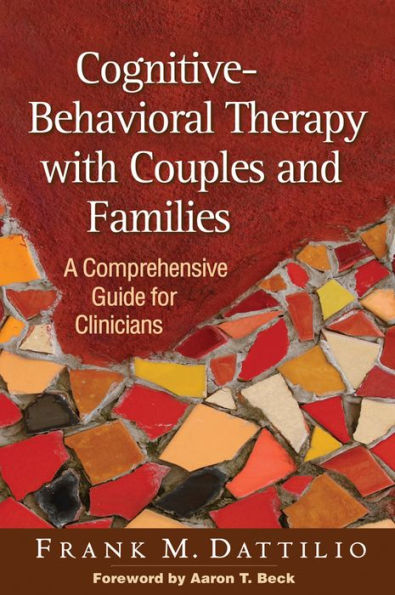
Cognitive-Behavioral Therapy with Couples and Families: A Comprehensive Guide for Clinicians
282eBook
Available on Compatible NOOK devices, the free NOOK App and in My Digital Library.
Related collections and offers
Overview
See also Dattilio's edited volume, Case Studies in Couple and Family Therapy, which features case presentations from distinguished practitioners plus commentary from Dattilio on how to integrate systemic and cognitive perspectives.

Product Details
| ISBN-13: | 9781606234549 |
|---|---|
| Publisher: | Guilford Publications, Inc. |
| Publication date: | 11/06/2009 |
| Sold by: | Barnes & Noble |
| Format: | eBook |
| Pages: | 282 |
| File size: | 3 MB |
About the Author
Read an Excerpt
CHAPTER 1
Introduction
OVERVIEW OF CONTEMPORARY COGNITIVE-BEHAVIORAL THERAPY WITH COUPLES AND FAMILIES
Cognitive-behavioral therapy (CBT) with couples and families has now entered the mainstream of contemporary family therapy and prominently appears in the majority of major textbooks in the field (Sexton, Weeks, & Robbins, 2003; Nichols & Schwartz, 2008; Goldenberg & Goldenberg,2008; Becvar & Becvar, 2009; Bitter, 2009).
In a national survey conducted within the past decade by the American Association for Marriage and Family Therapy (AAMFT), marriage and family therapists were asked to report "their primary treatment modality" (Northey, 2002, p. 448). Of the 27 different modalities that were mentioned, the most frequently identified modality was cognitive-behavioral family therapy (Northey, 2002). More recently, an additional survey, partnered with Columbia University, reported that of the 2,281 responders, 1,566 (68.7%) stated that they most often use CBT in combination with other methods (Psychotherapy Networker, 2007). This data is telling and reflects the utility and effectiveness of CBT with couples and families.
Applications of CBT to problems with intimate relationships were introduced almost 50 years ago with Albert Ellis's early writings on the important role that cognition plays in marital problems (Ellis & Harper, 1961). Ellis and his colleagues proposed that relationship dysfunction occurs when individuals (1) hold irrational or unrealistic beliefs about their partners and the relationship and (2) make negative evaluations when the partner and relationship do not live up to unrealistic expectations. When these negative cognitive processes occur, the individual is likely to experience strong negative emotions (anger, disappointment, and bitterness) and to behave in negative ways toward the partner. The principles of Ellis's rational-emotive therapy (RET) were applied to work with distressed couples, challenging the irrationality of their thinking (Ellis, 1977; Ellis, Sichel, Yeager, DiMattia, & DiGiuseppe, 1989). However, despite the popularity of RET as a form of individual and group treatment for many individual problems, RET with intimate relationships received only a lukewarm reception from couple and family therapists during the 1960s and 1970s. These decades marked the early development of the field of couple and family therapy, which was spearheaded by theorists and clinicians who eschewed models that focused on psychological processes and linear causality in favor of family interaction patterns and the circular causal concepts of systems theory (Nichols & Schwartz, 2008). Ellis's emphasis on individual cognition and the generally linear nature of his "ABC" model, in which irrational beliefs mediated individuals' emotional and behavioral responses to life events, was seen as incompatible with a family systems approach.
LEARNING THEORY PRINCIPLES
Another major development in psychotherapy during the 1960s and early 1970s involved behavior therapists' utilization of learning theory principles to address various problematic behaviors of children and adults. Later, behavior principles and techniques that were used successfully in the treatment of individuals were applied to distressed couples and families. For example, Stuart (1969), Liberman (1970), and Weiss, Hops, and Patterson (1973) described the use of social exchange theory and operant learning strategies to facilitate more satisfying interactions in distressed couples. Similarly, Patterson, McNeal, Hawkins, and Phelps (1967) and others (e.g., LeBow, 1976: Wahler, Winkel, Peterson, & Morrison, 1971) applied operant conditioning and contingency-contracting procedures to help parents control the behavior of aggressive children. This operant approach offered solid empirical support and became popular among behaviorally oriented therapists, but still received little recognition from couple and family therapists.
The behavioral approaches shared with family systems approaches a focus on observable behavior and the factors in interpersonal relationships that influence it. However, there were fundamental differences that made behavior therapies unappealing to many couple and family therapists. First, the behavioral model, with its emphasis on stimulus and response, tended to be too linear for systemically oriented therapists. Second, the systems theorists believed that an individual's symptomatic behavior served a function in the family, which seemed compatible with behaviorists' notion of "functional analysis" of antecedents and consequences of problematic behaviors. Family therapists commonly focused more on the individual's symptoms as having symbolic meaning for a larger family problem. Thus, even though early forms of behavioral family therapy did attend to the reciprocal influences that parents' and children's behavior have on each other, couple and family therapists tended to consider them relatively linear and simplistic when it came to accounting for complex family interactions. The early behavioral approach to family therapy was highlighted by specifying family problems in concrete, observable terms, and with the design of specific empirically based therapeutic strategies. These strategies were subjected to empirical analysis of their effects in achieving specific behavioral goals (Falloon & Lillie, 1988).
Robert Liberman (1970) contends that neither the family therapist nor the family he or she was treating needed to particularly understand the family dynamics in order to make a change in the family system. Liberman believed that a careful behavioral analysis was all that was required.
The late Ian Falloon (1998), however, encouraged behavioral couple and family therapists to adopt an open-systems approach that examined the multiplicity of forces that might operate within a family. He stressed a focus on the physiological status of the individual, as well as his or her cognitive, behavioral, and emotional responses, along with the interpersonal transactions that occur within the family, social, work, and cultural-political networks. "No single system is the focus to the exclusion of others" (p. 14). Hence, Falloon advocated for a more contextual approach, whereby each potentially causative factor should be considered in relation to other factors. This contextual approach was elaborated by Arnold Lazarus (1976) in his multimodal assessment approach. Ironically, family system approaches have focused almost exclusively on intrafamilial dynamics, viewing extrafamilial stress factors as almost irrelevant. The goal of a behavioral analysis is to explore all systems operating on each spouse or family member that contribute to the presenting problems. It is for this reason that pioneering behavioral family therapist Gerald Patterson (1974) stressed the need for assessment to occur in different settings, such as in adjunctive agencies or in school or work environments.
As behaviorally oriented therapists added the components of communication and problem-solving skills training to their interventions with couples and families (e.g., Falloon, 1988; Falloon, Boyd, & McGill, 1984; Jacobson & Margolin, 1979; Stuart, 1980), those interventions were often adopted by traditional family therapists. One reason for this integration seems to be that systemic therapists have commonly considered communication processes to be central in family interaction and have valued structured techniques for reducing the number of unclear messages family members send to one another.
However, there were still differences between the assumptions of systemic therapists and those of behavioral therapists about the role of communication in family functioning. Drawing from the legacy of concepts such as the double-bind hypothesis (Bateson, Daveson, Haley, & Weakland, 1956), which posited that contradictory and constraining messages from parents contribute to the development of psychotic thinking, systemically oriented therapists viewed communication training as a means of reducing the homeostatic function of an identified patient's disturbed behavior within the family. The double-bind theory has since been refuted (Firth & Johnstone, 2003; Kidman, 2007).
Research on family communication and mental disorders has not supported the view that disordered communication causes mental disorders, but rather that it acts as a stressor on an individual's biological vulnerability to a disorder (Mueser & Glynn, 1999). Behavioral family therapists such as Falloon and associates (1984) focused on altering unclear and negative family communication that acts as one of the major life stressors and increases the likelihood that symptoms of psychopathology will be exhibited. Research on expressed emotion, or the degree to which family members exhibit criticism, hostility, and emotional overinvolvement with a member diagnosed with a major mental disorder, demonstrated that such conditions within the family decreased the probability that the identified patient would improve with treatment and increased the likelihood that he or she would experience relapses (Miklowitz, 1995). Furthermore, behavioral family therapists viewed the clear, constructive expression of thoughts and emotions, empathic listening, and efficient problem-solving skills as crucial for the resolution of conflicts among family members, including couple conflicts and parent-child conflicts. Findings by researchers in several countries indicated that behaviorally oriented therapy that included communication and problem-solving skills training produced significant improvement in family functioning (Mueser & Glynn, 1999). Furthermore, studies on couple communication by researchers such as Christensen (1988) and Gottman (1994) indicated the importance of reducing avoidant behaviors, in addition to aggressive acts, between distressed partners. It appears that a lack of awareness of these developments has perpetrated the idea that behavior therapy is simplistic.
As behaviorally oriented therapists developed more comprehensive approaches to modifying family interactions that contribute to distressed relationships, their methods became more appealing to couple and family therapists whose work was guided by systems theory (Falloon, 1988). Nevertheless, schools of family therapy that have emphasized the modification of behavior patterns (e.g., the structural-strategic and solution-focused approaches) typically continued to use interventions that were different from those used by behavioral couple and family therapists (e.g., directives, paradoxical prescriptions, and unbalancing interventions, such as temporarily siding with one family member).
COGNITIVE THERAPY PRINCIPLES
It was not until the late 1970s that cognitions were introduced as a component of treatment within a behavior paradigm (Margolin & Weiss, 1978). Behavior therapists initially viewed cognitive techniques with disdain, perceiving them to be difficult to measure with any degree of reliability. This thinking, however, gradually changed with the release of new research results. Behavioral researchers such as Jacobson (1992) and Hahlweg, Baucom, and Markman (1988) provided examples of the systematic use of cognitive strategies in couple therapy: teaching spouses to recognize precipitants of disagreements and to subsequently restructure their behaviors. This was later followed up by a number of researchers, most specifically Baucom and Epstein (1990).
During the 1980s, cognitive factors became an area of increasing focus in the couple research and therapy literature. Cognitions were addressed in a more direct and systematic way by behaviorally oriented therapists (e.g., Baucom, 1987; Dattilio, 1989; Eidelson & Epstein, 1982; Epstein, 1982; Epstein & Eidelson, 1981; Fincham, Beach, & Nelson, 1987; Weiss, 1984) than by adherents of other theoretical approaches to couple and family therapy. Clearly, family members' thought processes have been considered important in a variety of family therapy theoretical orientations (e.g., reframing in the strategic approach, "problem-talk" in solution-focused therapy, and life stories in narrative therapy). However, none of the original mainstream family therapy approaches has used the concepts and systematic methods of CBT to assess and intervene with cognition in intimate relationships. Traditional family therapists looked at cognition, but only in very simple ways, such as addressing the specific thoughts that family members expressed and their obvious conscious attitudes. However, cognitive therapists were busy developing more thorough and complex ways to deal with family members' underlying belief systems that drove interaction with one another.
Established cognitive assessment and intervention methods derived from individual therapy were adapted by cognitive-behavioral therapists for use in couple therapy to identify and modify distorted cognitions that partners experience about each other (Baucom & Epstein, 1990; Dattilio & Padesky, 1990). As in individual psychotherapy, cognitive-behavioral interventions for couples were designed to enhance partners' skills for evaluating and modifying their own problematic cognitions, as well as skills for communicating and solving problems constructively (Baucom & Epstein, 1990; Epstein & Baucom, 2002).
Similarly, behavioral approaches to family therapy were broadened to include family members' cognitions about one another. Ellis (1982) was one of the first to introduce a cognitive approach to family therapy, using his RET approach. At the same time, Bedrosian (1983) applied Beck's model of cognitive therapy to understanding and treating dysfunctional family dynamics, as did Barton and Alexander (1981), which evolved into what later became known as functional family therapy (Alexander & Parsons, 1982). During the 1980s and 1990s the cognitive-behavioral family therapy (CBFT) model saw a rapid expansion (Alexander, 1988; Dattilio, 1993; Epstein & Schlesinger, 1996; Epstein, Schlesinger, & Dryden, 1988; Falloon et al., 1984; Schwebel & Fine, 1994; Teichman, 1981, 1992), and CBFT is now featured as a major treatment approach in family therapy textbooks (e.g., Becvar, 2008; Goldenberg & Goldenberg, 2000; Nichols & Schwartz, 2008; Bitter, 2009).
THE INTEGRATIVE POTENTIAL OF COGNITIVE-BEHAVIORAL THERAPY
Unfortunately, there are very few empirical outcome studies on CBT with families. Faulkner, Klock, and Gale (2002) conducted a content analysis on articles published in the marital/couple and family therapy literature from 1980 to 1999. The American Journal of Family Therapy, Contemporary Family Therapy, Family Process, and the Journal of Marital and Family Therapy were among the top journals from which 131 articles that used quantitative research methodology were examined. Of these 131 articles, fewer than half involved outcome studies. None of these studies that were reviewed considered CBT. A more recent scan of the professional literature indicates that this statistic has remained consistent (Dattilio, 2004a).
However, cognitive-behavioral couple therapy (CBCT) has been subjected to more controlled outcome studies than has any other therapeutic modality. There is substantial empirical evidence from treatment outcome studies with couples to indicate the effectiveness of CBT with relationships, although most studies have primarily focused on the behavior interventions of communication training, problem-solving training, and behavior contracts, with only a handful examining the impact of cognitive restructuring procedures (see Baucom et al., 1998, for a review that employed stringent criteria for efficacy). Baucom et al.'s (1998) review of outcome studies indicated that CBT is efficacious in reducing relationship distress. A smaller but growing number of studies on other marital and family therapy approaches, such as emotionally focused (Johnson & Talitman, 1997) and insight-oriented couple therapies (Snyder, Wills, & Grady-Fletcher, 1991), suggest that they have comparable, or in some cases, even better outcome results than the cognitive-behavioral approaches. Additional studies are necessary to enable us to draw conclusions about the relative efficacies of these empirically supported treatments, but there is encouraging support for cognitive-behavioral, emotionally focused, and insight-oriented therapies as treatments that can be helpful to many distressed couples (Davis & Piercy, 2007).
There has been less research on generic applications with individual disorders, such as schizophrenia and child conduct disorders. Outcome studies have demonstrated the effectiveness of behaviorally oriented family interventions (psychoeducation and training in communication and problem-solving skills) with such disorders (Baucom et al., 1998), although cognitive interventions, per se, have not been evaluated. As increasing emphasis has been placed on empirically validated treatments in the mental health field, the cognitive-behavioral approach has gained popularity and respect among clinicians, including couple and family therapists (Dattilio, 1998a; Dattilio & Epstein, 2003; Epstein & Baucom, 2002; Davis & Piercy, 2007). Sprenkle (2003) has noted the application of more rigorous outcome criteria in research on couple and family therapy, and the movement of the field in general toward a more evidenced-based discipline. In addition, there appears to be more attention given to case-based reports within the family therapy literature. Traditionally, case-based research has not been considered as scientific by many in the field, owing to the lack of controlled conditions and objectivity. However, case study materials can serve as the basis for drawing causal inferences in properly designed clinical cases (Dattilio, 2006a) and, in many ways, seem to be preferred among students and trainees.
(Continues…)
Excerpted from "Cognitive-Behavioral Therapy With Couples and Families"
by .
Copyright © 2010 The Guilford Press.
Excerpted by permission of The Guilford Press.
All rights reserved. No part of this excerpt may be reproduced or reprinted without permission in writing from the publisher.
Excerpts are provided by Dial-A-Book Inc. solely for the personal use of visitors to this web site.
Table of Contents
1. Introduction2. The Mechanics of Change with Couples and Families
3. The Schema Component in Cognitive-Behavioral Therapy
4. The Role of Neurobiological Processes
5. Methods of Clinical Assessment
6. Cognitive-Behavioral Techniques
7. Special Topics
8. Enhancements to Cognitive-Behavioral Therapy
9. Case Examples
10. Epilogue
Appendix A. Questionnaires and Inventories for Couples and Families
Appendix B. Dysfunctional Thought Record
Interviews
Clinicians who treat couples and families, including couple and family therapists and counselors, clinical psychologists, social workers, pastoral counselors, and psychiatrists; students in these fields. Serves as a text in such courses as Cognitive-Behavioral Couple Therapy, Marriage and Family Therapy, and Social Work Practice with Families and Couples.