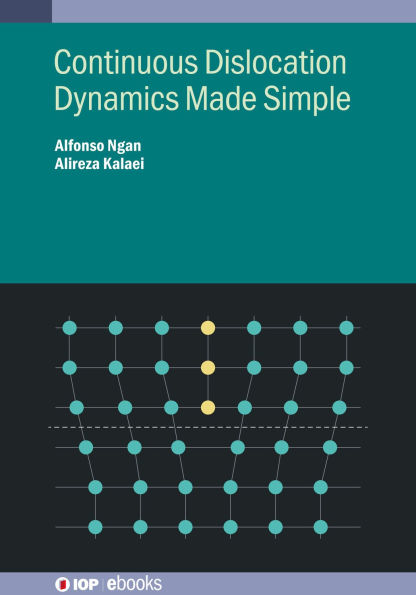
Continuous Dislocation Dynamics Made Simple

This book presents an easy-to-read introduction to Continuous Dislocation Dynamics (CDD). It aims at introducing CDD as an exact approach to crystal plasticity. The starting point is Maxwell’s equation for moving lines, which is generalized to densities of parallel dislocation quantities, and then to an “all-dislocation” density (ADD) defined on both the spatial and dislocation-character domains. The ADD is a representation of dislocation density of a coarse-grained resolution suitable for handling large systems, and yet an exact kinematics law is available.

Written in a style which aims to facilitate understanding of the difficult mathematical concepts of dislocation dynamics, the book provides simple illustrations and key computer codes. Suitable readers would be senior undergraduates or starting graduate students with a basic understanding of dislocations and engineering mathematics.

Key Features:

  • Explores the first dedicated treatment to CDD, an important meso-scale modelling method for dislocation plasticity
  • Focuses on exact theories of CDD
  • Presents an easy-to-read introduction to the subject at a level that is suitable for senior undergraduate or starting PhD students
  • Includes worked examples, simulation codes and simulation videos
1146025719
Continuous Dislocation Dynamics Made Simple

This book presents an easy-to-read introduction to Continuous Dislocation Dynamics (CDD). It aims at introducing CDD as an exact approach to crystal plasticity. The starting point is Maxwell’s equation for moving lines, which is generalized to densities of parallel dislocation quantities, and then to an “all-dislocation” density (ADD) defined on both the spatial and dislocation-character domains. The ADD is a representation of dislocation density of a coarse-grained resolution suitable for handling large systems, and yet an exact kinematics law is available.

Written in a style which aims to facilitate understanding of the difficult mathematical concepts of dislocation dynamics, the book provides simple illustrations and key computer codes. Suitable readers would be senior undergraduates or starting graduate students with a basic understanding of dislocations and engineering mathematics.

Key Features:

  • Explores the first dedicated treatment to CDD, an important meso-scale modelling method for dislocation plasticity
  • Focuses on exact theories of CDD
  • Presents an easy-to-read introduction to the subject at a level that is suitable for senior undergraduate or starting PhD students
  • Includes worked examples, simulation codes and simulation videos
159.0 In Stock
Continuous Dislocation Dynamics Made Simple

Continuous Dislocation Dynamics Made Simple

Continuous Dislocation Dynamics Made Simple

Continuous Dislocation Dynamics Made Simple

eBook

$159.00 

Available on Compatible NOOK devices, the free NOOK App and in My Digital Library.
WANT A NOOK?  Explore Now

Related collections and offers


Overview

This book presents an easy-to-read introduction to Continuous Dislocation Dynamics (CDD). It aims at introducing CDD as an exact approach to crystal plasticity. The starting point is Maxwell’s equation for moving lines, which is generalized to densities of parallel dislocation quantities, and then to an “all-dislocation” density (ADD) defined on both the spatial and dislocation-character domains. The ADD is a representation of dislocation density of a coarse-grained resolution suitable for handling large systems, and yet an exact kinematics law is available.

Written in a style which aims to facilitate understanding of the difficult mathematical concepts of dislocation dynamics, the book provides simple illustrations and key computer codes. Suitable readers would be senior undergraduates or starting graduate students with a basic understanding of dislocations and engineering mathematics.

Key Features:

  • Explores the first dedicated treatment to CDD, an important meso-scale modelling method for dislocation plasticity
  • Focuses on exact theories of CDD
  • Presents an easy-to-read introduction to the subject at a level that is suitable for senior undergraduate or starting PhD students
  • Includes worked examples, simulation codes and simulation videos

Product Details

ISBN-13: 9780750363303
Publisher: Institute of Physics Publishing
Publication date: 07/16/2024
Series: IOP ebooks
Sold by: Barnes & Noble
Format: eBook
Pages: 200
File size: 10 MB

About the Author

Alfonso Ngan is Kingboard Professor in Materials Engineering and Chair in Materials Science and Engineering at the University of Hong Kong (HKU). He obtained his PhD from the University of Birmingham, UK in 1992, and carried out postdoctoral research work at the University of Oxford, before joining HKU in 1993. His research interests include nanomechanics, smart actuating materials, and microstructural basis of material properties. He is an editorial board member for the IOP journal Modelling and Simulation in Materials Science and Engineering.

Alireza Kalaei is currently pursuing PhD studies at the University of Hong Kong. Prior to this, he completed his undergraduate studies at the Sharif University of Technology in 2020 and finished his MPhil studies at the University of Hong Kong in 2022. His research interests include mechanical properties of materials, microstructural basis of strength, and computational materials science. On the topic of continuous dislocation dynamics, he has made important contributions to the development of numerical schemes and simulation codes.

Table of Contents

Ch 1: Introduction: Why need CDD

Ch 2: What are dislocation densities?

Ch 3: Kinematics of intensive line density: evolution laws and simulation codes

Ch 4: Dynamics of intensive line density

Ch 5: “All-dislocation density” (ADD) for extensive microstructures - kinematics and dynamics closure

Ch 6: Numerical scheme for extensive microstructure simulation

Ch 7: Conclusion and Perspectives

From the B&N Reads Blog

Customer Reviews