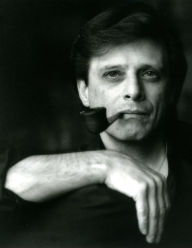
Harlan Ellison (1934–2018) wrote and edited more than 120 books and more than 1,700 stories, essays, and articles, as well as dozens of screenplays and teleplays. He won the Hugo Award nine times, the Nebula Award four times, the Bram Stoker Award six times (including the Lifetime Achievement Award in 1996), the Edgar Allan Poe Award of the Mystery Writers of America twice, the Georges Méliès Fantasy Film Award twice, and was awarded the Silver Pen for Journalism by PEN, the international writer’s union. He was named a Grand Master by the Science Fiction and Fantasy Writers of America in 2006.
Samuel R. Delany, winner of multiple Nebula and Hugo awards, is an acclaimed writer of speculative fiction. In 2002, he was inducted by the Science Fiction and Fantasy Hall of Fame. In 2010, he was awarded the third J. Lloyd Eaton Lifetime Achievement Award in Science Fiction from the academic Eaton Science Fiction Conference. The Science Fiction Writers of America named him its thirtieth Grand Master in 2013. For his lifetime contribution to lesbian and gay literature, he was awarded the Bill Whitehead Award.
Frederik Pohl (1919–2013) won the National Book Award in 1980 for his novel Jem. From about 1959 until 1969, he edited Galaxy magazine and its sister magazine, If, winning the Hugo Award for it three years in a row. His writing also won him four Hugos and multiple Nebula Awards. He became a Nebula Grand Master in 1993. In 2010 he won the Hugo Award for Best Fan Writer, based on the writing on his blog, “The Way the Future Blogs.”
J.G. Ballard (1930-2009) was an English writer of short stories and novels. Several of his best-known works were adapted into successful movies, including Crash, and Empire of the Sun. A continual recipient of critical acclaim, the Times included him in their 2008 list of The 50 Greatest British Writers.
Robert Silverberg is one of science fiction's most beloved writers, and the author of such contemporary classics as Dying Inside, Downward to the Earth, and Lord Valentine's Castle. He is a past president of the Science Fiction and Fantasy Writers of America and the winner of five Nebula Awards and five Hugo Awards. In 2004 the Science Fiction and Fantasy Writers of America presented him with the Grand Master Award. Silverberg is one of twenty-nine writers to have received that distinction.
Larry Niven is the New York Times bestselling and multiple Hugo, Locus, and Nebula Award–winning author of science fiction short stories and novels, including the Ringworld series and The Burning City, as well as many other science fiction masterpieces.
Roger Zelazny (1937-1995) was an American author of science fiction and fantasy novels, as well as many short stories. Known for including both mythological characters of different origins as well as elements from real history, Zelazny is perhaps best known for The Chronicles of Amber series. He was awarded the Nebula award three times and the Hugo award six times.
Poul Anderson (1926–2001) was one of the most prolific and popular writers in science fiction. He won the Hugo Award seven times and the Nebula Award three times, as well as many other awards, including the Grand Master Award of the Science Fiction Writers of America for a lifetime of distinguished achievement. With a degree in physics and a wide knowledge of other fields of science, he was noted for building stories on a solid foundation of real science, as well as for being one of the most skilled creators of fast-paced adventure stories. He was author of over one hundred novels and story collections, several hundred short stories, and several mysteries and nonfiction books.
Isaac Asimov began his Foundation Series at the age of twenty-one, not realizing that it woudl one day be considered a conerstone of science fiction. During his legendary career, Asimov penned over 470 books on subjects ranging from science to Shakespeare to histroy, though he was most loved for his award-winning science fiction sagas, whcih include the Robot, Empire, and Foundation series. Named a Grand Master of Science Fiction by the Science Fiction and Fantasy Writers of America, Asimov entertained and educated readers of all ages for close to five decades. He died, at the age of seventy-two, in April 1992.
Over a writing career that spanned three decades, PHILIP K. DICK (1928–1982) published 36 science fiction novels and 121 short stories in which he explored the essence of what makes man human and the dangers of centralized power. Toward the end of his life, his work turned to deeply personal, metaphysical questions concerning the nature of God. Eleven novels and short stories have been adapted to film, notably Blade Runner (based on Do Androids Dream of Electric Sheep?), Total Recall, Minority Report, and A Scanner Darkly, as well as television's The Man in the High Castle. The recipient of critical acclaim and numerous awards throughout his career, including the Hugo and John W. Campbell awards, Dick was inducted into the Science Fiction Hall of Fame in 2005, and between 2007 and 2009, the Library of America published a selection of his novels in three volumes. His work has been translated into more than twenty-five languages.