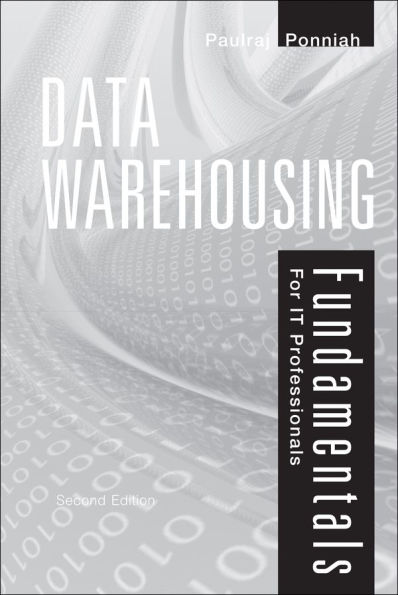
Data Warehousing Fundamentals for IT Professionals [NOOK Book]

Overview

Since the first edition of Data Warehousing Fundamentals, there has been an increase in enterprises either already having or in the process of obtaining the data warehousing programs. Data Warehousing Fundamentals not only explores important topics, like planning requirements, architecture, infrastructure, data preparation, and information delivery, but also the most up-to-date research on areas of technological improvements since the first edition. Additionally, Information Technologists will find expert advice,...
See more details below
Data Warehousing Fundamentals for IT Professionals

Available on NOOK devices and apps  
  • Nook Devices
  • NOOK HD/HD+ Tablet
  • NOOK
  • NOOK Color
  • NOOK Tablet
  • Tablet/Phone
  • NOOK for Windows 8 Tablet
  • NOOK for iOS
  • NOOK for Android
  • NOOK Kids for iPad
  • PC/Mac
  • NOOK for Windows 8
  • NOOK for PC
  • NOOK for Mac
  • NOOK Study
  • NOOK for Web

Want a NOOK? Explore Now

NOOK Book (eBook)
$75.81
BN.com price
(Save 43%)$133.00 List Price
Note: This NOOK Book can be purchased in bulk. Please email us for more information.

Overview

Since the first edition of Data Warehousing Fundamentals, there has been an increase in enterprises either already having or in the process of obtaining the data warehousing programs. Data Warehousing Fundamentals not only explores important topics, like planning requirements, architecture, infrastructure, data preparation, and information delivery, but also the most up-to-date research on areas of technological improvements since the first edition. Additionally, Information Technologists will find expert advice, review questions, exercises, as well as an answer section are all included in this revised text.
Read More Show Less

Product Details

  • ISBN-13: 9781118211304
  • Publisher: Wiley, John & Sons, Incorporated
  • Publication date: 9/20/2011
  • Sold by: Barnes & Noble
  • Format: eBook
  • Edition number: 2
  • Pages: 600
  • File size: 8 MB

Meet the Author

Paulraj Ponnian, PhD, with over thirty years of experience as an IT consultant, has worked with such organizations as Texaco, Sotheby’s Blue Cross/Blue Shield, NA Philips, New York-Presbyterian Hospital, Panasonic, and Bantam Doubleday Dell. He specializes in the design and Implementation of data warehouse and database systems. Dr. Ponniah has published three successful books and, as Adjunct Professor, continues to teach college courses in data warehousing and database design.

Read More Show Less

Table of Contents

Preface.

Part 1 OVERVIEW AND CONCEPTS.

1 The Compelling Need for Data Warehousing.

Chapter Objectives.

Escalating Need for Strategic Information.

Failures of Past Decision Support Systems.

Operational Versus Decision-Support Systems.

Data Warehousing—The Only Viable Solution.

Data Warehouse Defined.

The Data Warehousing Movement.

Evolution of Business Intelligence.

Chapter Summary.

Review Questions.

Exercises.

2 Data Warehouse: The Building Blocks.

Chapter Objectives.

Defining Features.

Data Warehouses and Data Marts.

Architectural Types.

Overview of Components.

Metadata in the Data Warehouse.

Chapter Summary.

Review Questions.

Exercises.

3 Trends in Data Warehousing.

Chapter Objectives.

Continued Growth in Data Warehousing.

Vendor Solutions and Products.

Significant Trends.

Emergence of Standards.

Web-Enabled Data Warehouse.

Chapter Summary.

Review Questions.

Exercises.

Part 2 PLANNING AND REQUIREMENTS.

4 Planning and Project Management.

Chapter Objectives.

Planning Your Data Warehouse.

The Data Warehouse Project.

The Project Team.

Project Management Considerations.

Chapter Summary.

Review Questions.

Exercises.

5 Defining the Business Requirements.

Chapter Objectives.

Dimensional Analysis.

Information Packages—A Useful Concept.

Requirements Gathering Methods.

Requirements Definition: Scope and Content.

Chapter Summary.

Review Questions.

Exercises.

6 Requirements as the Driving Force for Data Warehousing.

Chapter Objectives.

Data Design.

The Architectural Plan.

Data Storage Specifications.

Information Delivery Strategy.

Chapter Summary.

Review Questions.

Exercises.

Part 3 ARCHITECTURE AND INFRASTRUCTURE.

7 The Architectural Components.

Chapter Objectives.

Understanding Data Warehouse Architecture.

Distinguishing Characteristics.

Architectural Framework.

Technical Architecture.

Architectural Types.

Chapter Summary.

Review Questions.

Exercises.

8 Infrastructure as the Foundation for Data Warehousing.

Chapter Objectives.

Infrastructure Supporting Architecture.

Hardware and Operating Systems.

Database Software.

Collection of Tools.

Data Warehouse Appliances.

Chapter Summary.

Review Questions.

Exercises.

9 The Significant Role of Metadata.

Chapter Objectives.

Why Metadata is Important.

Metadata Types by Functional Areas.

Business Metadata.

Technical Metadata.

How to Provide Metadata.

Chapter Summary.

Review Questions.

Exercises.

Part 4 DATA DESIGN AND DATA PREPARATION.

10 Principles of Dimensional Modeling.

Chapter Objectives.

From Requirements to Data Design.

The STAR Schema.

STAR Schema Keys.

Advantages of the STAR Schema.

STAR Schema: Examples.

Chapter Summary.

Review Questions.

Exercises.

11 Dimensional Modeling: Advanced Topics.

Chapter Objectives.

Updates to the Dimension Tables.

Miscellaneous Dimensions.

The Snowflake Schema.

Aggregate Fact Tables.

Families of STARS.

Chapter Summary.

Review Questions.

Exercises.

12 Data Extraction, Transformation, and Loading.

Chapter Objectives.

ETL Overview.

Data Extraction.

Data Transformation.

Data Loading.

ETL Summary.

Other Integration Approaches.

Chapter Summary.

Review Questions.

Exercises.

13 Data Quality: A Key to Success.

Chapter Objectives.

Why is Data Quality Critical?.

Data Quality Challenges.

Data Quality Tools.

Data Quality Initiative.

Master Data Management (MDM).

Chapter Summary.

Review Questions.

Exercises.

Part 5 INFORMATION ACCESS AND DELIVERY.

14 Matching Information to the Classes of Users.

Chapter Objectives.

Information from the Data Warehouse.

Who Will Use the Information?

Information Delivery.

Information Delivery Tools.

Information Delivery: Special Topics.

Chapter Summary.

Review Questions.

Exercises.

15 OLAP in the Data Warehouse.

Chapter Objectives.

Demand for Online Analytical Processing.

Major Features and Functions.

OLAP Models.

OLAP Implementation Considerations.

Chapter Summary.

Review Questions.

Exercises.

16 Data Warehousing and the Web.

Chapter Objectives.

Web-Enabled Data Warehouse.

Web-Based Information Delivery.

OLAP and the Web.

Building a Web-Enabled Data Warehouse.

Chapter Summary.

Review Questions.

Exercises.

17 Data Mining Basics.

Chapter Objectives.

What is Data Mining?.

Major Data Mining Techniques.

Data Mining Applications.

Chapter Summary.

Review Questions.

Exercises.

Part 6 IMPLEMENTATION AND MAINTENANCE.

18 The Physical Design Process.

Chapter Objectives.

Physical Design Steps.

Physical Design Considerations.

Physical Storage.

Indexing the Data Warehouse.

Performance Enhancement Techniques.

Chapter Summary.

Review Questions.

Exercises.

19 Data Warehouse Deployment.

Chapter Objectives.

Data Warehouse Testing.

Major Deployment Activities.

Considerations for a Pilot.

Security.

Backup and Recovery.

Chapter Summary.

Review Questions.

Exercises.

20 Growth and Maintenance.

Chapter Objectives.

Monitoring the Data Warehouse.

User Training and Support.

Managing the Data Warehouse.

Chapter Summary.

Review Questions.

Exercises.

Answers to Selected Exercises.

Appendix A. Project Life Cycle Steps and Checklists.

Appendix B. Critical Factors for Success.

Appendix C. Guidelines for Evaluating Vendor Solutions.

Appendix D. Highlights of Vendors and Products.

Appendix E. Real-World Examples of Best Practices.

References.

Glossary.

Index.

Read More Show Less

Customer Reviews

Be the first to write a review
( 0 )
Rating Distribution

5 Star

(0)

4 Star

(0)

3 Star

(0)

2 Star

(0)

1 Star

(0)

Your Rating:

Your Name: Create a Pen Name or

Barnes & Noble.com Review Rules

Our reader reviews allow you to share your comments on titles you liked, or didn't, with others. By submitting an online review, you are representing to Barnes & Noble.com that all information contained in your review is original and accurate in all respects, and that the submission of such content by you and the posting of such content by Barnes & Noble.com does not and will not violate the rights of any third party. Please follow the rules below to help ensure that your review can be posted.

Reviews by Our Customers Under the Age of 13

We highly value and respect everyone's opinion concerning the titles we offer. However, we cannot allow persons under the age of 13 to have accounts at BN.com or to post customer reviews. Please see our Terms of Use for more details.

What to exclude from your review:

Please do not write about reviews, commentary, or information posted on the product page. If you see any errors in the information on the product page, please send us an email.

Reviews should not contain any of the following:

  • - HTML tags, profanity, obscenities, vulgarities, or comments that defame anyone
  • - Time-sensitive information such as tour dates, signings, lectures, etc.
  • - Single-word reviews. Other people will read your review to discover why you liked or didn't like the title. Be descriptive.
  • - Comments focusing on the author or that may ruin the ending for others
  • - Phone numbers, addresses, URLs
  • - Pricing and availability information or alternative ordering information
  • - Advertisements or commercial solicitation

Reminder:

  • - By submitting a review, you grant to Barnes & Noble.com and its sublicensees the royalty-free, perpetual, irrevocable right and license to use the review in accordance with the Barnes & Noble.com Terms of Use.
  • - Barnes & Noble.com reserves the right not to post any review -- particularly those that do not follow the terms and conditions of these Rules. Barnes & Noble.com also reserves the right to remove any review at any time without notice.
  • - See Terms of Use for other conditions and disclaimers.
Search for Products You'd Like to Recommend

Recommend other products that relate to your review. Just search for them below and share!

Create a Pen Name

Your Pen Name is your unique identity on BN.com. It will appear on the reviews you write and other website activities. Your Pen Name cannot be edited, changed or deleted once submitted.

 
Your Pen Name can be any combination of alphanumeric characters (plus - and _), and must be at least two characters long.

Continue Anonymously

    If you find inappropriate content, please report it to Barnes & Noble
    Why is this product inappropriate?
    Comments (optional)