- Shopping Bag ( 0 items )
Chapter 1
The sun beat down on the stained white city, the July sun that hurt the eyes and turned the sea from wine-dark to silver. Soldiers crowded the shade beneath the vendors’ awnings and hugged the lee of the alabaster buildings spilling down to the port. Sweat darkened their collars and cuffs, particularly those of the combat troops wearing heavy herringbone twill. Some had stripped off their neckties, but kept them folded and tucked in their belts for quick retrieval. The commanding general had been spotted along the wharves, and every man knew that George S. Patton, Jr., would levy a $25 fine on any GI not wearing his helmet or tie.
Algiers seethed with soldiers after eight months of Allied occupation: Yanks and Brits, Kiwis and Gurkhas, swabs and tars and merchant mariners who at night walked with their pistols drawn against the bandits infesting the port. Troops swaggered down the boulevards and through the souks, whistling at girls on the balconies or pawing through shop displays in search of a few final souvenirs. Sailors in denim shirts and white caps mingled with French Senegalese in red fezzes, and bearded goums with their braided pigtails and striped burnooses. German prisoners sang “Erika” as they marched in column under guard to the Liberty ships that would haul them to camps in the New World. British veterans in battle dress answered with a ribald ditty called “El Alamein”—“Tally-ho, tally-ho, and that was as far as the bastards did go”—while the Americans belted out “Dirty Gertie from Bizerte,” which was said to have grown to two hundred verses, all of them salacious. “Sand in your shoes,” they called to one another—the North African equivalent of “Good luck”—and with knowing looks they flashed their index fingers to signal “I,” for “invasion.”
Electric streetcars clattered past horsedrawn wine wagons, to be passed in turn by whizzing jeeps. Speeding by Army drivers had become so widespread that military policemen now impounded offenders’ vehicles—although General Eisenhower had issued a blanket amnesty for staff cars “bearing the insignia of a general officer.” Most Algerians walked or resorted to bicycles, pushcarts, and, one witness recorded, “every conceivable variety of buggy, phaeton, carryall, cart, sulky, and landau.” Young Frenchmen strolled the avenues in their narrow-brimmed hats and frayed jackets. Arab boys scampered through the alleys in pantaloons made from stolen barracks bags, with two holes cut for their legs and the stenciled name and serial number of the former owner across the rump. Tatterdemalion beggars in veils wore robes tailored from old Army mattress covers, which also served as winding-sheets for the dead. The only women in Algiers wearing stockings were the hookers at the Hotel Aletti bar, reputed to be the richest wage-earners in the city despite the ban on prostitution issued by military authorities in May.
Above it all, at high noon on July 4, 1943, on the Rue Michelet in the city’s most fashionable neighborhood, a French military band tooted its way through the unfamiliar strains of “The Star-Spangled Banner.” Behind the woodwinds and the tubas rose the lime-washed Moorish arches and crenellated tile roof of the Hôtel St. Georges, headquarters for Allied forces in North Africa. Palm fronds stirred in the courtyard, and the scent of bougainvillea carried on the light breeze.
Vice Admiral Henry Kent Hewitt held his salute as the anthem dragged to a ragged finish. Eisenhower, also frozen in salute on Hewitt’s right, had discouraged all national celebrations as a distraction from the momentous work at hand, but the British had insisted on honoring their American cousins with a short ceremony. The last strains faded and the gunfire began. Across the flat roofs of the lower city and the magnificent crescent of Algiers Bay, Hewitt saw a gray puff rise from H.M.S. Maidstone, then heard the first report. Puff followed puff, boom followed boom, echoing against the hills, as the Maidstone fired seaward across the breakwater.
Nineteen, twenty, twenty-one. Hewitt lowered his salute, but the bombardment continued, and from the corner of his eye the admiral could see Eisenhower with his right hand still glued to his peaked khaki cap. Unlike the U.S. Navy, with its maximum twenty-one-gun tribute, the Army on Independence Day fired forty-eight guns, one for each state, a protocol now observed by Maidstone’s crew. Hewitt resumed his salute until the shooting stopped, and made note of yet another difference between the sister services.
With the ceremony at an end, Hewitt hurried through the courtyard and across the lobby’s mosaic floor to his office, down the corridor from Eisenhower’s corner suite. Every nook of the St. Georges was jammed with staff officers and communications equipment. Eight months earlier, on the eve of the invasion of North Africa, Allied plans had called for a maximum of seven hundred officers to man the Allied Forces Headquarters, or AFHQ, a number then decried by one commander as “two or three times too many.” Now the figure approached four thousand, including nearly two hundred colonels and generals; brigades of aides, clerks, cooks, and assorted horse-holders brought the AFHQ total to twelve thousand. The military messages pouring in and out of Algiers via seven undersea cables were equivalent to two-thirds of the total War Department communications traffic. No message was more momentous than the secret order issued this morning: “Carry out Operation husky.”
Hewitt had never been busier, not even before Operation torch, the assault on North Africa. Then he had commanded the naval task force ferrying Patton’s thirty thousand troops from Virginia to Morocco, a feat of such extraordinary success—not a man had been lost in the hazardous crossing—that Hewitt received his third star and command of the U.S. Navy’s Eighth Fleet in the Mediterranean. After four months at home, he had arrived in Algiers on March 15, and every waking moment since had been devoted to scheming how to again deposit Patton and his legions onto a hostile shore.
He was a fighting admiral who did not look the part, notwithstanding the Navy Cross on his summer whites, awarded for heroism as a destroyer captain in World War I. Sea duty made Hewitt plump, or plumper, and in Algiers he tried to stay fit by riding at dawn with native spahi cavalrymen, whose equestrian lineage dated to the fourteenth-century Ottomans. Despite these efforts, his frame remained, as one observer acknowledged, “well-upholstered.” At the age of fifty-six, the former altar boy and bell ringer from Hackensack, New Jersey, was still proud of his ability to ring out “Softly Now the Light of Day.” He loved double acrostic puzzles and his Keuffel & Esser Log Log Trig slide rule, a device that had been developed at the Naval Academy in the 1930s when he chaired the mathematics department there. His virtues, inconspicuous only to the inattentive, included a keen memory, a willingness to make decisions, and the ability to get along with George Patton. The Saturday Evening Post described Hewitt as “the kind of man who keeps a dog but does his barking himself”; in fact, he rarely even growled. He was measured and reserved, a good if inelegant conversationalist, and a bit pompous. He liked parties, and in Algiers he organized a Navy dance combo called the Scuttlebutt Five. He also had established a soup kitchen for the poor with leavings from Navy galleys; he ate the first bowl himself. Two other attributes served his country well: he was lucky, and he had an exceptional sense of direction, which on a ship’s bridge translated into a gift for navigation. Kent Hewitt always knew where he was.
He called for his staff car—among those privileged vehicles exempt from impoundment—and drove from the St. Georges through the twisting alleyways leading to the port. At every pier around the grand crescent of the bay, ships were moored two and three deep: freighters and frigates, tankers and transports, minesweepers and landing craft. Others rode at anchor beyond the harbor’s submarine nets, protected by patrol planes and destroyers tacking along the coastline. The U.S. Navy had thirty-three camouflage combinations, from “painted false bow wave” to “graded system with splotches,” and most seemed to be represented in the vivid Algiers anchorage. Stevedores swarmed across the decks; booms swung from dock to hold and back to dock again; gantry cranes hoisted pallet after pallet from the wharves onto the vessels. Precautions against fire were in force on every ship: wooden chairs, drapes, excess movie film, even bulkhead pictures had been removed; rags and blankets were ashore or well stowed; sailors—who upon departure would don long-sleeved undershirts as protection against flash burns—had chipped away all interior paint and stripped the linoleum from every mess deck.
Hewitt’s flagship, the attack transport U.S.S. Monrovia, lay moored on the port side of berth 39, on the Mole de Passageurs in the harbor’s Basin de Vieux. Scores of military policemen had boarded for added security, making her desperately overcrowded. Ten to twenty officers packed each cabin on many ships, with enlisted bunks stacked four high, and Monrovia was more jammed than most. With Hewitt’s staff, Patton’s staff, and her own crew, she now carried fourteen hundred men, more than double her normal company. She would also carry, in some of those cargo nets being manhandled into the hold, 200,000 rounds of high-explosive ammunition and 134 tons of gasoline.
The admiral climbed from his car and strode up the gangplank, greeted with a bosun’s piping and a flurry of salutes. Monrovia’s passageways seemed dim and cheerless after the brilliant African light. In the crowded operations room below, staff officers pored over “Naval Operations Order husky,” a tome four inches thick. Twenty typists had needed seven full days to bang out the final draft, of which eight hundred copies were distributed to commanders across North Africa as a blueprint for the coming campaign.
Hewitt could remember his father, a burly mechanical engineer, chinning himself with a hundred-pound dumbbell balanced across his feet. Sometimes the husky ops order felt like that dumbbell. Nothing was simple about the operation except the basic concept: in six days, on July 10, two armies—one American and one British—would land on the southeast coast of Sicily, reclaiming for the Allied cause the first significant acreage in Europe since the war began. An estimated 300,000 Axis troops defended the island, including a pair of capable German divisions, and many others lurked nearby on the Italian mainland.
More than three thousand Allied ships and boats, large and small, were gathering for the invasion from one end of the Mediterranean to the other—“the most gigantic fleet in the world’s history,” as Hewitt observed. About half would sail under his command from six ports in Algeria and Tunisia; the rest would sail with the British from Libya and Egypt, but for a Canadian division coming directly from Britain. Patton’s Seventh Army would land eighty thousand troops in the assault; the British Eighth Army would land about the same, with more legions subsequently reinforcing both armies.
Under the elaborate nautical choreography required, several convoys had already begun steaming: the vast expedition would rendezvous at sea, near Malta, on July 9. A preliminary effort to capture the tiny fortified island of Pantelleria, sixty miles southwest of Sicily, had succeeded admirably: after a relentless three-week air bombardment, the stupefied garrison of eleven thousand Italian troops had surrendered on June 11, giving the Allies both a good airfield and the illusion that even the stoutest defenses could be reduced from the air.
A map of the Mediterranean stretched across a bulkhead in the operations room. Hewitt had become the U.S. Navy’s foremost amphibious expert, with one invasion behind him and another under way; three more were to come before war’s end. One inviolable rule in assaults from the open sea, he already recognized, was that the forces to be landed always exceeded the means to transport them, even with an armada as enormous as this one. From hard experience he also knew that two variables remained outside his control: the strength of the enemy defending the hostile shore and the caprice of the sea itself.
In husky, not only did he have three times more soldiers to put ashore than in Operation torch, he also commanded a flotilla of vessels seeing combat for the first time: nine new variations of landing craft and five new types of landing ship, including the promising LST, an abbreviation for “landing ship, tank,” but which sailors insisted meant “large slow target.” Some captains and crews had never been to sea before, and little was known about the seaworthiness of the new vessels, or how best to beach them, or what draught they would draw under various loads, or even how many troops and vehicles could be packed inside.
Much had been learned from the ragged, chaotic preparations for torch. Much had also been forgotten, or misapplied, or misplaced. The turmoil in North Africa in recent weeks seemed hardly less convulsive than that at Hampton Roads eight months earlier. Seven different directives on how to label overseas cargo had been issued the previous year; the resulting confusion led to formation of the inevitable committee, which led to another directive called the Schenectady Plan, which led to color-coded labels lacquered onto shipping containers, which led to more confusion. Five weeks after issuing a secret alert called Preparations for Movement by Water, the Army discovered that units crucial to husky had never received the order and thus had no plans for loading their troops, vehicles, and weapons onto the convoys. Seventh Army’s initial load plans also neglected to make room for the Army Air Forces, whose kit equaled a third of the Army’s total tonnage requirements. Every unit pleaded for more space; every unit claimed priority; every unit lamented the Navy’s insensitivity.
Despite the risk of German air raids, port lights burned all night as vexed loadmasters received still more manifest changes that required unloading another freighter or repacking another LST. Transportation officers wrestled with small oversights—the Navy had shipped bread ovens but no bread pans—and big blunders, as when ordnance officers mistakenly sent poisonous mustard gas to the Mediterranean. By the time Patton’s staff recognized that particular gaffe, on June 8, gas shells had been shipped with other artillery munitions; they now lay somewhere—no one knew precisely where—in the holds of one or more ships bound for Sicily.
Secrecy was paramount. Hewitt doubted that three thousand vessels could sneak up on Sicily, but husky’s success relied on surprise. All documents that disclosed the invasion destination were stamped with the classified code word bigot, and sentries at the husky planning headquarters in Algiers determined whether visitors held appropriate security clearances by asking if they were “bigoted.” (“I was frequently partisan,” one puzzled naval officer replied, “but had never considered my mind closed.”)
Soldiers and sailors, as usual, remained in the dark and subject to severe restrictions on their letters home. A satire of censorship regulations read to one ship’s crew included rule number 4—“You cannot say where you were, where you are going, what you have been doing, or what you expect to do”—and rule number 8—“You cannot, you must not, be interesting.” The men could, under rule number 2, “say you have been born, if you don’t say where or why.” And rule number 9 advised: “You can mention the fact that you would not mind seeing a girl.”
One airman tried to comply with the restrictions by writing, “Three days ago we were at X. Now we are at Y.” But the prevailing sentiment was best captured by a soldier who told his diary, “We know we are headed for trouble.”
More than half a million American troops now occupied North Africa. They composed only a fraction of all those wearing U.S. uniforms worldwide, yet in identity and creed they were emblematic of that larger force. One Navy lieutenant listed the civilian occupations of the fifteen hundred soldiers and sailors on his Sicily-bound ship: “farm boys and college graduates . . . lawyers, brewery distributors, millworkers, tool designers, upholsterers, steel workers, aircraft mechanics, foresters, journalists, sheriffs, cooks and glass workers.” One man even cited “horse mill fixer” as his trade.
Fewer than one in five were combat veterans from the four U.S. divisions that had fought extensively in Tunisia: the 1st, 9th, and 34th Infantry Divisions, and the 1st Armored Division, each of which was earmarked for Sicily or, later, for mainland Italy. “The front-line soldier I knew,” wrote the correspondent Ernie Pyle, who trudged with them across Tunisia, “had lived for months like an animal, and was a veteran in the fierce world of death. Everything was abnormal and unstable in his life.”
In the seven weeks since the Tunisian finale, those combat troops had tried to recuperate while preparing for another campaign. “The question of discipline has been very difficult,” the 1st Armored Division commander warned George Marshall. “There is a certain lawlessness . . . and a certain amount of disregard for consequences when men are about to go back.” In the 34th Division, “the men did not look well and seemed indifferent,” a visiting major general noted on June 15. Among other indignities, a thousand men had no underwear and five thousand others had but a single pair. “They felt very sorry for themselves,” he added. Thirteen hundred soldiers from the 34th had just been transferred to units headed straight for Sicily, leading to “incidents of self-maiming and desertion.” A captain in the 1st Division wrote home, “Too much self-commiseration, that is something we all must guard against.”
Even among the combat veterans, few considered themselves professional soldiers either by training or by temperament. Samuel Hynes, a fighter pilot who later became a university professor, described the prevalent “civilianness, the sense of the soldiering self as a kind of impostor.” They were young, of course—twenty-six, on average—and they shared a sense that “our youth had at last reached the place to spend itself,” in the words of a bomber pilot, John Muirhead.
They had been shoveled up in what Hynes called “our most democratic war, the only American war in which a universal draft really worked, [and] men from every social class went to fight.” Even the country’s most elite tabernacles had been dumped into a single egalitarian pot, the U.S. Army: of the 683 graduates from the Princeton University class of 1942, 84 percent were in uniform, and those serving as enlisted men included the valedictorian and salutatorian. Twenty-five classmates would die during the war, including nineteen killed in combat. “Everything in this world had stopped except war,” Pyle wrote, “and we were all men of a new profession out in a strange night.”
And what did they believe, these soldiers of the strange night? “Many men do not have a clear understanding of what they are fighting for,” a morale survey concluded in the summer of 1943, “and they do not know their role in the war.” Another survey showed that more than one-third had never heard of Roosevelt’s Four Freedoms, and barely one in ten soldiers could name all four. In a secret letter to his commanders that July, Eisenhower lamented that “less than half the enlisted personnel questioned believed that they were more useful to the nation as soldiers than they would have been as war workers,” and less than one-third felt “ready and anxious to get into the fighting.” The winning entry in a “Why I’m Fighting” essay contest declared, in its entirety: “I was drafted.”
Their pervasive “civilianness” made them wary of martial zeal. “We were not romantics filled with cape-and-sword twaddle,” wrote John Mason Brown, a Navy Reserve lieutenant headed to Sicily. “The last war was too near for that.” Military life inflamed their ironic sensibilities and their skepticism. A single crude acronym that captured the soldier’s lowered expectations—SNAFU, for “situation normal, all fucked up”—had expanded into a vocabulary of GI cynicism: SUSFU (situation unchanged, still fucked up); SAFU (self-adjusting fuck-up); TARFU (things are really fucked up); FUMTU (fucked up more than usual); JANFU (joint Army-Navy fuck-up); JAAFU (joint Anglo-American fuck-up); FUAFUP (fucked up and fucked up proper); and FUBAR (fucked up beyond all recognition).
Yet they held personal convictions that were practical and profound. “We were prepared to make all sacrifices. There was nothing else for us to do,” Lieutenant Brown explained. “The leaving of our families was part of our loving them.” The combat artist George Biddle observed, “They want to win the war so they can get home, home, home, and never leave it.” A soldier in the 88th Division added, “We have got to lick those bastards in order to get out of the Army.”
The same surveys that worried Eisenhower revealed that the vast majority of troops held at least an inchoate belief that they were fighting to “guarantee democratic liberties to all peoples.” A reporter sailing to Sicily with the 45th Division concluded, “Many of the men on this ship believe that the operation will determine whether this war will end in a stalemate or whether it will be fought to a clear-cut decision.” And no one doubted that come the day of battle, they would fight to the death for the greatest cause: one another. “We did it because we could not bear the shame of being less than the man beside us,” John Muirhead wrote. “We fought because he fought; we died because he died.”
A later age would conflate them into a single, featureless demigod, possessed of mythical courage and fortitude, and animated by a determination to rebalance a wobbling world. Keith Douglas, a British officer who had fought in North Africa and would die at Normandy, described “a gentle obsolescent breed of heroes. . . . Unicorns, almost.” Yet it does them no disservice to recall their profound diversity in provenance and in character, or their feet of clay, or the mortality that would make them compelling long after their passing.
Captain George H. Revelle, Jr., of the 3rd Infantry Division, in a letter to his wife written while bound for Sicily, acknowledged “the chiselers, slackers, people who believe we are suckers for the munitions makers, and all the intellectual hodgepodge looking at war cynically.” In some measure, he wrote on July 7, he was “fighting for their right to be hypocrites.”
But there was also a broader reason, suffused with a melancholy nobility. “We little people,” Revelle told her, “must solve these catastrophes by mutual slaughter, and force the world back to reason.”
Copyright © 2007 by Rick Atkinson. All rights reserved.
Anonymous
Posted May 15, 2008
My dad rarely spoke about his experiences with the 36th Division in Salerno and Anzio, so I bought this book hoping to gain some insight. Now I know why he tried to forget the horrors he witnessed. This is a most authentic account of the personalities involved in both running a war as well as the actual fighting.
4 out of 4 people found this review helpful.
Was this review helpful? Yes NoThank you for your feedback. Report this reviewThank you, this review has been flagged.Anonymous
Posted August 27, 2008
Authoritative and mountainous work on the 608 day campaign to liberate Italy during World War II, that would cost the Allies 312,000 casualities. The complex, controversial, bloody military campaign in Sicily and Italy is covered in Volume 2 of Rick Atkinson's Liberation Trilogy with mixed results for this reader. Atkinson does a tremendous job with military tactics, units, jargon, and intimate portraits of the central participants in the tragic and savage fight for Italy, that would cost American troops 120,000 casualities including 23,501 killed. His writing style lacks clarity and focus, however, and often times I felt his shifting attention caused a disjointed effect. I was given a more concise, succinct, and clearer description of the Italian campaign in the 12 pages of my copy of the Time-Life History of WWII, with a forward by Eric Sevaried' who Atkinson quotes frequently in this book,than in the entire 588 page tome here by Atkinson. I am someone who was able to give a complete oral history of the events leading up to, through, and following WWII, by the time I was 10 years old, and as such, I consider myself an expert on the war. Having read every book imaginable on the WWII, this book's style and tone disturbed me. Atkinson tries too hard to be poetic in his writing, which causes a strained effect for the reader, and he writes a very unflattering portrait of the Allies, and often seems to admire the Germans which is strangely bizarre. It's great to present a warts and all portrayal of history from all vantage points, but Atkinson plays up Allied mistakes and atrocities, plays down the German ones, with the exception of the Rome massacre, and seems to be following an agenda of somehow equating the Germans and Allies on the same moral plain. As someone who knows the war so well, most of this book is old news to me and a re-hash of events I learned about in the 1970's, and Atkinson conveniently leaves out facts such as the secret negotiations for the surrender of Kesselring's German army that began after the fall of Rome, but were hamstrung by the protests of the Russians, and the last crushing attacks by the Allies that ended the war in April 1945. Atkinson loves to make dubious assertions of opinion, and drone on and on about Allied mistakes, faults, and tragedy, and then he'll write so many times 'but with all this the Allies were able to overcome the Germans', and then never describes how the Allies were able to obtain victory through these tough struggles. Historians like Atkinson are trying to foist a new history of the war onto young audiences unfamiliar with WWII. Those of us well-versed in the history of WWII will not allow this revisionist history of WWII to go unchallenged.
2 out of 9 people found this review helpful.
Was this review helpful? Yes NoThank you for your feedback. Report this reviewThank you, this review has been flagged.I certainly do not agree with Mr Anonymous below and his negative review of this book and its author. His bragging of being an expert in the subject just belies the ignorance in his words. The only experts in war are those that have served and those that have died in that service. I don't believe Mr Anonymous is either.
Here we have the full panoply of bloody modern warfare, usually not
glorious and often with much pathos. We are with the Allied troops as they land in Sicily, most by amphibious, some by air drop. The fighting is detailed in all its minutiae with the main command characters profiled and followed in their decisions and interpersonal communications. The author makes all this very interesting and places the characters within the socio-politico spheres of the time. From Sicily the next location the Allies strike toward is mainland Italy. The Brits move in one direction and the Americans another. Again command figures take center stage, lead among them General Mark Clark. What a fellow. This part of the book becomes enthralling. The slugfest and amount of human and physical destruction wrought by these two forces is unbelievable. All culminating in the seizure of Rome on June 5, 1944. This is one day before the Normandy landings and the final chapter in the destruction of the Third Reich. Hence the Italian campaign becomes postscript to the events leading up to Germany's surrender on May 8, 1945. We have lived with these men through the author's words and we know the sacrifices that they have made. This important part of the European theater of war during World War II should never be forgotten and must always be honored.
1 out of 1 people found this review helpful.
Was this review helpful? Yes NoThank you for your feedback. Report this reviewThank you, this review has been flagged.Hiview
Posted November 26, 2008
Texas Ranger Division 36 142 Company D Infantry Regiment I bought this book to learn more about his experience in the war from 1943-1945. Few stories had been told only brief comments like I lost a lot of friends! He had enlisted and was sent to Texas from NY state...I learned a lot and can better put the pieces together of his reference to the "hill" and so many people lost ,not having clothing for the weather ! This book might help others like me that are trying to fill in brief stories they had heard. I know it was a help to me.
1 out of 1 people found this review helpful.
Was this review helpful? Yes NoThank you for your feedback. Report this reviewThank you, this review has been flagged.Anonymous
Posted January 1, 2012
Very interesting go Giants and Springboro, OH
0 out of 1 people found this review helpful.
Was this review helpful? Yes NoThank you for your feedback. Report this reviewThank you, this review has been flagged.Anonymous
Posted November 14, 2011
This well rrsearched historical narrative documents in convincing detail one of the lesser known, albeit extremely important, campaigns of WW2 By all means read the book rather than listen to its tedious rendering on CD
Was this review helpful? Yes NoThank you for your feedback. Report this reviewThank you, this review has been flagged.Saransk
Posted September 5, 2009
Long forgotten as a major front in WWII, except for Anzio, few know of the horrific battles fought in 1943-1944 in Italy. Mr. Anderson continues his outstanding scholarship and writing to brign home the details and actions from the landings in Sicily through the liberation of Rome. He is very balanced in his writing, detailing the strenghths and weaknesses of a full cast of commanders who, on both sides, had to deal with subordinates and political concerns as well as outright hostility among allies. What sets this work apart is how he has been able to relate the various actions to the overall campaign and how each influenced the other.
This is a must reading for any WWII reader and should be essential for any collection.
Best well written account of invasion of Sicily and Italy by Allies - easy to read, fascinating!
Was this review helpful? Yes NoThank you for your feedback. Report this reviewThank you, this review has been flagged.This book by Rick Atkinson about the battles of Sicily and Italy is greatly researched and the writing of the story is outstanding. He tells of the hardships and battles of the troops very touchingly. He also describes the harshness of the war and the hardships that the civilians also have. The losses of the soldiers is greatly brought out and when reading you can almost feel the bullets and other ordnance used coming out of the pages at you. The politicalloy minded officers and the way that they deal with the way they run the war is greatly exposed. It shows the brilliance of Patton in taking advantage of Montgomery's problems and :reconning in force: to the west part of Sicily, and taking Tripoli and then moving on and taking Messina before the British, by using bold end runs around the enemy and attacking from behind.
During the fight for Italy, he grealy details the allied push up the boot and the stubborness of the Italians around Namples. His desciption of the battle for Mount Cassion is sterling and he goes into great detail in the battle for this historic mission. He shows the ineptness of the commanders at Anzio and how their not pushing inland to attack the Germans cost a great many lives and prolonged the battle of Italy and the taking of Rome. I cant wait for the last book in the trilogy the Mr. Atkinson is to write to come out. This is an outstanding book as a follow up to "An Army at Dawn".
rick atkinson did an outstanding job of research and then putting forth the story of the battle for sicily. his story of the landing of the US Army in sicily and how they were suppose to wet nurse montgomery is outstanding. knowing that patton would not play second fiddle to the british and how he was able to get what he wanted after montgomery took the highway away from bradley's corp was outstanding. many things that montgomery tried to keep the americans from doing backfired on him. it shouwed the great impetus that patton put in getting his forces to do the things that he wanted to do and showed his great generalship on the two end runs that he made behind the german lines just before the fall of messina.
Was this review helpful? Yes NoThank you for your feedback. Report this reviewThank you, this review has been flagged.geoschwartz
Posted February 19, 2009
I Also Recommend:
Rick Atkinson has done it again. This superb book provides an absorbing and very readable history of the American campaign in Italy during World War II. The pages and pages of citations in the back of the book are a testament to the research effort that he puts into his works. But instead of flooding us with detail, he selects items that provide a cross-section -- observations from Private to General -- that help the reader get a feel for and understand what was going on at that moment.
While there were many extraordinary Soldiers revealed in this work, the story of the US Army in Italy was also the story of LTG Mark Clark, the Fifth US Army Commander. Atkinson provies a very balanced view of his generalship because as it turns out, Clark is a leader that could easily be despised. While there is no doubt that the Fifth Army was successful, would there have been so many casualties without Clark's hubris? It is almost overwhelming at times to consider the losses that were suffered at the Rapido River and Cassinio.
I look forward to the final volume in Atkinson's Liberation Trilogy.
Anonymous
Posted August 26, 2008
I had to drag stories out of my father about the Italian campaign, including this one: as the 34th prepared their third crossing of the Rapido, one of my fathers officers said: 'Captain, I can't live through another crossing. Somebody shoot me a little so I can go the hospital.' My father was cleaning a captured Walther PP pistol. Playfully, my father pointed the gun at the guy and gently touched the trigger. There was bullet left in the chamber and it took off the guys left pinky finger. He missed the crossing, but indeed did die in the next battle. My father led his company across the river, and afterward checked himself into the field hospital for psychiatric care.
Was this review helpful? Yes NoThank you for your feedback. Report this reviewThank you, this review has been flagged.Anonymous
Posted January 27, 2008
Anticipating the arrival of Atkinson's second volume, I was not disappointed. His approach mixes the reactions of soldiers on both sides with those of their commanders. Yet he moves the narrative forward with maps and strategic overviews of battle. The marvel of it all is that it is so seamlessly done. A must read.
Was this review helpful? Yes NoThank you for your feedback. Report this reviewThank you, this review has been flagged.Anonymous
Posted January 13, 2008
Atkinson is a great chronicler of the Italian Campign. Too often a war history is reported in a victory or defeat attitude and not the bloody crime it is. No one dies for their country, their lives were taken from them. Great job Rick.
Was this review helpful? Yes NoThank you for your feedback. Report this reviewThank you, this review has been flagged.Anonymous
Posted November 8, 2007
If an Army at Dawn earned a Pulitzer Prize, this effort deserves three. By far the best book I have ever read on WWII.
Was this review helpful? Yes NoThank you for your feedback. Report this reviewThank you, this review has been flagged.Anonymous
Posted January 13, 2010
No text was provided for this review.
Anonymous
Posted August 3, 2011
No text was provided for this review.
Anonymous
Posted December 7, 2011
No text was provided for this review.
Anonymous
Posted November 8, 2009
No text was provided for this review.
Anonymous
Posted January 13, 2009
No text was provided for this review.
Overview
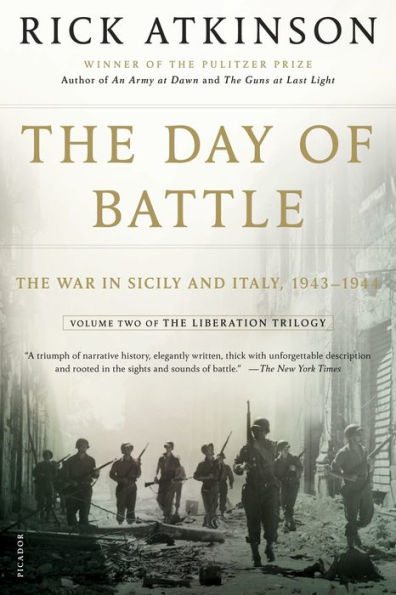
In the second volume of his epic trilogy about the liberation of Europe in World War II, Pulitzer Prize winner Rick Atkinson tells the harrowing story of the campaigns in Sicily and Italy In An Army at Dawn--winner of the Pulitzer Prize--Rick Atkinson provided a dramatic and authoritative history of the Allied triumph in North Africa. Now, in The Day of Battle, he follows the strengthening American and British armies as they invade Sicily in July 1943 and then, mile by bloody mile, fight their way north toward Rome.
The Italian campaign's outcome was never certain; in fact, Roosevelt, Churchill, and their military advisers engaged in heated debate about...