
How and why the US government gave up its control of ICANN, the global coordinator of internet names, numbers, and protocols—and what the geopolitical consequences were.
In 1997 the United States decided that the Internet should be governed not by governments but by something called the “global Internet community.” In Declaring Independence in Cyberspace, Milton Mueller tells the story of why it took 20 years of organizational and geopolitical struggle to make that happen.
ICANN (Internet Corporation for Assigned Names and Numbers), created in 1998, was the US government’s answer to the question of who would control the Internet registries—a key part of the Internet infrastructure supporting domain names, network numbers, IP addresses, and other protocol parameters. Originally, ICANN was a bold institutional innovation based on a vision of Internet governance that was thoroughly globalized and independent of nation-states. Declaring Independence in Cyberspace explains where this vision came from, the problems posed by its implementation, and the organization’s near-self destruction in its first five years.
The US government refused to let go of ICANN for 15 years, triggering geopolitical conflicts over sovereignty and US power. Mueller details why, what prompted its change of heart, and how the problem of making ICANN accountable to its community in the absence of US government control sparked a political battle in Washington. His account gets to the very heart of a pressing question with profound global implications: Is state sovereignty the immutable foundation of global governance, or do new technological capabilities change the model?
1146173668
In 1997 the United States decided that the Internet should be governed not by governments but by something called the “global Internet community.” In Declaring Independence in Cyberspace, Milton Mueller tells the story of why it took 20 years of organizational and geopolitical struggle to make that happen.
ICANN (Internet Corporation for Assigned Names and Numbers), created in 1998, was the US government’s answer to the question of who would control the Internet registries—a key part of the Internet infrastructure supporting domain names, network numbers, IP addresses, and other protocol parameters. Originally, ICANN was a bold institutional innovation based on a vision of Internet governance that was thoroughly globalized and independent of nation-states. Declaring Independence in Cyberspace explains where this vision came from, the problems posed by its implementation, and the organization’s near-self destruction in its first five years.
The US government refused to let go of ICANN for 15 years, triggering geopolitical conflicts over sovereignty and US power. Mueller details why, what prompted its change of heart, and how the problem of making ICANN accountable to its community in the absence of US government control sparked a political battle in Washington. His account gets to the very heart of a pressing question with profound global implications: Is state sovereignty the immutable foundation of global governance, or do new technological capabilities change the model?
Declaring Independence in Cyberspace: Internet Self-Governance and the End of US Control of ICANN
How and why the US government gave up its control of ICANN, the global coordinator of internet names, numbers, and protocols—and what the geopolitical consequences were.
In 1997 the United States decided that the Internet should be governed not by governments but by something called the “global Internet community.” In Declaring Independence in Cyberspace, Milton Mueller tells the story of why it took 20 years of organizational and geopolitical struggle to make that happen.
ICANN (Internet Corporation for Assigned Names and Numbers), created in 1998, was the US government’s answer to the question of who would control the Internet registries—a key part of the Internet infrastructure supporting domain names, network numbers, IP addresses, and other protocol parameters. Originally, ICANN was a bold institutional innovation based on a vision of Internet governance that was thoroughly globalized and independent of nation-states. Declaring Independence in Cyberspace explains where this vision came from, the problems posed by its implementation, and the organization’s near-self destruction in its first five years.
The US government refused to let go of ICANN for 15 years, triggering geopolitical conflicts over sovereignty and US power. Mueller details why, what prompted its change of heart, and how the problem of making ICANN accountable to its community in the absence of US government control sparked a political battle in Washington. His account gets to the very heart of a pressing question with profound global implications: Is state sovereignty the immutable foundation of global governance, or do new technological capabilities change the model?
In 1997 the United States decided that the Internet should be governed not by governments but by something called the “global Internet community.” In Declaring Independence in Cyberspace, Milton Mueller tells the story of why it took 20 years of organizational and geopolitical struggle to make that happen.
ICANN (Internet Corporation for Assigned Names and Numbers), created in 1998, was the US government’s answer to the question of who would control the Internet registries—a key part of the Internet infrastructure supporting domain names, network numbers, IP addresses, and other protocol parameters. Originally, ICANN was a bold institutional innovation based on a vision of Internet governance that was thoroughly globalized and independent of nation-states. Declaring Independence in Cyberspace explains where this vision came from, the problems posed by its implementation, and the organization’s near-self destruction in its first five years.
The US government refused to let go of ICANN for 15 years, triggering geopolitical conflicts over sovereignty and US power. Mueller details why, what prompted its change of heart, and how the problem of making ICANN accountable to its community in the absence of US government control sparked a political battle in Washington. His account gets to the very heart of a pressing question with profound global implications: Is state sovereignty the immutable foundation of global governance, or do new technological capabilities change the model?
31.99
In Stock
5
1


Declaring Independence in Cyberspace: Internet Self-Governance and the End of US Control of ICANN
264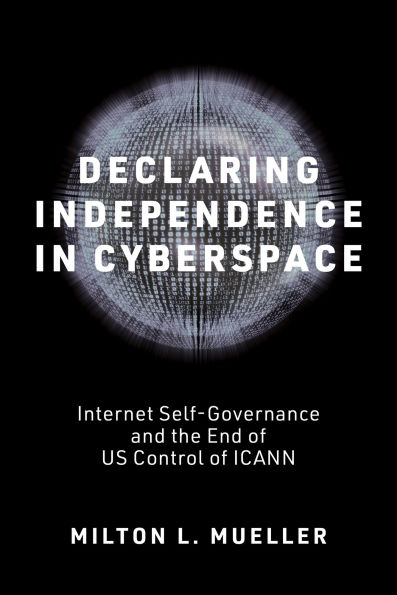
Declaring Independence in Cyberspace: Internet Self-Governance and the End of US Control of ICANN
264Related collections and offers
31.99
In Stock

Product Details
| ISBN-13: | 9780262383479 |
|---|---|
| Publisher: | MIT Press |
| Publication date: | 05/13/2025 |
| Series: | Information Policy |
| Sold by: | Penguin Random House Publisher Services |
| Format: | eBook |
| Pages: | 264 |
| File size: | 1 MB |
About the Author
What People are Saying About This
From the B&N Reads Blog