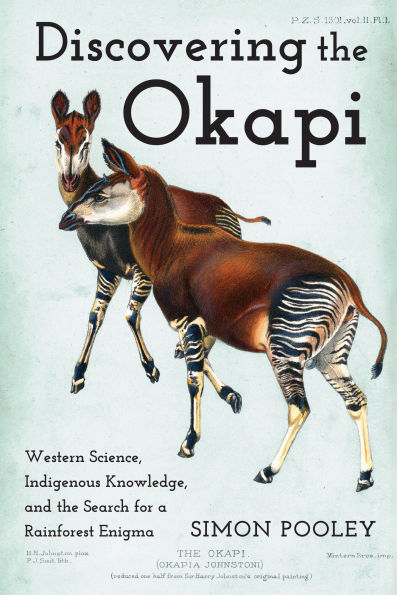
Discovering the Okapi: Western Science, Indigenous Knowledge, and the Search for a Rainforest Enigma

The captivating history of the okapi and its symbolic role in science, culture, and conservation.

In Discovering the Okapi, Simon Pooley offers a fascinating portrait of the okapi—an elusive short-necked giraffid with zebra stripes, surviving in the rainforests of central Africa's Congo basin—and unpacks the complicated layers of Western science and Indigenous knowledge that shaped the world's understanding of this unique creature.

Pooley tells the story of the okapi's "discovery" in 1900 by British naturalist Sir Harry Johnston, as well as the overlooked contributions of the Indigenous African people whose expertise made this sighting and subsequent hunt for specimens possible. The book traces how colonial politics and scientific racism shaped early accounts of the animal's study and examines the enduring biases that continue to influence conservation efforts today. The okapi became a symbol of scientific curiosity, colonial power, and conservation challenges, revealing complex intersections among biodiversity, cultural heritage, and environmental stewardship. Its precarious existence in captivity and the wild exposes how Western and Indigenous approaches to conservation can—and must—find common ground for its survival.

1147095788
Discovering the Okapi: Western Science, Indigenous Knowledge, and the Search for a Rainforest Enigma

The captivating history of the okapi and its symbolic role in science, culture, and conservation.

In Discovering the Okapi, Simon Pooley offers a fascinating portrait of the okapi—an elusive short-necked giraffid with zebra stripes, surviving in the rainforests of central Africa's Congo basin—and unpacks the complicated layers of Western science and Indigenous knowledge that shaped the world's understanding of this unique creature.

Pooley tells the story of the okapi's "discovery" in 1900 by British naturalist Sir Harry Johnston, as well as the overlooked contributions of the Indigenous African people whose expertise made this sighting and subsequent hunt for specimens possible. The book traces how colonial politics and scientific racism shaped early accounts of the animal's study and examines the enduring biases that continue to influence conservation efforts today. The okapi became a symbol of scientific curiosity, colonial power, and conservation challenges, revealing complex intersections among biodiversity, cultural heritage, and environmental stewardship. Its precarious existence in captivity and the wild exposes how Western and Indigenous approaches to conservation can—and must—find common ground for its survival.

39.95 In Stock
Discovering the Okapi: Western Science, Indigenous Knowledge, and the Search for a Rainforest Enigma

Discovering the Okapi: Western Science, Indigenous Knowledge, and the Search for a Rainforest Enigma

by Simon Pooley
Discovering the Okapi: Western Science, Indigenous Knowledge, and the Search for a Rainforest Enigma

Discovering the Okapi: Western Science, Indigenous Knowledge, and the Search for a Rainforest Enigma

by Simon Pooley

eBook

$39.95 

Available on Compatible NOOK devices, the free NOOK App and in My Digital Library.
WANT A NOOK?  Explore Now

Related collections and offers


Overview

The captivating history of the okapi and its symbolic role in science, culture, and conservation.

In Discovering the Okapi, Simon Pooley offers a fascinating portrait of the okapi—an elusive short-necked giraffid with zebra stripes, surviving in the rainforests of central Africa's Congo basin—and unpacks the complicated layers of Western science and Indigenous knowledge that shaped the world's understanding of this unique creature.

Pooley tells the story of the okapi's "discovery" in 1900 by British naturalist Sir Harry Johnston, as well as the overlooked contributions of the Indigenous African people whose expertise made this sighting and subsequent hunt for specimens possible. The book traces how colonial politics and scientific racism shaped early accounts of the animal's study and examines the enduring biases that continue to influence conservation efforts today. The okapi became a symbol of scientific curiosity, colonial power, and conservation challenges, revealing complex intersections among biodiversity, cultural heritage, and environmental stewardship. Its precarious existence in captivity and the wild exposes how Western and Indigenous approaches to conservation can—and must—find common ground for its survival.


Product Details

ISBN-13: 9781421452494
Publisher: Johns Hopkins University Press
Publication date: 11/11/2025
Series: Animals, History, Culture
Sold by: Barnes & Noble
Format: eBook
Pages: 392
File size: 61 MB
Note: This product may take a few minutes to download.
Age Range: 18 Years

About the Author

Simon Pooley is the Lambert Lecturer in Environment at Birkbeck, University of London. He is the coeditor of Histories of Bioinvasions in the Mediterranean and the author of Burning Table Mountain: An Environmental History of Fire on the Cape Peninsula.

Table of Contents

Preface
Introduction
1. Scientific Authority and Metropolitan Knowledge Institutions
2. Discovery of the Okapi
3. Settling Okapi Taxonomy and the First Monograph
4. Possession, Exhibition, Dissemination
5. Okapis Take Shape in the Western Imagination
6. Okapis in African Art, Ancient and Modern
7. Catching Okapi, 1901 to 1915
8. Pursuing Okapi in the Interwar Years
9. Capture,Transport and Survival of Okapi After 1918
10. Zoo Conservation and the Deadly Journey to the West
11. Nature of the Beast
12. Okapi Science After 1945
13. Indigenous Africans as "Primitive Experts" on Okapi
14. Western Framings of the Peoples and Forests of the Congo
15. Clashing World Views in a Crucible for Wildlife Conservation
Conclusion
Acknowledgements

What People are Saying About This

From the Publisher

Pooley has written a comprehensive account of the Western 'discovery' of the okapi. His dissection of this conceit is accompanied by an equally impressive account of okapi research during the imperial era. Throughout, he cultivates an intense empathy for an exceptionally beautiful animal—an emblem for one of the most complex communities on earth, and one of the communities most threatened by unbridled logging today.
—Jonathan Kingdon, author of Origin Africa: Safaris in Deep Time

In Discovering the Okapi, Simon Pooley has produced a rich history of one of Africa's most enigmatic and endangered animals. Pooley shows how science, art, economics, and politics made this secretive animal into a powerful symbol both of the global biodiversity crisis and of the perils of colonial conservation efforts intended to stop it.
—Peter S. Alagona, author of The Accidental Ecosystem: People and Wildlife in American Cities

From the B&N Reads Blog

Customer Reviews