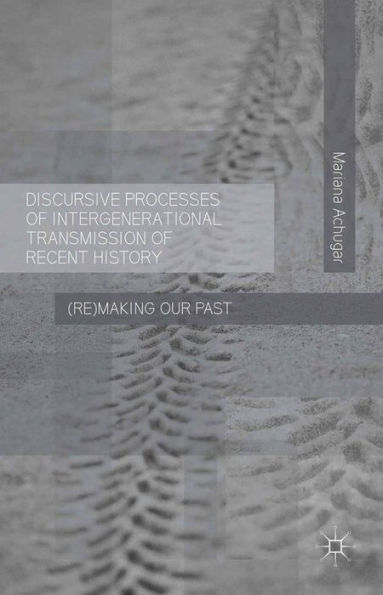
Discursive Processes of Intergenerational Transmission of Recent History: (Re)making Our Past

Debates about how to remember politically contested or painful pasts exist throughout the world. As with the case of the Holocaust in Europe and Apartheid in South Africa, South American countries are struggling with the legacy of state terrorism left by the 1970s dictatorships. Coming to terms with the past entails understanding the role different social actors played in those events as well as what those event mean for us today. Young people in these situations have to learn about painful historical events over which there is no national consensus.

This book explores discursive processes of intergenerational transmission of recent history through the case of the Uruguayan dictatorship. The main themes of the book are the discursive construction of social memory and intergenerational transmission of contested pasts through recontextualization, resemiotization and intertextuality.
1122629231
Discursive Processes of Intergenerational Transmission of Recent History: (Re)making Our Past

Debates about how to remember politically contested or painful pasts exist throughout the world. As with the case of the Holocaust in Europe and Apartheid in South Africa, South American countries are struggling with the legacy of state terrorism left by the 1970s dictatorships. Coming to terms with the past entails understanding the role different social actors played in those events as well as what those event mean for us today. Young people in these situations have to learn about painful historical events over which there is no national consensus.

This book explores discursive processes of intergenerational transmission of recent history through the case of the Uruguayan dictatorship. The main themes of the book are the discursive construction of social memory and intergenerational transmission of contested pasts through recontextualization, resemiotization and intertextuality.

54.99 In Stock
Discursive Processes of Intergenerational Transmission of Recent History: (Re)making Our Past

Discursive Processes of Intergenerational Transmission of Recent History: (Re)making Our Past

by M. Achugar
Discursive Processes of Intergenerational Transmission of Recent History: (Re)making Our Past

Discursive Processes of Intergenerational Transmission of Recent History: (Re)making Our Past

by M. Achugar

eBook1st ed. 2016 (1st ed. 2016)

$54.99 

Available on Compatible NOOK devices, the free NOOK App and in My Digital Library.
WANT A NOOK?  Explore Now

Related collections and offers


Overview

Debates about how to remember politically contested or painful pasts exist throughout the world. As with the case of the Holocaust in Europe and Apartheid in South Africa, South American countries are struggling with the legacy of state terrorism left by the 1970s dictatorships. Coming to terms with the past entails understanding the role different social actors played in those events as well as what those event mean for us today. Young people in these situations have to learn about painful historical events over which there is no national consensus.

This book explores discursive processes of intergenerational transmission of recent history through the case of the Uruguayan dictatorship. The main themes of the book are the discursive construction of social memory and intergenerational transmission of contested pasts through recontextualization, resemiotization and intertextuality.


Product Details

ISBN-13: 9781137487339
Publisher: Palgrave Macmillan
Publication date: 04/12/2016
Sold by: Barnes & Noble
Format: eBook
Pages: 240
File size: 874 KB

About the Author

Mariana Achugar is a Guggenheim Fellow. She works as Associate Professor in the Department of Modern Languages at Carnegie Mellon University, Pittsburgh, USA. Her research explores cultural reproduction and change from a critical discourse analysis perspective. Among her publications is What we remember: the construction of memory in military discourse (2008).

Table of Contents

1. Intergenerational Transmission, Discourse, and the Recent History
2. Narratives as Transmission Tools: Learning about the Dictatorship in Uruguay
3. Family Conversations about the Dictatorship: Appropriating Anecdotes and Taking an Affective Stance
4. Arguments with Peers: Negotiating the Past in the Present
5. Conversations in the History Classroom: Pedagogical Practices in the Transmission of the Recent Past

6. Transmission Processes in Popular Culture: Recontextualization and Resemiotization in Music

7. Appropriating the Recent Past: Meaning Making Processes through Time

What People are Saying About This

From the Publisher

“Mariana Achugar has written a powerful and solid book in which she gives voice to new generations of Uruguayan youth from Montevideo and rural Tacuarembó, who enter the public debate about the contested traumatic past of recent dictatorship. … Mariana expands the theoretical and methodological approaches in discourse analysis and focuses on the circulation and reception of texts. She examines intertextuality and resemiotization in recontextualized practices, for analyzing what youth know about the dictatorship and how they learn about it. In doing so, Mariana reveals the complexity of this circulation of meanings about the past through popular culture, family conversations and history classroom interactions in school contexts. … This is a highly relevant and much needed book for scholars interested in memory and critical discourse studies.” (Teresa Oteíza, Pontificia Universidad Católica de Chile, Chile)

“Memory scholars agree that the inter-generational transmission of collective memories is key to shaping the future, and others have noted that Uruguay is in the vanguard of using the school to transmit historical memories of the recent past to children who did not live it themselves, but no one has studied this process so closely or so well as Mariana Achugar...A landmark in Memory Studies.” (Peter Winn, Tufts University, USA)

“Mariana Achugar succeeds in bringing history to life – in presenting readers with a comprehensive multi-level study of the transmission and transfer of individual and collective memories from the generation which experienced a range of traumatic events during the dictatorship in Uruguay to the next generations, in interviews, family conversations, focus groups, songs, and via school books. Her convincing analysis illustrates how the past necessarily always impacts on the present and future. This is an excellent book – a must read for scholars and students alike who want to understand the complex dynamics of memory,history, trauma, politics and discourse.” (Ruth Wodak, Distinguished Professor of Discourse Studies, Lancaster University/University Vienna, UK/Austria)

From the B&N Reads Blog

Customer Reviews