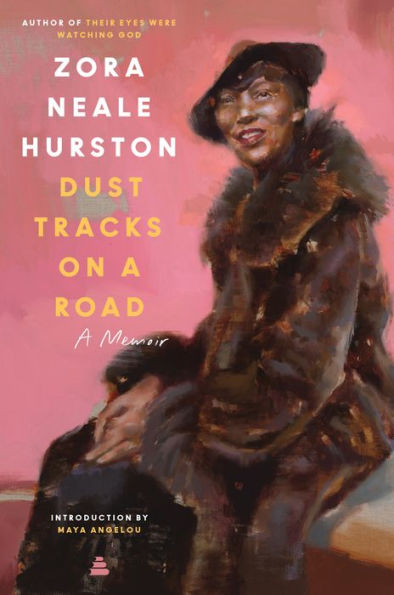
Read an Excerpt
Chapter One
MY BIRTHPLACELike the dead-seeming, cold rocks, I have memories within that came out of the material that went to make me. Time and place have had their say.
So you will have to know something about the time and place where I came from, in order that you may interpret the incidents and directions of my life.
I was born in a Negro town. I do not mean by that the black back-side of an average town. Eatonville, Florida, is, and was at the time of my birth, a pure Negro town--charter, mayor, council, town marshal and all. It was not the first Negro community in America, but it was the first to be incorporated, the first attempt at organized self-government on the part of Negroes in America.
Eatonville is what you might call hitting a straight lick with a crooked stick. The town was not in the original plan. It is a by-product of something else.
It all started with three white men on a ship off the coast of Brazil. They had been officers in the Union Army. When the bitter war had ended in victory for their side, they had set out for South America. Perhaps the post-war distress made their native homes depressing. Perhaps it was just that they were young, and it was hard for them to return to the monotony of everyday being after the excitement of military life, and they, as numerous other young men, set out to find new frontiers.
But they never landed in Brazil. Talking together on the ship, these three decided to return to the United States and try their fortunes in the unsettled country of South Florida. No doubt the same thing which had moved them to go to Brazil caused them to choose South Florida.
This had beendark and bloody country since the mid-seventeen hundreds. Spanish, French, English, Indian, and American blood had been bountifully shed.
The last great struggle was between the resentful Indians and the white planters of Georgia, Alabama, and South Carolina. The strong and powerful Cherokees, aided by the conglomerate Seminoles, raided the plantations and carried off Negro slaves into the Spanish-held Florida. Ostensibly they were carried off to be slaves to the Indians, but in reality the Negro men were used to swell the ranks of the Indian fighters against the white plantation owners. During lulls in the long struggle, treaties were signed, but invariably broken. The sore point of returning escaped Negroes could not be settled satisfactorily to either side. Who was an Indian and who was a Negro? The whites contended all who had negro blood. The Indians contended all who spoke their language belonged to the tribe. Since it was an easy matter to teach a slave to speak enough of the language to pass in a short time, the question could never be settled. So the wars went on.
The names of Oglethorpe, Clinch and Andrew Jackson are well known on the white side of the struggle. For the Indians, Miccanopy, Billy Bow-legs and Osceola. The noble Osceola was only a sub-chief, but he came to be recognized by both sides as the ablest of them all. Had he not been captured by treachery, the struggle would have lasted much longer than it did. With an offer of friendship, and a new rifle (some say a beautiful sword) he was lured to the fort seven miles outside of St. Augustine, and captured. He was confined in sombre Fort Marion that still stands in that city, escaped, was recaptured, and died miserably in the prison of a fort in Beaufort, South Carolina. Without his leadership, the Indian cause collapsed. The Cherokees and most of the Seminoles, with their Negro adherents, were moved west. The beaten Indians were moved to what is now Oklahoma. It was far from the then settlements of the Whites. And then too, there seemed to be nothing there that White people wanted, so it was a good place for Indians. The wilds of Florida heard no more clash of battle among men.
The sensuous world whirled on in the arms of ether for a generation or so. Time made and marred some men. So into this original hush came the three frontier-seekers who had been so intrigued by its prospects that they had turned back after actually arriving at the coast of Brazil without landing. These young men were no poor, refuge-seeking, wayfarers. They were educated men of family and wealth.
The shores of Lake Maitland were beautiful, so they chose the northern end and settled. There one of the old forts--built against the Indians, had stood. It had been commanded by Colonel Maitland, so the lake and the community took their names in memory of him. It was Mosquito County then and the name was just. It is Orange County now for equally good reason. The men persuaded other friends in the north to join them, and the town of Maitland began to be in a great rush.
Negroes were found to do the clearing. There was the continuous roar of the crashing of ancient giants of the lush woods, of axes, saws and hammers. And there on the shores of Lake Maitland rose stately houses, surrounded by beautiful grounds. Other settlers flocked in from upper New York state, Minnesota and Michigan, and Maitland became a center of wealth and fashion. In less than ten years, the Plant System, later absorbed into the Atlantic Coast Line Railroad, had been persuaded to extend a line south through Maitland, and the private coaches of millionaires and other dignitaries from North and South became a common sight on the siding. Even a president of the United States visited his friends at Maitland.
These wealthy homes, glittering carriages behind blooded horses and occupied by well-dressed folk, presented a curious spectacle in the swampy forests so dense that they are dark at high noon. The terrain swarmed with the deadly diamondback rattlesnake, most potent reptile on the North American continent. Huge, centuries-old bull alligators bellowed their challenge from the uninhabited shores of lakes. It was necessary to carry a lantern when one walked out at night, to avoid stumbling over these immense reptiles in the streets of Maitland.