
Ecological Studies in the Middle Reach of Chesapeake Bay: Calvert Cliffs
The decision to build a nuclear power plant at Calvert Cliffs on the western shore of the Chesapeake Bay in southern Maryland resulted in a Iandmark legal decision (Calvert Cliffs Coordinating Committee vs Atomic Energy Commission) and began one of the mostintensive long-term studies ever carried out in an American estuarine system. In the pages that follow we describe the major results and findings from studies conducted over more than a decade by scientists from The Academy of Natural Seiences of Philadelphia (ANSP). These studies were designed to assess the potential effects that operation of the Calvert Cliffs Nuclear Power Plant (CCNPP) might have on the mid-portion of Chesapeake Bay. The approach taken was to study major biotic components of the system over an area and a time period sufficient to allow comparison of conditions between preoperational and operational periods within a sampling locality, and comparisons of conditions at reference sites with those at impact sites afterplant operations began. Elementschosen for detailed study included: species composition and production rates of major primary producers; water chemistry; zooplankton, benthos and finfish abundance and species composition; the abundance and growth rates of commercially important shellfish (clams, oysters and blue crabs); and the colonization sequences of invertebrates on artificial substrates.
1111669708
Ecological Studies in the Middle Reach of Chesapeake Bay: Calvert Cliffs
The decision to build a nuclear power plant at Calvert Cliffs on the western shore of the Chesapeake Bay in southern Maryland resulted in a Iandmark legal decision (Calvert Cliffs Coordinating Committee vs Atomic Energy Commission) and began one of the mostintensive long-term studies ever carried out in an American estuarine system. In the pages that follow we describe the major results and findings from studies conducted over more than a decade by scientists from The Academy of Natural Seiences of Philadelphia (ANSP). These studies were designed to assess the potential effects that operation of the Calvert Cliffs Nuclear Power Plant (CCNPP) might have on the mid-portion of Chesapeake Bay. The approach taken was to study major biotic components of the system over an area and a time period sufficient to allow comparison of conditions between preoperational and operational periods within a sampling locality, and comparisons of conditions at reference sites with those at impact sites afterplant operations began. Elementschosen for detailed study included: species composition and production rates of major primary producers; water chemistry; zooplankton, benthos and finfish abundance and species composition; the abundance and growth rates of commercially important shellfish (clams, oysters and blue crabs); and the colonization sequences of invertebrates on artificial substrates.
109.99
In Stock
5
1


Ecological Studies in the Middle Reach of Chesapeake Bay: Calvert Cliffs
287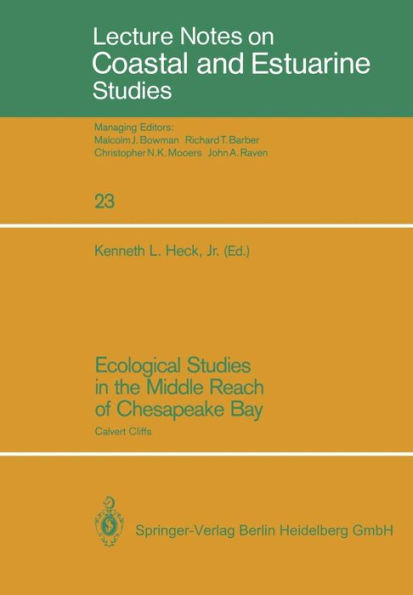
Ecological Studies in the Middle Reach of Chesapeake Bay: Calvert Cliffs
287Paperback(1987)
$109.99
109.99
In Stock

Product Details
| ISBN-13: | 9780387966687 |
|---|---|
| Publisher: | Springer New York |
| Publication date: | 12/01/1987 |
| Series: | Coastal and Estuarine Studies , #23 |
| Edition description: | 1987 |
| Pages: | 287 |
| Product dimensions: | 6.69(w) x 9.61(h) x 0.02(d) |
From the B&N Reads Blog