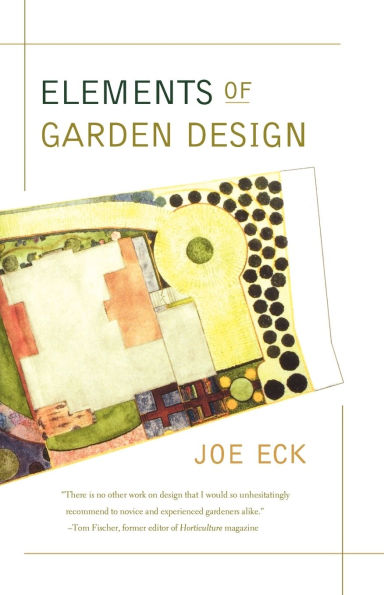
Elements of Garden Design

Marketplace (New and Used)
from
$4.89
$15.00 List Price (Save 67%)
Usually ships within 1-2 business days
All (10)  
Used (3)  
New (7)  
Close
Sort by
Page 1 of 1
Showing All
$4.89
(Save 67%)
Seller since 2009

Feedback rating:

(3449)

Condition:

New — never opened or used in original packaging.

Like New — packaging may have been opened. A "Like New" item is suitable to give as a gift.

Very Good — may have minor signs of wear on packaging but item works perfectly and has no damage.

Good — item is in good condition but packaging may have signs of shelf wear/aging or torn packaging. All specific defects should be noted in the Comments section associated with each item.

Acceptable — item is in working order but may show signs of wear such as scratches or torn packaging. All specific defects should be noted in the Comments section associated with each item.

Used — An item that has been opened and may show signs of wear. All specific defects should be noted in the Comments section associated with each item.

Refurbished — A used item that has been renewed or updated and verified to be in proper working condition. Not necessarily completed by the original manufacturer.

Good
Book shows a small amount of wear to cover and binding. Some pages show signs of use. Sail the Seas of Value

Ships from: Windsor, CT

Usually ships in 1-2 business days

  • Canadian
  • International
  • Standard, 48 States
  • Standard (AK, HI)
  • Express, 48 States
  • Express (AK, HI)
$4.89
(Save 67%)
Seller since 2007

Feedback rating:

(5384)

Condition: Good
Purchasing this book supports the King County Library System Foundation. Thriftbooks and KCLSF have partnered to help raise additional funds for the library system. Ex-Library ... book - will contain library markings. Light shelf wear and minimal interior marks. Millions of satisfied customers and climbing. Thriftbooks is the name you can trust, guaranteed. Spend Less. Read More. Read more Show Less

Ships from: Auburn, WA

Usually ships in 1-2 business days

  • Canadian
  • International
  • Standard, 48 States
  • Standard (AK, HI)
  • Express, 48 States
  • Express (AK, HI)
$7.88
(Save 47%)
Seller since 2012

Feedback rating:

(1)

Condition: Like New
2005-02-01 Paperback Like New Slight shelf wear, and cover is torn off spine two inches from the edge, quarter inch cut on front cover.

Ships from: Niagara Falls, NY

Usually ships in 1-2 business days

  • Canadian
  • International
  • Standard, 48 States
  • Standard (AK, HI)
  • Express, 48 States
  • Express (AK, HI)
$7.99
(Save 47%)
Seller since 2008

Feedback rating:

(11713)

Condition: New
Brand New and In-Stock and Fast Shipping

Ships from: Oldsmar, FL

Usually ships in 1-2 business days

  • Standard, 48 States
  • Standard (AK, HI)
$7.98
(Save 47%)
Seller since 2008

Feedback rating:

(349)

Condition: New
0865477108 With our experience and love of the book business, we will provide you with prompt customer service. We ship the books out within 24 hours excluding weekends & ... holidays. Expedite & international shipping is available. All orders in US have delivery confirmation. Read more Show Less

Ships from: Freeport, PA

Usually ships in 1-2 business days

  • Canadian
  • International
  • Standard, 48 States
  • Standard (AK, HI)
  • Express, 48 States
  • Express (AK, HI)
$8.04
(Save 46%)
Seller since 2007

Feedback rating:

(2434)

Condition: New
2005 Paperback New

Ships from: east moriches, NY

Usually ships in 1-2 business days

  • Canadian
  • International
  • Standard, 48 States
  • Standard (AK, HI)
  • Express, 48 States
  • Express (AK, HI)
$9.18
(Save 39%)
Seller since 2007

Feedback rating:

(21295)

Condition: New
BRAND NEW

Ships from: Avenel, NJ

Usually ships in 1-2 business days

  • Canadian
  • International
  • Standard, 48 States
  • Standard (AK, HI)
$9.33
(Save 38%)
Seller since 2009

Feedback rating:

(4135)

Condition: New
This item will be shipped from our warehouse in Chicago.

Ships from: Aurora, IL

Usually ships in 1-2 business days

  • Standard, 48 States
  • Standard (AK, HI)
$21.89
Seller since 2007

Feedback rating:

(2300)

Condition: New
Buy with confidence. Excellent Customer Service & Return policy.

Ships from: Richmond, TX

Usually ships in 1-2 business days

  • Canadian
  • International
  • Standard, 48 States
  • Standard (AK, HI)
$22.47
Seller since 2012

Feedback rating:

(143)

Condition: New
Free standard shipping in the Continental US

Ships from: Lakewood, NJ

Usually ships in 1-2 business days

  • Standard, 48 States
Page 1 of 1
Showing All
Close
Sort by
NOOK Book (eBook - First Edition)
$9.99
BN.com price

Available on NOOK devices and apps

  • Nook Devices
  • NOOK
  • NOOK Color
  • NOOK Tablet
  • Tablet/Phone
  • NOOK for iPad
  • NOOK for iPhone
  • NOOK for Android
  • NOOK for Android (Tablet)
  • NOOK Kids for iPad
  • PC/Mac
  • NOOK Study
  • NOOK for PC
  • NOOK for Mac

Need a NOOK? Explore Now

Overview

Elements of Garden Design does what few gardening books do—it addresses the process of conceiving a whole garden, as opposed to a single element like color or a particular class of plant. Joe Eck explores the idea of a garden, and offers a practical approach to translating concepts such as "intention" and "harmony" into the solid forms of hedges and terraces, paths and rooms. Novice and experienced professional alike will find both food for thought and down-on-the-ground advice on such matters as creating child- and pet-friendly designs.

Illustrated with 35 drawings, this book details the proper way to create foundation plantings, terraces and decks, fences, gateways, and trellises, utility areas such as the compost pile and the garage, places for children to play, home greenhouses, water in the garden, and areas for vegetable planting, sculptures, lawns, banks, and slopes.

Editorial Reviews

Publishers Weekly
Written for serious gardeners at any level of expertise, these thoughtful essays transcend the how-to genre and speak rather to the fine art of gardening as Eck defends his "argument'' that "what defines a garden is less what is grown in it than how what grows is arranged.'' Drawn from a series of articles Eck wrote in the early 1990s for Horticulture magazine, the book is divided into two sections, "Theory'' and "Practice,'' covering such principles as "Scale," "Structure" and "Symmetry," along with more concrete topics, e.g., "Lawns and Ground Covers," "Water in the Garden" and "Utility Areas." In the chapter entitled "Repose," for instance, Eck explores ways to achieve this quality in a garden, whether through a balance of mown grass against a border, the repetition of elements or the creation of a secluded corner. Eck, who coauthored A Year at North Hill with Wayne Winterrowd, writes a formal, elegant prose illuminated by wisdom gleaned from years of experience and sparked with flashes of dry wit. Inviting serious study as well as browsing, this volume deserves a spot on any dedicated gardener's shelf. (Jan.)
From The Critics
This volume consists of articles reprinted from Horticulture magazine. Eck, a landscape designer, discusses the basic garden design concepts that people might consider when planning a garden. He also includes chapters on garden elements such as foundation plantings, water features, greenhouses, sculpture, and the like. The book works well as an introduction to design concepts for gardeners who want to take a thoughtful approach in creating a garden that will reflect their individual taste. The lack of an index is a problem, however, for quick location of information. For comprehensive gardening collections or where there is an extensive demand for garden design materials. -Dale Luchsinger, Athens Area Technical Inst., Ga.

Product Details

  • ISBN-13: 9780865477100
  • Publisher: Farrar, Straus and Giroux
  • Publication date: 2/1/2005
  • Pages: 192
  • Sales rank: 1,140,495
  • Product dimensions: 5.54 (w) x 8.26 (h) x 0.52 (d)

Meet the Author

Joe Eck is cofounder of the garden design firm North Hill and coauthor of A Year at North Hill and Living Seasonally. He lives in Vermont.

Read an Excerpt

Elements of Garden Design

Part I

Theory


Intention

Like all the arts, gardening must be guided by an intention. For many, that intention will be to recreate some other garden, one that seems, from childhood memory or adult experience, ideally beautiful. For others, nature will be the model, and the garden, on a smaller scale, will exist to remind them of a natural landscape—an alpine meadow, a field of wildflowers, or a shady woodland walk. But many of us, in making our gardens, are guided less by examples in the mind than by a simple passion for plants. And although all gardeners love plants, they love them for very different reasons, and so make their gardens from very different impulses.

Some gardeners want to be collectors; they are addicts given to the pleasure that comes from owning simply all of something—every variety in the species, every species in the genus, every genus in the family. Others are lovers of color, of rich masses of it crushed together in great romantic sweeps or shifting from shade to shade in subtle adumbration (yellow to yellow-ivory to rich cream to milk-white to chalk to ...). Still others love plants for their perfume, endlessly varied and susceptible to minute discrimination, one from another. ("The smell of nutmeg," a greatnose once told me, "is really twelve distinct fragrances. Three of them are not pleasant.") And then there are botanists, whose interest lies in the infinite articulation of nature's order. ("It's a homely plant, to be sure, but it is the only member of its genus that is circumpolar.") Each of these intentions—and a thousand others—can result in the making of a beautiful garden, but only by acknowledging both the problems each poses and the solutions, successful or not, that other gardeners have attempted.

The problem posed by the collector's garden is one of sameness. Gardens composed chiefly of roses or lilacs, irises or daylilies or rhododendrons can fatigue even those who share the gardener's passion, for they are really but the vast multiplication of a single idea. Even the most beautiful gardens of this kind—Bagatette, for example, with its roses or Keukenhof with its masses of tulips—can be reduced in the eyes of a demanding critic to bloom on bloom and yet more bloom. Public or private, they are what one might call "tourists' gardens," the beauty of which might be breathtaking to visitors at their peak, but hardly sustainable throughout the growing year. They are only a step away from the growing fields, and there is neither quiet nor refreshment in them, because each garden unfolds all it has to offer at a single glance.

But the gardens of collectors need not reveal their intention at the first step we take into them. I know a garden of primitive plants, cycads chiefly, that still achieves in the dominant interest that governs it the qualities of variety and surprise. Its success lies in part in its terrain, a steeply sloping hillside threaded with paths and terraces that are hidden one from the other. But the gardener has also wisely varied his collection with other complementary plants—palms, aloes, and staghorn ferns—to create not just a sense of a primitive landscape, but also almost the idea of it, as if one were standing on the real bricks and looking at the real plants, transported into a landscape in the mind, a spot in the world—or its history—quite "someplace else."

The gardens of colorists face challenges of a different order. When one views a garden, the eye registers—often unconsciously—not merely color but also mass, volume, shape, and line. Gardens organized with an eye only to color, however successful its orchestration from shade to shade, often lack solidity even at the height of their season. One longs for a firm line, a satisfying neutral mass, an authoritative defining presence. And when not in flower, gardens that depend on color alone lack everything. It is for this reason that the carpet bedding still practiced in our large public parks is so unsatisfactory. One cannot look at such a plenitude of color without seeing the empty earth beneath. Conversely, the famous white garden at Sissinghurst is endlessly satisfying because it joins the finesse of its color scheme to the steady sustaining forces of yew hedge and green, trimmed boxwood and pavement.

The gardens of botanists, to give one last example, are concerned with scholarship. Their intention is the celebration of botanical or geographic relationships, sometimes to the minutest particular. At their worst, they can remind one rather forcefully of the dusty old-fashioned natural history museums to which one was taken as a child. They are not so much gardens as cases in which "specimens" are cataloged. If such plantings are to succeed as gardens, some larger and simply beautiful structure must embrace the botany. No better example of success in this regard existsthan in Strybing Arboretum in San Francisco, where a defining frame of tall plants and trees surrounds the Arthur Menzies collection of native plants. A magnificent dry streambed structures it within, and a rondel of aged limestone defines its heart. The result is a satisfying picture during all seasons, even in the dead of winter and even to gardeners who may have no particular interest in the rich flora of California native plants.

A particular intention does not of itself yield a successful garden. One may have the clearest idea of what one wishes to create, but an idea—however necessary it may be as a starting point—still exists only in the mind. Its success will lie in its concrete realization, in the arrangement of treasured plants within a framework of less transitory elements, of trees, shrubs, hedges, pavement, architecture. Lucky is the gardener who begins with a clear intention, even though, as with all aesthetic impulses, it must be subject to endless adjustments, additions and deletions, delicate tamperings. Most of us, however, come to consider the dominant intention of our gardens rather late in our gardening life. ("I have begun to realize," a wise gardening friend once said to me, "that I have not actually made a garden. I have only made a nursery.") There is a point, after we have acquired our favorite plants and learned to grow them well, when we realize that the parts of our garden do not actually make up a whole. It is at that point that we begin to crave an intention, an idea that will make of the garden a unified whole, an aesthetic entity.

Fortunately, at that point, one need not go it alone. One can turn to memory, to the wisdom of other garden makers, to gardens one has lived in, or visited, or merely read about. For this much is certain: Gardening, like all the other arts, is not finally a private act. Whatever their personal passions—to collect, to gratify the sense of sight or smell, to study—gardeners are engaged in a colloquy, in a rich and complex conversation between garden and garden, gardener and gardener, living, dead, and yet to be born. The subject of that conversation is both the definition and the achievement of a beautiful and satisfying place.

Copyright © 1995, 2005 by W Joseph Eck

Customer Reviews
If you've bought this product, tell the world how you liked it.
Write a Review

If you find inappropriate content, please report it to Barnes & Noble
Why is this product inappropriate?
Comments (optional)
500 character limit