Escape [NOOK Book]

NOOK Book (eBook)
$11.99
BN.com price

Available on NOOK devices and apps

  • Nook Devices
  • NOOK
  • NOOK Color
  • NOOK Tablet
  • Tablet/Phone
  • NOOK for iPad
  • NOOK for iPhone
  • NOOK for Android
  • NOOK for Android (Tablet)
  • NOOK Kids for iPad
  • PC/Mac
  • NOOK Study
  • NOOK for PC
  • NOOK for Mac

Need a NOOK? Explore Now

Overview

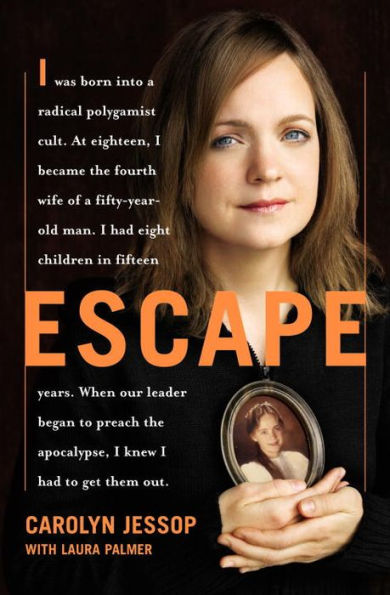
The dramatic first-person account of life inside an ultra-fundamentalist American religious sect, and one woman’s courageous flight to freedom with her eight children.

When she was eighteen years old, Carolyn Jessop was coerced into an arranged marriage with a total stranger: a man thirty-two years her senior. Merril Jessop already had three wives. But arranged plural marriages were an integral part of Carolyn’s heritage: She was born into and raised in the Fundamentalist Church of Jesus Christ of Latter-Day Saints (FLDS), the radical offshoot of the Mormon Church that had settled in small communities along the Arizona-Utah border. Over the next fifteen...
See more details below

Overview

The dramatic first-person account of life inside an ultra-fundamentalist American religious sect, and one woman’s courageous flight to freedom with her eight children.

When she was eighteen years old, Carolyn Jessop was coerced into an arranged marriage with a total stranger: a man thirty-two years her senior. Merril Jessop already had three wives. But arranged plural marriages were an integral part of Carolyn’s heritage: She was born into and raised in the Fundamentalist Church of Jesus Christ of Latter-Day Saints (FLDS), the radical offshoot of the Mormon Church that had settled in small communities along the Arizona-Utah border. Over the next fifteen years, Carolyn had eight children and withstood her husband’s psychological abuse and the watchful eyes of his other wives who were locked in a constant battle for supremacy.

Carolyn’s every move was dictated by her husband’s whims. He decided where she lived and how her children would be treated. He controlled the money she earned as a school teacher. He chose when they had sex; Carolyn could only refuse—at her peril. For in the FLDS, a wife’s compliance with her husband determined how much status both she and her children held in the family. Carolyn was miserable for years and wanted out, but she knew that if she tried to leave and got caught, her children would be taken away from her. No woman in the country had ever escaped from the FLDS and managed to get her children out, too. But in 2003, Carolyn chose freedom over fear and fled her home with her eight children. She had $20 to her name.

Escape exposes a world tantamount to a prison camp, created by religious fanatics who, in the name of God, deprive their followers the right to make choices, force women to be totally subservient to men, and brainwash children in church-run schools. Against this background, Carolyn Jessop’s flight takes on an extraordinary, inspiring power. Not only did she manage a daring escape from a brutal environment, she became the first woman ever granted full custody of her children in a contested suit involving the FLDS. And in 2006, her reports to the Utah attorney general on church abuses formed a crucial part of the case that led to the arrest of their notorious leader, Warren Jeffs.

Editorial Reviews

Carolyn See
It must be said up front that her narrative is inconsistent at times and irritatingly vague. You never know, for instance, whether she thinks that her escape has ruined her chance for salvation, whether she even believes in God, or whether, indeed, she ever did. But the book is fascinating for all that, mainly because of its close attention to the details of her everyday life and how it seemed to her. She took each event as it came, until her existence became unbearable, untenable, and then she came up with the courage to radically change her life…it's hard to get a handle on other people's religions, or even that salvation we hear so much about. Where should tolerance be exercised and where should it stop? Escape doesn't presume to answer these questions. It just tells a fascinating story that would properly horrify us if it occurred in Arabia or Afghanistan, but right here in America, it's just baffling.
—The Washington Post
From The Critics
Born into the Fundamentalist Church of the Latter Day Saints (FLDS), the author describes her life before, during and after her marriage at 18 to a 50-year-old man with three other wives. This painful memoir certainly doesn't bear much resemblance to the polygamous fantasies of the HBO series Big Love. The author's large family lived in grinding poverty, and Jessop was constantly subjected to humiliations at the hands of her husband, Merril. But she had inner resources. In a decidedly patriarchal culture, she often spoke her mind, and she talked Merril into letting her go to college. Her occasional questioning of his views, however, earned his suspicion and the condescension and mistrust of her fellow wives. So what kept Jessop in the community? Fear. From her earliest childhood, when she played a game called "apocalypse," she had been taught that God punished those who disobeyed his rules. Furthermore, she knew that no woman had ever managed to get herself and her children safely away from the community. Still, one night in 2003, Jessop snuck her eight children out of the house and fled to Salt Lake City. There, she found little in the way of support networks for women escaping polygamy. She was told that "there would be more legal and financial help for me if I were a refugee arriving from a foreign country." The chapters about her struggles to adjust to this new life are more riveting than the occasionally tedious descriptions of her earlier hardships. Especially wrenching are scenes featuring the two of Jessop's children who felt torn between their parents and resented their mother for taking them away from the FLDS church. The book's final pages recount triumphs large and small, fromgetting her first stylish haircut to standing up to her husband in court. Though Jessop's circumstances were unusual-and particularly harrowing-her memoir will appeal to many women who have left abusive relationships.

Product Details

  • ISBN-13: 9780767928472
  • Publisher: Broadway Books
  • Publication date: 10/16/2007
  • Sold by: Random House
  • Format: eBook
  • Pages: 304
  • Sales rank: 8,076
  • File size: 1,004 KB
  • Items ship to U.S, APO/FPO and U.S. Protectorate addresses.

Meet the Author

Carolyn Jessop

CAROLYN JESSOP was born into the Fundamentalist Church of Jesus Christ of Latter-Day Saints, a group splintered from and renounced by the Mormon Church, and spent most of her life in Colorado City, Arizona, the main base of the FLDS. Since leaving the group in 2003, she has lived in West Jordon, Utah, with her eight children. LAURA PALMER is the author of Shrapnel in the Heart and collaborated on five other books, the most recent being To Catch a Predator with NBC's Chris Hansen. She lives in New York City.

Read an Excerpt

Early Childhood

I was born in the bitter cold but into warm and loving hands. Aunt Lydia Jessop was the midwife who brought me into the world on January 1, 1968, just two hours after midnight.

Aunt Lydia could not believe I’d survived. She was the midwife who had delivered babies for two generations, including my mother. When she saw the placenta, she realized that my mother had chronic placental abruption. Mom had hemorrhaged throughout her pregnancy and thought she was miscarrying. But when the bleeding stopped, she shrugged it off, assuming she was still pregnant. Aunt Lydia, the midwife, said that by the time I was born, the placenta was almost completely detached from the uterus. My mother could have bled to death and I could have been born prematurely or, worse, stillborn.

But I came into the world as a feisty seven-pound baby, my mother’s second daughter. My father said she could name me Carolyn or Annette. She looked up both names and decided to call me Carolyn because it meant “wisdom.” My mother always said that even as a baby, I looked extremely wise to her.

I was born into six generations of polygamy on my mother’s side and started life in Hildale, Utah, in a fundamentalist Mormon community known as the FLDS, or the Fundamentalist Church of Jesus Christ of Latter-Day Saints. Polygamy was the issue that defined us and the reason we’d split from the mainstream Mormon Church.

My childhood memories really begin in Salt Lake City. We moved there when I was about five. Even though my parents believed in polygamy, my father had only one wife. He owned a small real estate business that was doing well and decided it made sense to use Salt Lake as a base. We had a lovely house with a porch swing and a landscaped yard and trees. This was a big change from the tiny house in Colorado City with dirt and weeds in the yard and a father who was rarely home.

But the biggest difference in moving to Salt Lake City was that my mother, Nurylon, was happy. She loved the city and delighted in having my father home every night after work. My dad was doing well, and Mom had enough money to buy plenty of groceries when we went to the store and even had some extra for toys.

There were soon four of us. I had two sisters, Linda and Annette. I was in the middle–Linda was eighteen months older than I and Annette two years younger. My baby brother Arthur arrived a few years after Annette. My mother was thrilled to finally have a son because in our culture, boys have more value than girls. Linda and my mother were very close. But my mother always seemed very irritated by me, in part, I think, because I was my father’s favorite.

I adored my dad, Arthur Blackmore. He was tall and thin, with large bones and dark, wavy hair. I remember that whenever we were around other families I thought I had the best-looking father in the entire world. I saw him as my personal protector and felt safe when I was in his presence. His face lit up when I entered the room; I was always the daughter he wanted to introduce when friends visited our house. My mother complained that he didn’t discipline me as much as he did my sister Linda, but he ignored her and didn’t seem to care.

We only lived in Salt Lake City for a year, but it was a happy one. Mother took us to the zoo and to the park, where we’d play on the swings and slides. My father’s business was successful and expanding. But he decided we needed to move back to Colorado City, Arizona—a tiny, nondescript FLDS enclave about 350 miles south of Salt Lake City and a stone’s throw from Hildale, Utah, where I was born. The reason we went back was that he didn’t want my sister Linda attending a regular public school. Even though she would technically be going to a public school in Colorado City, most of the teachers there were FLDS and very conservative. In theory, at least, religion is not to be taught in public schools, but in fact it was an integral part of the curriculum there.

When we returned to Colorado City, my father put an addition onto our house. There was more space to live in, but life became more claustrophobic. Mother changed. When we got up in the morning, she would still be sleeping. My father was on the road a lot now, so she was home alone. When we tried to wake her up, she’d tell us to go back to bed.

She’d finally surface midmorning and come into the kitchen to make us breakfast and talk about how much she wanted to die. While she made us hot cornmeal cereal, toast, or pancakes she’d complain about having nothing to live for and how she’d rather be dead. Those were the good mornings. The really awful mornings were the ones when she’d talk about how she was going to kill herself that day.

I remember how terrified I felt wondering what would happen to us if my mother killed herself. Who’d take care of us? Father was gone nearly all the time. One morning I asked my mother, “Mama, if a mother dies, what will happen to her children? Who will take care of them?”

I don’t think Mother noticed my urgency. She had no idea of the impact her words had been having on me. I think she felt my question arose from a general curiosity about dying. Mother was very matter–of–fact in responding to me: “Oh, the children will be all right. The priesthood will give their father a new wife. The new wife will take care of them.”

By this time I was about six. I looked at her and said, “Mama, I think that Dad better hurry up and get a new wife.”

I was beginning to notice other things about the world around me. One was that some of the women we’d see in the community when we went shopping were wearing dark sunglasses. I was surprised when a woman took her glasses off in the grocery store and I could see that both her eyes were blackened. I asked my mother what was wrong, but the question seemed to make her uncomfortable and she didn’t answer me. My curiosity was piqued, however, and every time I saw a woman in dark glasses, I stared at her to see if they were covering strange, mottled bruises.

What I did love about my mother was her beauty. In my eyes, she was gorgeous. She dressed with pride and care. Like my father, she was tall and thin. The clothes she made for herself and my sisters and me were exquisite. She always picked the best fabrics. She knew how to make pleats and frills. I remember beaming when someone would praise my mother for her well–mannered and well–dressed children. Everyone in the community thought she was an exceptional mother.

But that was the public façade. In private, my mother was depressed and volatile. She beat us almost every day. The range was anything from several small swats on the behind to a lengthy whipping with a belt. Once the beating was so bad I had bruises all over my back and my legs for more than a week. When she hit us, she accused us of always doing things to try to make her miserable.

I feared her, but my fear made me a student of her behavior. I watched her closely and realized that even though she slapped us throughout the day, she never spanked us more than once a day. The morning swats were never that intense or prolonged. The real danger came in late afternoon, when she was in the depths of her sorrow.

I concluded that if I got my spanking early in the morning and got it out of the way, I would basically have a free pass for the rest of the day. As soon as Mama got up, I knew I had a spanking coming. Linda and Annette quickly caught on to what I was doing, and they tried to get their spankings out of the way in the morning, too.

There were several times when my mother spanked me and then screamed and screamed at me. “I’m going to give you a beating you’ll never forget! I am not going to stop beating you until you shut up and stop crying! You make me so mad! How could you be so stupid!” Even though it’s been decades, her screams still echo inside me when I think about her.

I remember overhearing my mother say to a relative, “I just don’t understand what has gotten into my three daughters. As soon as I am out of bed every morning, they are so bad that no matter how much I warn them, they will just not be quiet until I give them all a spanking. After they have all gotten a spanking, then everything calms down and we can all get on with our day.”

When my mother beat me, she would always say she was doing it because she loved me. So I used to wish that she didn’t love me. I was afraid of her, but I would also get angry at her when she hit me. After she beat me she insisted on giving me a hug. I hated that. The hug didn’t make the spanking stop hurting. It didn’t fix anything.

I never told my father about the beatings because it was such an accepted part of our culture. What my mother was doing would be considered “good discipline.” My mother saw herself as raising righteous children and felt teaching us obedience was one of her most important responsibilities. Spanking your children was widely seen as the way to reach that goal. It wasn’t considered abuse; it was considered good parenting.

Some of the happiest times for me would be when we would have quilting parties at home. The women from the community would spend the day at our house, quilting around a big frame. Stories and gossip were shared, there was a lot of food, and the children all had a chance to play together. Quilting parties were the one time we had breathing room.

Once I was playing with dolls with my cousin under the quilt when I heard my aunt Elaine say, “I was so scared the other day. Ray Dee was playing out in the yard with her brothers and sisters. Some people from out of town stopped in front of our house. All of the other children ran into the house screaming, but Ray Dee stayed outside and talked to the out–of–towners.”

Aunt Elaine was beside herself that her daughter had spoken with outsiders. We were taught that outsiders were “agents of the devil” who wanted to kidnap us and take us away. They were seen as evil people who wanted to destroy the work of God. If they could get access to the children of God’s chosen, then they would try to hurt or destroy us.

Our community was so isolated it was rare that we ever saw anyone from the outside. Most of my cousins only left the community to go shopping with their mothers and had almost no sense of the outside world. I still had memories of our happy lives in Salt Lake City, where we even had a TV. (My parents also had a coffeemaker; coffee was strictly forbidden in the Mormon Church.)

As my mother’s depression worsened, she spent more of the day in bed. She neglected the house until the day before my father came home and then went into a cleaning frenzy. My father wanted his house spotless. One night he came home and we were all in our pajamas, clean and ready for bed. The house was immaculate. But my father walked over to the refrigerator and ran his finger across the top. It was dusty. He lit into my mother and said she had to do a better job of cleaning. My mother began screaming at my father to go to hell. She’d accuse him of not caring how hard she worked to keep up his home and care for his children. If he didn’t like the way she cleaned, then maybe he should take over the job and raise his children by himself.

Our home became a battleground, at least when our father came home. He and Mom would be going after each other within five or ten minutes after he walked through the door. The house was tense, the atmosphere ugly. But the spankings stopped when our father was home, which was a relief. For the most part, Mom avoided hitting us then, although she made it known that our behavior was expected to be perfect.

But there were days when Mom was happy and didn’t want to die. She loved to play games with us when she was in a good mood. One of our favorites was the Three Little Pigs. Linda, Annette, and I were the pigs and Mom was the big bad wolf. We’d build our playhouses of sticks and mud and she’d come and blow them all down until we made the brick house, which was stronger than she was. We also spent happy hours listening to Mama read fairy tales. She rarely read us religious scripture and, to our delight, much preferred the fantasy world of fairy tales.

Mother was devout, but she had a frisky side. One time when my father was away she and a friend went to town and came home with a Christmas tree. Imagine! This was completely forbidden in the FLDS. We decorated it with lights and homemade ornaments. I knew it was wrong to participate in such a worldly tradition, but I was having too much fun to care. Mother beamed. She loved our Christmas tree. We popped popcorn and made garlands for the tree. Before we went to bed that night we hung up our stockings and Mama told us there would be a prize in each of them the next morning. Nothing like this had happened in our lives before. The thought of presents made us wild with anticipation.

The next morning we found not only candy canes and fruit in our stockings but a present under the tree. My father let us have candy once a year—no more. My mother was clearly disobeying our father in giving us sugary treats. And she let us eat them before we had our breakfast!

Linda and I were old enough to realize that Mama was going to have to pay for her disobedience, but we loved feeling so spoiled. We had pancakes for breakfast and then went to the house of Mama’s friend, who’d also given her children a Christmas. These children told us Santa Claus had brought them presents, but we said ours came from Mama.

My father came home the next night. I went to sleep listening to them fighting and screaming. The next morning, our Christmas tree was gone. Mama was crying when she fixed us breakfast. When we finished eating, Linda and I went outside to play and saw the Christmas tree lying under the house, stripped of its glittery lights.

My mother was a beautiful person when she was happy. She glowed with delight and laughter the night we put up the tree. During these good times, Mother carried herself with poise and elegance and realized that she was a woman worthy of love. In Salt Lake City, we had been very happy and Mother was engaged in the world around her. In Colorado City, she was locked into a world of constant pregnancies, a loveless marriage, and a rural community strung together with dirt roads.

From the Hardcover edition.

Foreward

1. Carolyn Jessop tells us that she was born against the odds, after her mother’s difficult pregnancy. How did her spirit of survival help her throughout her life? What gave her the courage to ultimately escape her fate?

2. How is religion used to justify FLDS beliefs about sex, marriage, and parenting? How do these beliefs affect the daily lives of FLDS members? How are women particularly affected by the risk of sexual shame?

3. What are the biggest differences in the way men and women are treated in the FLDS? How does this influence the relationships between spouses?

4. Discuss the dynamics between the wives described by Carolyn. How did the situation cause cruel behavior, often driven by scarce resources? What does it take to reduce humans to such destructive levels of competition?

5. Why do you think polygamy has continued to exist in the modern world? Why would a woman stay in a community that strips her of power? Are there any advantages to living in such a situation?

6. How do Carolyn’s recollections of her childhood both sustain her and haunt her? What did her two mothers teach her about the role of women in the world?

7. How do the Nusses at times act like typical teenagers? What alliances does Carolyn build with them? What does marriage do to the Nusses’s sense of sisterhood?

8. Early on, Carolyn dreamed of becoming a doctor. How would you describe the FLDS’s attitude toward healthcare? What was the rationale for ignoring her near-deadly experiences with pregnancy? What was the FLDS’s approach to her children’s healthcare needs? Ultimately, what forms of healing, emotional and physical, wasCarolyn able to find?

9. How do FLDS children adapt to living in extremely large families? Do they typically accept their new brothers and sisters? How are favoritism and competition handled? How does this experience shape the way they view the world and their relationships with others?

10. Carolyn mentioned on “The Oprah Winfrey Show” that she favors decriminalizing polygamy, so that “people could live honestly, in the open, with dignity, and their children could be more mainstreamed.” What are your thoughts about such a plan? How far do you believe legislators can go in dictating behaviors that contradict religious beliefs?

11. How did you react when Carolyn described the ex-convict who began working at her husband’s motel? Why didn’t Merril care about her personal safety? How was Colorado City affected by the fact that the FLDS controlled local law enforcement?

12. Well into her marriage, at a later age than most FLDS women, Carolyn was allowed to receive the prophecy of her destiny. The reading predicted that she had special intellectual gifts that would be applied to unusual purposes. Why were such revelations of a woman’s destiny kept private? Do you believe she received any sort of true prophecy that day?

13. Carolyn describes how Warren Jeffs used 9/11 as an excuse to launch bizarre survivalist training. What led so many people in the FLDS to follow Jeffs’s apocalyptic preaching at that point? What happened to those who were skeptical?

14. How was money managed in Carolyn’s family and within the FLDS? How did Carolyn learn to make do and become a good provider for her family? How was Warren Jeffs able to build his fortune? Is it ever appropriate for someone who claims to follow Christ to accumulate wealth?

15. Why do you suppose Carolyn’s daughter, Betty, returned to the FLDS? Why was she more vulnerable to the threat of damnation? Could she become an agent for change within the organization? How is Betty’s rebellious spirit different from her mother’s?

16. How have the FLDS and other cults survived in America, despite widespread media attention? Will this ever change? What are your reasons for this prediction?

17. Education is tightly controlled by the FLDS, another tactic that limits the freedom of women. What led Carolyn to graduate from college, despite constant obstacles?

18. In her memoir’s closing scenes, Carolyn relishes spending time with the man she loves and is thrilled by a simple dinner and a movie. How has her story affected the way you see your own life? What actions are you inspired to take to help other victimized women and children in your community, or elsewhere in the world?

Reading Group Guide

1. How is God used to justify FLDS beliefs about sex, marriage, and parenting? How do these beliefs affect the daily lives of FLDS members? How are women particularly affected by the risk of sexual shame?

2. What are the biggest differences in the way men and women are treated in the FLDS? How does this influence the relationships between spouses?

3. Discuss the dynamics among the wives described by Carolyn. How did their situations cause cruel behavior, often driven by scarce resources? What does it take to reduce humans to such destructive levels of competition?

4. Why do you think polygamy has continued to exist in the modern world? What did the media’s images of Yearning for Zion mothers indicate about why a woman would stay in a community that strips her of power?

5. How do Carolyn’s recollections of her childhood both sustain her and haunt her? What did her two mothers teach her about the role of women in the world?

6. How do the nusses at times act like typical teenagers? What alliances does Carolyn build with them? What does marriage do to the nusses’s sense of sisterhood?

7. Early on, Carolyn dreamed of becoming a doctor. In her Epilogue, she describes her former classmate, Lloyd Barlow, who now serves as a physician at Yearning for Zion, and she expresses concern that an in-house FLDS doctor might turn a blind eye to abuse. How would you explain the FLDS’s attitude toward healthcare? Ultimately, what forms of healing, emotional and physical, was Carolyn able to find?

8. How do FLDS children adapt to living in extremely large families? Do they typically accept their new brothers and sisters? How are favoritism and competition handled? How does this experience shape the way they view the world and their relationships with others?

9. How did you react when Carolyn described the ex-convict who began working at her husband’s motel? Why didn’t Merril care about her personal safety? How was Colorado City affected by the fact that the FLDS controlled local law enforcement?

10. Well into her marriage, at a later age than most FLDS women, Carolyn was allowed to receive the prophecy of her destiny. The reading predicted that she had special intellectual gifts that would be applied to unusual purposes. Why were such revelations of a woman’s destiny kept private? Do you believe she received any sort of true prophecy that day?

11. Carolyn describes how Warren Jeffs used 9/11 to claim that God was answering the prophet’s prayers for the wicked to be destroyed. What led so many people in the FLDS to follow Jeffs’s apocalyptic preaching at that point? What happened to those who were skeptical?

12. How was money managed in Carolyn’s family and within the FLDS? How did Carolyn learn to make do and become a good provider for her family? How was Warren Jeffs able to build his fortune?

13. Why do you suppose Carolyn’s daughter, Betty, returned to the FLDS? How would you have handled the prospect of having to testify against your own daughter?

14. Carolyn believes that the Yearning for Zion ranch prevailed in court in 2008 partially because of substantial financial resources. Do you predict that the FLDS will ever become extinct, or dismantled by a court order?

15. Education is tightly controlled by the FLDS, another tactic that limits the freedom of women. What led Carolyn to graduate from college, despite constant obstacles?

16. How did you react to the news footage when authorities raided the Yearning for Zion ranch in 2008? What did Carolyn’s Epilogue reveal that was not covered by the media? Did media attention help or hurt the FLDS?

17. Discuss the powerful scene in which Carolyn testifies before a Senate Judiciary committee, alongside mainstream Mormon Senator Harry Reid. How did that experience transform her?

18. Carolyn continues to celebrate everyday freedoms, such as a simple dinner and a movie with Brian. How has her story affected the way you appreciate your own life? What actions could you take to help victimized women and children in your community, or elsewhere in the world?
Customer Reviews
Average Rating 4.5
( 252 )

Rating Distribution

If you've bought this product, tell the world how you liked it.
Write a Review
See All Sort by: Showing 1 – 20 of 254 Customer Reviews
  • Anonymous

    Posted August 16, 2011

    Eye opening

    A very honest telling of what goes on within polygamis relationships. You will be shocked to learn about firsthand experiences. You will find yourself rooting for Carolyn and her children through it all.

    2 out of 2 people found this review helpful.

    Was this review helpful? Yes  No   Report this review
  • Anonymous

    Posted November 8, 2007

    American Taliban Alive and Well

    'Escape' is an amazing eye opener into American Polygamy, and more spellbinding than a fictional thriller. Reading this book will leave you breathless and wondering why these women aren't running away by the thousands. Carolyn Jessop reveals what has been hidden for decades in the Mormon Fundamentalist lifesyle, paving the way for freedom from the oppression of these women and children. Put this AWESOME book at the top of your must read soon list.

    2 out of 2 people found this review helpful.

    Was this review helpful? Yes  No   Report this review
  • Anonymous

    Posted November 4, 2007

    Likes to read true stories about courageous people

    Once you start this book, you will not want to put it down! It is heart wrenching to read in some chapters just because of all the abuse she suffered in that world, but to know that she escaped this awful place makes you rejoice at the end. I have difficult time thinking that in this day and age, cults like that exist. Ms. Jessop's strength was amazing as she went through this ordeal...I do not think I could have survived what she did. God bless her...

    2 out of 2 people found this review helpful.

    Was this review helpful? Yes  No   Report this review
  • Anonymous

    Posted October 1, 2011

    Highly Recommend

    I had read Stolen Innocence so I was somewhat familiar with FDLS and was curious to see another viewpoint on the group. This book was so well written and so intriguing that I couldn't put it down. This woman's strength and courage are amazing. I am now reading her follow up book Triumph-Life After the Cult.

    1 out of 1 people found this review helpful.

    Was this review helpful? Yes  No   Report this review
  • Posted June 1, 2011

    Great book!

    Buy it! You wont regreat it!

    1 out of 2 people found this review helpful.

    Was this review helpful? Yes  No   Report this review
  • Posted November 21, 2011

    more from this reviewer

    Good book club discussion book.

    Interesting and informative. Not very well writen, but does give an insiders look to the extremists of the Morman religion.

    Can't believe this is going on now and in America

    Was this review helpful? Yes  No   Report this review
  • Posted November 17, 2011

    An amazing story of courage

    I could not put this book down as I had to find out how Carolyn finally escaped her polygamist marriage. This provides a glimpse into life as an FLDS woman and how the dynamics of the wives relationships with eachother and their husband. At times, I found myself not understanding why she could not leave sooner and continued to have more children with the abusive man she was married to. Overall, I enjoyed the story but I would also like to know more about what life is like for her now and how she adjusted to life in the "real" world.

    Was this review helpful? Yes  No   Report this review
  • Posted October 24, 2011

    5 stars!!

    What a crazy and amazing story! Carolyn is a survivor and this book details all of the unbelievable nonsense she went through!

    Was this review helpful? Yes  No   Report this review
  • Posted October 18, 2011

    Good read

    I pray for those left behind.

    Was this review helpful? Yes  No   Report this review
  • Posted October 4, 2011

    more from this reviewer

    Unbelievable and Inspiring

    "'Escape' by Carolyn Jessop is the true account of one woman's life in the FLDS (Fundamentalist Church of Jesus Christ of Latter-Day Saints), a radically conservative polygamist sect of the Mormon church - and the story of how she eventually escaped with her eight children. Carolyn relates what her life was like growing up in the FLDS, and through her experience we see how drastically the church changed once power shifted from prophet to prophet - and how it became unbearable under the leadership of Warren Jeffs. By this time, Carolyn had already been married and become a mother; when she was eighteen years old, she became the fourth wife of Merril Jessop - a man more than twice her own age. ..."

    For full review, please visit me (Les Livres) on Blogger!

    Was this review helpful? Yes  No   Report this review
  • Posted August 27, 2011

    Sooo Good!

    Could not put this book down

    Was this review helpful? Yes  No   Report this review
  • Anonymous

    Posted August 27, 2011

    I Also Recommend:

    Very Engrossing

    The Housewives reality shows drama is nothing compared to what the Mormon women of the wealthy men endure in this cult. One woman dares to defy more odds then any woman in America has ever had to chance, to save her children of a spiraling destruction they were quickly getting sucked into. Her husband had so much power that it infiltrated the justices system and pulls every trick in the book to stop her. Her life is always on the line but she outsmarts him. Unbelievable quest for justice with a warm and happy ending of joy for her. An intense story, one all should be educated about. Lots of nail biting pages to read but triumphs with lots of cheers for a woman with determination and brains. A Hero to many I'm sure!

    Was this review helpful? Yes  No   Report this review
  • Anonymous

    Posted August 4, 2011

    Geat Book!!

    I bought this book thinking i would see what all this jeffs stuff was about, I will say it was worth every penny, to think of what these women an children go through makes me so sick to my stomach. Was so happy to see on the news today jeffs was found guilty, now if the if the feds can get the others like the men in this book this will be a better world!!!

    Was this review helpful? Yes  No   Report this review
  • Posted May 28, 2011

    super

    i bought this book right when it came out in hardcover. i lent it out and lost it so i am so happy i can read it again on my nook. i loved this book. you wont be disappointed.

    Was this review helpful? Yes  No   Report this review
  • Posted May 25, 2011

    RIVETING

    You wont want to put it down. As Jessop completely engulfs your very soul into her story!! Did i mention amazing?!

    Was this review helpful? Yes  No   Report this review
  • Posted May 14, 2011

    Great Book

    This is an excellent book, I couldn't put it down! It reads like fiction, you can't believe its a true story!

    Was this review helpful? Yes  No   Report this review
  • Posted April 20, 2011

    Love Love Love this book

    I received this book as a gift and I must say it is beyond one of my favorites. Once I started reading this book, I couldn't stop. I finished it within 3 days. I would recommed this book to anyone. It is a story of survial.

    Was this review helpful? Yes  No   Report this review
  • Posted April 10, 2011

    Worth every penny!

    Excellent story of abrave woman that realizes just how cruel the flds is to woman and children,even young men. And that they are def brain washed, I absolutely loved it. I commend you carolyn!

    Was this review helpful? Yes  No   Report this review
  • Posted March 11, 2011

    Highly Recommended

    This book is awesome I only wish I could lend it out,

    Was this review helpful? Yes  No   Report this review
  • Posted March 10, 2011

    a must read

    what a wonderful book. I read it in tw o days and couldn't put this book down. being a true story, and Jessup being on TV, tells the reader what the lives are like for these women. Carolyn is a real hero, escaping from the horrors of a multiple marriage. she gives a description of her life inside these prison walls of control, abuse and terror. hats off to you Carolyn for being a strong woman. I wish u the best of luck, happiness, and health. God Bless you, you did the right thing, leaving that monster who held u in bondage.

    Was this review helpful? Yes  No   Report this review
See All Sort by: Showing 1 – 20 of 254 Customer Reviews

If you find inappropriate content, please report it to Barnes & Noble
Why is this product inappropriate?
Comments (optional)
500 character limit