
Essays on Heidegger and Others: Philosophical Papers
The second volume pursues the themes of the first volume in the context of discussions of recent European philosophy focusing on the work of Heidegger and Derrida. His four essays on Heidegger include "Philosophy as Science, as Metaphor and as Politics" and "Heidegger, Kundera, and Dickens;" three essays on Derrida (including "Deconstruction and Circumvention" and "Is Derrida a Transcendental Philosopher?") are followed by a discussion of the uses to which Paul de Man and his followers have put certain Derridean ideas. Rorty's concluding essays broaden outward with an essay on "Freud and Moral Deliberation" and essays discussing the social theories and political attitudes of various contemporary figures—Foucault, Lyotard, Habermas, Unger, and Castoriadis.
1100951605
Essays on Heidegger and Others: Philosophical Papers
The second volume pursues the themes of the first volume in the context of discussions of recent European philosophy focusing on the work of Heidegger and Derrida. His four essays on Heidegger include "Philosophy as Science, as Metaphor and as Politics" and "Heidegger, Kundera, and Dickens;" three essays on Derrida (including "Deconstruction and Circumvention" and "Is Derrida a Transcendental Philosopher?") are followed by a discussion of the uses to which Paul de Man and his followers have put certain Derridean ideas. Rorty's concluding essays broaden outward with an essay on "Freud and Moral Deliberation" and essays discussing the social theories and political attitudes of various contemporary figures—Foucault, Lyotard, Habermas, Unger, and Castoriadis.
30.0
In Stock
5
1
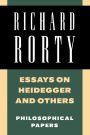

Essays on Heidegger and Others: Philosophical Papers
212
Essays on Heidegger and Others: Philosophical Papers
212Paperback(New Edition)
$30.00
30.0
In Stock

Product Details
| ISBN-13: | 9780521358781 |
|---|---|
| Publisher: | Cambridge University Press |
| Publication date: | 02/22/1991 |
| Series: | Philosophical Papers Series , #2 |
| Edition description: | New Edition |
| Pages: | 212 |
| Product dimensions: | 5.98(w) x 8.90(h) x 0.59(d) |
From the B&N Reads Blog