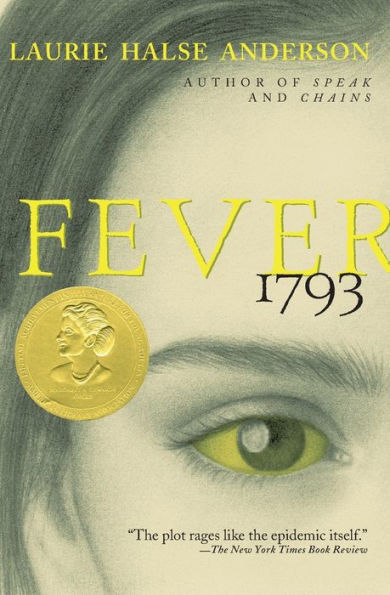
Fever 1793

( 491 )

Pick Up in Store

Reserve and pick up in 60 minutes at your local store

Paperback (Reprint)
$6.99
BN.com price
Marketplace (New and Used)
from
$0.99
$6.99 List Price (Save 86%)
Usually ships within 1-2 business days
All (199)  
Used (176)  
New (23)  
Close
Sort by
Page 1 of 20
Showing 1 – 10 of 199 (20 pages)
$0.99
(Save 86%)
Seller since 2005

Feedback rating:

(18888)

Condition:

New — never opened or used in original packaging.

Like New — packaging may have been opened. A "Like New" item is suitable to give as a gift.

Very Good — may have minor signs of wear on packaging but item works perfectly and has no damage.

Good — item is in good condition but packaging may have signs of shelf wear/aging or torn packaging. All specific defects should be noted in the Comments section associated with each item.

Acceptable — item is in working order but may show signs of wear such as scratches or torn packaging. All specific defects should be noted in the Comments section associated with each item.

Used — An item that has been opened and may show signs of wear. All specific defects should be noted in the Comments section associated with each item.

Refurbished — A used item that has been renewed or updated and verified to be in proper working condition. Not necessarily completed by the original manufacturer.

Very Good
2002-03-01 Trade Paperback Very Good Trade paperback (US). Glued binding. 256 p.

Ships from: Sparks, NV

Usually ships in 1-2 business days

  • Canadian
  • International
  • Standard, 48 States
  • Standard (AK, HI)
  • Express, 48 States
  • Express (AK, HI)
$0.99
(Save 86%)
Seller since 2007

Feedback rating:

(2540)

Condition: Good
2002 Paperback Good A copy that has been read, but remains in clean condition. All pages are intact, and the cover is intact (including dustcover, if applicable). The spine ... may show signs of wear. Pages can include limited notes and highlighting, and the copy can include "from the library of" labels. Read more Show Less

Ships from: Los Angeles, CA

Usually ships in 1-2 business days

  • Canadian
  • International
  • Standard, 48 States
  • Standard (AK, HI)
  • Express, 48 States
  • Express (AK, HI)
$0.99
(Save 86%)
Seller since 2011

Feedback rating:

(144)

Condition: Acceptable
2002 Paperback Fair The book is clean but may have markings or highlights througout.

Ships from: St Paul, MN

Usually ships in 1-2 business days

  • Canadian
  • International
  • Standard, 48 States
  • Standard (AK, HI)
  • Express, 48 States
  • Express (AK, HI)
$0.99
(Save 86%)
Seller since 2011

Feedback rating:

(15)

Condition: Acceptable
2002 Paperback Fair Binding shows wear ACCEPTABLE-Any or all listed conditions may apply: Covers may show wear( cracks, bends, rips, etc. )binding may show wear ( yet still ... intact) Pages May be worn, bent, dirty, yellowed with age, stained, etc. Item may include notations, underlining, highlighting, inscription. GOOD READING COPY-not typically collection worthy-USED CONDITION. WNYBOOKS Appreciates Your Patronage And Support. Thank You for Shopping With Us and Supporting The Goodwill Mission. Read more Show Less

Ships from: Buffalo, NY

Usually ships in 1-2 business days

  • Canadian
  • International
  • Standard, 48 States
  • Standard (AK, HI)
  • Express, 48 States
  • Express (AK, HI)
$0.99
(Save 86%)
Seller since 2011

Feedback rating:

(24)

Condition: Good
2002 Paperback Good Spine is creased. Sticker residue on front cover. The average used book with all pages present. Books with loose bindings, highlighting, cocked spine, torn ... dust jackets, can fall into this category. Read more Show Less

Ships from: Grandville, MI

Usually ships in 1-2 business days

  • Canadian
  • International
  • Standard, 48 States
  • Standard (AK, HI)
  • Express, 48 States
  • Express (AK, HI)
$0.99
(Save 86%)
Seller since 2009

Feedback rating:

(189)

Condition: Good
2002 Paperback Good This book looks good. It is like any used book you would expect to find in a used book shop.

Ships from: Garner, NC

Usually ships in 1-2 business days

  • Canadian
  • International
  • Standard, 48 States
  • Standard (AK, HI)
  • Express, 48 States
  • Express (AK, HI)
$1.95
(Save 72%)
Seller since 2011

Feedback rating:

(142)

Condition: Like New
2002 Paperback Fine (We ship fast. Items arrive in 4-14 business days. Full refunds provided if you are dissatisfied)

Ships from: Fort Lauderdale, FL

Usually ships in 1-2 business days

  • Canadian
  • International
  • Standard, 48 States
  • Standard (AK, HI)
  • Express, 48 States
  • Express (AK, HI)
$1.97
(Save 72%)
Seller since 2005

Feedback rating:

(799)

Condition: Very Good
2002-03-01 Paperback Used-Very Good Sound soft cover with slight shelf wear. Next day shipping! Delivery Confirmation on all orders! !

Ships from: Albuquerque, NM

Usually ships in 1-2 business days

  • Canadian
  • International
  • Standard, 48 States
  • Standard (AK, HI)
  • Express, 48 States
  • Express (AK, HI)
$1.99
(Save 72%)
Seller since 2009

Feedback rating:

(3470)

Condition: Acceptable
Sail the Seas of Value

Ships from: Windsor, CT

Usually ships in 1-2 business days

  • Canadian
  • International
  • Standard, 48 States
  • Standard (AK, HI)
  • Express, 48 States
  • Express (AK, HI)
$1.99
(Save 72%)
Seller since 2009

Feedback rating:

(3470)

Condition: Acceptable
Sail the Seas of Value

Ships from: Windsor, CT

Usually ships in 1-2 business days

  • Canadian
  • International
  • Standard, 48 States
  • Standard (AK, HI)
  • Express, 48 States
  • Express (AK, HI)
Page 1 of 20
Showing 1 – 10 of 199 (20 pages)
Close
Sort by
NOOK Book (eBook)
$5.99
BN.com price

Available on NOOK devices and apps

  • Nook Devices
  • NOOK
  • NOOK Color
  • NOOK Tablet
  • Tablet/Phone
  • NOOK for iPad
  • NOOK for iPhone
  • NOOK for Android
  • NOOK for Android (Tablet)
  • NOOK Kids for iPad
  • PC/Mac
  • NOOK Study
  • NOOK for PC
  • NOOK for Mac

Need a NOOK? Explore Now

Note: Kids' Club Eligible. See More Details.

Overview

From Fever 1793

"Where's Polly?" I asked as I dropped the bucket down the well. "Did you pass by the blacksmith's?

"I spoke with her mother, with Mistress Logan," Mother answered softly, looking at her neat rows of carrots.

"And?" I waved a mosquito away from my face.

"It happened quickly. Polly sewed by candlelight after dinner. Her mother repeated that over and over, 'she sewed by candlelight after dinner.' And then she collapsed."

I released the handle and the bucket splashed, a distant sound.

"Matilda, Polly's dead."

August 1793. Fourteen-year-old Mattie Cook is ambitious, adventurous, and sick to death of listening to her mother. Mattie has plans of her own. She wants to turn the Cook Coffeehouse into the finest business in Philadelphia, the capital of the new United States.

But the waterfront is abuzz with reports of disease. "Fever" spreads from the docks and creeps toward Mattie's home, threatening everything she holds dear.

As the cemeteries fill with fever victims, fear turns to panic, and thousands flee the city. Then tragedy strikes the coffeehouse, and Mattie is trapped in a living nightmare. Suddenly, her struggle to build a better life must give way to something even more important — the fight to stay alive.

In 1793 Philadelphia, sixteen-year-old Matilda Cook, separated from her sick mother, learns about perseverance and self-reliance when she is forced to cope with the horrors of a yellow fever epidemic.

Editorial Reviews

Publishers Weekly
The opening scene of Anderson's ambitious novel about the yellow fever epidemic that ravaged Philadelphia in the late 18th century shows a hint of the gallows humor and insight of her previous novel, Speak. Sixteen-year-old Matilda "Mattie" Cook awakens in the sweltering summer heat on August 16th, 1793, to her mother's command to rouse and with a mosquito buzzing in her ear. She shoos her cat from her mother's favorite quilt and thinks to herself, "I had just saved her precious quilt from disaster, but would she appreciate it? Of course not." Mattie's wit again shines through several chapters later during a visit to her wealthy neighbors' house, the Ogilvies. Having refused to let their serving girl, Eliza, coif her for the occasion, Mattie regrets it as soon as she lays eyes on the Ogilvie sisters, who wear matching bombazine gowns, curly hair piled high on their heads ("I should have let Eliza curl my hair. Dash it all"). But thereafter, Mattie's character development, as well as those of her grandfather and widowed mother, takes a back seat to the historical details of Philadelphia and environs. Extremely well researched, Anderson's novel paints a vivid picture of the seedy waterfront, the devastation the disease wreaks on a once thriving city, and the bitterness of neighbor toward neighbor as those suspected of infection are physically cast aside. However, these larger scale views take precedence over the kind of intimate scenes that Anderson crafted so masterfully in Speak. Scenes of historical significance, such as George Washington returning to Philadelphia, then the nation's capital, to signify the end of the epidemic are delivered with more impact than scenes of great personal significance to Mattie. Ages 10-14. (Sept.) Copyright 2000 Cahners Business Information.
From The Critics
PW called this ambitious novel about the yellow fever epidemic that ravaged 18th-century Philadelphia "extremely well researched. However, larger scale views take precedence over the kind of intimate scenes that Anderson crafted so masterfully in Speak." Ages 10-up. (Mar.) Copyright 2001 Cahners Business Information.

Product Details

  • ISBN-13: 9780689848919
  • Publisher: Simon & Schuster Books For Young Readers
  • Publication date: 3/1/2002
  • Edition description: Reprint
  • Pages: 272
  • Sales rank: 16,034
  • Age range: 10 - 14 Years
  • Lexile: 580L (what's this?)
  • Product dimensions: 5.20 (w) x 7.60 (h) x 0.70 (d)

Meet the Author

Laurie Halse Anderson

Laurie Halse Anderson grew up in Syracuse, New York, and now lives in Pennsylvania with her husband and two daughters. Her first novel, Speak, a Printz Honor and National Book Award finalist, is available on audio from Listening Library


Read an Excerpt

CHAPTER TWO -- August 16th, 1793

...the first and most principal to be, a perfect skill and knowledge in cookery...because it is a duty well belonging to women.
-- Gervase Markham
The English House Wife, 1668

As soon as I stepped into the kitchen, Mother started her lecture.

"Too much sleep is bad for your health, Matilda." She slipped a freshly made ball of butter into a stone crock. "It must be a grippe, a sleeping sickness."

I tried not to listen to her. I had not cleared the wax from my ears all summer, hoping it would soften her voice. It had not worked.

"You should be dosed with fish oil. When I was a girl..." She kept talking to herself as she carried a steaming pot of water outside to rinse the butter churn.

I sat down at the table. Our kitchen was larger than most, with an enormous hearth crowded with pots and kettles, and two bake ovens built into the brickwork beside it. The size of the room did not match the size of our family. We were only three: Mother, Grandfather, and me, plus Eliza who worked for us. But the roomy kitchen could feed one hundred people in a day. My family owned the Cook Coffeehouse. The soon-to-be famous Cook Coffeehouse, Grandfather liked to say.

My father had built our home and business after the War for Independence ended in 1783. I was six years old. The coffeehouse sat just off the corner of Seventh and High Streets. At first we were lucky if a lost farmer strayed in, but business improved when President Washington's house was built two blocks away.

Father was a carpenter by trade, and he built us a sturdy home. The room where we served customers filled most of the first floor and had four large windows. The kitchen was tucked into the back, filled with useful shelves and built-in cupboards to store things. We could have used a sitting room, truth be told. Father would have added one on if he had lived. But he fell off a ladder and died of a broken neck two months after the coffeehouse opened. That's when Grandfather joined us.

A coffeehouse was a respectable business for a widow and her father-in-law to run. Mother refused to serve spirits, but she allowed card games and a small bit of gambling as long as she didn't have to see it. By midday the front room was usually crowded with gentlemen, merchants, and politicians enjoying a cup of coffee, a bite to eat, and the news of the day. Father would have been proud. I wondered what he would have thought of me.

"Good morning," Eliza said loudly, startling me. "I thought you were going to sleep the day away. Have you eaten?" She set a sack of coffee beans on the table.

"I'm starving," I said, clutching my stomach.

"As usual," she said with a smile. "Let me get you something quick."

Eliza was the coffeehouse cook. Mother couldn't prepare a meal fit for pigs. I found this amusing, considering our last name was Cook. In a manner, though, it was serious. If not for Eliza's fine victuals, and the hungry customers who paid to eat them, we'd have been in the streets long ago. Mother's family had washed their hands of her when she ran off to marry a carpenter, a tradesman (the horror!), when she was but seventeen. So we were very fond of Eliza.

Like most blacks in Philadelphia, Eliza was free. She said Philadelphia was the best city for freed slaves or freeborn Africans. The Quakers here didn't hold with slavery and tried hard to convince others that slavery was against God's will. Black people were treated different than white people, that was plain to see, but Eliza said nobody could tell her what to do or where to go, and no one would ever, ever beat her again.

She had been born a slave near Williamsburg, Virginia. Her husband saved up his horseshoeing money and bought her freedom right after they were married. She told me that was the best day of her life. She moved to Philadelphia and cooked for us, saving her wages to set her husband free.

When I was eight, she got a letter saying her husband had been killed by a runaway horse. That was her worst day. She didn't say a word for months. My father had only been dead two years, so Mother knew just what lay in Eliza's heart. They both supped sorrow with a big spoon, that's what Mother said. It took years, but the smile slowly returned to Eliza's face. She didn't turn sour like Mother did.

Eliza was the luckiest person I knew. She got to walk from the river past shop windows, market stalls, and the courthouse up to Seventh Street every morning. She told stories even better than Grandfather, and she knew how to keep a secret. She laughed once when I told her she was my best friend, but it was the truth.

She dished up a bowl of oatmeal from a pot that hung by the side of the hearth, then carefully set it in front of me. "Eat up," she said. One corner of her mouth turned up just a bit and she winked.

I tasted the oatmeal. It was sweet. Eliza had hidden a sugar lump at the bottom of the bowl.

"Thank you," I whispered.

"You're welcome," she whispered back.

"Why is Polly late?" I asked. "Have you seen her?"

Eliza shook her head. "Your mother is in a lather, I promise you," she warned. "If Polly doesn't get here soon, she may need to find herself another position."

"I bet she's dawdling by the forge," I said, "watching Matthew work with his shirt collar open."

"Maybe she's ill," Eliza said. "There's talk of sickness by the river."

Mother strode into the room carrying wood for the fire.

"Serving girls don't get sick," Mother said. "If she doesn't appear soon, you'll have to do her chores as well as your own, Matilda. And where is your grandfather? I sent him to inquire about a box of tea an hour ago. He should have returned by now."

"I'd be happy to search for him," I offered. "I could look for Polly, too."

Mother added wood to the fire, poking the logs until the flames jumped. The delicate tip of her shoe tapped impatiently. "No. I'll go. If Father comes back, don't let him leave. And Matilda, see to the garden."

She quickly tied a bonnet under her chin and left, the back door closing behind her with the sharp sound of a musket shot.

"Well," said Eliza. "That's it, then. Here, have some veal and corn bread. Seems like you've a long day ahead of you."

After she cut me two slices of cold veal and a thick piece of fresh corn bread, Eliza started to make gingerbread, one of her specialties. Nutmeg and cinnamon perfumed the air as she ground the spices with a pestle. If not for the heat, I could have stayed in the kitchen for an eternity. The house was silent except for the popping of the applewood in the fire, and the tall clock ticking in the front room. I took a sip from a half-filled mug on the table.

"Ugh! It's coffee!" Black coffee, bitter as medicine. "How can you drink this?" I asked Eliza.

"It tastes better if you don't steal it," she answered. She took the cup from my hands. "Pour your own and leave mine be."

"Are we out of cider?" I asked. "I could get some at the marketplace."

"Oh, no," Eliza said. "You'll stay right here. Your mother needs your help, and that poor garden is like to expire. It is time for you to haul some water, little Mattie."

Little Mattie indeed. Another month and I'd be almost as tall as Eliza. I hated to be called "little."

I sighed loudly, put my dishes in the washtub, and tucked my hair into my mob cap. I tied a disreputable straw hat atop the cap, one I could never wear in the street, and snatched a bite of dough from Eliza's bowl before I ran outside.

The garden measured fifty paces up one side and twenty along the other, but after six weeks of drought it seemed as long and wide as a city block, filled with thousands of drooping plants crying for help.

I dropped the bucket into the well to fill it with water, then turned the handle to bring it back up again. Little Mattie, indeed. I was big enough to be ordered around like an unpaid servant. Big enough for mother to grumble about finding me a husband.

I carried the water to the potato patch and poured it out too fast. Big enough to plan for the day when I would no longer live here.

If I was going to work as hard as a mule, it might as well be for my own benefit. I was going to travel to France and bring back fabric and combs and jewelry that the ladies of Philadelphia would swoon over. And that was just for the dry goods store. I wanted to own an entire city block -- a proper restaurant, an apothecary, maybe a school, or a hatter's shop. Grandfather said I was a Daughter of Liberty, a real American girl. I could steer my own ship. No one would call me little Mattie. They would call me "Ma'am."

"Dash it all." I had watered a row of weeds.

As I returned to the well, Mother came through the garden gate.

"Where's Polly?" I asked as I dropped the bucket down the well. "Did you pass by the blacksmith's?"

"I spoke with her mother, with Mistress Logan," Mother answered softly, looking at her neat rows of carrots.

"And?" I waved a mosquito away from my face.

"It happened quickly. Polly sewed by candlelight after dinner. Her mother repeated that over and over, 'she sewed by candlelight after dinner.' And then she collapsed."

I released the handle and the bucket splashed, a distant sound.

"Matilda, Polly's dead."

Copyright © 2000 by Laurie Halse Anderson

First Chapter

CHAPTER TWO -- August 16th, 1793

...the first and most principal to be, a perfect skill and knowledge in cookery ...because it is a duty well belonging to women.
-- Gervase Markham
The English House Wife, 1668

As soon as I stepped into the kitchen, Mother started her lecture.

"Too much sleep is bad for your health, Matilda." She slipped a freshly made ball of butter into a stone crock. "It must be a grippe, a sleeping sickness."

I tried not to listen to her. I had not cleared the wax from my ears all summer, hoping it would soften her voice. It had not worked.

"You should be dosed with fish oil. When I was a girl..." She kept talking to herself as she carried a steaming pot of water outside to rinse the butter churn.

I sat down at the table. Our kitchen was larger than most, with an enormous hearth crowded with pots and kettles, and two bake ovens built into the brickwork beside it. The size of the room did not match the size of our family. We were only three: Mother, Grandfather, and me, plus Eliza who worked for us. But the roomy kitchen could feed one hundred people in a day. My family owned the Cook Coffeehouse. The soon-to-be famous Cook Coffeehouse, Grandfather liked to say.

My father had built our home and business after the War for Independence ended in 1783. I was six years old. The coffeehouse sat just off the corner of Seventh and High Streets. At first we were lucky if a lost farmer strayed in, but business improved when President Washington's house was built two blocks away.

Father was a carpenter by trade, and he built us a sturdy home. The room where we served customers filled most of the first floor and had four large windows. The kitchen was tucked into the back, filled with useful shelves and built-in cupboards to store things. We could have used a sitting room, truth be told. Father would have added one on if he had lived. But he fell off a ladder and died of a broken neck two months after the coffeehouse opened. That's when Grandfather joined us.

A coffeehouse was a respectable business for a widow and her father-in-law to run. Mother refused to serve spirits, but she allowed card games and a small bit of gambling as long as she didn't have to see it. By midday the front room was usually crowded with gentlemen, merchants, and politicians enjoying a cup of coffee, a bite to eat, and the news of the day. Father would have been proud. I wondered what he would have thought of me.

"Good morning," Eliza said loudly, startling me. "I thought you were going to sleep the day away. Have you eaten?" She set a sack of coffee beans on the table.

"I'm starving," I said, clutching my stomach.

"As usual," she said with a smile. "Let me get you something quick."

Eliza was the coffeehouse cook. Mother couldn't prepare a meal fit for pigs. I found this amusing, considering our last name was Cook. In a manner, though, it was serious. If not for Eliza's fine victuals, and the hungry customers who paid to eat them, we'd have been in the streets long ago. Mother's family had washed their hands of her when she ran off to marry a carpenter, a tradesman (the horror!), when she was but seventeen. So we were very fond of Eliza.

Like most blacks in Philadelphia, Eliza was free. She said Philadelphia was the best city for freed slaves or freeborn Africans. The Quakers here didn't hold with slavery and tried hard to convince others that slavery was against God's will. Black people were treated different than white people, that was plain to see, but Eliza said nobody could tell her what to do or where to go, and no one would ever, ever beat her again.

She had been born a slave near Williamsburg, Virginia. Her husband saved up his horseshoeing money and bought her freedom right after they were married. She told me that was the best day of her life. She moved to Philadelphia and cooked for us, saving her wages to set her husband free.

When I was eight, she got a letter saying her husband had been killed by a runaway horse. That was her worst day. She didn't say a word for months. My father had only been dead two years, so Mother knew just what lay in Eliza's heart. They both supped sorrow with a big spoon, that's what Mother said. It took years, but the smile slowly returned to Eliza's face. She didn't turn sour like Mother did.

Eliza was the luckiest person I knew. She got to walk from the river past shop windows, market stalls, and the courthouse up to Seventh Street every morning. She told stories even better than Grandfather, and she knew how to keep a secret. She laughed once when I told her she was my best friend, but it was the truth.

She dished up a bowl of oatmeal from a pot that hung by the side of the hearth, then carefully set it in front of me. "Eat up," she said. One corner of her mouth turned up just a bit and she winked.

I tasted the oatmeal. It was sweet. Eliza had hidden a sugar lump at the bottom of the bowl.

"Thank you," I whispered.

"You're welcome," she whispered back.

"Why is Polly late?" I asked. "Have you seen her?"

Eliza shook her head. "Your mother is in a lather, I promise you," she warned. "If Polly doesn't get here soon, she may need to find herself another position."

"I bet she's dawdling by the forge," I said, "watching Matthew work with his shirt collar open."

"Maybe she's ill," Eliza said. "There's talk of sickness by the river."

Mother strode into the room carrying wood for the fire.

"Serving girls don't get sick," Mother said. "If she doesn't appear soon, you'll have to do her chores as well as your own, Matilda. And where is your grandfather? I sent him to inquire about a box of tea an hour ago. He should have returned by now."

"I'd be happy to search for him," I offered. "I could look for Polly, too."

Mother added wood to the fire, poking the logs until the flames jumped. The delicate tip of her shoe tapped impatiently. "No. I'll go. If Father comes back, don't let him leave. And Matilda, see to the garden."

She quickly tied a bonnet under her chin and left, the back door closing behind her with the sharp sound of a musket shot.

"Well," said Eliza. "That's it, then. Here, have some veal and corn bread. Seems like you've a long day ahead of you."

After she cut me two slices of cold veal and a thick piece of fresh corn bread, Eliza started to make gingerbread, one of her specialties. Nutmeg and cinnamon perfumed the air as she ground the spices with a pestle. If not for the heat, I could have stayed in the kitchen for an eternity. The house was silent except for the popping of the applewood in the fire, and the tall clock ticking in the front room. I took a sip from a half-filled mug on the table.

"Ugh! It's coffee!" Black coffee, bitter as medicine. "How can you drink this?" I asked Eliza.

"It tastes better if you don't steal it," she answered. She took the cup from my hands. "Pour your own and leave mine be."

"Are we out of cider?" I asked. "I could get some at the marketplace."

"Oh, no," Eliza said. "You'll stay right here. Your mother needs your help, and that poor garden is like to expire. It is time for you to haul some water, little Mattie."

Little Mattie indeed. Another month and I'd be almost as tall as Eliza. I hated to be called "little."

I sighed loudly, put my dishes in the washtub, and tucked my hair into my mob cap. I tied a disreputable straw hat atop the cap, one I could never wear in the street, and snatched a bite of dough from Eliza's bowl before I ran outside.

The garden measured fifty paces up one side and twenty along the other, but after six weeks of drought it seemed as long and wide as a city block, filled with thousands of drooping plants crying for help.

I dropped the bucket into the well to fill it with water, then turned the handle to bring it back up again. Little Mattie, indeed. I was big enough to be ordered around like an unpaid servant. Big enough for mother to grumble about finding me a husband.

I carried the water to the potato patch and poured it out too fast. Big enough to plan for the day when I would no longer live here.

If I was going to work as hard as a mule, it might as well be for my own benefit. I was going to travel to France and bring back fabric and combs and jewelry that the ladies of Philadelphia would swoon over. And that was just for the dry goods store. I wanted to own an entire city block -- a proper restaurant, an apothecary, maybe a school, or a hatter's shop. Grandfather said I was a Daughter of Liberty, a real American girl. I could steer my own ship. No one would call me little Mattie. They would call me "Ma'am."

"Dash it all." I had watered a row of weeds.

As I returned to the well, Mother came through the garden gate.

"Where's Polly?" I asked as I dropped the bucket down the well. "Did you pass by the blacksmith's?"

"I spoke with her mother, with Mistress Logan," Mother answered softly, looking at her neat rows of carrots.

"And?" I waved a mosquito away from my face.

"It happened quickly. Polly sewed by candlelight after dinner. Her mother repeated that over and over, -- she sewed by candlelight after dinner.' And then she collapsed."

I released the handle and the bucket splashed, a distant sound.

"Matilda, Polly's dead."

Copyright © 2000 by Laurie Halse Anderson
Customer Reviews
Average Rating 4.5
( 491 )

Rating Distribution

If you've bought this product, tell the world how you liked it.
Write a Review
See All Sort by: Showing 1 – 20 of 494 Customer Reviews
  • Anonymous

    Posted November 3, 2009

    Fever

    The book Fever 1793 is a wonderful book to read if you are like 10-12 years old of course it took place in 1793 it was when Washington lived. This book takes place in Philadelphia the book is about this girl named Matilda she is 12 years old and lives with her grandfather and mother (her father died). Yellow fever come into town and more then a 1,000 people were killed it was a disaster. All of Matilda family gets sick and has yellow fever even her to find out if she died or not read this book. If u cry when you read sad book then get a tissue box and start reading!!!! :)

    8 out of 11 people found this review helpful.

    Was this review helpful? Yes  No   Report this review
  • Posted November 4, 2010

    Highly Recommended !

    Fever by Laurie Halse Anderson, is a Historical Fiction novel about a young girl named Matilda who goes threw a rough time when a terrifying disease reaches town. This story takes place in Philadelphia in the late 1700's.Matilda's widowed mother and grandfather own a coffee house underneath there home. There works Matilda's mother, Matilda and Eliza a free slave who is the Coffee house cook.
    Things start going wrong once they hear about this horrific disease spreading around Philadelphia called Yellow Fever.Matilda's mother becomes sick therefore Matilda must leave town with her grandfather due to her mother's wish while Eliza stays and takes care of her.
    As Matilda and her grandfather try to leave town they pass by bumps on the road, and realize that the disease isn't just in their little town in Philadelphia, it's everywhere. Matilda and her grandfather try everything to stay as "sick free" as possible but the disease is so contagious.Now they have to try everything to make it back home to Philadelphia alive and safe.
    -Student from Young Womans Preparatory Academy

    5 out of 8 people found this review helpful.

    Was this review helpful? Yes  No   Report this review
  • Posted November 4, 2010

    Fever 1793 Book Review

    Any teenager would love this book, they can perfectly relate to the main character Mattie Cook. the book begins with Mattie and her mother consistently arguing about when to do chores and work, but Mattie wants the general family coffee shop to turn into Philadelphia's greatest. Just one problem, suddenly the yellow fever strikes Philadelphia causing numerous amounts of sudden death. The yellow fever causes Mattie's family to separate, and endangering their lives. When Mattie arrives in this new land, she realizes that the fever is taking over everywhere. She has to realize how to adapt to a sick environment and survive the fever.
    Even though the setting is based in the late 1700's you can easily relate to the characters. Mattie is like any teenage girl, she is opinionated and strong willed. The point to view of the book is in first person, from Mattie's perspective. As you read this novel, you may interpret her mother as a demanding housewife but as the story precede you realize Mattie's great appreciation for her mother. If an adult were to have read this novel, they would most likely have a different perspective of the story.
    I recommend this book to anyone that loves suspense and history. This book is very suspenseful, you are always thinking about what is going to happen next. It is hard to put the book down! Also this book made me realize history can be very interesting. I felt that it took me back in time. This book was so intense you could feel what the character feels. I loved this book.

    5 out of 5 people found this review helpful.

    Was this review helpful? Yes  No   Report this review
  • Posted November 4, 2010

    Very Good Book!

    Fever by Laurie Halse Anderson is a book about an experience the main character Mattie has with yellow fever. This book is during the mid 1700's, when one of Mattie's relatives gets infected with yellow fever she has to go away with her grandfather. When leaving she went through many struggles, causing her life to become very difficult. Putting her life in danger to save others she cared for, becoming very dramatic.

    Fever gave me a very good experience knowing how tough it was during the Fever with not that many families that didn't survive the Yellow Fever. Mattie went through many obstacles that caused her life to change, with her being much more mature and responsible.

    In my opinion I believe that the book Fever was a book that taught a historical lesson, however I would have expected something else from the ending of the book. Excluding the ending I enjoyed the book very much for a person who does not enjoy books who are drsmatic. I reccomend this book to anybody who enjoys reading books with drama, suspense, and historical events.

    4 out of 5 people found this review helpful.

    Was this review helpful? Yes  No   Report this review
  • Posted November 8, 2010

    Interesting Book

    Fever 1793 by Laurie Halse Anderson, is a really interesting book about a girl named Matilda who lives with her mother and her grandfather they run a coffee shop and work with a woman named Eliza. Mattie as she is called is a girl who is always trying to avoid her chores but her dream is to turn their little coffee shop into the most spectacular Philadelphia has ever seen. Although Matilda's dreams get crashed when yellow fever gets spread through out Philadelphia.

    When Matilda's mother came down with the disease she convinced Mattie's grandfather to go out of town to make them safe. In their way Matilda gets sick and has to go to the hospital for help where she meets Mrs. Flagg a nurse that takes care of her while she is sick. When Matilda and her grandfather go back to Philadelphia they found out that their coffee shop had been robbed and that Matilda's mother was missing. Matilda also has to deal with the dead of her grandfather who dies because a man struck him. Since then Matilda's life becomes even more difficult than it was before.

    Matilda's life changed and also everybody's that lived in Philadelphia. Matilda finds her mother but the days she suffered will never be erased from her memory. In my opinion the book was great although I think the ending was kind of plain I would of liked it to be more interesting but overall I recommend this book.

    2 out of 3 people found this review helpful.

    Was this review helpful? Yes  No   Report this review
  • Posted February 11, 2009

    more from this reviewer

    I Also Recommend:

    AWESOME BOOK!!!!!

    I read this book in class and it was embarrassing when I cried at the end- that's how well Laurie Halse Anderson writes! I could feel Mattie's emotions as I was reading and now I'm making my mom read it, too! If you want suspense and thrill (or just a great book), look no further than Fever 1793!

    2 out of 4 people found this review helpful.

    Was this review helpful? Yes  No   Report this review
  • Anonymous

    Posted October 29, 2008

    So, I just read fever 1793...

    This was an absolutely interesting book, for sure. The characters spoke in Old English, somewhat. Many parts were very emotional, but the characters knew how to make fun of a situation. Although this book was good overall, I wouldn't give it five stars. I found it very difficult to get hooked, to keep reading. I basically had to push myself to finish the book. It was pretty interesting overall, though.

    2 out of 2 people found this review helpful.

    Was this review helpful? Yes  No   Report this review
  • Anonymous

    Posted February 8, 2012

    A Haunting Read

    This is PERFECT for 10-12 year olds! I remember reading it in fourth grade and loving it. Heck, I still will pick it up now for memmory's sake. This is the type of story that will stick with you and haunt the reader -- in a good way.

    1 out of 1 people found this review helpful.

    Was this review helpful? Yes  No   Report this review
  • Anonymous

    Posted January 15, 2012

    A fav

    I read this book when i was 8, and loved it. At 18, it is still a favorite, expessialy knowing the history

    1 out of 1 people found this review helpful.

    Was this review helpful? Yes  No   Report this review
  • Anonymous

    Posted January 14, 2012

    Great book

    I loved this book and all of the twists and turns that were in it!

    1 out of 1 people found this review helpful.

    Was this review helpful? Yes  No   Report this review
  • Anonymous

    Posted January 23, 2012

    Readalot

    Read it three times through. All the characters seemed so real. The setting also seemed so real. You could feal there joy, and pain. Simply a amazing book. A must read!!!!!

    -readalot

    1 out of 1 people found this review helpful.

    Was this review helpful? Yes  No   Report this review
  • Anonymous

    Posted January 8, 2012

    <4

    I LOVE THIS BOOK

    1 out of 1 people found this review helpful.

    Was this review helpful? Yes  No   Report this review
  • Anonymous

    Posted January 3, 2012

    A need read

    Really great i thought that it was really cool

    1 out of 1 people found this review helpful.

    Was this review helpful? Yes  No   Report this review
  • Anonymous

    Posted January 1, 2012

    Amazing!

    At first i found it slow but by the middle i was hooked!! I LOVE IT!!!!!!!!!

    1 out of 1 people found this review helpful.

    Was this review helpful? Yes  No   Report this review
  • Anonymous

    Posted January 1, 2012

    Good book

    This was a pretty good book.

    1 out of 1 people found this review helpful.

    Was this review helpful? Yes  No   Report this review
  • Anonymous

    Posted January 8, 2012

    Pretty good ya'll.

    it looks like a boring book, especially becuz i read it in school (6th grade) but its actually really good, really deep, and it has something for everyone, even the girls like me:) (hence the mattie+nathaniel relashonship) <3

    1 out of 1 people found this review helpful.

    Was this review helpful? Yes  No   Report this review
  • Posted November 8, 2010

    Must read

    Fever, written by Laurie Halse Anderson, is about a girl named Mattie Cook who is a 13 year old girl. Her personality changes when the fever strikes in Philadelphia. she admires a boy named Nathaniel who likes her back, but her mom does not want her to admire him because she wants her to have a good husband ,such as lawyer. Her mom is a very strong woman who was raised in a very rich family, but then married a carpenter. In the beginning of the book Mattie's dad is dead. The Cook family has a Coffee house which was very big in the 1700's, the coffeehouse is owned by her mom and her grandfather.


    Everything was normal but when the fever struck everything changed. Death was everywhere in Philadelphia, especially close to the docks. Mattie's mom did not let her be anywhere near the docks or way down by the market. People started to flee the country ,even the president left. Mattie and her grandfather left the country too, waiting for the frost to come. When they returned home the frost had not come ,but the house was a mess and deserted. Mattie was worried about what happened to her mother, she has to stay incase she comes.


    Mattie is stronger and acts like her mom. Her entire life changes because of the fever. Does the fever end? what happened to her mom? the adventure still continues.The book talks about a fever that struck in the 1700's and this happened in real life This is not fiction book it is real by the events that happen in the book and in history.


    I recommend this book to everyone because fever is a really good book that shows empowerment that has grown on Mattie since the fever. This is an amazing book that shows great events that happened in Fever, but the ending in the book was not really what I expected because I thought the ending was very simple. In my opinion I think this is one of the best books I have ever read.

    1 out of 1 people found this review helpful.

    Was this review helpful? Yes  No   Report this review
  • Posted November 4, 2010

    Highly Recommended!!

    In Philadelphia during the late 17th century, Matilda Cook has many dreams and hopes. She works with her mother and grandfather in a coffeehouse, with their helpers Eliza and Polly. Later on as Matilda was working, her mother tells her something so shocking, Polly was sick. A rare disease called yellow fever broke through in 1793. When she found out her mother had the fever she had to leave Philadelphia with her grandfather, to journey around to find a safe place. Later on Matilda finds out that the fever is everywhere, passing houses and houses with the yellow flags. They were trap! As they came back to the coffee shop they noticed that her mother was gone and the shop was vandalize The author Laurie Halse Anderson is also the author of these other great books; Speak and Chains, she has an amazing mind making the book so realistic. Fever is historical, twisting, and realistic, it blows my mind away with tears and joy.

    1 out of 2 people found this review helpful.

    Was this review helpful? Yes  No   Report this review
  • Posted November 4, 2010

    Very Inspirational, Touching !

    Fever by Laurie Halse Anderson was a very emotional book for the reason being that the main character: Matilda (Mattie) suffers with situations a teenager shouldn't go through alone. She faces real-life dilemmas, those she can fix and those she simply has no control over. Matilda and her family run a coffeehouse so their schedule is kind of busy, but her mind and soul keeps it going with a smile in her face. The town of Philadelphia get struck with the burden of Yellow-Fever and the smile of Matilda's appearance quickly turns upside down as the town experiences the hard faces of the yet incurable disease.

    The novel fever lets you know that no matter where you are, who you're with, you'll always face problems that you have to make the best of. Fever situations can be closely compared to what people did face on the late 1700 like Yellow-Fever and the enslaved African Americans. Disease and Pain played a major role in the book and the only thing you need to take in count of is hope and that by time, everything will get better.

    One word to describe Fever is unforgettable. Fever relates to you and can advice you to have Faith. While Matilda's mom is missing, she can only think of her and that shes in a safe environment and will be home soon. While Faith was taking action, everything was falling back to place as the town was reunited, but as everyone realized, it will never be the same, however it can be turned closely to what it was.

    1 out of 2 people found this review helpful.

    Was this review helpful? Yes  No   Report this review
  • Posted November 4, 2010

    Really Good Book !

    I found the book Fever very interesting. It tells the story of Maddie Cook, a innocent girl living a happy, worry-free life in Philadelphia. Her happiness came crashing down when her friend Polly unexpectedly dies of an unknown illness. Following Polly's death, several people fall prey to the same mysterious illness that took Polly's life and also die. As the illness spreads and gets hold of Maddie's mother, her grandfather decides that the only way for Maddie to survive is to leave Philadelphia Fever tells the story of Maddie and her incredible struggle for survival.

    1 out of 2 people found this review helpful.

    Was this review helpful? Yes  No   Report this review
See All Sort by: Showing 1 – 20 of 494 Customer Reviews

If you find inappropriate content, please report it to Barnes & Noble
Why is this product inappropriate?
Comments (optional)
500 character limit