- Shopping Bag ( 0 items )
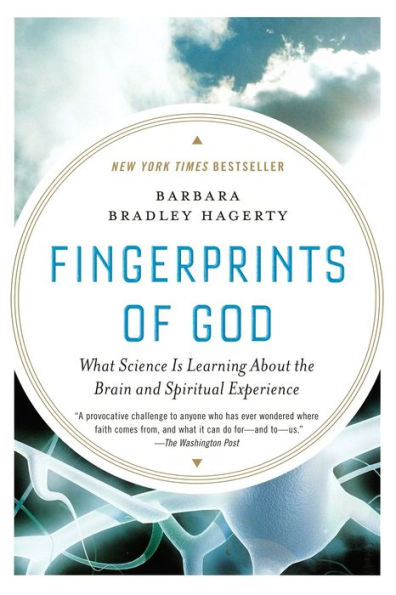
From the award-winning NPR religion correspondent comes a fascinating investigation of how science is seeking to answer the question that has puzzled humanity for generations: Can science explain God?
Is spiritual experience real or a delusion? Are there realities that we can experience but not easily measure? Does your consciousness depend entirely on your brain, or does it extend beyond? In Fingerprints of God, award-winning journalist Barbara Bradley Hagerty delves into the discoveries science is making about how faith and spirituality affect us physically and emotionally as it attempts to understand whether the ineffable place beyond this world can be rationally -even scientifically-explained.
Hagerty interviews some of the world's top scientists to describe what their groundbreaking research reveals about our human spiritual experience. From analyses of the brain functions of Buddhist monks and Carmelite nuns, to the possibilities of healing the sick through directed prayer, to what near-death experiences illuminate about the afterlife, Hagerty reaches beyond what we think we know to understand what happens to us when we believe in a higher power.
Paralleling the discoveries of science is Hagerty's own account of her spiritual evolution. Raised a Christian Scientist, she was a scrupulous adherent until a small moment as an adult triggered a revaluation of her beliefs, which in turn led her to a new way of thinking about God and faith.
An insightful examination of what science is learning about how and why we believe, Fingerprints of God is also a moving story of one person's search for a communion with a higher power and what she discovered on that journey.
In her first book, National Public Radio correspondent Hagerty acts as a tour guide through the rocky terrain of scientists who study religious experience. Is there a so-called "God gene"? Why do some people have mystical experiences while others never see the so-called light? Right up front, Hagerty reveals that this is not an entirely objective exercise. As a Christian, she wants to understand her own mystical encounter with the divine and why she believes when others do not. Yet to each interview, whether with a world-renowned neuroscientist or a back-road mystic, she brings a suitably skeptical eye. Along the way, she manages to explain some pretty cutting-edge science-psychoneuroimmunology, anyone?-and unravel some people's pretty hard-to-comprehend religious experiences without sacrificing depth or complexity. Then, with equal aplomb, she dances off to peyote ceremonies, church services and Alcoholics Anonymous meetings. The real beauty of this book lies in watching Hagerty gracefully balance her own trust in faith and science and, in the end, come down with one foot planted firmly in both. (May)
Copyright © Reed Business Information, a division of Reed Elsevier Inc. All rights reserved.Articles about research on spirituality and the brain are usually written from the point of view that religious experience can be understood from a purely scientific perspective. Hagerty's (religion correspondent, NPR) book does not have this naturalistic or materialistic tendency. Rather, as both a reporter and a religious person, she seeks insight on spirituality and science while being open to the possibility that spirituality may still have a transcendent component. The book is interesting to read because the author has interviewed many scientists as well as many people who attest to having mystical or near-death experiences. In a way, the reader feels like a participant in Hagerty's own encounter with the various pieces of information and evidence, struggling with her to make sense of it all. Highly recommended.
—John Jaeger
Ch. 1 Crossing the Stream 1
Ch. 2 The God Who Breaks and Enters 16
Ch. 3 The Biology of Belief 45
Ch. 4 The Triggers for God 63
Ch. 5 Hunting for the God Gene 81
Ch. 6 Isn't God a Trip? 104
Ch. 7 Searching for the God Spot 134
Ch. 8 Spiritual Virtuosos 164
Ch. 9 Out of My Body or out of My Mind? 192
Ch. 10 Are We Dead Yet? 216
Ch. 11 A New Name for God 243
Ch. 12 Paradigm Shifts 268
Acknowledgments 287
Notes 291
Index 313
If you're planning to read this book in order to find scientific proof that there is a God, put it down. It's not that kind of a book. This book is more of an erudite summarion of personal anecdotes along with reports of what various researchers are discovering about what the human brain looks like in periods of prayer and meditation. Most of the researchers interviewed will tell you that these variations in brain patterns are not evidence that there is a God; rather, it's evidence of how the brain reacts or changes during periods of prayer.
What I found more interesting personally were the recurring themes among a variety of believers as they reported their experiences. It wasn't just that most of them experienced feelings of euphoria or that they encountered a white light of some kind; it was that they felt a fundamental change in their outlook because of their experiences. Additionally, each person -- no matter their religious persuasion (or lack thereof) -- described their spiritual encounters with a figure they would describe as God (as in creator and omniscient being, no matter what name they gave it) and were left with a sense that religious affiliation was an artificial construct (i.e., it didn't matter whether a person were Jewish or Christian or Hindu or agnostic -- all paths lead to the same place).
In his book Spectrum, Dr. Dean Ornish urges meditation as a component of healthful living because it has been proven to reduce stress. Having read Fingerprints of God I am convinced that this is true. That it also opened up some new "visions" for my personal spiritual life is also helpful, but that's beside the point for the purposes of review because not everyone will find this book helpful in that regard.
Barbara Bradley Hagerty writes clearly and with a gentle sense of humor, by the way. She brings her journalistic style of writing and sense of organization to the overall tale. It's a joy to read her writing.
3 out of 3 people found this review helpful.
Was this review helpful? Yes NoThank you for your feedback. Report this reviewThank you, this review has been flagged.TM4VP
Posted July 26, 2009
For those who feel they are seekers of spiritual growth and willing to look at many paths this is a wonderful enquiry into the realms of modern explanation, scientific and otherwise for such a desire. Compelling hopeful and honest.
2 out of 2 people found this review helpful.
Was this review helpful? Yes NoThank you for your feedback. Report this reviewThank you, this review has been flagged.As a person continually seeking answers to the big questions, I really enjoyed Barbara Hagerty's book Fingerprints of God.
As with Losing my religion by xxx I was impressed by the courage of the author to freely discuss the parts of her life that most people keep under a basket. For a book of this genre, absolute truth is essential but also rare.
I also appreciated the excellent writing. Her year of award winning journalism was quite evident in her sharp writing and ability to distill the complex into simplicity with analogy and metaphor.
Of the 12 chapters, my favorites were chapter 6 - Isn't God a Trip and chapter 11 - A New Name for God. In 2008 I published a book which dealt with the subject in chapter 6 although I did not provide the rich detail that Barbara gives us. While some may find this to be a 'flaky' science, it is not. Even the top scientists admit they do not understand the mechanics or the ramifications.
Another aspect of this wonderful book was the clear sense that the author was not always adhering to a rigid outline. That is, is apparent that at times her mind would pick up new, fresh ideas and thoughts as she actually wrote the book. For me, this is the mark of a true author. Anyone can 'paint by numbers'. This is not one of those books. The evidence suggests the ideas flowed from the mind to the fingers as the work was being produced. I would also recommend, the Language of God and the Mind of God. Older works for sure, but still highly compelling.
I highly recommend this book to anyone that seeks a link between our spirit and modern science. It is thought provoking and in this age of atheism, very relevant.
I hope you enjoyed this review.
Michael L. Gooch
2 out of 2 people found this review helpful.
Was this review helpful? Yes NoThank you for your feedback. Report this reviewThank you, this review has been flagged.Penny_King
Posted July 18, 2009
My interest was spurred when Hagerty presented her findings in a tantalizing series featured on NPR. I ordered the book in audio format and found myself wishing it had been read by the enthusiastic journalist Hagerty herself instead of a theatrical paid professional. But my criticism stops there. My husband and I listened to the book on a recent road trip. While most of the concepts are not new, the research compiled into one volume is. Each chapter stimulated conversation between us, and friends for that matter, that has gone on for days. Hagerty's explorations have delighted two old metaphysicians.
1 out of 1 people found this review helpful.
Was this review helpful? Yes NoThank you for your feedback. Report this reviewThank you, this review has been flagged.Anonymous
Posted March 2, 2012
I have been seriously searching for the answer to Barbara's question "is there more?" Most of my life. I find myself strongly relating to her experiences and what she has to say.
There is much truth here!
Ritun_Minor
Posted June 10, 2010
An eye opener for skeptics.
Well written, absorbing, a personal, uncompromising, rational search through scientific data and personal interviews - for the big question: is there a G?
The writer isn't preaching for a certain God or any God - but left me (a rationalist) excited to see what fantastic revelations science may bring us - about the power of thought, faith and maybe, possibly - a certain type of God.
The author's journalism credentials should be revoked. This is pure theism, and cloaking it with dribs and drabs of scientific opinion does not earn it any scientific authority whatsoever. It's dishonest philosophy; yet another lame attempt to drag God back into a universe where it doesn't exist. Don't waste your time!
0 out of 3 people found this review helpful.
Was this review helpful? Yes NoThank you for your feedback. Report this reviewThank you, this review has been flagged.Anonymous
Posted December 31, 2009
No text was provided for this review.
Anonymous
Posted January 4, 2010
No text was provided for this review.
Anonymous
Posted January 28, 2010
No text was provided for this review.
Anonymous
Posted January 28, 2010
No text was provided for this review.
Anonymous
Posted December 18, 2009
No text was provided for this review.
Anonymous
Posted April 30, 2011
No text was provided for this review.
Anonymous
Posted July 13, 2009
No text was provided for this review.
Anonymous
Posted January 14, 2010
No text was provided for this review.
Anonymous
Posted October 15, 2010
No text was provided for this review.
Anonymous
Posted February 17, 2011
No text was provided for this review.
Anonymous
Posted January 27, 2010
No text was provided for this review.
Anonymous
Posted January 27, 2010
No text was provided for this review.
Anonymous
Posted December 9, 2009
No text was provided for this review.
Overview
From the award-winning NPR religion correspondent comes a fascinating investigation of how science is seeking to answer the question that has puzzled humanity for generations: Can science explain God?
Is spiritual experience real or a delusion? Are there realities that we can experience but not easily measure? Does your consciousness depend entirely on your brain, or does it extend beyond? In Fingerprints of God, award-winning journalist Barbara Bradley Hagerty delves into the discoveries science is making about how faith and spirituality affect us physically and emotionally as it attempts to understand whether the ...