
The British essayist on his U.S. Navy immersion.

Uh-oh, it looks like your Internet Explorer is out of date.
For a better shopping experience, please upgrade now.
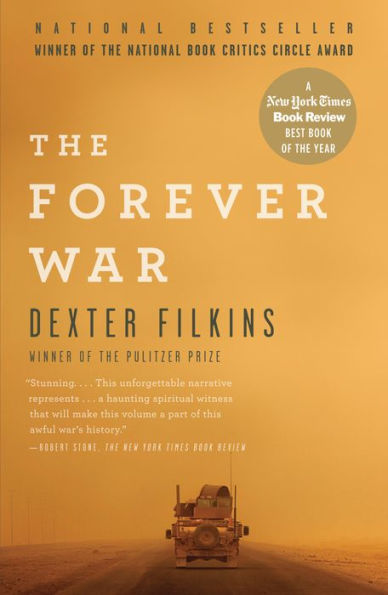
NATIONAL BOOK CRITICS CIRCLE AWARD WINNER • NATIONAL BESTSELLER • The definitive account of America's conflict with Islamic fundamentalism and a searing exploration of its human costs—an instant classic of war reporting from the Pulitzer Prize winning journalist.
Through the eyes of Dexter Filkins, a foreign correspondent for the New York Times, we witness the rise of the Taliban in the 1990s, the aftermath of the attack on New York on September 11th, and the American wars in Afghanistan and Iraq. Filkins is the only American journalist to have reported on all these events, and his experiences are conveyed in a riveting narrative filled with unforgettable characters and astonishing scenes.
Brilliant and fearless, The Forever War is not just about America's wars after 9/11, but about the nature of war itself.
NATIONAL BOOK CRITICS CIRCLE AWARD WINNER • NATIONAL BESTSELLER • The definitive account of America's conflict with Islamic fundamentalism and a searing exploration of its human costs—an instant classic of war reporting from the Pulitzer Prize winning journalist.
Through the eyes of Dexter Filkins, a foreign correspondent for the New York Times, we witness the rise of the Taliban in the 1990s, the aftermath of the attack on New York on September 11th, and the American wars in Afghanistan and Iraq. Filkins is the only American journalist to have reported on all these events, and his experiences are conveyed in a riveting narrative filled with unforgettable characters and astonishing scenes.
Brilliant and fearless, The Forever War is not just about America's wars after 9/11, but about the nature of war itself.
NATIONAL BOOK CRITICS CIRCLE AWARD WINNER • NATIONAL BESTSELLER • The definitive account of America's conflict with Islamic fundamentalism and a searing exploration of its human costs—an instant classic of war reporting from the Pulitzer Prize winning journalist.
Through the eyes of Dexter Filkins, a foreign correspondent for the New York Times, we witness the rise of the Taliban in the 1990s, the aftermath of the attack on New York on September 11th, and the American wars in Afghanistan and Iraq. Filkins is the only American journalist to have reported on all these events, and his experiences are conveyed in a riveting narrative filled with unforgettable characters and astonishing scenes.
Brilliant and fearless, The Forever War is not just about America's wars after 9/11, but about the nature of war itself.

| ISBN-13: | 9780307270344 |
|---|---|
| Publisher: | Knopf Doubleday Publishing Group |
| Publication date: | 09/16/2008 |
| Sold by: | Random House |
| Format: | eBook |
| Pages: | 384 |
| File size: | 815 KB |
Only ThisThey led the man to a spot at the middle of the field. A soccer field, grass, with mainly dirt around the center where the players spent most of the game. There was a special section for the handicapped on the far side, a section for women. The orphans were walking up and down the bleachers on my side selling candy and cigarettes.A couple of older men carried whips. They wore grenade launchers on their backs.The people are coming, a voice was saying into the loudspeaker, and the voice was right, the people were streaming in and taking their seats. Not with any great enthusiasm, as far as I could tell; they were kind of shuffling in. I probably had more enthusiasm than anybody. I had a special seat; they’d put me in the grass at the edge of the field. In America, I would have been on the sidelines, at the fifty yard line with the coaches. Come sit with us, they’d said; you are our honored guest.A white Toyota Hi-Lux drove onto the field and four men wearing green hoods climbed out of the back. There was a fifth man, a prisoner, no hood, sitting in the bed of the truck. The hooded men laid their man in the grass just off midfield, flat on his back, and crouched around him. It was hard to see. The man on his back was docile; there was no struggle at all. The voice on the loudspeaker said he was a pickpocket.“Nothing that is being done here is against God’s law,” the voice said.The green hoods appeared busy, and one of them stood up. He held the man’s severed right hand in the air, displaying it for the crowd. He was holding it up by its middle finger, moving in a semicircle so everyone could see. The handicapped and the women. Then he pulled his hood back, revealing his face, and he took a breath. He tossed the hand into the grass and gave a little shrug.I couldn’t tell if the pickpocket had been given any sort of anesthesia. He wasn’t screaming. His eyes were open very wide, and as the men with the hoods lifted him back into the bed of the Hi-Lux, he stared at the stump of his hand. I took notes the whole time.I looked back at the crowd, and it was remarkably calm, unfeeling almost, which wasn’t really surprising, after all they’d been through. A small drama with the orphans was unfolding in the stands; they were getting crazy and one of the guards was beating them with his whip.“Get back,” he was saying, drawing the whip over his head. The orphans cowered.I thought that was it, but as it turned out the amputation was just a warm-up. Another Toyota Hi-Lux, this one ma-roon, rumbled onto midfield carrying a group of long-haired men with guns. The long hair coming out of their white turbans. They had a blindfolded man with them. The Taliban were known for a lot of things and the Hi-Lux was one, jacked up and fast and menacing; they had conquered most of the country with them. You saw a Hi-Lux and you could be sure that something bad was going to happen soon.“The people are coming!” the voice said again into the speaker, louder now and more excited. “The people are coming to see, with their own eyes, what sharia means.”The men with guns led the blindfolded man from the truck and walked him to midfield and sat him down in the dirt. His head and body were wrapped in a dull gray blanket, all of a piece. Seated there in the dirt at midfield at the Kabul Sports Stadium, he didn’t look much like a man at all, more like a sack of flour. In that outfit, it was difficult even to tell which way he was facing. His name was Atiqullah, one of the Talibs said.The man who had pulled his hood back was standing at midfield, facing the crowd. The voice on the loudspeaker introduced him as Mulvi Abdur Rahman Muzami, a judge. He was pacing back and forth, his green surgical smock still intact. The crowd was quiet.Atiqullah had been convicted of killing another man in an irrigation dispute, the Talibs said. An argument over water. He’d beaten his victim to death with an ax, or so they said. He was eighteen.“The Koran says the killer must be killed in order to create peace in society,” the loudspeaker said, echoing inside the stadium. “If punishment is not meted out, such crimes will become common. Anarchy and chaos will return.”By this time a group had gathered behind me. It was the family of the murderer and the family of the victim. The two groups behind me were toing-and-froing as in a rugby game. One family spoke, leaning forward, then the other. The families were close enough to touch. Sharia law allows for the possibility of mercy: Atiqullah’s execution could be halted if the family of the victim so willed it.Judge Muzami hovered a few feet away, watching.“Please spare my son,” Atiqullah’s father, Abdul Modin, said. He was weeping. “Please spare my son.”“I am not ready to do that,” the victim’s father, Ahmad Noor, said, not weeping. “I am not ready to forgive him. He killed my son. He cut his throat. I do not forgive him.”The families were wearing olive clothes that looked like old blankets and their faces were lined and dry. The women were weeping. Everyone looked the same. I forgot who was who.“Even if you gave me all the gold in the world,” Noor said, “I would not accept it.”Then he turned to a young man next to him. My son will do it, he said.The mood tightened. I looked back and saw the Taliban guards whipping some children who had tried to sneak into the stadium. Atiqullah was still sitting on the field, possibly oblivious. The voice crackled over the loudspeaker.“O ye who believe!” the voice in the loudspeaker called. “Revenge is prescribed for you in the matter of the murdered; the freeman for the freeman, and the slave for the slave, and the female for the female.“People are entitled to revenge.”One of the green hoods handed a Kalashnikov to the murder victim’s brother. The crowd fell silent.Just then a jumbo jet appeared in the sky above, rumbling, forcing a pause in the ceremony. The brother stood holding his Kalashnikov. I looked up. I wondered how a jet airliner could happen by such a place, over a city such as this, wondered where it might be going. I considered for a second the momentary collision of the centuries.The jumbo jet flew away and the echo died and the brother crouched and took aim, leveling his Kalashnikov at Atiqullah’s head.“In revenge there is life,” the loudspeaker said.The brother fired. Atiqullah lingered motionless for a second then collapsed in a heap under the gray blanket. I felt what I believed was a vibration from the stands. The brother stood over Atiqullah, aimed his AK-47 and fired again. The body lay still under the blanket.“In revenge there is life,” the loudspeaker said.The brother walked around Atiqullah, as if he were looking for signs of life. Seeing one, apparently, he crouched and fired again.Spectators rushed onto the field just like the end of a college football game. The two men, killer and avenger, were carried away in separate Hi-Luxes, one maroon, one white. The brother stood up in the bed of the white truck as it rumbled away, surrounded by his fellows. He held his arms in the air and was smiling.I had to move fast to talk to people before they went home. Most everyone said they approved, but no one seemed to have any enthusiasm.“In America, you have television and movies—the cinema,” one of the Afghans told me. “Here, there is only this.”I left the stadium and walked in a line of people through the streets. I spotted something in the corner of my eye. It was a boy, a street boy, with bright green eyes. He was standing in an alley, watching me. The boy stood for a few more seconds, his eyes following mine. Then he turned and ran.In the late afternoons the center of Kabul had an empty, twilight feel, a quiet that promised nothing more than another day like itself. There were hardly any cars then, just some women floating silently in their head-to-toe burqas.* Old meat hung in the stalls. Buildings listed in the ruins.One of those afternoons, a thin little shoeshine boy walked up to me. He was smiling and running his finger across his throat.“Mother is no more,” he said, finger across the neck. “Father is finished.”His name was Nasir and he repeated the phrase in German and French, smiling as he did. “Mutter ist nicht mehr. Vater ist fertig.” He dragged the finger across his throat again. Rockets, he said. Racketen. His pale green eyes were rimmed in black. He did not ask for money; he wanted to clean my boots. Then he was gone, scampering down the muddy street with his tiny wooden box.Kabul was full of orphans like Nasir, woebegone children who peddled little labors and fantastic tales of grief. You’d see them in packs of fifty and sometimes even a hundred, skittering in mismatched shoes and muddy faces. They’d thunder up to you like a herd of wild horses; you could hear the padding of so many tiny feet. Sometimes I’d wonder where all the parents had gone, why they’d let their children run around like that, and then I’d catch myself. The orphans would get out of control sometimes, especially when they saw a foreigner, grabbing and shoving one another, until they were scattered by one of the men with whips. They’d come out of nowhere, the whip wielders, like they’d been waiting offstage. The kids would squeal and scatter, then circle back again, grinning. If I raised a hand, they’d flinch like strays.If a war went on long enough the men always died, and someone had to take their place. Once I found seven boy soldiers fighting for the Northern Alliance on a hilltop in a place called Bangi. The Taliban positions were just in view, a minefield in between. The boys were wolflike, monosyllabic with no attention spans. Eyes always darting. Laughing the whole time. Dark fuzz instead of beards. They wore oddly matched apparel like high-top tennis shoes and hammer-and-sickle belts, embroidered hajj caps and Russian rifles.I tried to corner one of the boys on the hill. His face was half wrapped in a checkered scarf that covered his mouth. Abdul Wahdood. All I could see were his eyes. I kept asking him how old he was and he kept looking over at his brother. His father had been killed a year before, he said, but they fed him here and with the money he could take care of his whole family, $30 a month. “My mother is not weeping,” Abdul said. I could see how bored he was, and his friends definitely noticed because one of them started firing his Kalashnikov over our heads. That really got them going, laughing hilariously and falling over each other. Two of them started wrestling. My photographer and I calmed them down and asked them to pose in a picture with us, and they lined up and grew very grave. After that they stood behind us in a semicircle and raised their guns, not like they were aiming at anything but more like they were saluting. Then a couple of men appeared on the hilltop bearing a kettle of rice and the boys descended on it. The Taliban came down the road a few months later. I’ve got the boys’ picture on a bookcase in my apartment.I drove in from the east. I rode in a little taxi, on a road mostly erased, moving slowly across the craters as the Big Dipper rose over the tops of the mountains that encircled the capital on its high plateau. The cars in front of us were disappearing into the craters as we were climbing out of ours, disappearing then reappearing, swimming upward and then out, like ships riding the swells.I passed the overturned tanks of the departed army, the red stars faded on the upside-down turrets. I passed checkpoints manned by men who searched for music. I stopped halfway and drank cherry juice from Iran and watched the river run through the walls of the Kabul gorge. There was very little electricity then, so I couldn’t see much of the city coming in, neither the people nor the landscape nor the ruined architecture, nothing much but the twinkling stars. From the car, I could make out the lighter shade of the blasted buildings, lighter gray against the darkness of everything else, the scree and the wash of the boulders and bricks, a shattered window here and there. A single turbaned man on a bicycle.One morning I was standing amid the blown-up storefronts and the broken buildings of Jadi Maiwand, the main shopping street before it became a battlefield, and I was trying to take it in when I suddenly had the sensation one sometimes feels in the tropics, believing that a rock is moving, only to discover it is a living thing perfectly camouflaged. They were crawling out to greet me: legless men, armless boys, women in tents. Children without teeth. Hair stringy and matted.Help us, they said.Help us. A woman appeared. I guessed it was a woman but I couldn’t see her through her burqa. “Twelve years of schooling,” she said, and she kept repeating the phrase like some mantra, like it would get her a job.For the first time I was talking to a woman I couldn’t see. I could trace the words as they exited the vent, watch the fabric flutter as she breathed and spoke. But no face. No mouth. “Twelve years of schooling,” she said. She had a name, Shah Khukhu, fifty, a mother of five, missing a finger and a leg. She was hiking up her burqa to show me.*A burqua is a head-to-toe garment worn by women.
The British essayist on his U.S. Navy immersion.