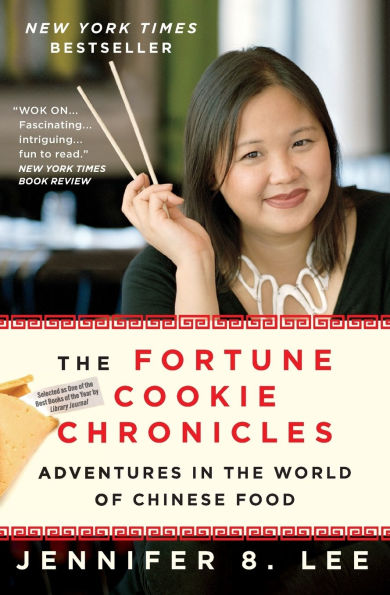
The Fortune Cookie Chronicles: Adventures in the World of Chinese Food

( 20 )

Pick Up in Store

Reserve and pick up in 60 minutes at your local store

Paperback (Reprint)
$9.98
BN.com price
$13.00 List Price (Save 23%)
Marketplace (New and Used)
from
$2.95
$13.00 List Price (Save 77%)
Usually ships within 1-2 business days
All (18)  
Used (7)  
New (11)  
Close
Sort by
Page 1 of 2
Showing 1 – 10 of 18 (2 pages)
$2.95
(Save 77%)
Seller since 2005

Feedback rating:

(959)

Condition:

New — never opened or used in original packaging.

Like New — packaging may have been opened. A "Like New" item is suitable to give as a gift.

Very Good — may have minor signs of wear on packaging but item works perfectly and has no damage.

Good — item is in good condition but packaging may have signs of shelf wear/aging or torn packaging. All specific defects should be noted in the Comments section associated with each item.

Acceptable — item is in working order but may show signs of wear such as scratches or torn packaging. All specific defects should be noted in the Comments section associated with each item.

Used — An item that has been opened and may show signs of wear. All specific defects should be noted in the Comments section associated with each item.

Refurbished — A used item that has been renewed or updated and verified to be in proper working condition. Not necessarily completed by the original manufacturer.

Very Good
2009 Paperback Very good All new inventory received to basement (formerly known as bsmt) This is a copy that has been read, but remains in excellent condition. Pages are ... intact and are not marred by notes or highlighting. The spine remains undamaged. All orders guaranteed and ship within 24 hours. Your purchase supports More Than Words, a nonprofit job training program for youth, empowering youth to take charge of their lives by taking charge of a business. Read more Show Less

Ships from: Waltham, MA

Usually ships in 1-2 business days

  • Canadian
  • International
  • Standard, 48 States
  • Standard (AK, HI)
  • Express, 48 States
  • Express (AK, HI)
$3.49
(Save 73%)
Seller since 2012

Feedback rating:

(9530)

Condition: Like New
GREAT Bargain Book Deal - like new - some may have small remainder mark - Ships out by NEXT Business Day - 100% Satisfaction Guarantee!

Ships from: Buffalo, NY

Usually ships in 1-2 business days

  • Canadian
  • International
  • Standard, 48 States
  • Standard (AK, HI)
  • Express, 48 States
  • Express (AK, HI)
$4.00
(Save 69%)
Seller since 2009

Feedback rating:

(61)

Condition: Good
2009 Paperback Good

Ships from: Ann Arbor, MI

Usually ships in 1-2 business days

  • Canadian
  • International
  • Standard, 48 States
  • Standard (AK, HI)
  • Express, 48 States
  • Express (AK, HI)
$5.07
(Save 61%)
Seller since 2005

Feedback rating:

(45317)

Condition: Very Good
SHIPS FAST! via UPS(AK/HI Priority Mail) within 24 hrs/ used sticker/some hilite

Ships from: Columbia, MO

Usually ships in 1-2 business days

  • Standard, 48 States
  • Standard (AK, HI)
  • Express, 48 States
  • Express (AK, HI)
$6.10
(Save 53%)
Seller since 2009

Feedback rating:

(86)

Condition: Good
2009 Paperback Good

Ships from: Madison, WI

Usually ships in 1-2 business days

  • Canadian
  • International
  • Standard, 48 States
  • Standard (AK, HI)
  • Express, 48 States
  • Express (AK, HI)
$7.38
(Save 43%)
Seller since 2008

Feedback rating:

(11733)

Condition: New
Absolutely Brand New & In Stock. 100% 30-Day Money Back. Direct from our warehouse. 5+ million customers served-In business since 1997. Happy Customers is Our #1 Goal. Toll Free ... Support. 4 to 14 business day Delivery Time by US Post Office. Read more Show Less

Ships from: Oldsmar, FL

Usually ships in 1-2 business days

  • Standard, 48 States
  • Standard (AK, HI)
$7.69
(Save 41%)
Seller since 2007

Feedback rating:

(21316)

Condition: New
BRAND NEW

Ships from: Avenel, NJ

Usually ships in 1-2 business days

  • Canadian
  • International
  • Standard, 48 States
  • Standard (AK, HI)
$7.98
(Save 39%)
Seller since 2009

Feedback rating:

(124)

Condition: Very Good
2009 Paperback Very Good Very Good Paperback clean, unmark, scuffing to top and bottom of spine, creasing to extremities otherwise a fine copy-ss All orders are shipped by kbooks ... every business day. Read more Show Less

Ships from: Niagara Falls, NY

Usually ships in 1-2 business days

  • Canadian
  • International
  • Standard, 48 States
  • Standard (AK, HI)
  • Express, 48 States
  • Express (AK, HI)
$8.33
(Save 36%)
Seller since 2008

Feedback rating:

(12864)

Condition: New
Brand New, Perfect Condition, Please allow 4-14 business days for delivery. 100% Money Back Guarantee, Over 1,000,000 customers served.

Ships from: South Bend, IN

Usually ships in 1-2 business days

  • Canadian
  • International
  • Standard, 48 States
  • Standard (AK, HI)
$8.34
(Save 36%)
Seller since 2009

Feedback rating:

(4150)

Condition: New
This item will be shipped from our warehouse in Chicago.

Ships from: Aurora, IL

Usually ships in 1-2 business days

  • Standard, 48 States
  • Standard (AK, HI)
Page 1 of 2
Showing 1 – 10 of 18 (2 pages)
Close
Sort by
NOOK Book (eBook)
$8.99
BN.com price

Available on NOOK devices and apps

  • Nook Devices
  • NOOK
  • NOOK Color
  • NOOK Tablet
  • Tablet/Phone
  • NOOK for iPad
  • NOOK for iPhone
  • NOOK for Android
  • NOOK for Android (Tablet)
  • NOOK Kids for iPad
  • PC/Mac
  • NOOK Study
  • NOOK for PC
  • NOOK for Mac

Need a NOOK? Explore Now

Overview

If you think McDonald's is the most ubiquitous restaurant experience in America, consider that there are more Chinese restaurants in America than McDonalds, Burger Kings, and Wendys combined. New York Times reporter and Chinese-American (or American-born Chinese). In her search, Jennifer 8 Lee traces the history of Chinese-American experience through the lens of the food. In a compelling blend of sociology and history, Jenny Lee exposes the indentured servitude Chinese restaurants expect from illegal immigrant chefs, investigates the relationship between Jews and Chinese food, and weaves a personal narrative about her own relationship with Chinese food. The Fortune Cookie Chronicles speaks to the immigrant experience as a whole, and the way it has shaped our country.

Editorial Reviews

From Barnes & Noble
If America is Fast Food Nation, it speaks with an Asian accent. In the U.S., Chinese restaurants are more numerous than McDonald's, Burger King, and Wendys combined. In Fortune Cookie Chronicles, New York Times reporter Jennifer 8 Lee (her Chinese middle name signifies "prosperity") takes us on a coast-to-coast takeout tour of America's most pervasive ethnic eateries. On the way, readers receive generous helpings of cultural history and sociology, tidbits about small business ingenuity, and insights about national eating habits. An auspicious reading adventure awaits you.
Lee is a city-beat reporter for The New York Times. Her inclination as a journalist is to trace a story all the way to its genesis, but not without taking some fascinating detours…It's fun to read about the Jewish passion for "safe treyf" (Yiddish for nonkosher food) and to accompany Lee on an exhaustive hunt for "The Greatest Chinese Restaurant in the World" outside China, Hong Kong and Taiwan. But amusing as such diversions are, Lee's book is more serious than its jolly subtitle suggests, exposing some very ugly sides of the business.
—The New York Times - Jane and Michael Stern
From The Critics
Reading Lee's book is almost like watching a documentary travelogue. From all-you-can-eat buffets in Kansas to the small southern Chinese village of Jietoupu, where she tracks down descendants of General Tso (who, natch, have never heard of, seen or tasted their forefather's infamous chicken dish), the author takes readers by the hand and brings them on her adventure…Where Lee really shines, though, is in describing the people who have cooked, served and delivered America's favorite cuisine. The Fortune Cookie Chronicles isn't just about the popularization of Chinese food; it's also a story of Chinese immigrants in America.
—The Washington Post

Product Details

  • ISBN-13: 9780446698979
  • Publisher: Grand Central Publishing
  • Publication date: 3/23/2009
  • Edition description: Reprint
  • Pages: 320
  • Sales rank: 155,739
  • Product dimensions: 5.20 (w) x 7.90 (h) x 1.00 (d)

Meet the Author

Jennifer 8 Lee, the daughter of Chinese immigrants and a fluent speaker of Mandarin Chinese herself, grew up eating her mother's authentic Chinese food in her family's New York City kitchen before graduating from Harvard in 1999 with a degree in Applied Mathematics and economics and studying at Beijing University. At the age of 24, she was hired by the New York Times, where she is a metro repoter and has written a variety of stories on culture, poverty, and technology.

Read an Excerpt

The Fortune Cookie Chronicles

By Jennifer 8. Lee
Twelve
Copyright © 2008 Jennifer 8. Lee
All right reserved.

ISBN: 978-0-446-58007-6


Chapter One
American-Born Chinese

There are some forty thousand Chinese restaurants in the United States-more than the number of McDonald's, Burger Kings, and KFCs combined.

Tucked into exurban strip malls, urban ghettos, and tiny midwestern towns that are afterthoughts for cartographers, Chinese restaurants have spread nearly everywhere across America-from Abbeville, Louisiana, to Zion, Illinois, to Navajo reservations, where, in a distinction shared with only a handful of businesses, they're exempted from tribe-member ownership. Old restaurants, clothing stores on Main Streets, and empty storefronts have been reborn as Chinese restaurants. The Washington, D.C., boardinghouse where John Wilkes Booth and his accomplices planned Abraham Lincoln's assassination is now a Chinese restaurant called Wok n Roll.

Chinese restaurants have long been a weekly or monthly ritual for many Americans.

As far back as 1942, chop suey and chow mein were added to the U.S. Army cookbook. Jonas Salk, while developing the polio vaccine in the early 1950s, would eat his lunch at Bamboo Garden on Forbes Avenue, near the University of Pittsburgh, nearly every day. He always ordered the same thing: a bowl of wonton soup, an egg roll, rice, and chicken chow mein made with homegrown bean sprouts-all for $1.35.

Chinese restaurants are sought out for special events, too. In 1961, before the Freedom Riders left for the first fateful bus ride through the Deep South to protest segregation, a number of that company met for dinner at a Chinese restaurant in Washington. "Someone referred to this meal as the Last Supper," said John Lewis, then a young theology student from rural Georgia, later a congressman. In October 1962, emissaries for John F. Kennedy and Nikita Khrushchev met secretly at Yenching Palace in the Cleveland Park neighborhood of Washington to work out a solution to the Cuban missile crisis. Chinese restaurants were neutral territory.

Nearly everyone has a go-to Chinese restaurant. Dwight Eisenhower ordered his chicken chop suey from Sun Chop Suey Restaurant on Columbia Road in Washington, D.C., for decades. When he became president, the FBI investigated every employee at the restaurant (just as a precaution). Likewise, Peking Gourmet Inn outside Falls Church, Virginia, had to install a bulletproof glass window near table N17. That is where the Bushes, both father and son, sit at their favorite Chinese restaurant.

It's not surprising that the Powerball officials heard the same tale repeated over and over again across the twenty-nine states, from coast to coast. The stories were different. The stories were the same. It was takeout. It was sit-down. It was an all-you-can-eat buffet. It happened years ago, months ago, earlier that day. It was dinner. It was lunch. It was where they ate every week with coworkers. It was on a family vacation to a neighboring state. The number had been in a fortune cookie they had cracked open themselves. The number had been on a fortune found while cleaning a car or waiting at a convenience-store counter. But the one thing all those stories had in common was the starting point: a meal from a Chinese restaurant that had ended with a fortune cookie.

The lottery story ran in AM New York, the commuter daily I picked up one morning to read on the New York City subway. The one-paragraph article said the March 30 Powerball had been pummeled with an unusually large number of winners, 110 in all, largely because of fortune cookies.

I perked up.

I am obsessed with Chinese restaurants. Like many Americans, I first discovered them in my childhood. I grew up during the 1980s on the Upper West Side of Manhattan, where Broadway is sometimes called Szechuan Alley for the density of Chinese restaurants along it. My parents had first settled in the area when my father was studying for his Ph.D. at Columbia University; because my mom never learned to drive, our family never moved out of the city. As a result, I was raised not too far in time and place from many of the changes that revolutionized Chinese food in the United States.

My siblings and I are known as ABCs, American-born Chinese. We're also known as bananas (yellow on the outside but white on the inside) and Twinkies (which has more of a pop-culture but processed ring to it). There are a lot of inside jokes among immigrant families. My family even has one embedded in the children's names. My parents named me Jennifer; my sister is Frances; my brother is Kenneth. If you string together our first initials, you get JFK, which, my parents tease, is the airport they landed at when they first came to America.

My parents arrived in the United States courtesy of the Immigration Reform Act of 1965, which opened the doors to educated and skilled workers like my father and dramatically shifted the balance of immigration away from Europe. Countries like Taiwan, South Korea, and India stood ready to offer the best products of their meritocratic educational systems.

My mom took care of the home and did most of the cooking, while my father worked on Wall Street. But like many families in our area, we'd order Chinese takeout when she was too busy to cook. As a girl I would run down to the neighborhood Chinese restaurant with a crisp twenty-dollar bill in my pocket. Barely tall enough to see past the counter, I'd solemnly order dishes from the big white menu, using the Chinese names that my mom had carefully taught me. (Without exception, the vocabulary words that Chinese-American kids-and immigrant kids in general-know best are almost always related to food.)

Then I'd lug home my treasure: a plastic bag of steaming, generously stuffed trapezoidal white cartons. Our family gathered around the table as we pulled out the boxes, each one bursting with the potential of anonymity. Out came chopsticks, the little clear packets of black soy sauce, and crunchy fortune cookies. Each untucking of the lid released a surge of aroma and a sight to spark the appetite. Would it be the amber-colored noodles of roast pork lo mein? The lightly sweetened crispiness of General Tso's chicken nestled in a bed of flash-cooked broccoli? Or the spicy red chili oils of mapo tofu? Virginal white rice would be doused with steaming sauces, the mingling of simmered soy sauce, piquant vinegar, slivers of ginger, and fragrant garlic. The Chinese food begged to be mixed together: sweet, sour, salty, and savory flavors layering upon one another. They tasted even better the next day when the leftovers were reheated. We'd break open the fortune cookies for the message inside, rarely eating the cookie. The cheerfully misspelled, awkwardly phrased, but wise words of the Chinese fortune cookie sages gave me comfort. My parents' bookshelves were lined with Chinese philosophical classics like Confucius's Analects and the I Ching. For a girl who could not untangle the thicket of Chinese characters in those opaque and mysterious books, the little slips of insight represented the distillation of hundreds of years of Chinese wisdom.

Then came a shocking revelation.

Fortune cookies weren't Chinese.

It was like learning I was adopted while being told there was no Santa Claus. How could that be? I had always believed in the crispy, curved, vanilla-flavored wafers with the slips inside.

It was through reading The Joy Luck Club by Amy Tan when I was in middle school that I first became aware of the mass deception. In one tale, two Chinese women find jobs in a San Francisco fortune cookie factory, where one is utterly perplexed when she learns that the cookies and their cryptic messages are considered Chinese.

I asked my mom if she had known all along that fortune cookies weren't Chinese. She shrugged. She said when she first got to the United States from Taiwan, she'd assumed they were from Hong Kong or mainland China. China is a large and fractured place. She had never been to mainland China. Neither had I.

The Americanness of fortune cookies hit home a few years later, in a 1992 front-page story in the New York Times with the headline "A Fortune Will Greet You in an Endeavor Faraway." The article announced that Brooklyn-based Wonton Food was to sell fortune cookies in China. It added that in Hong Kong, the cookies were already being marketed as "genuine American fortune cookies."

The Americanness of fortune cookies should have served as a hint for what else I was to learn about Chinese food. Only now, looking back, do I find it obvious. As a child, I never considered it strange that the food we ordered from Chinese restaurants didn't quite resemble my mom's home cooking. My mom used white rice, soy sauce, garlic, scallions, and a wok. But she never deep-fried chunks of meat, succulent and soft, then drenched them with rich, flavorful sauce. She cooked with ingredients that were pickled and dried and of strange shapes and never appeared on the takeout menu. Her kitchen was filled with jars and bags of all sorts of unusual things-white fungus, red beans, pungent black mushrooms, porous lotus roots. She used preserved foods: eerily translucent thousand-year-old eggs, spicy pickled bamboo shoots, vinegared mustard greens. Her dishes involved bones and shells-sweet-and-sour ribs, boiled garlic shrimp, chicken feet.

At the open seafood storefronts of Manhattan's Chinatown, my parents would pick through the bins of live crabs, sluggish but still menacing to a wide-eyed six-year-old girl. We would haul the writhing creatures back home in thin plastic bags and deposit them in the kitchen sink. We would steam the life out of them in my mother's decade-old wok, their waving pincers gradually slowing to a halt as their bodies became progressively red and orange. The Chinese holistic approach to crab was not the sanitized, edited version of Red Lobster. Our crabs burst forth with weird colors and textures. The goopy orange paste, called gao, was the best part, my mom told me.

My parents were always annoyed when we went to the "real Chinese restaurants" in Flushing, Queens, and I asked for my favorite dishes, beef with broccoli and lo mein. They inevitably ordered dishes that had eyeballs, like steamed whole fish with ginger and scallions. For a girl who was more familiar with the pleasantly geometric fish-fillet sandwiches of her elementary school cafeteria, the piscine servings were unnerving. Instead of eating this fish that had been merrily swimming in the tank just minutes before, I turned my chopsticks to the comforting crisp green broccoli, tender slices of beef, and soft amber noodles. My siblings and I turned up our noses at the bitter hot tea. We either added sugar or insisted on having cups of ice water. My parents were exasperated. They had thrown their children into a pool of cultural heritage in America: Chinese Saturday school, Chinese camp, Chinese chorus, Chinese martial arts, and Chinese folk dancing. (Perhaps 90 percent of all Chinese-Americans girls have twirled a silk ribbon at some point in their lives.) Yet on the issue of food, our taste buds were firmly entrenched. They groused about our inability to appreciate "real Chinese food."

I never really understood what "real Chinese food" meant until I went to China. Years of study in Chinese Saturday school, daily classes in college, and a semester in Taiwan had opened up the world of the dense opaque characters of my mother's books. China was a foreign country to me, but one where I happened to speak the language. Ostensibly I spent my fellowship year studying at Beijing University, but in reality I was educating myself by traveling cross-country from the deserts of Inner Mongolia to the lakes of Sichuan to the peaks of Tibet. Alongside the Coca-Cola, McDonald's, and KFCs that have penetrated China's core, I encountered a variety of cuisines that were more akin to my mom's cooking than the ones of America's Chinese restaurants: more vegetables, less meat, less oil. I began spitting bones out onto the table and drinking watery soup after a meal to wash it all down. I even drank hot tea-no fortune cookies to be found. I began to roll my eyes at the takeout Chinese food I had grown up with; it wasn't authentic.

But as interesting as the local food was to me, I was interesting to the locals. You could see their minds processing: She looks perfectly Chinese. She speaks Chinese perfectly. But something is amiss. Perhaps it was the way I moved, the way I laughed, the way I dressed. I wasn't, they felt, of China. Hong Kong? Taiwan? they asked.

"I'm American," I explained.

Their reply: "No, you're Chinese. You were just born in America."

I was not an American to them. I was an American-born Chinese. Maybe the same thing was true of Chinese food back home: It's Chinese. It just happened to be born in America.

Or maybe the truth was closer to this: It's American. It just looks Chinese.

That morning, as I read about the Powerball winners on the subway, people swarmed around me as usual. I looked at them and thought about how many of them had eaten Chinese food in the last week, how many had read their fortunes and added "in bed," how many kept a favorite fortune folded in their wallet. How many might have played the lottery with their lucky numbers? I had never played the lottery, but I was entranced by the idea that so many people took the same leap of faith and played the identical numbers from a fortune cookie. Right there on the subway, I decided to follow those fortune cookies back to their source-from the winners back to the restaurants, back to the factory and the people who write the fortunes, back to the very historic origins of fortune cookies. Following the Powerball fortune cookie trail, I believed, was something that would help me unravel the nagging mysteries of Chinese food in America. For the story of the Powerball trail was the story of Chinese food in reverse. I'd fallen into an obsession with Chinese food-in a way that my friends and parents actually found rather worrisome, given my hyperrational nature. Charitably, you could describe me as "passionate" about Chinese food. Passions seem lively and motivating, while obsessions sound dark and vaguely deviant. But the line between passion and obsession is a wobbly one. Obsessions pick us more than we pick them. They control us more than we control them. Why do people become obsessed with bird-watching, solving mathematical proofs, making money? Maybe they're trying to complete themselves, to fill a void, whether it be through beauty, truth, or security.

Within hours, I identified one of the Powerball restaurants, Lee's China, in Omaha, Nebraska. I looked up the number online and dialed. A woman picked up.

I started out by introducing myself in Mandarin Chinese.

I received the telephone equivalent of a blank stare.

I switched to basic Cantonese.

More blankness.

I tried English.

The woman cut me off. "We're Korean," she said in a thick accent. Then she hung up.

Over the next year I compiled a list of the Powerball restaurants and winners, drew up an itinerary, and began a consuming journey that crisscrossed the country. By the end, I had visited forty-two states, with nearly all of the Powerball states among them. I had driven cars until bugs had splattered across my windshield like egg whites dropped in soup. I'd taken red-eye flights, pulled all-nighters driving on interstate highways, stewed on buses for twenty-three consecutive hours, and crashed in the relative air-conditioned comfort of Amtrak trains.

I must pause to acknowledge my Garmin GPS machine, which is one of the best dollar-for-dollar investments in happiness I have ever made. If you simply have faith in it, you can let go of your worries. You may not understand why it is telling you to do whatever it is telling you to do, but you trust that it will get you to your final destination. Like religion.

If you don't own a Chinese restaurant, you can get in on the action by investing in the stock PFCB-P. F. Chang's China Bistro, a publicly traded Chinese restaurant chain. The Chinese chain Panda Express may have more restaurants nationwide, but it is privately held. P. F. Chang's, which brings in an astounding $5 million each year per restaurant, is headquartered in the expansive desert, in an adobe-style complex tucked among the cactuses and lush golf courses of Scottsdale, Arizona.

I was brought to the original P. F. Chang's in Phoenix by an affable Chinese restaurant owner named Jim Ye, who once worked as a wok cook in P. F. Chang's. Jim was an owner of the Chinese Gourmet Buffet in Chandler, Arizona, where the Cobbs family got the fortune cookie that made them winners in the fateful March 30 Powerball. Years ago, in trying to learn about upscale Chinese restaurants, he'd taken a job at P. F. Chang's. The other employees were surprised to see him. Wow! Finally, a Chinese person! A real Chinese cook! That's because your average cook in P. F. Chang's is more likely to speak Spanish than Chinese. The entire top management team has nary a Chinese face. The executive chef is named Paul Muller; he's originally from Rosedale, Long Island.

(Continues...)


Excerpted from The Fortune Cookie Chronicles by Jennifer 8. Lee Copyright © 2008 by Jennifer 8. Lee. Excerpted by permission.
All rights reserved. No part of this excerpt may be reproduced or reprinted without permission in writing from the publisher.
Excerpts are provided by Dial-A-Book Inc. solely for the personal use of visitors to this web site.

Table of Contents

Prologue: March 30, 2005     1
American-Born Chinese     9
The Menu Wars     27
A Cookie Wrapped in a Mystery Inside an Enigma     38
The Biggest Culinary Joke Played by One Culture on Another     49
The Long March of General Tso     66
The Bean Sprout People Are in the Same Boat We Are     84
Why Chow Mein Is the Chosen Food of the Chosen People-or, The Kosher Duck Scandal of 1989     89
The Golden Venture: Restaurant Workers to Go     107
Take-out Takeaways     139
The Oldest Surviving Fortune Cookies in the World?     143
The Mystery of the Missing Chinese Deliveryman     151
The Soy Sauce Trade Dispute     165
Waizhou, U.S.A.     179
The Greatest Chinese Restaurant in the World     209
American Stir-fry     250
Tsujiura Senbei     260
Open-Source Chinese Restaurants     266
So What Did Confucius Really Say?     273
Acknowledgments     292
Notes     296
Bibliography     303
Customer Reviews
Average Rating 3.5
( 20 )

Rating Distribution

  • ( 5 )
  • ( 6 )
  • ( 6 )
  • ( 1 )
  • ( 2 )
If you've bought this product, tell the world how you liked it.
Write a Review
Sort by: Showing all of 20 Customer Reviews
  • Posted February 10, 2009

    more from this reviewer

    I Also Recommend:

    I loved this.

    It starts out in 2005 when there were 110 second place winners in the Powerball lottery. The got their winning numbers from a fortune cookie. Lee begins her quest to visit all the Chinese restaurants that sold the winning cookies but ends up taking the reader on a journey that includes Chop Suey, soy sauce, and American Chinese food abroad. She's very informative and follows the stories and legends of how certain dishes and treats came to be with a fascinating thoroughness. This is an enjoyable read for any foodie.

    3 out of 3 people found this review helpful.

    Was this review helpful? Yes  No   Report this review
  • Posted May 7, 2009

    Are Fortune Cookies really from China? Is Chop Suey strictly an American dish?

    Well, as a lover of Chinese food, this was an interesting read. Throughout the United States, there are more Chinese Restaurants then there are McDonalds, Burger Kings, and KFC's combined.

    Jennifer 8 Lee is an American-Born Chinese who many evenings her mother would send her down the street to the Chinese Restaurant to get supper for them, if she had a busy day at work. Then there is always the fortune cookie at the end.

    Later on, as she read about the 110 people across the United States who all won the lottery by what else, using numbers found in their fortune cookies, which I used to throw away. Well, as a lover of Chinese food, this was an interesting read. Throughout the United States, there are more Chinese Restaurants then there are McDonalds, Burger Kings, and KFC's combined.

    Jennifer 8 Lee is an American-Born Chinese who many evenings her mother would send her down the street to the Chinese Restaurant to get supper for them, if she had a busy day at work. Then there is always the fortune cookie at the end.

    Later on, as she read about the 110 people across the United States who all won the lottery by what else, using numbers found in their fortune cookies, which I used to throw away. Jennifer started looking into the mystery and from there into the world of Chinese food and restaurants.

    Are Fortune Cookies really from China? Is Chop Suey strictly an American dish?

    To me, this was like reading a documentary, which I really enjoy.

    Follow along as she travels the country side and visits Chinese Restaurants from Wyoming, to California, to Louisiana. Travel with her as she finds the legends of what most of all love to eat.. Chinese food.

    Are Fortune Cookies really from China? Is Chop Suey strictly an American dish?

    To me, this was like reading a documentary, which I really enjoy.

    1 out of 4 people found this review helpful.

    Was this review helpful? Yes  No   Report this review
  • Posted July 22, 2010

    Fun, interesting, offbeat and clever

    I enjoyed reading this book--it provided light entertainment and yet was completely non-fictional. It was interesting to view Chinese topics in America as discussed by a 1st-generation Chinese author.

    Was this review helpful? Yes  No   Report this review
  • Anonymous

    Posted March 23, 2009

    Fortune Cookie Chronicles

    Ms. Lee's book was a quick, fun read, but it shows her youth and need to dig a little deeper. Restaurants like Chun Cha Fu (Upper Westside), Port Arthur, China Lane (Chinatown), Tom's Shangri-La and Ho-Ho (midtown) all should/could have been a part of the story.

    0 out of 4 people found this review helpful.

    Was this review helpful? Yes  No   Report this review
  • Anonymous

    Posted December 11, 2008

    No text was provided for this review.

  • Anonymous

    Posted May 25, 2010

    No text was provided for this review.

  • Anonymous

    Posted July 25, 2011

    No text was provided for this review.

  • Anonymous

    Posted January 18, 2010

    No text was provided for this review.

  • Anonymous

    Posted November 1, 2008

    No text was provided for this review.

  • Anonymous

    Posted July 3, 2010

    No text was provided for this review.

  • Anonymous

    Posted September 7, 2010

    No text was provided for this review.

  • Anonymous

    Posted July 25, 2011

    No text was provided for this review.

  • Anonymous

    Posted January 21, 2011

    No text was provided for this review.

  • Anonymous

    Posted April 20, 2010

    No text was provided for this review.

  • Anonymous

    Posted October 2, 2010

    No text was provided for this review.

  • Anonymous

    Posted May 8, 2009

    No text was provided for this review.

  • Anonymous

    Posted April 17, 2010

    No text was provided for this review.

  • Anonymous

    Posted November 30, 2008

    No text was provided for this review.

  • Anonymous

    Posted June 21, 2011

    No text was provided for this review.

  • Anonymous

    Posted January 21, 2011

    No text was provided for this review.

Sort by: Showing all of 20 Customer Reviews

If you find inappropriate content, please report it to Barnes & Noble
Why is this product inappropriate?
Comments (optional)
500 character limit