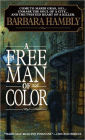
A Free Man of Color (Benjamin January Series #1)

( 13 )

Pick Up in Store

Reserve and pick up in 60 minutes at your local store

Paperback (Mass Market Paperback - Reprint) 
A small-format, low-cost paperback -- usually 4 1/4" x 6 3/4" -- most often used for genres such as mystery, romance, and sci-fi, as well as bestsellers with broad commercial appeal.
$7.99
BN.com price
Marketplace (New and Used)
from
$0.01
$7.99 List Price (Save 100%)
All (89)  
Used (73)  
New (16)  
Close
Sort by
Page 1 of 9
Showing 1 – 10 of 89 (9 pages)
$0.01
(Save 100%)
Seller since 2006

Feedback rating:

(50880)

Condition:

New — never opened or used in original packaging.

Like New — packaging may have been opened. A "Like New" item is suitable to give as a gift.

Very Good — may have minor signs of wear on packaging but item works perfectly and has no damage.

Good — item is in good condition but packaging may have signs of shelf wear/aging or torn packaging. All specific defects should be noted in the Comments section associated with each item.

Acceptable — item is in working order but may show signs of wear such as scratches or torn packaging. All specific defects should be noted in the Comments section associated with each item.

Used — An item that has been opened and may show signs of wear. All specific defects should be noted in the Comments section associated with each item.

Refurbished — A used item that has been renewed or updated and verified to be in proper working condition. Not necessarily completed by the original manufacturer.

Good
Shows some signs of wear, and may have some markings on the inside. 100% Money Back Guarantee. Shipped to over one million happy customers. Your purchase benefits world literacy!

Ships from: Mishawaka, IN

Usually ships in 1-2 business days

  • Canadian
  • International
  • Standard, 48 States
  • Standard (AK, HI)
  • Express, 48 States
  • Express (AK, HI)
$0.01
(Save 100%)
Seller since 2006

Feedback rating:

(50880)

Condition: Acceptable
Shows definite wear, and perhaps considerable marking on inside. 100% Money Back Guarantee. Shipped to over one million happy customers. Your purchase benefits world literacy!

Ships from: Mishawaka, IN

Usually ships in 1-2 business days

  • Canadian
  • International
  • Standard, 48 States
  • Standard (AK, HI)
  • Express, 48 States
  • Express (AK, HI)
$0.01
(Save 100%)
Seller since 2009

Feedback rating:

(22563)

Condition: Good
Giving great service since 2004: Buy from the Best! 4,000,000 items shipped to delighted customers. We have 1,000,000 unique items ready to ship! Find your Great Buy today!

Ships from: Lakewood, WA

Usually ships in 1-2 business days

  • Canadian
  • International
  • Standard, 48 States
  • Standard (AK, HI)
  • Express, 48 States
  • Express (AK, HI)
$0.01
(Save 100%)
Seller since 2009

Feedback rating:

(551)

Condition: Good
Used book in average shape. Quick shipping, friendly service. Your satisfaction is guaranteed! BN

Ships from: Lakewood, WA

Usually ships in 1-2 business days

  • International
  • Standard, 48 States
  • Standard (AK, HI)
  • Express, 48 States
  • Express (AK, HI)
$0.01
(Save 100%)
Seller since 2009

Feedback rating:

(664)

Condition: Good
Good book, great price! We ship daily via USPS. Buy with the best! BN

Ships from: Lakewood, WA

Usually ships in 1-2 business days

  • International
  • Standard, 48 States
  • Standard (AK, HI)
  • Express, 48 States
  • Express (AK, HI)
$0.79
(Save 90%)
Seller since 2008

Feedback rating:

(13615)

Condition: Good
Good condition..

Ships from: Frederick, MD

Usually ships in 1-2 business days

  • Canadian
  • International
  • Standard, 48 States
  • Standard (AK, HI)
  • Express, 48 States
  • Express (AK, HI)
$0.79
(Save 90%)
Seller since 2008

Feedback rating:

(13615)

Condition: Very Good
Very Good condition..

Ships from: Frederick, MD

Usually ships in 1-2 business days

  • Canadian
  • International
  • Standard, 48 States
  • Standard (AK, HI)
  • Express, 48 States
  • Express (AK, HI)
$0.99
(Save 88%)
Seller since 2005

Feedback rating:

(2444)

Condition: Acceptable
1998 Mass Market Paperback Fair Overall below average used book. May have highlighting, underlining, notes, price sticker on cover, or be an ex-library book.

Ships from: Edmond, OK

Usually ships in 1-2 business days

  • Canadian
  • International
  • Standard, 48 States
  • Standard (AK, HI)
  • Express, 48 States
  • Express (AK, HI)
$0.99
(Save 88%)
Seller since 2008

Feedback rating:

(397)

Condition: Good
1998 Mass-market paperback Good. Mass market (rack) paperback. Glued binding. 432 p. Benjamin January (Paperback). Intended for a young adult/teenage audience.

Ships from: Phoenix, AZ

Usually ships in 1-2 business days

  • Canadian
  • International
  • Standard, 48 States
  • Standard (AK, HI)
  • Express, 48 States
  • Express (AK, HI)
$0.99
(Save 88%)
Seller since 2007

Feedback rating:

(1039)

Condition: Good
1998-06-01 Mass Market Paperback Good Average wear.

Ships from: Irons, MI

Usually ships in 1-2 business days

  • Canadian
  • International
  • Standard, 48 States
  • Standard (AK, HI)
  • Express, 48 States
  • Express (AK, HI)
Page 1 of 9
Showing 1 – 10 of 89 (9 pages)
Close
Sort by
NOOK Book (eBook)
$7.99
BN.com price

Available on NOOK devices and apps

  • Nook Devices
  • NOOK
  • NOOK Color
  • NOOK Tablet
  • Tablet/Phone
  • NOOK for iPad
  • NOOK for iPhone
  • NOOK for Android
  • NOOK for Android (Tablet)
  • NOOK Kids for iPad
  • PC/Mac
  • NOOK Study
  • NOOK for PC
  • NOOK for Mac

Want a NOOK? Explore Now

Overview

A lush and haunting novel of a city steeped in decadent pleasures...and of a man, proud and defiant, caught in a web of murder and betrayal.

It is 1833. In the midst of Mardi Gras, Benjamin January, a Creole physician and music teacher, is playing piano at the Salle d'Orleans when the evenings festivities are interrupted—by murder.

Ravishing Angelique Crozat, a notorious octoroon who travels in the city's finest company, has been strangled to death. With the authorities reluctant to become involved, Ben begins his own inquiry, which will take him through the seamy haunts of riverboatmen and into the huts of voodoo-worshipping slaves.

But soon the eyes of suspicion turn toward Ben—for, black as the slave who fathered him, this free man of color is still the perfect scapegoat....

Editorial Reviews

J. Ashley
...Hambly puts together a fine story and creates fascinating three-dimensional characters....This novel is less a traditional "whodunit" and more of a historical novel in which a murder occurs....Benjamin January is a wonderful addition to mystery sleuths, and this novel contributes greatly to historical fiction. The characters, setting, plot, weave together to produce a satisfying and thought-provoking read.
Mystery Magazine Online
Publishers Weekly
In her breakout from fantasy and Star Wars novels, Hambly (Mother of Winter) chronicles the adventures of piano teacher and surgeon Ben January, a free man of color. The setting, 1833 New Orleans, is vivid and ornate. Riverboat dandies and roughshod frontiermen rub elbows with dueling gentlemen of the landed aristocracy as their splendidly gowned wives and colored mistresses celebrate Mardi Gras, oblivious to the squalor, fever and plague around them. Social and sexual mores are lax. Racial bigotry is the norm in a society that classifies people according to an elaborate scale of color and bloodline (octoroon, quadroon, musterfino, etc.). The plot is a whodunit involving the murder of Angelique Crozat, a beautiful but grasping octoroon who was the ex-mistress of a recently deceased Creole (white) planter. Back home after 16 years in Paris, January intervenes on behalf of Madeleine Dubonnet, a former piano student recently widowed by Arnaud Trepagier, the murdered woman's former patron. For his trouble, the ebony-skinned January becomes an unwitting scapegoat of the influential white suspects. Menaced by ruthless cutthroats, he must risk his freedom to absolve himself. Hambly pays rich attention to period detailfashion, food, manners, music and voodoo. Her characters, however, speak and think with decidedly modern accents, a departure from period verisimilitude that's easily justified on grounds of rhythm and pace. The tale lacks some of the moral gravity implied by the title, but it works as an escapist entertainment flavored liberally with the sights, textures, sounds and tastes of a decadent city in a distant time. (June)
VOYA
Set in early nineteenth-century New Orleans, this murder mystery follows Benjamin Janvier, musician and free man of color, as he seeks the murder of Angelique, mistress of the husband of a white pupil he fondly remembers. Unfortunately, his search is slow and mostly devoid of the suspense suggested by the jacket illustration. The only thing that happens quickly in this novel is the introduction of the characters: fourteen in the first chapter, sixteen more in the second. Most of them remain names. The only two who come alive, police lieutenant Abishag Shaw and Benjamin's mother Livia, are in too few scenes. Hambly, a writer of intelligence, is fascinated by this world of kept women (placées) and its refined racial distinctions. The atmosphere is rich but marred by an excess of writerly writing: "the primal ocean of her hair," "pomegranate with rage," "the long fjords of his retreating hair line." Only especially interested young readers who read well will stay with this book. Even the jacket, title, and type will have little appeal for our audience. This novel is for adults with lots of time who need a new mystery romance with an unusual twist. VOYA Codes: 2Q 2P S (Better editing or work by the author might have warranted a 3Q, For the YA with a special interest in the subject, Senior High-defined as grades 10 to 12).
Library Journal
With this historical novel, Hambly departs from her usual work in the sf/fantasy genre (e.g., Traveling with the Dead, LJ 8/95). Her new work is set in 19th-century Louisiana Creole society, where it was customary for a man to have a wife and also to keep a mistress in her own house. Benjamin January, a free Creole with dark brown skin, has returned to this society after living in Paris for more than a decade. He is trained as a surgeon, but in Louisiana, he makes his living playing the piano. Soon he is the main suspect in the death of a wealthy man's young mistress, found murdered at a ball. January spends the rest of the book gathering evidence in his defense with the help of his sisters and a host of other colorful characters he encounters on the run. The result is a complicated mystery that could have used more romantic involvement. Recommended for larger libraries.Shirley Coleman, Ann Arbor Dist. Lib., Mich.
Kirkus Reviews
Once again exercising her talent for goldstained description, Hambly moves from a stylish fin de siècle tale of Continental vampirism (Traveling with the Dead, 1995) to an equally stylish romantic suspenser set in New Orleans.

The author focuses on the delicate, twilit world of color in New Orleans in the 1830s, striving to capture both the city's exotic strangeness and an absolute sense of physical reality. Despite rapt storytelling, though, Hambly's prose shows less care than her research, being replete with tired phrases ("crimson with rage," etc.). After 16 years abroad, widower Benjamin January, a very dark Creole, returns from Paris having earned his degree as a physician and, for Carnival, takes up playing piano in the band for the Blue Ribbon Ball at the Salle d'Orleans. This is the ball at which white gentlemen meet their mistresses of various skin shades, having parked their wives at the nearby Théâtre d'Orleans. When Benjamin spots a former piano student, the virtuous, newly widowed, pure white Madame Madeleine Trepagier (née Dubonnet), at the wrong ball, he tries to save her from disgrace. She's there to recover her family jewels from the city's worst, most malicious woman of color, Angelique Crozat, mistress of the late Armand Trepagier. But Angelique is strangled, robbed, and stuffed into a closet before Madeleine can talk with her. The murder investigation plunges us into the tangled nature of race relations in New Orleans, made even more complex by the fact that the free colored folk there now have to deal with the recently arrived imperial Americans, who don't recognize (as the French, the founders of the city, did) a colored entitlement to civil rights. What does it mean that the dead Angelique was wearing Madeleine's own handsewn white dress when she died?

A sharp portrait of curiously nuanced class divisions transforms Hambly's latest into something far more than the modest melodrama it might otherwise have been.

Product Details

  • ISBN-13: 9780553575262
  • Publisher: Random House Publishing Group
  • Publication date: 6/28/1998
  • Format: Mass Market Paperback
  • Edition description: Reprint
  • Pages: 432
  • Sales rank: 308,565
  • Series: Benjamin January Series , #1
  • Product dimensions: 4.25 (w) x 6.85 (h) x 1.15 (d)

Meet the Author

Barbara Hambly is the author of The Emancipator’s Wife, a finalist for the Michael Shaara Award for Excellence in Civil War Fiction. She is also the author of Fever Season, a New York Times Notable Book of the Year, and seven acclaimed historical novels.

Read an Excerpt

The ochre stucco cottage on Rue Burgundy was silent when January reached it. It was one of a row of four. He listened for a moment at the closed shutters of each of its two front rooms, then edged his way down the muddy slot between the closely set walls of the houses to the yard, where he had to turn sideways and duck to enter the gate. The shutters there were closed as well. The yard boasted a privy, a brick kitchen, and a garçonnière above it.

When first he had lived there, his sister had occupied the rear bedroom, his mother the front, the two parlors—one behind the other—being used for the entertainment of St.-Denis Janvier. Although he was only nine years old, Benjamin had slept from the first in the garçonnière, waiting until the house lights were put out and then climbing down the rickety twist of the outside stair to run with Olympe and Will Pavegeau and Nic Gignac on their midnight adventures. He smiled, recalling the white glint of Olympe's eyes as she dared them to follow her to the cemetery, or to the slave dances out on Bayou St. John.

His younger sister—his full sister—had been a skinny girl then, like a black spider in a raggedy blue-and-red skirt and a calico blouse a slave woman would have scorned to wear. Having a back room with access to the yard hadmade it easy for her to slip out, though he suspected that if she'd been locked in a dungeon, Olympe would still have managed to get free.

Olympe had been fifteen the year of Dominique's birth. The two girls had shared that rear chamber for only a year. Then Dominique had occupied it alone, a luxury for a little girl growing up. But then, Dominique had always been her mother's princess, her father's pride.

Presumably Dominique had occupied the room until Henri Viellard had come into her life when she was sixteen. By that time St.-Denis Janvier was dead, leaving his mistress comfortably off, and Livia Janvier had married a cabinetmaker, Christophe Levesque, who had died a few years ago. The rear room that had been Olympe's, then Dominique's, had been for a short spell Levesque's workshop. Now it was shut up, though Minou was of the opinion that her mother should take a lover.

January stepped to the long opening and drew back one leaf of the green shutters, listening at the slats of the jalousie for his mother's soft, even breath.

He heard nothing. Quietly, he lifted the latch, pushed the jalousie inward. The room was empty, ghostly with dust. He crossed to the door of his mother's bedroom, which stood half-slid back into its socket. Slatted light leaked through the louvers of the doors to the street. The gaily patterned coverlet was thrown back in a snowstorm of clean white sheets. Two butter-colored cats—Les Mesdames—dozed, paws tucked, on the end of the bed, opening their golden eyes only long enough to give him the sort of gaze high-bred Creole ladies generally reserved for drunken keelboat men sleeping in their own vomit in the gutters of the Rue Bourbon. There was water in the washbowl and a robe of heavy green chintz lay draped over the cane-bottomed chair. The smell of coffee hung in the air, a few hours old.

Euphrasie Dreuze, or one of her friends, he thought. They had come to her for comfort, and Livia Janvier Levesque had gone.

January crossed the yard again, his black leather music satchel under one arm. There was still fire in the kitchen stove, banked but emitting warmth. The big enamel coffeepot at the back contained several cups' worth. He poured himself some and carried it up the twisting steps and drank it as he changed his clothes and ate the beignets and pastry he'd cadged from the ballroom tables in the course of the night. Half his gleanings he'd left at Hannibal's narrow attic, stowed under a tin pot to keep the rats out of it, though he suspected the minute he was gone one or another of the girls who worked cribs in the building would steal it, as they stole Hannibal's medicine, his laudanum, and every cent he ever had in his pockets.

Before eating he knelt on the floor beside his bed and took from his pocket the rosary he'd had from his childhood—cheap blue glass beads, a crucifix of cut steel—and told over the swift decades of prayers for the soul of Angelique Crozat. She had been, by his own experience and that of everyone he'd talked to, a thoroughly detestable woman, but only God could know and judge. Wherever she was, she had died unconfessed and would need the prayers. They were little enough to give.


Table of Contents

Interviews & Essays

From the Author

Since my college days (back in the late Mesozoic Era) I've wanted to do a mystery set in the antebellum South with a free black protagonist. Historical mysteries are mostly comedies of manners--investigations of the ins and outs of the society in which they take place--and the artificiality of that milieu fascinated me. I deliberately steered clear of the Civil War and the era immediately preceding it because a) a lot of other people have done it better than I could and b) because the issues, and the people, were very different even a generation earlier. It mokes it harder to research--very little is done about that changeover generation between Jeffersonian and Jacksonian America--but the more I study, the more fascinating stuff I find. It's a goldmine for a writer.

One of the things I enjoy most about the Benjamin January series is the continuing cast of characters. Family and friends are a major subtheme of the books: you need your family. You need your friends. After Benjamin s wife dies he returns to New Orleans, a city in which he will automatically become a non-person and will be in periodic danger of enslavement, because his family is there and in his grief and his pain he cannot survive without them. This is not only an emotional truth in all times and places, but very typical of the society about which I'm writing. To the antebellum New Orleans Creoles, both white and black, family was everything.

I must say I love writing Ben's mother. She's an absolutely horrible woman, snobbish and greedy and self-centered, but she's a wonderful mechanism to advance plots by giving the reader whole reams of Information in the form ofspiteful gossip. In fact I love writing about most of those people--Ben's sisters, and his worthless white pal Hannibal, and Lieutenant Shaw. I'll occasionally use historical characters in the books, like Madame Lalaurie or John Davis, the man who owned the Orleans Ballroom, and I try to get those people as accurately as I can, from what I can learn of them. There was no lack of fascinating people running around New Orleans in that era. About some of them. like the voodoo queen Marie Laveau, it's almost impossible to find "hard" information--only rumors and traditions and tales that have been colored by the prejudice or political correctness of the tellers.

I try, too, to portray what the city must have been like, what people must have been like. New Orleans fascinates me because there were literally four separate social systems--white Creoles, white Americans, mixed-race free colored, and black slaves--living in the same few square miles of territory and none of them dealing with the others unless absolutely necessary. The concept of solidarity between the free colored and the blacks was almost unheard-of: the free colored, for the most part, identified with the white Creoles, the people who had power and money. January is an interesting character to me precisely because he was raised with a French Creole outlook, because he has the outlook of an educated European. He's very much a man between two worlds, on outsider among his own people.

For most of my life I've been a student of history, although I've had a fairly long career as a writer of sword-and-sorcery fantasy before I began writing historical mysteries. My degree is in Medieval History, something I've seldom used in any of my writing: basically what I learned was how to research, and how to set up a non-industrial society. From the time I was five I knew that I wanted to write, and I've tried to do at least a little of the things I write about: hand-to-hand combat, riding a horse, loading black powder weapons. dancing, wearing a corset. My love of history was one of the things that drew me to New Orleans for the first time, though I fell in love with the city--and with my husband, whom I met there--and ended up living in New Orleans half-time for nearly three years.

I feel like I have so much more to learn.

About myself I will just say that I was born In California, raised here, and currently live in Los Angeles with my husband, two dogs, two cats, and two lizards. Like Benjamin, I treasure my family and my friends. In the course of getting my degree in Medieval History I spent a year at the University of Bordeaux in the early seventies, and in connection with writing a couple of historical vampire thrillers I've traveled through Europe learning that there are no back-alleys in the old part of Vienna (oops, I guess I'll have to re-write that back-alley scene) and that the sunlight in Istanbul is not like light anywhere else that I've seen.

My husband, who is a science fiction writer, and I go back to New Orleans a few, times a year. Even in the eighteenth century it was remarked on that once someone had lived there, the city would draw them back.

I hope to go on writing about that town for a very long time.

—Barbara Hambly

Customer Reviews

Average Rating 4
( 13 )

Rating Distribution

5 Star

(6)

4 Star

(2)

3 Star

(3)

2 Star

(1)

1 Star

(1)

Your Rating:

Your Name: Create a Pen Name or Leave Anonymously

Barnes & Noble.com Review Rules

Our reader reviews allow you to share your comments on titles you liked, or didn't, with others. By submitting an online review, you are representing to Barnes & Noble.com that all information contained in your review is original and accurate in all respects, and that the submission of such content by you and the posting of such content by Barnes & Noble.com does not and will not violate the rights of any third party. Please follow the rules below to help ensure that your review can be posted.

Reviews by Our Customers Under the Age of 13

We highly value and respect everyone's opinion concerning the titles we offer. However, we cannot allow persons under the age of 13 to have accounts at BN.com or to post customer reviews. Please see our Terms of Use for more details.

What to exclude from your review:

Please do not write about reviews, commentary, or information posted on the product page. If you see any errors in the information on the product page, please send us an email.

Reviews should not contain any of the following:

  • - HTML tags, profanity, obscenities, vulgarities, or comments that defame anyone
  • - Time-sensitive information such as tour dates, signings, lectures, etc.
  • - Single-word reviews. Other people will read your review to discover why you liked or didn't like the title. Be descriptive.
  • - Comments focusing on the author or that may ruin the ending for others
  • - Phone numbers, addresses, URLs
  • - Pricing and availability information or alternative ordering information
  • - Advertisements or commercial solicitation

Reminder:

  • - By submitting a review, you grant to Barnes & Noble.com and its sublicensees the royalty-free, perpetual, irrevocable right and license to use the review in accordance with the Barnes & Noble.com Terms of Use.
  • - Barnes & Noble.com reserves the right not to post any review -- particularly those that do not follow the terms and conditions of these Rules. Barnes & Noble.com also reserves the right to remove any review at any time without notice.
  • - See Terms of Use for other conditions and disclaimers.
Search for Products You'd Like to Recommend

Recommend other products that relate to your review. Just search for them below and share!

Create a Pen Name

Your Pen Name is your unique identiy on BN.com. It will appear on the reviews you write and other website activities. Your Pen Name cannot be edited, changed or deleted once submitted.

Your Pen Name can be any combination of alphanumeric characters (plus - and _), and must be at least two characters long.

Continue Anonymously

We're sorry, but penname is already taken.

Please select one of the following:
Your Pen Name can be any combination of alphanumeric characters (plus - and _), and must be at least two characters long.

Continue Anonymously

penname is available!

By visiting the BN.com website or marking a purchase on BN.com, a User is deemed to have accepted the Terms of Use.

Continue Anonymously

Welcome, penname

You have successfully created your Pen Name. Start enjoying the benefits of the BN.com Community today.

Sort by: Showing all of 13 Customer Reviews
  • Posted December 19, 2011

    Fascinating

    The first of a series of mysteries set in 1830s New Orleans, this book is a must read for anyone who enjoyed Cane River and is interested in the social/racial hierarchy and customs in and about New Orleans during that time period. It is an easy, suspenseful, fascinating read. I hope the sequels are as good!

    Was this review helpful? Yes  No   Report this review
  • Posted August 26, 2011

    Lush--and painful

    Interesting as a mystery; and more interesting as a richly detailed historical novel. Benjamin January is "colored," in the language of the day; and Hambly never lets us forget that, since January can't. A Free Man of Color gives readers a wonderful sense of the complexities of January's position and of the ways in which people react to him according to their own race. The series offers a wonderful view into a maddeningly racist, sexist, xenophobic, ethnocentric, graceful, vulgar, energetic period in American history.

    Was this review helpful? Yes  No   Report this review
  • Posted January 15, 2011

    Exceptional Mystery - 1820's New Orleans Atmosphere

    Benjamin January was born a slave in Louisiana, but through his mother's protector, was educated as a physician and exquisite musician. He had moved to Paris and married, but returned to New Orleans when his wife died of the scourge of typhoid. Upon returning he saw New Orleans with fresh eyes and in pursuit of crimes and mysteries with the local police chief intelligent but low-born, Abishag Shaw, he can move seamlessly between all the complex layers of Orleans society. Voo-doo, French influence, pre-civil war tensions, the sultry, stifling summers- are all beautifully intertwined with a psychological mystery. This book is a masterpiece with more superb mysteries to follow in the series.

    Was this review helpful? Yes  No   Report this review
  • Anonymous

    Posted July 25, 2003

    What a Wonderful Historical Mystery!

    This was a very well-written historical mystery. It starts a little slow, and it's difficult keeping all the names of the characters straight since there are so many and the names are quite French and different than what most are used to. But the story is extremely well-researched. It's easy to see that this author is in love with her era and her place of choice (New Orleans in 1833). This is a lush, haunting novel like New Orleans itself. The time of the story is Mardi Gras week and Ms. Hambly deftly describes all the decadent pleasures, glittery ballrooms and the very complicated caste system of old New Orleans. The hero in the book is Benjamin January, a free man of colour who makes his living by playing the piano even though he is a trained surgeon. January was born in New Orleans and had moved to France at the age of 16 where he studied to be a surgeon. He made a life for himself there, but his wife dies of a fever, so he heads back home to be with his family. He gets thrown into a messy murder that happens at one of the dances he is playing at. There are many twists and turns in the plots, and the finale I'm sure will shock you, as it shocked me. The book starts slow but builds up momentum the further along the story goes. It's a stunner!

    Was this review helpful? Yes  No   Report this review
  • Anonymous

    Posted August 20, 2001

    Unbelievable, and Thrilling!

    One of the most educational and thrilling books to date. Benjamin is one of my favorite protagonists because of this book, and the descriptions, movie-like atmosphere, feel of the weather, the times, the smell of the food... made me feel like I was right there with the main character. This book is unbelievable. This novel should be a reading requirement in African American History classes in universities. I have learned more about the time period than that of any textbook. My mother read this, passed it on to me, now I shall pass it on. I look forward to more from Ms. Barbara Hambly, and hopefully having it hit the big screen.

    Was this review helpful? Yes  No   Report this review
  • Anonymous

    Posted May 17, 2011

    No text was provided for this review.

  • Anonymous

    Posted April 2, 2011

    No text was provided for this review.

  • Anonymous

    Posted October 7, 2011

    No text was provided for this review.

  • Anonymous

    Posted June 12, 2011

    No text was provided for this review.

  • Anonymous

    Posted April 9, 2011

    No text was provided for this review.

  • Anonymous

    Posted May 17, 2010

    No text was provided for this review.

  • Anonymous

    Posted February 16, 2011

    No text was provided for this review.

  • Anonymous

    Posted March 19, 2011

    No text was provided for this review.

Sort by: Showing all of 13 Customer Reviews

If you find inappropriate content, please report it to Barnes & Noble
Why is this product inappropriate?
Comments (optional)
500 character limit