“By turns a medical thriller, detective story, and paean to city life, Johnson's account of the outbreak and its modern implications is a true page-turner.” —The Washington Post
“Thought-provoking.” —Entertainment Weekly
It's the summer of 1854, and London is just emerging as one of the first modern cities in the world. But lacking the infrastructure-garbage removal, clean water, sewers-necessary to support its rapidly expanding population, the city has become the perfect breeding ground for a terrifying disease no one knows how to cure. As the cholera outbreak takes hold, a physician and a local curate are spurred to action-and ultimately solve the most pressing medical riddle of their time.
In a triumph of multidisciplinary thinking, Johnson illuminates the intertwined histories of the spread of disease, the rise of cities, and the nature of scientific inquiry, offering both a riveting history and a powerful explanation of how it has shaped the world we live in.
“By turns a medical thriller, detective story, and paean to city life, Johnson's account of the outbreak and its modern implications is a true page-turner.” —The Washington Post
“Thought-provoking.” —Entertainment Weekly
It's the summer of 1854, and London is just emerging as one of the first modern cities in the world. But lacking the infrastructure-garbage removal, clean water, sewers-necessary to support its rapidly expanding population, the city has become the perfect breeding ground for a terrifying disease no one knows how to cure. As the cholera outbreak takes hold, a physician and a local curate are spurred to action-and ultimately solve the most pressing medical riddle of their time.
In a triumph of multidisciplinary thinking, Johnson illuminates the intertwined histories of the spread of disease, the rise of cities, and the nature of scientific inquiry, offering both a riveting history and a powerful explanation of how it has shaped the world we live in.

The Ghost Map: The Story of London's Most Terrifying Epidemic--and How It Changed Science, Cities, and the Modern World
336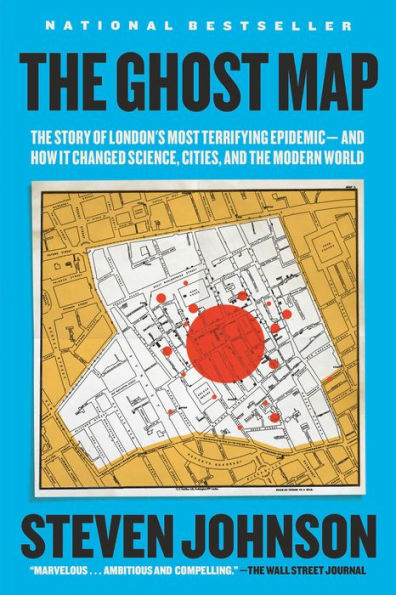
The Ghost Map: The Story of London's Most Terrifying Epidemic--and How It Changed Science, Cities, and the Modern World
336Paperback(Reprint)
-
PICK UP IN STORECheck Availability at Nearby Stores
Available within 2 business hours
Related collections and offers
Overview
“By turns a medical thriller, detective story, and paean to city life, Johnson's account of the outbreak and its modern implications is a true page-turner.” —The Washington Post
“Thought-provoking.” —Entertainment Weekly
It's the summer of 1854, and London is just emerging as one of the first modern cities in the world. But lacking the infrastructure-garbage removal, clean water, sewers-necessary to support its rapidly expanding population, the city has become the perfect breeding ground for a terrifying disease no one knows how to cure. As the cholera outbreak takes hold, a physician and a local curate are spurred to action-and ultimately solve the most pressing medical riddle of their time.
In a triumph of multidisciplinary thinking, Johnson illuminates the intertwined histories of the spread of disease, the rise of cities, and the nature of scientific inquiry, offering both a riveting history and a powerful explanation of how it has shaped the world we live in.

Product Details
| ISBN-13: | 9781594482694 |
|---|---|
| Publisher: | Penguin Publishing Group |
| Publication date: | 10/02/2007 |
| Edition description: | Reprint |
| Pages: | 336 |
| Sales rank: | 58,894 |
| Product dimensions: | 5.40(w) x 8.20(h) x 0.80(d) |
| Age Range: | 18 Years |
About the Author
Read an Excerpt
Monday, August 28
THE NIGHT-SOIL MEN
IT IS AUGUST 1854, AND LONDON IS A CITY OF SCAVENGERS. Just the names alone read now like some kind of exotic zoological catalogue: bone-pickers, rag-gatherers, pure-finders, dredgermen, mud-larks, sewer-hunters, dustmen, night-soil men, bunters, toshers, shoremen. These were the London underclasses, at least a hundred thousand strong. So immense were their numbers that had the scavengers broken off and formed their own city, it would have been the fifth-largest in all of England. But the diversity and precision of their routines were more remarkable than their sheer number. Early risers strolling along the Thames would see the toshers wading through the muck of low tide, dressed almost comically in flowing velveteen coats, their oversized pockets filled with stray bits of copper recovered from the water’s edge. The toshers walked with a lantern strapped to their chest to help them see in the predawn gloom, and carried an eight-foot-long pole that they used to test the ground in front of them, and to pull themselves out when they stumbled into a quagmire. The pole and the eerie glow of the lantern through the robes gave them the look of ragged wizards, scouring the foul river’s edge for magic coins. Beside them fluttered the mud-larks, often children, dressed in tatters and content to scavenge all the waste that the toshers rejected as below their standards: lumps of coal, old wood, scraps of rope.
Above the river, in the streets of the city, the pure-finders eked out a living by collecting dog shit (colloquially called “pure”) while the bone-pickers foraged for carcasses of any stripe. Below ground, in the cramped but growing network of tunnels beneath London’s streets, the sewer-hunters slogged through the flowing waste of the metropolis. Every few months, an unusually dense pocket of methane gas would be ignited by one of their kerosene lamps and the hapless soul would be incinerated twenty feet below ground, in a river of raw sewage.
The scavengers, in other words, lived in a world of excrement and death. Dickens began his last great novel, Our Mutual Friend, with a father-daughter team of toshers stumbling across a corpse floating in the Thames, whose coins they solemnly pocket. “What world does a dead man belong to?” the father asks rhetorically, when chided by a fellow tosher for stealing from a corpse. “’Tother world. What world does money belong to? This world.” Dickens’ unspoken point is that the two worlds, the dead and the living, have begun to coexist in these marginal spaces. The bustling commerce of the great city has conjured up its opposite, a ghost class that somehow mimics the status markers and value calculations of the material world. Consider the haunting precision of the bone-pickers’ daily routine, as captured in Henry Mayhew’s pioneering 1844 work, London Labour and the London Poor:
It usually takes the bone-picker from seven to nine hours to go over his rounds, during which time he travels from 20 to 30 miles with a quarter to a half hundredweight on his back. In the summer he usually reaches home about eleven of the day, and in the winter about one or two. On his return home he proceeds to sort the contents of his bag. He separates the rags from the bones, and these again from the old metal (if he be luckly enough to have found any). He divides the rags into various lots, according as they are white or coloured; and if he have picked up any pieces of canvas or sacking, he makes these also into a separate parcel. When he has finished the sorting he takes his several lots to the ragshop or the marine-store dealer, and realizes upon them whatever they may be worth. For the white rags he gets from 2d. to 3d. per pound, according as they are clean or soiled. The white rags are very difficult to be found; they are mostly very dirty, and are therefore sold with the coloured ones at the rate of about 5 lbs. for 2d.
The homeless continue to haunt today’s postindustrial cities, but they rarely display the professional clarity of the bone-picker’s impromptu trade, for two primary reasons. First, minimum wages and government assistance are now substantial enough that it no longer makes economic sense to eke out a living as a scavenger. (Where wages remain depressed, scavenging remains a vital occupation; witness the perpendadores of Mexico City.) The bone collector’s trade has also declined because most modern cities possess elaborate systems for managing the waste generated by their inhabitants. (In fact, the closest American equivalent to the Victorian scavengers—the aluminum-can collectors you sometimes see hovering outside supermarkets—rely on precisely those waste-management systems for their paycheck.) But London in 1854 was a Victorian metropolis trying to make do with an Elizabethan public infrastructure. The city was vast even by today’s standards, with two and a half million people crammed inside a thirty-mile circumference. But most of the techniques for managing that kind of population density that we now take for granted—recycling centers, public-health departments, safe sewage removal—hadn’t been invented yet.
And so the city itself improvised a response—an unplanned, organic response, to be sure, but at the same time a response that was precisely contoured to the community’s waste-removal needs. As the garbage and excrement grew, an underground market for refuse developed, with hooks into established trades. Specialists emerged, each dutifully carting goods to the appropriate site in the official market: the bone collectors selling their goods to the bone-boilers, the pure-finders selling their dog shit to tanners, who used the “pure” to rid their leather goods of the lime they had soaked in for weeks to remove animal hair. (A process widely considered to be, as one tanner put it, “the most disagreeable in the whole range of manufacture.”)
We’re naturally inclined to consider these scavengers tragic figures, and to fulminate against a system that allowed so many thousands to eke out a living by foraging through human waste. In many ways, this is the correct response. (It was, to be sure, the response of the great crusaders of the age, among them Dickens and Mayhew.) But such social outrage should be accompanied by a measure of wonder and respect: without any central planner coordinating their actions, without any education at all, this itinerant underclass managed to conjure up an entire system for processing and sorting the waste generated by two million people. The great contribution usually ascribed to Mayhew’s London Labour is simply his willingness to see and record the details of these impoverished lives. But just as valuable was the insight that came out of that bookkeeping, once he had run the numbers: far from being unproductive vagabonds, Mayhew discovered, these people were actually performing an essential function for their community. “The removal of the refuse of a large town,” he wrote, “is, perhaps, one of the most important of social operations.” And the scavengers of Victorian London weren’t just getting rid of that refuse—they were recycling it.
WASTE RECYCLING IS USUALLY ASSUMED TO BE AN INVENTION of the environmental movement, as modern as the blue plastic bags we now fill with detergent bottles and soda cans. But it is an ancient art. Composting pits were used by the citizens of Knossos in Crete four thousand years ago. Much of medieval Rome was built out of materials pilfered from the crumbling ruins of the imperial city. (Before it was a tourist landmark, the Colosseum served as a de facto quarry.) Waste recycling—in the form of composting and manure spreading—played a crucial role in the explosive growth of medieval European towns. High-density collections of human beings, by definition, require significant energy inputs to be sustainable, starting with reliable supplies of food. The towns of the Middle Ages lacked highways and container ships to bring them sustenance, and so their population sizes were limited by the fecundity of the land around them. If the land could grow only enough food to sustain five thousand people, then five thousand people became the ceiling. But by plowing their organic waste back into the earth, the early medieval towns increased the productivity of the soil, thus raising the population ceiling, thereby creating more waste—and increasingly fertile soil. This feedback loop transformed the boggy expanses of the Low Countries, which had historically been incapable of sustaining anything more complex than isolated bands of fishermen, into some of the most productive soils in all of Europe. To this day, the Netherlands has the highest population density of any country in the world.
Waste recycling turns out to be a hallmark of almost all complex systems, whether the man-made ecosystems of urban life, or the microscopic economies of the cell. Our bones are themselves the result of a recycling scheme pioneered by natural selection billions of years ago. All nucleated organisms generate excess calcium as a waste product. Since at least the Cambrian times, organisms have accumulated those calcium reserves, and put them to good use: building shells, teeth, skeletons. Your ability to walk upright is due to evolution’s knack for recycling its toxic waste.
Waste recycling is a crucial attribute of the earth’s most diverse ecosystems. We value tropical rain forests because they squander so little of the energy supplied by the sun, thanks to their vast, interlocked system of organisms exploiting every tiny niche of the nutrient cycle. The cherished diversity of the rain-forest ecosystem is not just a quaint case of biological multiculturalism. The diversity of the system is precisely why rain forests do such a brilliant job of capturing the energy that flows through them: one organism captures a certain amount of energy, but in processing that energy, it generates waste. In an efficient system, that waste becomes a new source of energy for another creature in the chain. (That efficiency is one of the reasons why clearing the rain forests is such a shortsighted move: the nutrient cycles in their ecosystems are so tight that the soil is usually very poor for farming: all the available energy has been captured on its way down to the forest floor.)
Coral reefs display a comparable knack for waste management. Corals live in a symbiotic alliance with tiny algae called zooxanthellae. Thanks to photosynthesis, the algae capture sunlight and use it to turn carbon dioxide into organic carbon, with oxygen as a waste product of the process. The coral then uses the oxygen in its own metabolic cycle. Because we’re aerobic creatures ourselves, we tend not to think of oxygen as a waste product, but from the point of view of the algae, that’s precisely what it is: a useless substance discharged as part of its metabolic cycle. The coral itself produces waste in the form of carbon dioxide, nitrates, and phosphates, all of which help the algae to grow. That tight waste-recycling chain is one of the primary reasons coral reefs are able to support such a dense and diverse population of creatures, despite residing in tropical waters, which are generally nutrient-poor. They are the cities of the sea.
There can be many causes behind extreme population density—whether the population is made up of angelfish or spider monkeys or humans—but without efficient forms of waste recycling, those dense concentrations of life can’t survive for long. Most of that recycling work, in both remote tropical rain forests and urban centers, takes place at the microbial level. Without the bacteria-driven processes of decomposition, the earth would have been overrun by offal and carcasses eons ago, and the life-sustaining envelope of the earth’s atmosphere would be closer to the uninhabitable, acidic surface of Venus. If some rogue virus wiped out every single mammal on the planet, life on earth would proceed, largely unaffected by the loss. But if the bacteria disappeared overnight, all life on the planet would be extinguished within a matter of years.
You couldn’t see those microbial scavengers at work in Victorian London, and the great majority of scientists—not to mention laypeople—had no idea that the world was in fact teeming with tiny organisms that made their lives possible. But you could detect them through another sensory channel: smell. No extended description of London from that period failed to mention the stench of the city. Some of that stench came from the burning of industrial fuels, but the most objectionable smells—the ones that ultimately helped prod an entire public-health infrastructure into place—came from the steady, relentless work of bacteria decomposing organic matter. Those deadly pockets of methane in the sewers were themselves produced by the millions of microorganisms diligently recycling human dung into a microbial biomass, with a variety of gases released as waste products. You can think of those fiery, underground explosions as a kind of skirmish between two different kinds of scavenger: sewer-hunter versus bacterium—living on different scales but nonetheless battling for the same territory.
But in that late summer of 1854, as the toshers and the mud-larks and the bone collectors made their rounds, London was headed toward another, even more terrifying, battle between microbe and man. By the time it was over, it would prove as deadly as any in the city’s history.
LONDON’S UNDERGROUND MARKET OF SCAVENGING HAD ITS own system of rank and privilege, and near the top were the night-soil men. Like the beloved chimney sweeps of Mary Poppins, the night-soil men worked as independent contractors at the very edge of the legitimate economy, though their labor was significantly more revolting than the foraging of the mud-larks and toshers. City landlords hired the men to remove the “night soil” from the overflowing cesspools of their buildings. The collecting of human excrement was a venerable occupation; in medieval times they were called “rakers” and “gong-fermors,” and they played an indispensable role in the waste-recycling system that helped London grow into a true metropolis, by selling the waste to farmers outside the city walls. (Later entrepreneurs hit upon a technique for extracting nitrogen from the ordure that could be reused in the manufacture of gunpowder.) While the rakers and their descendants made a good wage, the work conditions could be deadly: in 1326, an ill-fated laborer by the name of Richard the Raker fell into a cesspool and literally drowned in human shit.
By the nineteenth century, the night-soil men had evolved a precise choreography for their labors. They worked the graveyard shift, between midnight and five a.m., in teams of four: a “ropeman,” a “holeman,” and two “tubmen.” The team would affix lanterns at the edge of the cesspit, then remove the floorboards or stone covering it, sometimes with a pickax. If the waste had accumulated high enough, the ropeman and holeman would begin by scooping it out with the tub. Eventually, as more night soil was removed, the men would lower a ladder down and the holeman would descend into the pit and scoop waste into his tub. The ropeman would help pull up each full tub, and pass it along to the tubmen who emptied the waste into their carts. It was standard practice for the night-soil men to be offered a bottle of gin for their labors. As one reported to Mayhew: “I should say that there’s been a bottle of gin drunk at the clearing of every two, ay, and more than every two, out of three cesspools emptied in London; and now that I come to think on it, I should say that’s been the case with three out of every four.”
The work was foul, but the pay was good. Too good, as it turned out. Thanks to its geographic protection from invasion, London had become the most sprawling of European cities, expanding far beyond its Roman walls. (The other great metropolis of the nineteenth century, Paris, had almost the same population squeezed into half the geographic area.) For the night-soil men, that sprawl meant longer transport times—open farmland was now often ten miles away—which drove the price of their removing waste upward. By the Victorian era, the night-soil men were charging a shilling a cesspool, wages that were at least twice that of the average skilled laborer. For many Londoners, the financial cost of removing waste exceeded the environmental cost of just letting it accumulate—particularly for landlords, who often didn’t live on top of these overflowing cesspools. Sights like this one, reported by a civil engineer hired to survey two houses under repair in the 1840s, became commonplace: “I found whole areas of the cellars of both houses were full of nightsoil to the depth of three feet, which had been permitted for years to accumulate from the overflow of the cesspools…. Upon passing through the passage of the first house I found the yard covered in nightsoil, from the overflowing of the privy to the depth of nearly six inches and bricks were placed to enable the inmates to get across dryshod.” Another account describes a dustheap in Spital-fields, in the heart of the East End: “a heap of dung the size of a tolerably large house, and an artificial pond into which the content of cesspits are thrown. The contents are allowed to desiccate in the open air, and they are frequently stirred for that purpose.” Mayhew described this grotesque scene in an article published in the London Morning Chronicle in 1849 that surveyed the ground zero of that year’s cholera outbreak:
We then journeyed on to London-street…. In No. 1 of this street the cholera first appeared seventeen years ago, and spread up it with fearful virulence; but this year it appeared at the opposite end, and ran down it with like severity. As we passed along the reeking banks of the sewer, the sun shone upon a narrow slip of the water. In the bright light it appeared the colour of strong green tea, and positively looked as solid as black marble in the shadow—indeed, it was more like watery mud than muddy water; and yet we were assured this was the only water the wretched inhabitants had to drink. As we gazed in horror at it, we saw drains and sewers emptying their filthy contents into it; we saw a whole tier of doorless privies in the open road, common to men and women, built over it; we heard bucket after bucket of filth splash into it; and the limbs of the vagrant boys bathing in it seemed by pure force of contrast, white as Parian marble. And yet, as we stood doubting the fearful statement, we saw a little child, from one of the galleries opposite, lower a tin can with a rope to fill a large bucket that stood beside her. In each of the balconies that hung over the stream the self-same tub was to be seen in which the inhabitants put the mucky liquid to stand, so that they may, after it has rested for a day or two, skim the fluid from the solid particles of filth, pollution, and disease. As the little thing dangled her tin cup as gently as possible into the stream, a bucket of night-soil was poured down from the next gallery.
Victorian London had its postcard wonders, to be sure—the Crystal Palace, Trafalgar Square, the new additions to Westminster Palace. But it also had wonders of a different order, no less remarkable: artificial ponds of raw sewage, dung heaps the size of houses.
The elevated wage of the night-soil men wasn’t the only culprit behind this rising tide of excrement. The runaway popularity of the water closet heightened the crisis. A water-flushing device had been invented in the late sixteenth century by Sir John Harington, who actually installed a functioning version for his godmother, Queen Elizabeth, at Richmond Palace. But the device didn’t take off until the late 1700s, when a watchmaker named Alexander Cummings and a cabinetmaker named Joseph Bramah filed for two separate patents on an improved version of Harington’s design. Bramah went on to build a profitable business installing water closets in the homes of the well-to-do. According to one survey, water-closet installations had increased tenfold in the period between 1824 and 1844. Another spike happened after a manufacturer named George Jennings installed water closets for public use in Hyde Park during the Great Exhibition of 1851. An estimated 827,000 visitors used them. The visitors no doubt marveled at the Exhibition’s spectacular display of global culture and modern engineering, but for many the most astonishing experience was just sitting on a working toilet for the first time.
Water closets were a tremendous breakthrough as far as quality of life was concerned, but they had a disastrous effect on the city’s sewage problem. Without a functioning sewer system to connect to, most WCs simply flushed their contents into existing cesspools, greatly increasing their tendency to overflow. According to one estimate, the average London household used 160 gallons of water a day in 1850. By 1856, thanks to the runaway success of the water closet, they were using 244 gallons.
But the single most important factor driving London’s waste-removal crisis was a matter of simple demography: the number of people generating waste had almost tripled in the space of fifty years. In the 1851 census, London had a population of 2.4 million people, making it the most populous city on the planet, up from around a million at the turn of the century. Even with a modern civic infrastructure, that kind of explosive growth is difficult to manage. But without infrastructure, two million people suddenly forced to share ninety square miles of space wasn’t just a disaster waiting to happen—it was a kind of permanent, rolling disaster, a vast organism destroying itself by laying waste to its habitat. Five hundred years after the fact, London was slowly re-creating the horrific demise of Richard the Raker: it was drowning in its own filth.
ALL OF THOSE HUMAN LIVES CROWDED TOGETHER HAD AN inevitable repercussion: a surge in corpses. In the early 1840s, a twenty-three-year-old Prussian named Friedrich Engels embarked on a scouting mission for his industrialist father that inspired both a classic text of urban sociology and the modern Socialist movement. Of his experiences in London, Engels wrote:
The corpses [of the poor] have no better fate than the carcasses of animals. The pauper burial ground at St Bride’s is a piece of open marshland which has been used since Charles II’s day and there are heaps of bones all over the place. Every Wednesday the remains of dead paupers are thrown in to a hole which is 14 feet deep. A clergyman gabbles through the burial service and then the grave is filled with loose soil. On the following Wednesday the ground is opened again and this goes on until it is completely full. The whole neighborhood is infected from the dreadful stench.
One privately run burial ground in Islington had packed 80,000 corpses into an area designed to hold roughly three thousand. A gravedigger there reported to the Times of London that he had been “up to my knees in human flesh, jumping on the bodies, so as to cram them in the least possible space at the bottom of the graves, in which fresh bodies were afterwards placed.”
Dickens buries the mysterious opium-addicted law-writer who overdoses near the beginning of Bleak House in a comparably grim setting, inspiring one of the book’s most famous, and famously impassioned, outbursts:
a hemmed-in churchyard, pestiferous and obscene, whence malignant diseases are communicated to the bodies of our dear brothers and sisters who have not departed…. With houses looking on, one very side, save where a reeking little tunnel of a court gives access to the iron gate—with every villainy of life in action close on death, and every poisonous element of death in action close on life—here, they lower our dear brother down a foot or two: here, sow him in corruption, to be raised in corruption: an avenging ghost at many a sick-bedside: a shameful testimony to future ages, how civilization and barbarism walked this boastful island together.
To read those last sentences is to experience the birth of what would become a dominant rhetorical mode of twentieth-century thought, a way of making sense of the high-tech carnage of the Great War, or the Taylorite efficiencies of the concentration camps. The social theorist Walter Benjamin reworked Dickens’ original slogan in his enigmatic masterpiece “Theses on the Philosophy of History,” written as the scourge of fascism was enveloping Europe: “There is no document of civilization that is not also a document of barbarism.”
The opposition between civilization and barbarism was practically as old as the walled city itself. (As soon as there were gates, there were barbarians ready to storm them.) But Engels and Dickens suggested a new twist: that the advance of civilization produced barbarity as an unavoidable waste product, as essential to its metabolism as the gleaming spires and cultivated thought of polite society. The barbarians weren’t storming the gates. They were being bred from within. Marx took that insight, wrapped it in Hegel’s dialectics, and transformed the twentieth century. But the idea itself sprang out of a certain kind of lived experience—on the ground, as the activists still like to say. It came, in part, from seeing human beings buried in conditions that defiled both the dead and the living.
But in one crucial sense Dickens and Engels had it wrong. However gruesome the sight of the burial ground was, the corpses themselves were not likely spreading “malignant diseases.” The stench was offensive enough, but it was not “infecting” anyone. A mass grave of decomposing bodies was an affront to both the senses and to personal dignity, but the smell it emitted was not a public-health risk. No one died of stench in Victorian London. But tens of thousands died because the fear of stench blinded them to the true perils of the city, and drove them to implement a series of wrongheaded reforms that only made the crisis worse. Dickens and Engels were not alone; practically the entire medical and political establishment fell into the same deadly error: everyone from Florence Nightingale to the pioneering reformer Edwin Chadwick to the editors of The Lancet to Queen Victoria herself. The history of knowledge conventionally focuses on breakthrough ideas and conceptual leaps. But the blind spots on the map, the dark continents of error and prejudice, carry their own mystery as well. How could so many intelligent people be so grievously wrong for such an extended period of time? How could they ignore so much overwhelming evidence that contradicted their most basic theories? These questions, too, deserve their own discipline—the sociology of error.
The fear of death’s contamination can sometimes last for centuries. In the middle of the Great Plague of 1665, the Earl of Craven purchased a block of land in a semirural area to the west of central London called Soho Field. He built thirty-six small houses “for the reception of poor and miserable objects” suffering from plague. The rest of the land was used as a mass grave. Each night, the death carts would empty dozens of corpses into the earth. By some estimates, over four thousand plague-infected bodies were buried there in a matter of months. Nearby residents gave it the appropriately macabre-sounding name of “Earl of Craven’s pest-field,” or “Craven’s field” for short. For two generations, no one dared erect a foundation in the land for fear of infection. Eventually, the city’s inexorable drive for shelter won out over its fear of disease, and the pesthouse fields became the fashionable district of Golden Square, populated largely by aristocrats and Huguenot immigrants. For another century, the skeletons lay undisturbed beneath the churn of city commerce, until late summer of 1854, when another outbreak came to Golden Square and brought those grim souls back to haunt their final resting grounds once more.
CRAVEN’S FIELD ASIDE, SOHO IN THE DECADES AFTER THE plague quickly became one of London’s most fashionable neighborhoods. Almost a hundred titled families lived there in the 1690s. In 1717, the Prince and Princess of Wales set up residence in Leicester House in Soho. Golden Square itself had been built out with elegant Georgian townhouses, a haven from the tumult of Piccadilly Circus several blocks to the south. But by the middle of the eighteenth century, the elites continued their inexorable march westward, building even grander estates and townhouses in the burgeoning new neighborhood of Mayfair. By 1740, there were only twenty titled residents left. A new kind of Soho native began to appear, best embodied by the son of a hosier who was born at 28 Broad in 1757, a talented and troubled child by the name of William Blake, who would go on to be one of England’s greatest poets and artists. In his late twenties, he returned to Soho and opened a printing shop next door to his late father’s shop, now run by his brother. Another Blake brother opened a bakery across the road at 29 Broad shortly thereafter, and so for a few years, the Blake family had a mini-empire growing on Broad Street, with three separate businesses on the same block.
The mix of artistic vision and entrepreneurial spirit would define the area for several generations. As the city grew increasingly industrial, and as the old money emptied out, the neighborhood became grittier; landlords invariably broke up the old townhouses into separate flats; courtyards between buildings filled up with impromptu junkyards, stables, jury-rigged extensions. Dickens described it best in Nicholas Nickleby:
In that quarter of London in which Golden Square is situated, there is a bygone, faded, tumble-down street, with two irregular rows of tall meagre houses, which seem to have stared each other out of countenance years ago. The very chimneys appear to have grown dismal and melancholy from having had nothing better to look at than the chimneys over the way…. To judge from the size of the houses, they have been, at one time, tenanted by persons of better condition than their present occupants; but they are now let off, by the week, in floors or rooms, and every door has almost as many plates or bell-handles as there are apartments within. The windows are, for the same reason, sufficiently diversified in appearance, being ornamented with every variety of common blind and curtain that can easily be imagined; which every doorway is blocked up, and rendered nearly impassable, by a motley collection of children and porter pots of all sizes, from the baby in arms and the half-pint pot, to the full-grown girl and half-gallon can.
By 1851, the subdistrict of Berwick Street on the west side of Soho was the most densely populated of all 135 subdistricts that made up Greater London, with 432 people to the acre. (Even with its skyscrapers, Manhattan today only houses around 100 per acre.) The parish of St. Luke’s in Soho had thirty houses per acre. In Kensington, by contrast, the number per acre was two.
But despite—or perhaps because of—the increasingly crowded and unsanitary conditions, the neighborhood was a hotbed of creativity. The list of poets and musicians and sculptors and philosophers who lived in Soho during this period reads like an index to a textbook on Enlightenment-era British culture. Edmund Burke, Fanny Burney, Percy Shelley, William Hogarth—all were Soho residents at various points in their lives. Leopold Mozart leased a flat on Frith Street while visiting with his son, the eight-year-old prodigy Wolfgang, in 1764. Franz Liszt and Richard Wagner also stayed in the neighborhood when visiting London in 1839–1840.
(Continues…)
Excerpted from "The Ghost Map"
by .
Copyright © 2007 Steven Johnson.
Excerpted by permission of Penguin Publishing Group.
All rights reserved. No part of this excerpt may be reproduced or reprinted without permission in writing from the publisher.
Excerpts are provided by Dial-A-Book Inc. solely for the personal use of visitors to this web site.
Table of Contents
The Ghost MapPrefaceMonday, August 28
The Night-Soil Men
Saturday, September 2
Eyes Sunk, Lips Dark Blue
Sunday, September 3
The Investigator
Monday, September 4
That Is To Say, Jo Has Not Yet Died
Tuesday. September 5
All Smell Is Disease
Wednesday, September 6
Building The Case
Friday, September 8
The Pump Handle
Conclusion
The Ghost Map
Epilogue
Broad Street Revisited
Author's Note
Acknowledgments
Appendix: Notes on Further Reading
Notes
Bibliography
Index
Reading Group Guide
INTRODUCTION
“This is a story with four protagonists: a deadly bacterium, a vast city, and two gifted but very different men.” So begins Steven Johnson’s multi-layered account of the 1854 London cholera epidemic. London was just emerging as one of the first modern cities in the world, but it lacked the public health infrastructure to support its exploding population. As a result, the city became the perfect breeding ground for a deadly disease. Rising up against the dogma of the scientific community, two men, Dr. John Snow and Reverend Henry Whitehead, attempted to put a stop to the epidemic, and in doing so revolutionized the way we think of the spread of disease, the nature of scientific inquiry, and the rise of the modern city.
ABOUT STEVEN JOHNSON
Steven Johnson is the bestselling author of Everything Bad Is Good For You, Mind Wide Open, Emergence, and Interface Culture. He is a Distinguished Writer in Residence at New York University’s Department of Journalism, and the founder of several influential websites, including FEED, Plastic, and, currently, outside.in. He lives in Brooklyn with his wife and their three sons.
PRAISE FOR THE GHOST MAP
“By turns a medical thriller, detective story and paean to city life, Johnson’s account of the outbreak and its modern implications is a true page turner.” —The Washington Post
“This is more than a great medical detective story. It’s the triumph of reason and evidence over superstition and theory, and Johnson tells it in loving detail.” —Chicago Tribune
“[An] unputdownable tale…This is a marvelous little book, based to a large extent on the essays delivered to an academic colloquium, just as was Dava Sobel’s Longitude. Yet The Ghost Map is a far more ambitious and compelling work…Wonderful.” —The Wall Street Journal
“Steven Johnson gives us history at its best: colorful, connected, and compelling. At the core is a medical mystery, or what today would be called an epidemiological detective story…A masterpiece of historical writing.” —Seattle Times
“Steven Johnson tells the tale with verve, spicing his narrative with scenes of Dickensian squalor and the vibrant street life surrounding that squalor. But in Johnson’s hands, The Ghost Map morphs into something more than mere history.” —San Diego Union-Tribune
DISCUSSION QUESTIONS
Related Subjects
Customer Reviews
Explore More Items