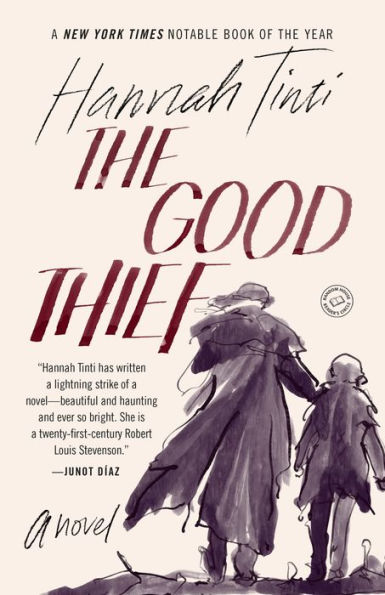
The Good Thief [NOOK Book]

NOOK Book (eBook)
$11.99
BN.com price

Available on NOOK devices and apps

  • Nook Devices
  • NOOK
  • NOOK Color
  • NOOK Tablet
  • Tablet/Phone
  • NOOK for iPad
  • NOOK for iPhone
  • NOOK for Android
  • NOOK for Android (Tablet)
  • NOOK Kids for iPad
  • PC/Mac
  • NOOK Study
  • NOOK for PC
  • NOOK for Mac

Need a NOOK? Explore Now

Overview

Winner of the 2008 John Sargent, Sr. First Novel Prize
• A Washington Post Best Book of 2008
• A Kirkus Reviews Best Book of 2008

Richly imagined and gothically spooky, The Good Thief introduces one of the most appealing young heroes in contemporary fiction and ratifies Hannah Tinti as one of our most exciting talents writing today.

Twelve year-old Ren is missing his left hand. How it was lost is a mystery that Ren has been trying to solve for his entire life, as well as who his parents are, and why he was abandoned as an infant at Saint Anthony’s Orphanage for boys. When a young man...

See more details below

Overview

Winner of the 2008 John Sargent, Sr. First Novel Prize
• A Washington Post Best Book of 2008
• A Kirkus Reviews Best Book of 2008

Richly imagined and gothically spooky, The Good Thief introduces one of the most appealing young heroes in contemporary fiction and ratifies Hannah Tinti as one of our most exciting talents writing today.

Twelve year-old Ren is missing his left hand. How it was lost is a mystery that Ren has been trying to solve for his entire life, as well as who his parents are, and why he was abandoned as an infant at Saint Anthony’s Orphanage for boys. When a young man named Benjamin Nab appears, claiming to be Ren’s long-lost brother, his convincing tale of how Ren lost his hand persuades the monks at the orphanage to release the boy and to give Ren some hope. But is Benjamin really who he says he is? As Ren is introduced to a life of hardscrabble adventure filled with outrageous scam artists, grave robbers, and petty thieves, he begins to suspect that Benjamin not only holds the key to his future, but to his past as well….

  • Hannah Tinti
    Hannah Tinti

Editorial Reviews

Janet Maslin
Recently in The Story of Edgar Sawtelle, and now in The Good Thief, the reader can find plain-spoken fiction full of traditional virtues: strong plotting, pure lucidity, visceral momentum and a total absence of writerly mannerisms. In Ms. Tinti's case that means an American Dickensian tale with touches of Harry Potterish whimsy, along with a macabre streak of spooky New England history.
—The New York Times
From The Critics
The effect of Tinti's steady, authoritative style is to make odd and extraordinary events seem natural: if she says there are hat boys and mousetrap girls, there are. And because of the seeming transparency of the narrator, we experience the world as Ren does, and feel his fear, unfiltered, when he's left alone with a wagonload of corpses and one of them sits up. Writing for adults while keeping to a child's perspective isn't easy, and Tinti makes it look effortless. And it is a book for adults, in addition to being the kind of story that might have kept you reading all day when you were home sick from school. It's about the nature of family—Ren's band of outlaws turns out to be more sustaining than the family he longed for—but it's also about the nature of storytelling, about invention's claims on the truth.
—The New York Times Book Review

Product Details

  • ISBN-13: 9780440337898
  • Publisher: Random House Publishing Group
  • Publication date: 8/26/2008
  • Sold by: Random House
  • Format: eBook
  • Sales rank: 45,116
  • File size: 2 MB
  • Items ship to U.S, APO/FPO and U.S. Protectorate addresses.

Meet the Author

Hannah Tinti's work has appeared in magazines and anthologies, including The Best American Mystery Stories 2003. Her short-story collection, Animal Crackers, has been sold in fifteen countries, and was a runner-up for the PEN/Hemingway Award. She is the editor of One Story magazine.

From the Hardcover edition.

Read an Excerpt

The Good Thief
By Hannah Tinti
The Dial Press Copyright © 2008 Hannah Tinti
All right reserved.

ISBN: 9780385337458


Chapter One


The man arrived after morning prayers. Word spread quickly that someone had come, and the boys of Saint Anthony’s elbowed each other and strained to catch a glimpse as he unhitched his horse and led it to the trough for drinking. The man’s face was hard to make out, his hat pulled so far down that the brim nearly touched his nose. He tied the reins to a post and then stood there, patting the horse’s neck as it drank. The man waited, and the boys watched, and when the mare finally lifted its head, they saw the man lean forward, stroke the animal’s nose, and kiss it. Then he wiped his lips with the back of his hand, removed his hat, and made his way across the yard to the monastery.

Men often came for children. Sometimes it was for cheap labor, sometimes for a sense of doing good. The brothers of Saint Anthony’s would stand the orphans in a line, and the men would walk back and forth, inspecting. It was easy to tell what they were looking for by where their eyes went. Usually it was to boys almost fourteen, the taller ones, the loudest, the strongest. Then their eyes went down to the barely crawling, the stumbling two-year-olds—still untainted and fresh. This left the in-betweens— those who had lost their baby fat and curls but were not yet old enough to be helpful. These children were usually ill-tempered and had little to offer but lice and a bad case of the measles. Ren was one ofthem.

He had no memory of a beginning—of a mother or father, sister or brother. His life was simply there, at Saint Anthony’s, and what he remembered began in the middle of things—the smell of boiled sheets and lye; the taste of watery oatmeal; the feel of dropping a brick onto a piece of stone, watching the red pieces split off, then using those broken shards to write on the wall of the monastery, and being slapped for this, and being forced to wash the dust away with a cold, wet rag.

Ren’s name had been sewn into the collar of his nightshirt: three letters embroidered in dark blue thread. The cloth was made of good linen, and he had worn it until he was nearly two. After that it was taken away and given to a smaller child to wear. Ren learned to keep an eye on Edward, then James, then Nicholas—and corner them in the yard. He would pin the squirming child to the ground and examine the fading letters closely, wondering what kind of hand had worked them. The R and E were sewn boldly in a cross-stitch, but the N was thinner, slanting to the right, as if the person working the thread had rushed to complete the job. When the shirt wore thin, it was cut into bandages. Brother Joseph gave Ren the piece of collar with the letters, and the boy kept it underneath his pillow at night.

Ren watched now as the visitor waited on the steps of the priory. The man passed his hat back and forth in his hands, leaving damp marks along the felt. The door opened and he stepped inside. A few minutes later Brother Joseph came to gather the children, and said, “Get to the statue.”

The statue of Saint Anthony sat in the center of the yard. It was carved from marble, dressed in the robes of the Franciscan friars. The dome of Saint Anthony’s head was bald, with a halo circling his brow. In one hand he held a lily and in the other a small child wearing a crown. The child was holding out one palm in supplication and using the other to touch the saint’s cheek. There were times, when the sun receded in the afternoon and shadows played across the stone, that the touch looked more like a slap. This child was Jesus Christ, and the pairing was proof of Saint Anthony’s ability to carry messages to God. When a loaf of bread went missing from the kitchen, or Father John couldn’t find the keys to the chapel, the children were sent to the statue. Saint Anthony, Saint Anthony, come bring what I’ve lost back to me.

Catholics were rare in this part of New England. A local Irishman who’d made a fortune pressing cheap grapes into strong port had left his vineyard to the church in a desperate bid for heaven before he died. The brothers of Saint Anthony were sent to claim the land and build the monastery. They found themselves surrounded by Protestants, who, in the first month of their arrival, burned down the barn, fouled the well, and caught two brothers after dark on the road and sent them home tarred and feathered.

After praying for guidance, the brothers turned to the Irishman’s winepress, which was still intact and on the grounds. Plants were sent from Italy, and after some trial and error the brothers matched the right vine with their stony New England soil. Before long Saint Anthony’s became well-known for their particular vintage, which they aged in old wooden casks and used for their morning and evening masses. The unconsecrated wine was sold to the local taverns and also to individual landowners, who sent their servants to collect the bottles in the night so that their neighbors would not see them doing business with Catholics.

Soon after this the first child was left. Brother Joseph heard cries one morning before sunrise and opened the door to find a baby wrapped in a soiled dress. The second child was left in a bucket near the well. The third in a basket by the outhouse. Girls were collected every few months by the Sisters of Charity, who worked in a hospital some distance away. What happened to them, no one knew, but the boys were left at Saint Anthony’s, and before long the monastery had turned into a de facto orphanage for the bastard children of the local townspeople, who still occasionally tried to burn the place to the ground.

To control these attempts at arson, the brothers built a high brick wall around the property, which sloped and towered like a fortress along the road. At the bottom of the wooden gate that served as the entrance they cut a small swinging door, and it was through this tiny opening that the babies were pushed. Ren was told that he, too, had been pushed through this gate and found the following morning, covered in mud in the prior’s garden. It had rained the night before, and although Ren had no memory of the storm, he often wondered why he had been left in bad weather. It always led to the same conclusion: that whoever had dropped him off could not wait to be rid of him.

The gate was hinged to open one way—in. When Ren pushed at the tiny door with his finger, he could feel the strength of the wooden frame behind it. There was no handle on the children’s side, no groove to lift from underneath. The wood was heavy, thick, and old—a fine piece of oak planed years before from the woods beyond the orphanage. Ren liked to imagine he felt a pressure in return, a mother reaching back through, changing her mind, groping wildly, a thin white arm.

•••

Underneath Saint Anthony’s statue the younger boys fidgeted and pushed, the older ones cleared their throats nervously. Brother Joseph walked down the line and straightened their clothes, or spit on his hand and scrubbed their faces, bumping his large stomach into the children who had fallen out of place. He pushed it now toward a six-year-old who had suddenly sprung a bloody nose from the excitement.

“Hide it quick,” he said, shielding the boy with his body. Across the yard Father John was solemnly approaching, and behind him was the man who had kissed the horse.

He was a farmer. Perhaps forty years old. His shoulders were strong, his fingers thick with calluses, his skin the color of rawhide from the sun. There was a rash of brown spots across his forehead and the backs of his hands. His face was not unkind, and his coat was clean, his shirt pressed white, his collar tight against his neck. A woman had dressed him. So there would be a wife. A mother.

The man began to make his way down the line. He paused before two blond boys, Brom and Ichy. They were also in- betweens, twins left three winters after Ren. Brom’s neck was thicker, by about two inches, and Ichy’s feet were longer, by about two inches, but beyond those distinguishing characteristics it was hard to tell the boys apart when they were standing still. It was only when they were out in the fields working, or throwing stones at a pine tree, or washing their faces in the morning that the differences became clear. Brom would splash a handful of water over his head and be done with it. Ichy would fold a handkerchief into fourths, dab it into the basin, then set to work carefully and slowly behind his ears.

It was said that no one would adopt Brom and Ichy because they were twins. One was sure to be unlucky. Second-borns were usually considered changelings and drowned right after birth. But no one knew who came first, Brom or Ichy, so there was no way to tell where the bad luck was coming from. What the brothers needed to do was separate, make themselves look as different as possible. Ren kept this information to himself. They were his only friends, and he did not want to lose them.

Standing together now the twins grinned at the farmer, and then, suddenly, Brom threw his arms around his brother and attempted to lift him off the ground. He had done this once before, as a show of strength in front of two elderly gentlemen, and it had ended badly. Ren watched from the other end of the line as Ichy, taken by surprise, began to recite his multiplication tables, all the while struggling violently against his brother, to the point that one of his boots flew into the air and sailed past the farmer’s ear.

Father John kept a small switch up the sleeve of his robe, and he put it to work now on the twins, while Brother Joseph fetched Ichy’s boot and the farmer continued down the line. Ren put his arms behind his back and stood at attention. He held his breath as the man stopped in front of him.

“How old are you?”

Ren opened his mouth to answer, but the man spoke for him.

“You look about twelve.”

Ren wanted to say that he could be any age, that he could make himself into anything the man wanted, but instead he followed what he had been taught by the brothers, and said nothing.

“I want a boy,” said the farmer. “Old enough to help me work and young enough for my wife to feel she has a child. Someone who’s honest and willing to learn. Someone who can be a son to us.” He leaned forward and lowered his voice so that only Ren could hear him. “Do you think you could do that?”

Father John came up behind them. “You don’t want that one.”

Continues...

Excerpted from The Good Thief by Hannah Tinti Copyright © 2008 by Hannah Tinti. Excerpted by permission.
All rights reserved. No part of this excerpt may be reproduced or reprinted without permission in writing from the publisher.
Excerpts are provided by Dial-A-Book Inc. solely for the personal use of visitors to this web site.

Foreward

1. How do the time period and the locale shape the novel? How did the needy and the sly fare in rural America before the twentieth century? What historical aspects of The Good Thief surprised you the most?

 2. What were your impressions of Saint Anthony's? What were the motivations of Father John and the brothers who cared for Ren there? Were they cruel or simply realistic? 

3. Did you believe the story Benjamin told when he took Ren from Saint Anthony's? Would you have fallen for the scams they ran? What vulnerabilities did they prey on? What is the key to being a successful scoundrel? 

4. What did The Lives of the Saints mean to Ren before and after he left Saint Anthony's? How did his feelings about religion change throughout the novel? How did his early lessons in sin, penance, and ritual serve him in the real world? 

5. What enabled Benjamin and Tom to engage in grave robbing without feeling repulsed? Can their practical logic be justified? What is the emotional value of the possessions of the dead? 

6. In chapter fourteen, Doctor Milton lets Ren see his scarred skin under a microscope. What changes for Ren in that en- counter? How did his injury affect his life in different ways throughout the novel? How did you react when you discovered how his hand had been severed? 

7. The Harelip, Mrs. Sands, and Sister Agnes all seem powerful and skilled in different ways but don't fit traditional female archetypes of wives or mothers. How are women represented in The Good Thief ? Howdo these women affect Ren's story? 

8. In what ways is Ren wiser than Brom or Ichy? What makes him better prepared for life on the lam? 

9. What does Dolly teach Ren about himself and about the nature of death and darkness in the world? What effect does Ren have on Dolly? 

10. Discuss the images Ren had created of an ideal mother as someone beautiful who could provide comfort, a warm bed, and good cooking. How does Sister Agnes help him cope with the reality of his mother? Should he have been sheltered from knowing the truth? How does Mrs. Sands fulfill or not fulfill the role of mother for Ren? 

11. What is the source of McGinty's sadism and bitterness? What did it take to defeat him? 

12. Early in the novel, Benjamin and Tom discover Ren's ease with trickery and declare that he is already one of them. Did he possess these skills innately or were they the result of having to survive at Saint Anthony's? How much control over his destiny did Ren have? Did nature or nurture have the greater role in his approach to the world? 

13. Discuss the title. What makes a good thief—either in terms of being a noble thief or a skillful one? Can this be applied to the epigraph from Emerson, describing the rewards available to a good "trapper"? And how does this relate to the biblical story of the Good Thief, who was crucified with Jesus Christ on Golgotha? 

14. What innovative approaches to storytelling appear in The Good Thief

Reading Group Guide

1. How do the time period and the locale shape the novel? How did the needy and the sly fare in rural America before the twentieth century? What historical aspects of The Good Thief surprised you the most?

 2. What were your impressions of Saint Anthony's? What were the motivations of Father John and the brothers who cared for Ren there? Were they cruel or simply realistic? 

3. Did you believe the story Benjamin told when he took Ren from Saint Anthony's? Would you have fallen for the scams they ran? What vulnerabilities did they prey on? What is the key to being a successful scoundrel? 

4. What did The Lives of the Saints mean to Ren before and after he left Saint Anthony's? How did his feelings about religion change throughout the novel? How did his early lessons in sin, penance, and ritual serve him in the real world? 

5. What enabled Benjamin and Tom to engage in grave robbing without feeling repulsed? Can their practical logic be justified? What is the emotional value of the possessions of the dead? 

6. In chapter fourteen, Doctor Milton lets Ren see his scarred skin under a microscope. What changes for Ren in that en- counter? How did his injury affect his life in different ways throughout the novel? How did you react when you discovered how his hand had been severed? 

7. The Harelip, Mrs. Sands, and Sister Agnes all seem powerful and skilled in different ways but don't fit traditional female archetypes of wives or mothers. How are women represented in The Good Thief ? How do these women affect Ren's story? 

8. In what ways is Ren wiser than Brom or Ichy? What makes him better prepared for life on the lam? 

9. What does Dolly teach Ren about himself and about the nature of death and darkness in the world? What effect does Ren have on Dolly? 

10. Discuss the images Ren had created of an ideal mother as someone beautiful who could provide comfort, a warm bed, and good cooking. How does Sister Agnes help him cope with the reality of his mother? Should he have been sheltered from knowing the truth? How does Mrs. Sands fulfill or not fulfill the role of mother for Ren? 

11. What is the source of McGinty's sadism and bitterness? What did it take to defeat him? 

12. Early in the novel, Benjamin and Tom discover Ren's ease with trickery and declare that he is already one of them. Did he possess these skills innately or were they the result of having to survive at Saint Anthony's? How much control over his destiny did Ren have? Did nature or nurture have the greater role in his approach to the world? 

13. Discuss the title. What makes a good thief—either in terms of being a noble thief or a skillful one? Can this be applied to the epigraph from Emerson, describing the rewards available to a good "trapper"? And how does this relate to the biblical story of the Good Thief, who was crucified with Jesus Christ on Golgotha? 

14. What innovative approaches to storytelling appear in The Good Thief

Customer Reviews
Average Rating 4
( 92 )

Rating Distribution

If you've bought this product, tell the world how you liked it.
Write a Review
See All Sort by: Showing 1 – 20 of 92 Customer Reviews
  • Anonymous

    Posted September 17, 2008

    The Good Thief

    Ren is an orphan who does not know his age, last name, who his parents are or how he lost his left hand. With that important limb missing, he is routinely passed over by the visitors to Saint Anthony's orphanage, who come seeking to adopt a son or hire a worker. But then handsome Benjamin Nab arrives one day and claims Ren is his brother. The boy cannot believe his luck, even when Nab - clearly not his brother - turns out to be a silver-tongued man with a grave-robbing sideline. 'This is not a child,' he tells his alcoholic friend Tom after showing him Ren's stump. 'This is a gold mine.' It is impossible to read Tinti's first novel, set in the sinister town of North Umbrage in 19th-century England, without continually referencing Dickens. The Oliver Twist grimness of the orphanage soon gives way to a Great Expectations-style adventure with larger-than-life characters. These include Dolly, a giant murderer that Ren befriends, and McGinty, the menacing owner of North Umbrage's huge mousetrap factory. But Tinti also brings her own skills to the table: brevity of languageas well as a masterful ability to marry terror and humor. She also crafts her characters with such humanity and sympathy that their lack of morality just seems like good business sense. 'No heroics,' Tom says to Ren as they set out for their first con job. 'If something goes wrong, I want you to run.' Ren is himself a good thief, in both senses of the phrase: a deft purloiner, as well as a kind fingersmith. Like all of Tinti's other characters, he is an interesting study in amorality: Even as it chills him to stand next to a murderer, he cannot help wondering what it would be like 'to have no feelings, no guilt. To never say penance again'. The novel takes a slightly surreal turn in the last half when Ren is persecuted by McGinty over a dark secret. But it remains a shining example of that rare breed of book: a good, solid read.

    6 out of 6 people found this review helpful.

    Was this review helpful? Yes  No   Report this review
  • Anonymous

    Posted September 6, 2008

    unputtdownable!

    Almost quite literally impossible to put down and even if your mother steals your copy for a week or so (as mine did), you live with the characters in the meantime and pick right up with them after you get it back from her. Especially nice to read a novel that takes place in the past but doesn't have 'research' screaming from between the lines. As you read it you just feel like you're back there, then, with this boy and these con artists--and that there and then is where you want to be. It had been quite a while since I'd gotten this lost in a book--took me back to those great reading days of childhood and adolescence.

    3 out of 3 people found this review helpful.

    Was this review helpful? Yes  No   Report this review
  • Anonymous

    Posted December 29, 2010

    Odd book- not recommended

    The story seemed interesting and the other reviews proclaimed The Good Thief to be such an excellent read, so I ordered the book. I found it to be okay, hardly excellent. The characters were memorable to a certain degree but the story itself was just odd. Digging up bodies for medical knowledge may be a fact of the past but its weird to link a story about a child without a family and a mysterious past to that. Every character had some bizarre characteristic. Ren didn't have a hand. Dolly, who was a large man killed people for a living and slept all the time... added nothing to the story. The dwarf, yes dwarf, on the roof added nothing to the story. Mrs Sands screamed everytime she talked. The villian had a speech impediment and owned a mousetrap factory -of all things - which ultimately saved the town. Hairlip- the heroine if you will, didn't have to have a hairlip. Tom had a drinking problem. It was all so out there that it was almost stupid. The ending was disappointing. Would not recommend this book.

    2 out of 7 people found this review helpful.

    Was this review helpful? Yes  No   Report this review
  • Anonymous

    Posted July 4, 2010

    One of the best books I've ever read--magical!

    I read a great deal of contemporary fiction and this was one of the best books I ever read. The characters were well drawn and I was pulled helplessly into the life of Ren, the main character, just as he is pulled helplessly into the adventures that befall him. The plot is exciting and filled with surprises. The writing is excellent and I couldn't wait to enter the world that Hannah Tinti created.

    2 out of 2 people found this review helpful.

    Was this review helpful? Yes  No   Report this review
  • Anonymous

    Posted August 17, 2008

    The Good Thief

    Ren had no memory of his life before St. Anthony's. The only clues to his past is the initials REN sewn into the collar of his nightshirt and his missing left hand. One day a stranger, Benjamin Nab, comes to St. Anthony's looking for him, claiming to be his older brother, and reeling off a story of high adventure that explains both how Ren lost his hand and the reason he was left at St. Anthony's. However, Ren soon discovers that Benjamin Nab is not at all who he claims to be, but instead is ...more Ren had no memory of his life before St. Anthony's. The only clues to his past is the initials REN sewn into the collar of his nightshirt and his missing left hand. One day a stranger, Benjamin Nab, comes to St. Anthony's looking for him, claiming to be his older brother, and reeling off a story of high adventure that explains both how Ren lost his hand and the reason he was left at St. Anthony's. However, Ren soon discovers that Benjamin Nab is not at all who he claims to be, but instead is a smooth talking con man that hopes to use Ren's disability in order to pull off more lucrative cons. When Ren decides, against his better judgment, to throw his lot in with Nab, he realizes that his life is never going to be the same again. This contemporary book is a classic adventure story with the literary style and singular characters that will remind the reader of the works of Robert Louis Stevenson, Charles Dickens, and/or Mark Twain. It is a well-written, fast-plotted, thoroughly enjoyable read that holds up very well to these hefty comparisons.

    2 out of 2 people found this review helpful.

    Was this review helpful? Yes  No   Report this review
  • Posted September 28, 2011

    more from this reviewer

    Pointless!

    Well written but pointless. I really didn't get it.

    1 out of 3 people found this review helpful.

    Was this review helpful? Yes  No   Report this review
  • Posted October 31, 2010

    more from this reviewer

    A Very Gratifying Read!

    I really didn't know what to expect from this novel and I was very surprised. I found it amusing, entertaining, poignant, and scrappy. I believe it it would make a great movie and to see this book on the screen would be so much fun.

    1 out of 1 people found this review helpful.

    Was this review helpful? Yes  No   Report this review
  • Posted August 13, 2010

    I Also Recommend:

    Dark and Light

    While usually I try to stay away from books that are dark and disturbing, this book drew me in and I just couldn't put it down. I even woke up early to finish it this morning and I'm not a morning person. While the details are gory and often times unpleasant, Tinti composes her prose in a way that is honest and tugs at your heart. Some authors add gore as shock value but she used it to further the plot and make you care for Ren. This book is a true mix of fantasy and reality that will make you cringe, smile and possibly cry. Tinti has such a flare for writing. I haven't seen this quality of work in a very long time. Her literary skills could set her in the ranks of the classics. It will be interesting to see what she comes up with next.

    1 out of 1 people found this review helpful.

    Was this review helpful? Yes  No   Report this review
  • Posted February 22, 2010

    A good book that's well worth reading.

    Recommended.

    1 out of 1 people found this review helpful.

    Was this review helpful? Yes  No   Report this review
  • Posted November 12, 2009

    I Also Recommend:

    The Good Read

    If you were to mix Dickens with a shot of Twain, and economize the amount of words, you would get something like this. It is, oversimply, a gothic tale of an orphan searching for answers to his mysterious past - most notably, his missing hand. On his journey, he encounters con men, petty thieves, grave robbers, and a mousetrap factory. It is a joy to read, a treasure of the best kind.

    1 out of 1 people found this review helpful.

    Was this review helpful? Yes  No   Report this review
  • Posted September 16, 2009

    more from this reviewer

    I Also Recommend:

    Great New Story!!!

    For a while there, I was in dire need of a new book. That's when I found the Good Thief! For me this book was a breath of fresh air. I became fascinated with the characters as they traveled from one adventure to the next. This is definitely one of those books that can trasnport you back in time. You can't help but to fall in love with all the characters and be intirgued with the plot. A great gothic type novel for a wide range of readers!

    1 out of 1 people found this review helpful.

    Was this review helpful? Yes  No   Report this review
  • Anonymous

    Posted August 16, 2009

    Loved every minute of it!

    Loved her first book, Animal Crackers, so I knew I couldn't wait to read this one. She made me love all the characters despite their flaws. This novel has an old world feel. i devoured this book in only a weeks time. If you are looking for a book to take you away this summer -this is the one for you.

    1 out of 1 people found this review helpful.

    Was this review helpful? Yes  No   Report this review
  • Anonymous

    Posted September 2, 2008

    I absolutely loved this book!

    I think this book is fantastic! The main charatcer Ren, is so lovable, it was really hard for me to put this book down. I would reccommend this book to anyone! I hope she writes a sequel!!!

    1 out of 1 people found this review helpful.

    Was this review helpful? Yes  No   Report this review
  • Anonymous

    Posted August 7, 2008

    An engaging historical

    In New England at Saint Anthony¿s for Boys orphanage, twelve years old resident Ren wonders how he lost his left hand and who his biological parents are. He has tried to solve both puzzles for as long as he can remember, but has made no progress on either of his inquiries. He especially would like to find his family as he fears the Brothers who run the facility will soon toss him out into the real world.----------------- Adult Benjamin Nab arrives at Saint Antony with an astonishing claim that Ren is his younger brother. He backs his declaration by explaining how the preadolescent lost his hand and ended up in an orphanage. The Brothers feels good for Ren that his older sibling has come to take him home. However, Benjamin and his partner Tom are con artists whose newest ploy is to use a young angelic looking cripple to expedite the swindle. This proves quite lucrative as Ren takes to a life of crime as if he was born to it Benjamin and Tom are family to him until they reach North Umbrage where everything unravels.------------------- This engaging historical stars three fascinating crooks with radically different personalities whose adventures in con crime is somewhat abated. Readers especially the young adult audience will relish Ren¿s escapades but also undertsanbd his obsessive need to belong to someone who cares about him even if that means criminal activities this is similar to youngsters joining gangs. Hannah Tinti provides a deep look at THE GOOD THIEF whose psychological relational needs are the driving elements to this enjoyable nineteenth century character driven thriller.------------- Harriet Klausner

    1 out of 1 people found this review helpful.

    Was this review helpful? Yes  No   Report this review
  • Anonymous

    Posted November 26, 2011

    LOVE

    This book is really awesome. I read it cover to cover in one day. Highly recommended!!

    Was this review helpful? Yes  No   Report this review
  • Anonymous

    Posted November 6, 2011

    A new favorite

    Engaging characters, great narrative voice and an amazing story make this book a genuine masterpiece. I genuinely pity anyone who doesn't 'get' it. Read this book!!!

    Was this review helpful? Yes  No   Report this review
  • Posted June 30, 2010

    I Also Recommend:

    Excellent Read

    An excellent adventure story - somewhere it's compared with Stevenson and I think it does have many elements of his writing. there is something mysterious about Benjamin Nab and charming. Ren is an endearing and lovable character. His plight and that of his friends is terrible - and the tension of not knowing what indeed will happen to this good little thief and the mystery surround him are what make the book so difficult to put down. A very good read - and not just for young adults but any age.

    Was this review helpful? Yes  No   Report this review
  • Posted May 16, 2010

    I Also Recommend:

    A classic tale

    I bought The Good Thief for my 14 year old nephew for Christmas. I was attracted to the cover and the story outline on the back. I started reading it to see if it would keep my interest and I was hooked. It takes place in Colonial New England and the world Hannah Tinti creates has fantastical characters and dreadfully sinister settings. It is a fantastic adventure novel with characters you root for and characters you hate. Ren is a boy of courage. His friends can't be trusted and he doesn't trust them, yet he must. His life depends on it. Who will turn on him for a buck to be had and who will be there to save him in the nick of time? This would be a great book for middle school and high school reading. Don't get me wrong. It's a great adult read too. It's well written. It's mature. It's colorful.

    Was this review helpful? Yes  No   Report this review
  • Posted May 14, 2010

    more from this reviewer

    This story has it all...

    good guys, bad guys, really bad guys, orphans, widows and shysters, dark and stormy nights,giants,grave diggers, charm, wit, humor and trepidation...wrapped in a setting long ago and far away. Part fairy tale
    and part fable, readers sink into Remy's ever changing reality and his search for his place in the world. The variety of characters which could be unrelatably odd are instead written in a way that makes them endearing...those that we wonder about long after closing the book.

    Was this review helpful? Yes  No   Report this review
  • Posted May 5, 2010

    Dickensenian Thriller

    Lose yourself in the story of a one handed orphan boy who has only one memento from his mother. A scrap of linen embroidered with the initials REN are the only clue to his history. He was left on the door of the orphanage dressed in a night shirt with the red letters stitched in the neck band. A stranger comes to review the boys for adoption. When he sees Ren's truncated arm he spins a yarn for the priest and whisks the boy off for an unbelievable adventure. Horse theft, fires, dwarves, alcoholics, deceit and heroism round out the tale. Ren's yearning for a family comes to fruition but not in a way he ever dreamed possible.

    Was this review helpful? Yes  No   Report this review
See All Sort by: Showing 1 – 20 of 92 Customer Reviews

If you find inappropriate content, please report it to Barnes & Noble
Why is this product inappropriate?
Comments (optional)
500 character limit