
A survey of current knowledge about Hamiltonian systems with three or more degrees of freedom and related topics. The Hamiltonian systems appearing in most of the applications are non-integrable. Hence methods to prove non-integrability results are presented and the different meaning attributed to non-integrability are discussed. For systems near an integrable one, it can be shown that, under suitable conditions, some parts of the integrable structure, most of the invariant tori, survive. Many of the papers discuss near-integrable systems.
From a topological point of view, some singularities must appear in different problems, either caustics, geodesics, moving wavefronts, etc. This is also related to singularities in the projections of invariant objects, and can be used as a signature of these objects. Hyperbolic dynamics appear as a source on unpredictable behaviour and several mechanisms of hyperbolicity are presented. The destruction of tori leads to Aubrey-Mather objects, and this is touched on for a related class of systems. Examples without periodic orbits are constructed, against a classical conjecture.
Other topics concern higher dimensional systems, either finite (networks and localised vibrations on them) or infinite, like the quasiperiodic Schrödinger operator or nonlinear hyperbolic PDE displaying quasiperiodic solutions.
Most of the applications presented concern celestial mechanics problems, like the asteroid problem, the design of spacecraft orbits, and methods to compute periodic solutions.
1132019962
From a topological point of view, some singularities must appear in different problems, either caustics, geodesics, moving wavefronts, etc. This is also related to singularities in the projections of invariant objects, and can be used as a signature of these objects. Hyperbolic dynamics appear as a source on unpredictable behaviour and several mechanisms of hyperbolicity are presented. The destruction of tori leads to Aubrey-Mather objects, and this is touched on for a related class of systems. Examples without periodic orbits are constructed, against a classical conjecture.
Other topics concern higher dimensional systems, either finite (networks and localised vibrations on them) or infinite, like the quasiperiodic Schrödinger operator or nonlinear hyperbolic PDE displaying quasiperiodic solutions.
Most of the applications presented concern celestial mechanics problems, like the asteroid problem, the design of spacecraft orbits, and methods to compute periodic solutions.
Hamiltonian Systems with Three or More Degrees of Freedom
A survey of current knowledge about Hamiltonian systems with three or more degrees of freedom and related topics. The Hamiltonian systems appearing in most of the applications are non-integrable. Hence methods to prove non-integrability results are presented and the different meaning attributed to non-integrability are discussed. For systems near an integrable one, it can be shown that, under suitable conditions, some parts of the integrable structure, most of the invariant tori, survive. Many of the papers discuss near-integrable systems.
From a topological point of view, some singularities must appear in different problems, either caustics, geodesics, moving wavefronts, etc. This is also related to singularities in the projections of invariant objects, and can be used as a signature of these objects. Hyperbolic dynamics appear as a source on unpredictable behaviour and several mechanisms of hyperbolicity are presented. The destruction of tori leads to Aubrey-Mather objects, and this is touched on for a related class of systems. Examples without periodic orbits are constructed, against a classical conjecture.
Other topics concern higher dimensional systems, either finite (networks and localised vibrations on them) or infinite, like the quasiperiodic Schrödinger operator or nonlinear hyperbolic PDE displaying quasiperiodic solutions.
Most of the applications presented concern celestial mechanics problems, like the asteroid problem, the design of spacecraft orbits, and methods to compute periodic solutions.
From a topological point of view, some singularities must appear in different problems, either caustics, geodesics, moving wavefronts, etc. This is also related to singularities in the projections of invariant objects, and can be used as a signature of these objects. Hyperbolic dynamics appear as a source on unpredictable behaviour and several mechanisms of hyperbolicity are presented. The destruction of tori leads to Aubrey-Mather objects, and this is touched on for a related class of systems. Examples without periodic orbits are constructed, against a classical conjecture.
Other topics concern higher dimensional systems, either finite (networks and localised vibrations on them) or infinite, like the quasiperiodic Schrödinger operator or nonlinear hyperbolic PDE displaying quasiperiodic solutions.
Most of the applications presented concern celestial mechanics problems, like the asteroid problem, the design of spacecraft orbits, and methods to compute periodic solutions.
329.99
In Stock
5
1

Hamiltonian Systems with Three or More Degrees of Freedom
658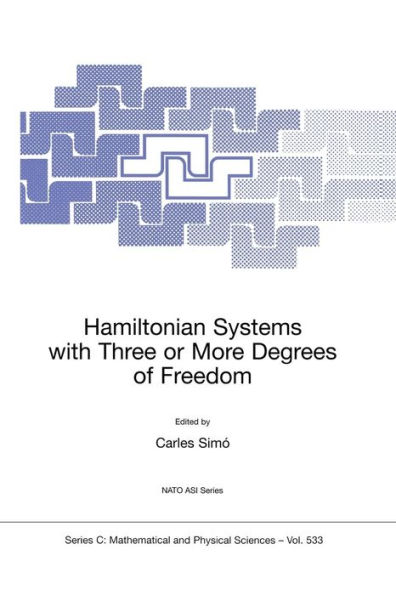
Hamiltonian Systems with Three or More Degrees of Freedom
658Paperback(Softcover reprint of the original 1st ed. 1999)
$329.99
329.99
In Stock

Product Details
| ISBN-13: | 9789401059688 |
|---|---|
| Publisher: | Springer Netherlands |
| Publication date: | 11/05/2012 |
| Series: | Nato Science Series C: , #533 |
| Edition description: | Softcover reprint of the original 1st ed. 1999 |
| Pages: | 658 |
| Product dimensions: | 6.30(w) x 9.45(h) x 0.05(d) |
From the B&N Reads Blog