
Handbook of Lasers
Lasers continue to be an amazingly robust field of activity. Anyone seeking a photon source is now confronted with an enormous number of possible lasers and laser wavelengths to choose from, but no single, comprehensive source to help them make that choice.The Handbook of Lasers provides an authoritative compilation of lasers, their properties, and original references in a readily accessible form. Organized by lasing media-solids, liquids, and gases-each section is subdivided into distinct laser types. Each type carries a brief description, followed by tables listing the lasing element or medium, host, lasing transition and wavelength, operating properties, primary literature citations, and, for broadband lasers, reported tuning ranges.The importance and value of the Handbook of Lasers cannot be overstated. Serving as both an archive and as an indicator of emerging trends, it reflects the state of knowledge and development in the field, provides a rapid means of obtaining reference data, and offers a pathway to the literature. It contains data useful for comparison with predictions and for developing models of processes, and may reveal fundamental inconsistencies or conflicts in the data.
1127739946
Handbook of Lasers
Lasers continue to be an amazingly robust field of activity. Anyone seeking a photon source is now confronted with an enormous number of possible lasers and laser wavelengths to choose from, but no single, comprehensive source to help them make that choice.The Handbook of Lasers provides an authoritative compilation of lasers, their properties, and original references in a readily accessible form. Organized by lasing media-solids, liquids, and gases-each section is subdivided into distinct laser types. Each type carries a brief description, followed by tables listing the lasing element or medium, host, lasing transition and wavelength, operating properties, primary literature citations, and, for broadband lasers, reported tuning ranges.The importance and value of the Handbook of Lasers cannot be overstated. Serving as both an archive and as an indicator of emerging trends, it reflects the state of knowledge and development in the field, provides a rapid means of obtaining reference data, and offers a pathway to the literature. It contains data useful for comparison with predictions and for developing models of processes, and may reveal fundamental inconsistencies or conflicts in the data.
86.99
In Stock
5
1


Handbook of Lasers
1224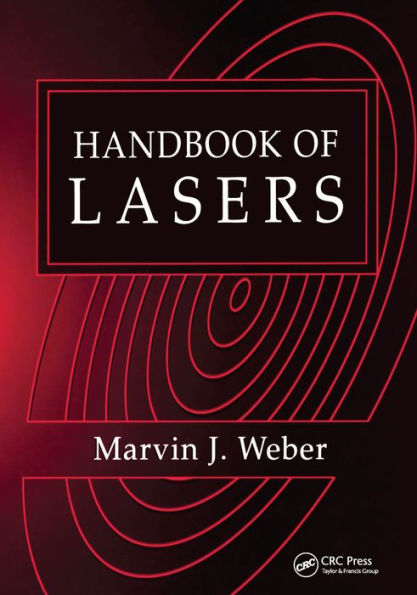
Handbook of Lasers
1224
86.99
In Stock

Product Details
| ISBN-13: | 9781351835510 |
|---|---|
| Publisher: | CRC Press |
| Publication date: | 04/30/2019 |
| Series: | Laser & Optical Science & Technology , #18 |
| Sold by: | Barnes & Noble |
| Format: | eBook |
| Pages: | 1224 |
| File size: | 167 MB |
| Note: | This product may take a few minutes to download. |
About the Author
From the B&N Reads Blog