Handbook of Process Integration (PI): Minimisation of Energy and Water Use, Waste and Emissions
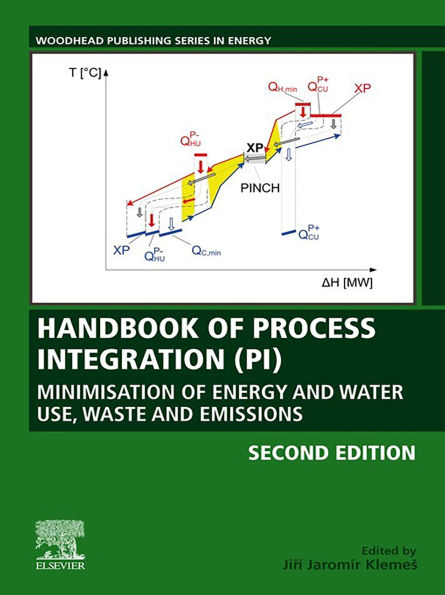
Handbook of Process Integration (PI): Minimisation of Energy and Water Use, Waste and Emissions, Second Edition provides an up-to-date guide on the latest PI research and applications. Since the first edition published, methodologies and sustainability targets have developed considerably. Each chapter has been fully updated, with six new chapters added in this release, covering emissions, transport, water scarcity, reliability and maintenance, environmental impact and circular economy. This version also now includes worked examples and simulations to deepen the reader's understanding.

With its distinguished editor and international team of expert contributors, this book is an important reference work for managers and researchers in all energy and sustainability industries, as well as academics and students in Energy, Chemical, Process, and Environmental Engineering.

- Provides a fully updated handbook with six new chapters that reflect the latest research and applications on process integration

- Reviews a wide range of process design and integration topics, ranging from heat and utility systems to water, recycling, waste and hydrogen systems

- Covers equipment design and operability issues, with a strong extension to environmental engineering and suitability issues

1113867728
Handbook of Process Integration (PI): Minimisation of Energy and Water Use, Waste and Emissions
Handbook of Process Integration (PI): Minimisation of Energy and Water Use, Waste and Emissions, Second Edition provides an up-to-date guide on the latest PI research and applications. Since the first edition published, methodologies and sustainability targets have developed considerably. Each chapter has been fully updated, with six new chapters added in this release, covering emissions, transport, water scarcity, reliability and maintenance, environmental impact and circular economy. This version also now includes worked examples and simulations to deepen the reader's understanding.

With its distinguished editor and international team of expert contributors, this book is an important reference work for managers and researchers in all energy and sustainability industries, as well as academics and students in Energy, Chemical, Process, and Environmental Engineering.

- Provides a fully updated handbook with six new chapters that reflect the latest research and applications on process integration

- Reviews a wide range of process design and integration topics, ranging from heat and utility systems to water, recycling, waste and hydrogen systems

- Covers equipment design and operability issues, with a strong extension to environmental engineering and suitability issues

410.0 In Stock
Handbook of Process Integration (PI): Minimisation of Energy and Water Use, Waste and Emissions

Handbook of Process Integration (PI): Minimisation of Energy and Water Use, Waste and Emissions

by Jirí Jaromír Klemes (Editor)
Handbook of Process Integration (PI): Minimisation of Energy and Water Use, Waste and Emissions

Handbook of Process Integration (PI): Minimisation of Energy and Water Use, Waste and Emissions

by Jirí Jaromír Klemes (Editor)

eBook

$410.00 

Available on Compatible NOOK devices, the free NOOK App and in My Digital Library.
WANT A NOOK?  Explore Now

Related collections and offers


Overview

Handbook of Process Integration (PI): Minimisation of Energy and Water Use, Waste and Emissions, Second Edition provides an up-to-date guide on the latest PI research and applications. Since the first edition published, methodologies and sustainability targets have developed considerably. Each chapter has been fully updated, with six new chapters added in this release, covering emissions, transport, water scarcity, reliability and maintenance, environmental impact and circular economy. This version also now includes worked examples and simulations to deepen the reader's understanding.

With its distinguished editor and international team of expert contributors, this book is an important reference work for managers and researchers in all energy and sustainability industries, as well as academics and students in Energy, Chemical, Process, and Environmental Engineering.

- Provides a fully updated handbook with six new chapters that reflect the latest research and applications on process integration

- Reviews a wide range of process design and integration topics, ranging from heat and utility systems to water, recycling, waste and hydrogen systems

- Covers equipment design and operability issues, with a strong extension to environmental engineering and suitability issues


Product Details

ISBN-13: 9780128238516
Publisher: Woodhead Publishing, Limited
Publication date: 11/09/2022
Series: Woodhead Publishing Series in Energy
Sold by: Barnes & Noble
Format: eBook
Pages: 1190
File size: 102 MB
Note: This product may take a few minutes to download.

About the Author

Prof Dr-Hab Jiří Jaromír KLEMEŠ, DSc, Dr h c (mult) and George Pólya Professor. Head of a Centre of Excellence “Sustainable Process Integration Laboratory – SPIL”, NETME Centre, Faculty of Mechanical Engineering, Brno University of Technology - VUT Brno, Czech Republic. Previously the Project Director, Senior Project Officer and Hon Reader at Department of Process Integration at UMIST, The University of Manchester and the University of Edinburgh, UK Founder and a long-term Head of the Centre for Process Integration and Intensification – CPI2, University of Pannonia, Veszprém, Hungary. Awarded by the EC with Marie Curie Chair of Excellence (EXC). Track record of managing and coordinating 97 major EC, NATO, bilateral and UK Know-How projects. Research funding attracted over 46 M€. Co-Editor-in-Chief of Journal of Cleaner Production (IF 2020 = 9.297) and Chemical Engineering Transactions, Editor in Chief Cleaner Technologies and Engineering and Cleaner Chemical Engineering (Elsevier); Subject Editor of Energy (IF 2020 = 7.147) Managing Guest Editor of Renewable and Sustainable Energy Reviews (IF 2020 = 14.982). The founder and President of 25 y of PRES (Process Integration for Energy Saving and Pollution Reduction) conferences. Seven years Chairperson of CAPE Working Party of European Federation of Chemical Engineering, a member of WP on Process Intensification. A Member of the IChemE, UK, Sargent Medal International Committee on CAPE. Awarded by the Web of Science and Publons as a Highly Cited Researcher, Top Peer Reviewer and Top Handling Editor. He authored and co-authored 792 papers (WoS) in 106 scientific journals, h-index in Google Scholar 78, Scopus 67, PUBLONS (WoS) 61. His Publons profile (Web of Science) has 2,552 reviews for 186 scientific journals and 17,020 Editor Merits for 24 Editorial boards. Invited lecturer at 68 universities, 14 Distinguished Visiting Professor, 6 Doctor Honoris causa, 36 PhD students, 44 Expert Evaluator. Several times Distinguished Visiting Professor incl Universiti Teknologi Malaysia and University Technology Petronas, Malaysia; Xi’an Jiaotong University; the South China University of Technology, Guangzhou, Xi’an Jiaotong-Liverpool University Suzhou, JiangSu, and Tianjin University in China; University of Maribor, Slovenia; the Brno University of Technology, the Russian Mendeleev University of Chemical Technology, Moscow and Cracow University of Technology, Poland. Doctor Honoris Causa of Kharkiv National University “Kharkiv Polytechnic Institute”, Ukraine, the University of Maribor, Slovenia, University POLITEHNICA Bucharest, Romania, Széchenyi István University Györ, Hungary and “Honorary Doctor of Engineering” Universiti Teknologi Malaysia”. Awarded with “Honorary Membership of Czech Society of Chemical Engineering”, “European Federation of Chemical Engineering (EFCE) Life-Time Achievements Award” and “Pro Universitaire Pannonica” Gold Medal.

Table of Contents

Part I: Overview of Process Integration and Analysis1. Process Integration (PI): An Introduction2. Basic Process Integration Terminology3. Process Design, Integration and Optimisation: Advantages, Challenges and DriversPart II: Heat Integration4. Heat Integration: Targets and Heat Exchanger Network Design5. Application of Process Integration to the Synthesis of Heat and Power Utility Systems Including Combined Heat and Power (CHP) and Industrial Heat Pumps6. Total Site Methodology7. Extending Total Site Methodology to Address Varying Energy Supply and Demand8. Analysis and Design of Heat Recovery Systems for Grassroots and Retrofit Situations9. Heat Integration in Batch ProcessesPart III: Mass Integration10. Water Pinch Analysis for Water Management and Minimisation: An Introduction11. Using Systematic Design Methods to Minimise Water Use in Process Industries12. Synthesis of Water Networks with Water Loss and Gain via an Extended Pinch Analysis Technique13. Conserving Material Resources through Process Integration: Material Conservation NetworksPart IV: Extended Process Integration14. Process Integration for Cleaner Process Design15. Process Integration Concepts for Combined Energy and Water Integration16. Process Integration Techniques for Cogeneration and Trigeneration Systems17. Pinch Analysis for Sustainable Energy Planning Using Diverse Quality Measures18. A Unified Targeting Algorithm for Diverse Process Integration Problems19. A Process Integration Approach for Supply Chain Development20. Application of Heat Recovery Loops to Semi-continuous Processes for Process IntegrationPart V: Applications and Case Studies21. Applications of Energy and Water Process Integration Methodologies in Oil Refineries and Petrochemical Complexes22. Process Integration of an Oil Refinery Hydrogen Network23. Retrofit Mass Integration of Acid Gas Removal Systems in Petrochemical Plants24. Applications of Pinch Technology to Total Sites: A Heavy Chemical Industrial Complex and a Steel Plant25. Applications of Process Integration Methodologies in the Pulp and Paper Industry26. Application of Process Integration Methodologies to the Thermal Processing of Waste27. Application of Process Integration Methodologies in the Brewing Industry28. Applications of Process Integration Methodologies in Dairy and Cheese Production29. Applications of Process Integration Methodologies in Beet Sugar Plants30. Application of Process Integration Techniques for the Efficient Use of Energy in a Urea Fertiliser Plant:31. Process Integration for Energy Saving in Buildings and Building Complexes32. Heat Transfer Enhancement in Heat Exchanger Networks33. Applications of Pinch Analysis in the Design of Isolated Energy SystemsPart VI: Software Tools and Epilogue34. Software Tools for Heat Integration35. Mass and Water Integration Software Tools36. Epilogue: The Importance of Problem Formulation and Data Extraction in Process Integration

What People are Saying About This

From the Publisher

A fully updated and expanded handbook on Process Integration with a strong extension to sustainability

From the B&N Reads Blog

Customer Reviews