
Today's eighteen-year-olds may not know who Mrs. Robinson is, the size of a breadbox, or why going postal refers to a major uproar. Such "retroterms" are words or phrases whose origin lies in our past. I Love It When You Talk Retro discusses these verbal fossils that linger in our national conversation long after the topic they refer to has galloped into the sunset. That could be a person (Charles Ponzi), product (Edsel), radio show (Gang Busters), or ad slogan ("Cha-ching!"). How many realize that cooties was World War I slang for lice, or that doofus came from the comic strip Popeye?
Ralph Keyes takes us on an illuminating and engaging tour through what he calls retrotalk. This journey along the highways of history and byways of culture is an invaluable handbook for anyone who's ever wondered about an obscure word or phrase, "I wonder where that came from?" Ralph Keyes's book answers that question. Repeatedly. And is a lot of fun to read.
Today's eighteen-year-olds may not know who Mrs. Robinson is, the size of a breadbox, or why going postal refers to a major uproar. Such "retroterms" are words or phrases whose origin lies in our past. I Love It When You Talk Retro discusses these verbal fossils that linger in our national conversation long after the topic they refer to has galloped into the sunset. That could be a person (Charles Ponzi), product (Edsel), radio show (Gang Busters), or ad slogan ("Cha-ching!"). How many realize that cooties was World War I slang for lice, or that doofus came from the comic strip Popeye?
Ralph Keyes takes us on an illuminating and engaging tour through what he calls retrotalk. This journey along the highways of history and byways of culture is an invaluable handbook for anyone who's ever wondered about an obscure word or phrase, "I wonder where that came from?" Ralph Keyes's book answers that question. Repeatedly. And is a lot of fun to read.

I Love It When You Talk Retro: Hoochie Coochie, Double Whammy, Drop a Dime, and the Forgotten Origins of American Speech
320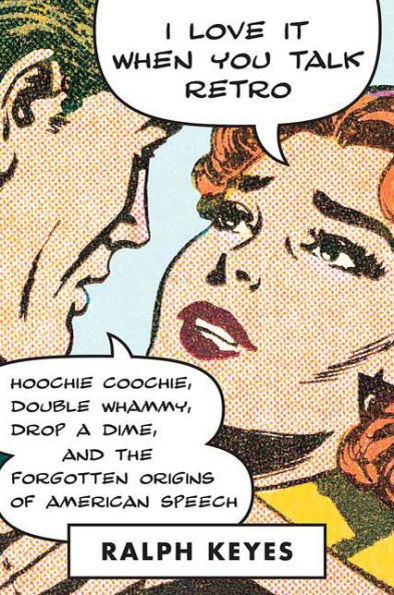
I Love It When You Talk Retro: Hoochie Coochie, Double Whammy, Drop a Dime, and the Forgotten Origins of American Speech
320Paperback(First Edition)
-
SHIP THIS ITEMIn stock. Ships in 1-2 days.PICK UP IN STORE
Your local store may have stock of this item.
Available within 2 business hours
Related collections and offers
Overview
Today's eighteen-year-olds may not know who Mrs. Robinson is, the size of a breadbox, or why going postal refers to a major uproar. Such "retroterms" are words or phrases whose origin lies in our past. I Love It When You Talk Retro discusses these verbal fossils that linger in our national conversation long after the topic they refer to has galloped into the sunset. That could be a person (Charles Ponzi), product (Edsel), radio show (Gang Busters), or ad slogan ("Cha-ching!"). How many realize that cooties was World War I slang for lice, or that doofus came from the comic strip Popeye?
Ralph Keyes takes us on an illuminating and engaging tour through what he calls retrotalk. This journey along the highways of history and byways of culture is an invaluable handbook for anyone who's ever wondered about an obscure word or phrase, "I wonder where that came from?" Ralph Keyes's book answers that question. Repeatedly. And is a lot of fun to read.

Product Details
| ISBN-13: | 9780312606404 |
|---|---|
| Publisher: | St. Martin's Publishing Group |
| Publication date: | 02/02/2010 |
| Edition description: | First Edition |
| Pages: | 320 |
| Product dimensions: | 5.42(w) x 8.22(h) x 0.87(d) |
About the Author
Read an Excerpt
I Love It When You Talk Retro
Hoochie Coochie, Double Whammy, Drop a Dime, and the Forgotten Origins of American SpeechBy Keyes, Ralph
St. Martin's Press
Copyright © 2009 Keyes, RalphAll right reserved.
ISBN: 9780312340056
Chapter One
Talking Retro
A list compiled every fall at Beloit College attracts much attention. This list gathers cultural references that might puzzle first-year students. "You sound like a broken record," for example, doesn't make much sense to a generation that grew up with iPod buds in their ears. Terms such as "stuck in a groove" and "flip side" could also be puzzling. Today's eighteen-year-olds may not know who Ma Bell is, why 1984 was a year to be concerned about, or how to get to Peyton Place.
Watergate is problematic too. Three de cades after the break-in at that office complex in Washington, D.C., a South Carolina high school teacher asked students in her government class what "Watergate" referred to. Some had a vague idea that it had something to do with Richard Nixon. Others thought it referred to a fight between the British and Americans in 1789, or that it happened in the mid-1900s, or the late nineteenth century, and could have involved bribery, or the Clintons, or Vietnam, or possibly World War II.
And it isn't just not-so-current events that can be perplexing. In Ohio, thirty-seven students in a Canton high school class were polled about their familiarity with everyday itemsbarely a generation old. None knew what "45 rpm" referred to. One fifteen-year-old thought it might be a term for modem speed—the rate per minute perhaps. Another fifteen-year-old guessed that "45 rpm" referred to the rotations per minute of a car wheel. These teenagers were vaguely familiar with vinyl records ("You mean those giant black discs? My parents have some in the basement.") and rotary phones, because a few of their grandparents still used them. On the other hand, they could only speculate that a fuzz buster might be some sort of vacuum cleaner.
Not just young students but recent immigrants are liable to be puzzled when dated allusions come up. That's what a Harvard graduate student named Michele Gordon discovered when she surveyed twenty colleagues about their familiarity with common American expressions such as "Put your John Hancock there," "The buck stops here," and "You're not in Kansas anymore." Half of her subjects were native-born, half English-speaking students from countries such as Denmark, Switzerland, and Nigeria. Even when they realized what such expressions meant, her foreign-born subjects seldom knew why. Although most had heard the name John Hancock, none could say why his name was synonymous with signatures. As for not being in Kansas anymore, Gordon assumed that because The Wizard of Oz runs so often on television, her foreign-born group would be familiar with this expression and its meaning. She was wrong. Although some had a general idea that it meant one was no longer in a rural environment, they missed the broader connotation of leaving a provincial setting for one that's more cosmopolitan. None realized that this catchphrase came from a movie. One guessed that it originated in the Broadway musical Oklahoma.
The foreign-born participants in Gordon's study were taken aback by their lack of familiarity with these allusions. Some figured the references were likely to puzzle most Americans as well. But native-born participants did not find the expressions puzzling at all. Most found their meaning obvious. Asking about them was "a silly exercise" one told Gordon.
It wasn't. Even though American discourse is filled with references we assume "everyone's heard of," everyone hasn't. Those who were born after what's alluded to took place, who grew up in another country, or who simply don't know what it refers to, get left out in the conversational cold. After seeing "Ka-Ching" in a newspaper headline, an elderly New Yorker assumed this expression came from China and asked several Chinese acquaintances what it meant. Michele Gordon herself had no idea why "The buck stops here" refers to the final point of responsibility. (It comes from the old poker player's expression pass the buck, discussed in chapter 21.) Any one of us is liable to be puzzled by an allusion whose meaning presumably is clear to others but not to us. Even terms we commonly use aren't ones whose origins are always familiar. Who was Hobson and what was his choice? Why does zipless have sexual overtones? And what's the big deal about drinking Kool-Aid?
Think of this as retrotalk. Retrotalk is a slippery slope of puzzling allusions to past phenomena. Such allusions take the form of retroterms, verbal artifacts that hang around in our national conversation long after the topic they refer to has galloped into the sunset.* They are verbal fossils, ones that outlive the organism that made their impression in the first place. This could be a person, a product, a past bestseller, an old radio or TV show, an athletic contest, a comic strip, an acronym, or an advertisement long forgotten. To qualify as a retroterm, a word or phrase must be in current use yet have an origin that isn't current. Iconic individuals can be the source of retroterms. Leftover slang is a common part of retrotalk, and old jokes that left punch lines behind but not always the setup. ("Take my wife (please).") They're clear to those who are familiar with these phenomena, confusing to those who aren't. This distinguishes retroterms from idioms, which tend to be self-explanatory (e.g., "dig your own grave," "skate on thin ice") or easily deciphered ("born with a silver spoon in his mouth"). Retroterms have no intrinsic meaning. These words and phrases make sense only when one knows where they came from.
Relying on retroterms can be problematic. For those of a certain age, making reference to things past is so routine that they're seldom even aware of doing this. But it's painfully apparent to those who aren't familiar with dated verbal shorthand. Take my son Scott (please). When he was in middle school, Scott—who was born just after history's worst nuclear power disaster—asked, "Who's this Cher Noble I keep hearing about?"
Such verbal confusion is more than a mere curiosity for those who want to communicate with younger cohorts. Members of the media have a particular problem here. During just a few evenings of televised political coverage I've watched middle-aged news analysts allude to Hercule Poirot, Judge Crater, Apollo Creed, Popeye Doyle, Rain Man, Ponzi schemes, blue plate specials, and eighteen-and-a-half-minute tape gaps. Such allusions confirm shared experiences but create distance from those who didn't share them. When Meet the Press guest David Brooks said about Hillary Clinton, "In the first debate she's Emily Post, now she's Howard Beale"—referencing the late etiquette maven and the angry protagonist of the 1976 movie Network—he set himself apart from viewers born in the last three de cades. Those who fall back on such references might as well hang a sign around their neck reading OLDER YAKKER AT WORK. NO ONE UNDER 50 NEED PAY ATTENTION.
Journalists, teachers, and communicators of all kinds run the risk of casually using dated allusions that draw blank looks. Tom Wolfe has lamented the fact that authors of his generation so often rely on imagery from a more agrarian era such as "bark up the wrong tree," "has blinders on," and "a hard row to hoe." Those phrases mean little to those who aren't familiar with that era. When a Florida teacher told her third graders that while visiting a century-old school house they'd learn to shoot marbles, churn butter, and hoe the ground, some snickered. "Isn't 'ho a bad word?" asked one student.
This illustrates how the same terminology can mean different things to members of different generations. To parents beta is a videotape format that lost the marketing war to VHS. To their kids it's a software program being tested. To them thongs are an exciting type of minimalist underwear. To their mothers and fathers thongs are cheap sandals with a thingie that goes between the toes. Hoody to me is hoodlumlike behavior. To my sons it's a sweatshirt with a hood.
Discourse between members of different generations can be a minefield of perplexing allusions. To the annoyance (and disdain) of their offspring, parents and grandparents routinely use terms such as icebox, tin foil, and dime store. Those who use such retroterms don't necessarily mind that they're confusing to younger ears. Language is a potent weapon in the generational wars. Older folks often complain that they can't make head or tail out of what younger folks are talking about with all their slang. Well, duh. That's just the point. Kids everywhere shoot slang at their parents and always have. Parents retaliate with retrotalk.
For those words to make sense one must be familiar with the experiences that gave them birth. Just as slang can be self-consciously in-group talk, allusions are an effective way to confuse outsiders. Those who don't get the allusion clearly don't belong. One reason for using references known only to the cognoscenti is to distinguish insiders from outsiders. This has always been an important role of language among ethnic or geographic groups, and it is just as important today when generations collide. Retroterms and modern synonyms draw lines in the generational sand. Lipstick is what our ancestors wore. We use lip gloss. They used rouge, we use blush. They ate prunes, we eat dried plums. They got crew cuts, we get buzz cuts. They got VD, we get STDs. Very important distinctions, as you can see.
Although my original intention for this book was to explore the origins of dated allusions that might puzzle young people and immigrants, the more deeply I got into this project, the more I realized how many of the words and phrases I was investigating were ones whose origins weren't necessarily known to all. What made me realize this was how many I encountered that mystified me. In a New York Times column, Maureen Dowd referred allegorically to "Nosey Parker." Who he? To characterize those who naively believe that managed health care drives down medical costs, Dowd's colleague Paul Krugman used the expression "There must be a pony in there somewhere." Say what? Upon investigation, such puzzling allusions proved to have a clear historical root, and often a fascinating one (discussed more fully in the text). After chasing down their origins I found myself repeatedly musing, "So that's where that comes from!"
Along the way my book's scope broadened to include a wide variety of allusions in current use whose origins aren't always clear. It isn't meant to compensate for a spotty education. I'm assuming that most readers can recognize a Mona Lisa smile and know what it means to "meet your Waterloo." Shakespeare and the Bible are rich with retroterms I've mostly ignored on the assumption that their genesis is widely known. But assuming familiarity with a wide range of other terms is risky. Making sense of the many linguistic relics in our lexicon requires familiarity with events that left behind a verbal residue. This is what syndicated columnist Leonard Pitts discovered when he referred to Mayberry in a column. His editor, who grew up in a home without television, challenged Pitts's reference to a town she thought could make readers ask, "Where's that?"
That's the type of question this book strives to answer. In examining its contents, some may wonder, "What's X doing here? Or Y? Everyone knows what they refer to." But everyone doesn't. We're all familiar with some allusions but not others. (While serving as White House press secretary, Dana Perino confessed that she didn't know what the Cuban missile crisis referred to.) Which retroterms we know about and which we don't vary with the individual. That's why I've tried to err on the side of inclusiveness. But even familiar terminology may have an unfamiliar origin story. This book is full of those stories. They explain where such retroterms came from and why they've lingered in American discourse.
Although not a work of history as such, I Love It When You Talk Retro hits the high points: those allusions from our past that made a big enough impression to stick around. As Bill Bryson wrote in Made in America, "unless we understand the social context in which words are formed . . . we cannot begin to appreciate the richness and vitality of the words that make up our speech." That's why this book concerns itself with social history as much as word history. One can't be divorced from the other. Language reflects its times. Words, phrases, and allusions are excellent barometers of what mattered to us during a given period of history: what resonated, struck our fancy, or simply tickled our funny bone.
Americans love to play with words. Ever since the first hotcake was fried in bear grease, they've invented new terms with abandon, revised grammar on the fly, and continually moved concepts from one context to another. As visitors routinely discover, American conversation is filled with inventive terms and always has been. While visiting the United States in the early nineteenth century, an Englishman named Basil Hall discussed this topic with dictionary compiler Noah Webster. Webster was favorably impressed by the many new words Americans had coined. Hall was appalled. If a new word proved useful, asked Webster, why not add it to the lexicon? "Because there are words enough already," Hall responded, "and it only confuses matters, and hurts the cause of letters to introduce such words."
New circumstances demand new words, however, and Americans have always been up to the task of supplying them. A recurring question in this book is why some endure as retroterms while others don't. In their Darwinian struggle for survival, new terms that take hold are not necessarily the .ashiest, most colorful, or most widely used. The only thing that really matters when a fledgling word or phrase is being auditioned is utility. Does it improve on an existing one? Has anything better come along to take its place? Perhaps most important, do we like the terms in question? That's why Retrotalk returns so often to the concept of striking a chord. Certain events, people, movie lines, or ad slogans linger in our collective memory. It's intriguing not only to identify them and explore their origins but to understand why they stuck around when others didn't. How is it that the comic strip characters Alphonse and Gaston left their names behind but the Katzenjammer Kids didn't? Why has boxing been the source of so many analogies and football so few? And what makes us rely on sell the sizzle long after we've forgotten who coined that expression?
Even though it's not always clear why some words and phrases gain traction while others don't, here are some guidelines. Lasting retroterms:
1. Strike a chord. For what ever reason, some terms just strike our fancy in a lasting way. This can be seen in TV ads that contribute catchphrases which do—or don't—stick around. "Flick my Bic" lasted for only a season, as did Alka-Seltzer's "I can't believe I ate the whole thing!" But "Where's the beef?" is still part of our national conversation more than two de cades after Wendy's rolled it out, and Chiffon margarine's "It's not nice to fool Mother Nature!" has lasted even longer. Both struck a durable chord.
2. Fill a void. It is well known among lexicographers that words and phrases most likely to enter the vernacular .ll a gap. They prove more useful as a form of verbal shorthand than any existing word. Gerrymander is one example, a term coined early in the nineteenth century to describe artfully drawn voting districts. (See chapter 5.) More recently, Mrs. Robinson has proved more economical and far more evocative than "an older woman who seduces a younger man," just as the forgettable movie Mr. Mom left its title behind in our lingo because those two words allude to a stay-at-home father better than any others that have come along.
3. Excite strong feeling. Intense emotion, fear especially, welds content into our brains. Ask any psychiatrist. Conveying a sense of dread, as director Alfred Hitchcock did so effectively so often, guaranteed that movies such as Psycho and The Birds would be a fertile source of lasting retroterms.
4. Are fun to say. A retroterm's life expectancy is helped immeasurably if it feels good on the tongue. Cootie. Cha-ching! Rope-a-dope. Sizzle. Gong. Bimbo. All these terms have endured in large part because they're just so gosh-darn fun to say. For someone's name to become iconic, it helps to roll smoothly off the tongue. "Kiplingesque" doesn't work very well. Nor does "Woolfian" or "Conradian." "Hemingwayian" is a complete nonstarter, and "Hemingwayesque" isn't much better. Proustian works just fine though, as does Dickensian. Orwellian works best of all and Kafkaesque nearly as well.
One problem retroterms present to those unfamiliar with them is a simple matter of spelling. Phonetics are no help. Quite the contrary. While researching this book I've seen references to "brass tax," "text's bad boy," "Mutton Jeff," and "Profit of God." In a Blondie comic strip, Dagwood holds a black platter, saying, "Look. Here's our old Guy Lombardo New Year's record." "Let's take it up to the attic and play it on the old Victrola," responds Blondie. Their teenage daughter Cookie overhears this exchange. When her brother Alexander asks, "Where are Mom and Dad?" Cookie says, "I'm not sure. They're going to play with some guy named Vic Trola who has lumbago."
Not all retrotalk takes place on a generational fault line, however. Some allusions can be perplexing to anyone of any age or station. Take "waiting for the other shoe to drop." I once asked a twenty-eight-year-old graduate of an Ivy League college if she knew the genesis of that common catchphrase. The woman didn't. My subsequent minipoll found she was not alone. Most of those whom I queried realized this phrase referred to an unresolved situation; but few knew why. Where did that allusion come from?
Excerpted from I LOVE IT WHEN YOU TALK RETRO by Hoochie Coochie, Double Whammy, Drop a Dime
Copyright © 2009 by Ralph Keyes
Published in April 2009 by St. Martin's Press
All rights reserved. This work is protected under copyright laws and reproduction is strictly prohibited. Permission to reproduce the material in any manner or medium must be secured from the Publisher.
Continues...
Excerpted from I Love It When You Talk Retro by Keyes, Ralph Copyright © 2009 by Keyes, Ralph. Excerpted by permission.
All rights reserved. No part of this excerpt may be reproduced or reprinted without permission in writing from the publisher.
Excerpts are provided by Dial-A-Book Inc. solely for the personal use of visitors to this web site.