
Identifying Future-Proof Science
Is science getting at the truth?
The sceptics—those who spread doubt about science—often employ a simple argument: scientists were 'sure' in the past, and then they ended up being wrong. Through a combination of historical investigation and philosophical-sociological analysis, Identifying Future-Proof Science defends science against this potentially dangerous scepticism. Indeed, we can confidently identify many scientific claims that are future-proof: they will last forever, so long as science continues. How do we identify future-proof claims? This appears to be a new question for science scholars, and not an unimportant one. It is argued that the best way to identify future-proof science is to avoid any attempt to analyse the relevant first-order scientific evidence, instead focusing purely on second-order evidence. Specifically, a scientific claim is future-proof when the relevant scientific community is large, international, and diverse, and at least 95 per cent of that community would describe the claim as a 'scientific fact'. In the entire history of science, no claim meeting these criteria has ever been overturned, despite enormous opportunity.
1147084301
The sceptics—those who spread doubt about science—often employ a simple argument: scientists were 'sure' in the past, and then they ended up being wrong. Through a combination of historical investigation and philosophical-sociological analysis, Identifying Future-Proof Science defends science against this potentially dangerous scepticism. Indeed, we can confidently identify many scientific claims that are future-proof: they will last forever, so long as science continues. How do we identify future-proof claims? This appears to be a new question for science scholars, and not an unimportant one. It is argued that the best way to identify future-proof science is to avoid any attempt to analyse the relevant first-order scientific evidence, instead focusing purely on second-order evidence. Specifically, a scientific claim is future-proof when the relevant scientific community is large, international, and diverse, and at least 95 per cent of that community would describe the claim as a 'scientific fact'. In the entire history of science, no claim meeting these criteria has ever been overturned, despite enormous opportunity.
Identifying Future-Proof Science
Is science getting at the truth?
The sceptics—those who spread doubt about science—often employ a simple argument: scientists were 'sure' in the past, and then they ended up being wrong. Through a combination of historical investigation and philosophical-sociological analysis, Identifying Future-Proof Science defends science against this potentially dangerous scepticism. Indeed, we can confidently identify many scientific claims that are future-proof: they will last forever, so long as science continues. How do we identify future-proof claims? This appears to be a new question for science scholars, and not an unimportant one. It is argued that the best way to identify future-proof science is to avoid any attempt to analyse the relevant first-order scientific evidence, instead focusing purely on second-order evidence. Specifically, a scientific claim is future-proof when the relevant scientific community is large, international, and diverse, and at least 95 per cent of that community would describe the claim as a 'scientific fact'. In the entire history of science, no claim meeting these criteria has ever been overturned, despite enormous opportunity.
The sceptics—those who spread doubt about science—often employ a simple argument: scientists were 'sure' in the past, and then they ended up being wrong. Through a combination of historical investigation and philosophical-sociological analysis, Identifying Future-Proof Science defends science against this potentially dangerous scepticism. Indeed, we can confidently identify many scientific claims that are future-proof: they will last forever, so long as science continues. How do we identify future-proof claims? This appears to be a new question for science scholars, and not an unimportant one. It is argued that the best way to identify future-proof science is to avoid any attempt to analyse the relevant first-order scientific evidence, instead focusing purely on second-order evidence. Specifically, a scientific claim is future-proof when the relevant scientific community is large, international, and diverse, and at least 95 per cent of that community would describe the claim as a 'scientific fact'. In the entire history of science, no claim meeting these criteria has ever been overturned, despite enormous opportunity.
35.0
In Stock
5
1

Identifying Future-Proof Science
288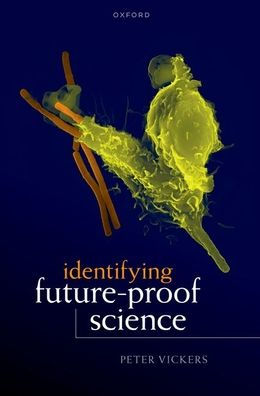
Identifying Future-Proof Science
288Paperback
$35.00
35.0
In Stock

Product Details
| ISBN-13: | 9780198966227 |
|---|---|
| Publisher: | Oxford University Press |
| Publication date: | 08/12/2025 |
| Pages: | 288 |
| Product dimensions: | 6.18(w) x 9.25(h) x 0.59(d) |
About the Author
From the B&N Reads Blog