- Shopping Bag ( 0 items )
-
All (13) from $1.99
-
New (3) from $13.46
-
Used (10) from $1.99
More About This Textbook
Overview
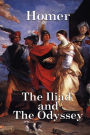
The Odyssey: Journey with Ulysses as he battles to bring his victorious, but decimated, troops home from the Trojan War, dogged by the wrath of the god Poseidon at every turn. Having been away for twenty years, little does he know what awaits him when he finally makes his way home.
These two books are some of the most import books in the literary cannon, having influenced virtually every adventure tale ever told. And yet they are still accessible and immediate and now you can have both in one binding.
Editorial Reviews
School Library Journal
Gr 3-5 - All three adaptations of these classic novels fall prey to the usual pitfalls involved in such a process. The bare outlines of the plots are provided, but character development, a true sense of place and time with regard to setting, and masterful description of the action all go by the wayside. Jungle Bookis mistitled as it references only the Mowgli stories and moves from incident to incident so quickly that the "law of the jungle" morals in Kipling's anthropomorphic fables are lost. Treasure Islandis written in a similar breakneck, choppy style, and Long John Silver, one of the most memorable characters ever created, is eminently forgettable in this telling. In 80 Days, the historic events that made such a journey even thinkable, like the opening of the Suez Canal and the completion of the Transcontinental Railroad, are never mentioned, nor is the International Date Line, which enabled Fogg to win his wager, mentioned, let alone explained. The cartoon illustrations in all three volumes border on offensive as no matter which country or culture is depicted, the dot-eyed faces are virtually identical except for minor variations in skin tone. Some illustrations make no sense, as when the action in 80 Daysdescribes the servant Passepartout at the bottom of a circus pyramid, but the picture is of a Japanese tearoom.-Grace Oliff, Ann Blanche Smith School, Hillsdale, NJ
Copyright 2007 Reed Business InformationProduct Details
Related Subjects
Meet the Author
Greek epic poet, traditionally said to be the author of the epic
poems the Iliad and the Odyssey. The ancient Greeks generally
believed that Homer was a historical individual, but modern
scholars are skeptical: no reliable biographical information has
been handed down from classical antiquity, and the poems themselves
manifestly represent the culmination of many centuries of oral
story-telling and a well-developed "formulaic" system of poetic
composition. According to Martin West, "Homer" is "not the name of
a historical poet, but a fictitious or constructed name." The poems
are now widely regarded as the culmination of a long tradition of
orally composed poetry, but the way in which they reached their
final written form, and the role that an individual poet, or poets,
played in this process is disputed. By the reckoning of scholars
like Geoffrey Kirk, both poems were created by an individual genius
who drew much of his material from various traditional stories.
Others, like Martin West, hold that the epics were composed by a
number of poets. Gregory Nagy maintains that the epics are not the
creation of any individual; rather, they slowly evolved towards
their final form over a period of centuries and, in this view, are
the collective work of generations of poets. The date of Homer's
existence was controversial in antiquity and is no less so today.
Herodotus said that Homer lived 400 years before his own time,
which would place him at about 850 BC; but other ancient sources
gave dates much closer to the supposed time of the Trojan War.
Biography
We know very little about the author of The Odyssey and its companion tale, The Iliad. Most scholars agree that Homer was Greek; those who try to identify his origin on the basis of dialect forms in the poems tend to choose as his homeland either Smyrna, now the Turkish city known as Izmir, or Chios, an island in the eastern Aegean Sea.According to legend, Homer was blind, though scholarly evidence can neither confirm nor contradict the point.
The ongoing debate about who Homer was, when he lived, and even if he wrote The Odyssey and The Iliad is known as the "Homeric question." Classicists do agree that these tales of the fall of the city of Troy (Ilium) in the Trojan War (The Iliad) and the aftermath of that ten-year battle (The Odyssey) coincide with the ending of the Mycenaean period around 1200 BCE (a date that corresponds with the end of the Bronze Age throughout the Eastern Mediterranean). The Mycenaeans were a society of warriors and traders; beginning around 1600 BCE, they became a major power in the Mediterranean. Brilliant potters and architects, they also developed a system of writing known as Linear B, based on a syllabary, writing in which each symbol stands for a syllable.
Scholars disagree on when Homer lived or when he might have written The Odyssey. Some have placed Homer in the late-Mycenaean period, which means he would have written about the Trojan War as recent history. Close study of the texts, however, reveals aspects of political, material, religious, and military life of the Bronze Age and of the so-called Dark Age, as the period of domination by the less-advanced Dorian invaders who usurped the Mycenaeans is known. But how, other scholars argue, could Homer have created works of such magnitude in the Dark Age, when there was no system of writing? Herodotus, the ancient Greek historian, placed Homer sometime around the ninth century BCE, at the beginning of the Archaic period, in which the Greeks adopted a system of writing from the Phoenicians and widely colonized the Mediterranean. And modern scholarship shows that the most recent details in the poems are datable to the period between 750 and 700 BCE.
No one, however, disputes the fact that The Odyssey (and The Iliad as well) arose from oral tradition. Stock phrases, types of episodes, and repeated phrases -- such as "early, rose-fingered dawn" -- bear the mark of epic storytelling. Scholars agree, too, that this tale of the Greek hero Odysseus's journey and adventures as he returned home from Troy to Ithaca is a work of the greatest historical significance and, indeed, one of the foundations of Western literature.
Author biography from the Barnes & Noble Classics edition of The Odyssey.
Good To Know
The meter (rhythmic pattern of syllables) of Homer's epic poems is dactylic hexameter.