Uh-oh, it looks like your Internet Explorer is out of date.
For a better shopping experience, please upgrade now.
Information at Sea: Shipboard Command and Control in the U.S. Navy, from Mobile Bay to Okinawa
This is the first book to explore information management at sea as practiced by the U.S. Navy from the Civil War to World War II.
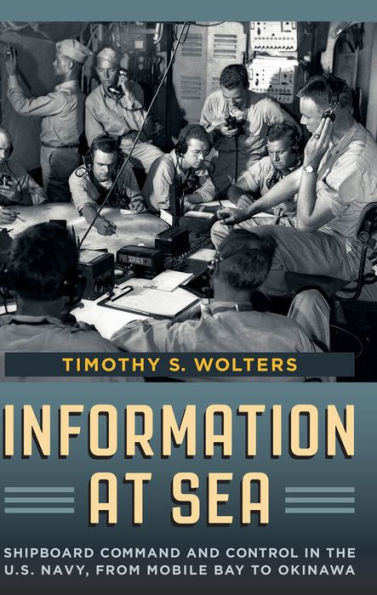
The brain of a modern warship is its combat information center (CIC). Data about friendly and enemy forces pour into this nerve center, contributing to command decisions about firing, maneuvering, and coordinating. Timothy S. Wolters has written the first book to investigate the history of the CIC and the many other command and control systems adopted by the U.S. Navy from the Civil War to World War II. What institutional ethos spurred such innovation? Information at Sea tells the fascinating stories of the naval and civilian personnel who developed an array of technologies for managing information at sea, from signal flares and radio to encryption machines and radar.
Wolters uses previously untapped archival sources to explore how one of America's most technologically oriented institutions addressed information management before the advent of the digital computer. He argues that the human-machine systems used to coordinate forces were as critical to naval successes in World War II as the ships and commanders more familiar to historians.
1115450474
Information at Sea: Shipboard Command and Control in the U.S. Navy, from Mobile Bay to Okinawa
This is the first book to explore information management at sea as practiced by the U.S. Navy from the Civil War to World War II.
The brain of a modern warship is its combat information center (CIC). Data about friendly and enemy forces pour into this nerve center, contributing to command decisions about firing, maneuvering, and coordinating. Timothy S. Wolters has written the first book to investigate the history of the CIC and the many other command and control systems adopted by the U.S. Navy from the Civil War to World War II. What institutional ethos spurred such innovation? Information at Sea tells the fascinating stories of the naval and civilian personnel who developed an array of technologies for managing information at sea, from signal flares and radio to encryption machines and radar.
Wolters uses previously untapped archival sources to explore how one of America's most technologically oriented institutions addressed information management before the advent of the digital computer. He argues that the human-machine systems used to coordinate forces were as critical to naval successes in World War II as the ships and commanders more familiar to historians.
60.0
In Stock
51
Information at Sea: Shipboard Command and Control in the U.S. Navy, from Mobile Bay to Okinawa
This is the first book to explore information management at sea as practiced by the U.S. Navy from the Civil War to World War II.
The brain of a modern warship is its combat information center (CIC). Data about friendly and enemy forces pour into this nerve center, contributing to command decisions about firing, maneuvering, and coordinating. Timothy S. Wolters has written the first book to investigate the history of the CIC and the many other command and control systems adopted by the U.S. Navy from the Civil War to World War II. What institutional ethos spurred such innovation? Information at Sea tells the fascinating stories of the naval and civilian personnel who developed an array of technologies for managing information at sea, from signal flares and radio to encryption machines and radar.
Wolters uses previously untapped archival sources to explore how one of America's most technologically oriented institutions addressed information management before the advent of the digital computer. He argues that the human-machine systems used to coordinate forces were as critical to naval successes in World War II as the ships and commanders more familiar to historians.
Timothy S. Wolters, an engineer-qualified submariner and captain in the United States Navy Reserve, is an assistant professor of history at Iowa State University. He formerly held the Ramsey Chair of Naval Aviation History at the Smithsonian Institution’s National Air and Space Museum.
Table of Contents
Acknowledgments Introduction 1. Flags, Flares, and Lights: A World before Wireless 2. Sparks and Arcs: The Navy Adopts Radio 3. War and Peace: Coordinating Naval Forces 4. A Most Complex Problem: Demanding Information 5. Creating the Brain of a Warship: Radar and the CIC Conclusion Abbreviations Notes Essay on Sources Archives and Manuscript Collections Index
What People are Saying About This
From the Publisher
An extremely well-researched and well-written history of the U.S. Navy’s efforts to develop the technology and technological systems necessary to manage operations at sea, especially during war. —William M. McBride, United States Naval Academy
William M. McBride
An extremely well-researched and well-written history of the U.S. Navy’s efforts to develop the technology and technological systems necessary to manage operations at sea, especially during war.