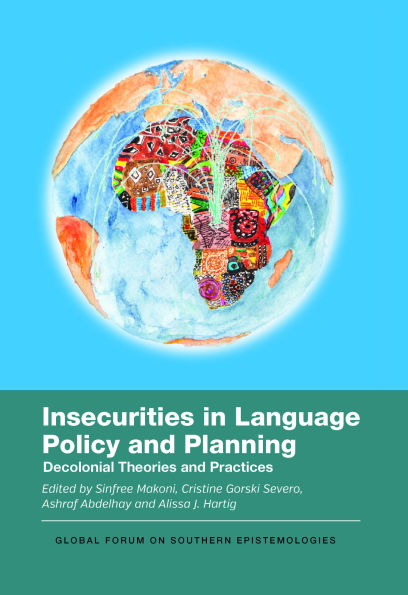
Insecurities in Language Policy and Planning: Decolonial Theories and Practices
Invites readers to question whether language planning and policy can survive decolonialization.

This book represents a vital step forward in the process of decolonizing language policy and planning (LPP). It addresses both theoretical and practical aspects of LPP, while exploring its intersection with domains including security, politics and education. A decolonized LPP invites us to view language as an interconnected phenomenon, with boundaries that are not defined by structural, territorial, ethnic or historical limitations.

The chapters in this book problematize the positivist, instrumental, pragmatic and technical dimensions of LPP, while offering a renewed perspective in dialogue with contemporary struggles and claims. It covers a range of geopolitical contexts, with particular attention to the dialogues and contradictions between the North and the South.
1147719195
Insecurities in Language Policy and Planning: Decolonial Theories and Practices
Invites readers to question whether language planning and policy can survive decolonialization.

This book represents a vital step forward in the process of decolonizing language policy and planning (LPP). It addresses both theoretical and practical aspects of LPP, while exploring its intersection with domains including security, politics and education. A decolonized LPP invites us to view language as an interconnected phenomenon, with boundaries that are not defined by structural, territorial, ethnic or historical limitations.

The chapters in this book problematize the positivist, instrumental, pragmatic and technical dimensions of LPP, while offering a renewed perspective in dialogue with contemporary struggles and claims. It covers a range of geopolitical contexts, with particular attention to the dialogues and contradictions between the North and the South.

179.95 Pre Order
Insecurities in Language Policy and Planning: Decolonial Theories and Practices

Insecurities in Language Policy and Planning: Decolonial Theories and Practices

Insecurities in Language Policy and Planning: Decolonial Theories and Practices

Insecurities in Language Policy and Planning: Decolonial Theories and Practices

Hardcover

$179.95 
  • SHIP THIS ITEM
    Available for Pre-Order. This item will be released on January 13, 2026

Related collections and offers


Overview

Invites readers to question whether language planning and policy can survive decolonialization.

This book represents a vital step forward in the process of decolonizing language policy and planning (LPP). It addresses both theoretical and practical aspects of LPP, while exploring its intersection with domains including security, politics and education. A decolonized LPP invites us to view language as an interconnected phenomenon, with boundaries that are not defined by structural, territorial, ethnic or historical limitations.

The chapters in this book problematize the positivist, instrumental, pragmatic and technical dimensions of LPP, while offering a renewed perspective in dialogue with contemporary struggles and claims. It covers a range of geopolitical contexts, with particular attention to the dialogues and contradictions between the North and the South.


Product Details

ISBN-13: 9781836681922
Publisher: Channel View Publications
Publication date: 01/13/2026
Series: Global Forum on Southern Epistemologies , #8
Pages: 402
Product dimensions: 6.85(w) x 9.65(h) x (d)

About the Author

Sinfree Makoni is Director of African Studies, Liberal Arts Professor of African Studies and Applied Linguistics, The Pennsylvania State University, USA.

Cristine Gorski Severo is an Associate Professor at Federal University of Santa Catarina, Brazil and a CNPq national Fellow. 

Ashraf Abdelhay works for the Doha Institute for Graduate Studies, Qatar, as an Associate Professor in the program of Linguistics and Arabic Lexicography.

Alissa J. Hartig is Associate Professor of Applied Linguistics, Portland State University, USA.

Table of Contents

Contributors

José del Valle: Preface

Sinfree Makoni, Ashraf Abdelhay and Cristine Severo: Introduction

Chapter 1. Bernard Spolsky: Continued Thoughts on Language Policy   

Chapter 2. Michal Tannenbaum and Elana Shohamy: A New Multilingual Educational Policy in Israel: The Role of Research as a Contributing Factor  

Chapter 3. Rochelle Pinto: Becoming a Language of State

Chapter 4. Ben Rampton, Daniel Silva and Constadina Charalambous: Sociolinguistics and Securitization as Another Mode of Governance  

Chapter 5. Nicholas Faraclas: Longue Durée and Durée Profonde: Udumu, Utu and Bringing Language Back to Earth  

Chapter 6. Joseph Gafaranga: Doing Translanguaging, Unknowingly and Differently  

Chapter 7. Chaoqun Lian: Metaphorical Language Policy and Language Politics in the Arabic-Speaking World  

Chapter 8. Yonatan Mendel: Arabic in Israel: The Consequences of Harnessing Language for Security

Chapter 9. Yasir Suleiman-Malley: Language and Conflict in the Israeli–Palestinian Sphere: The View from Below

Chapter 10. Folúkẹ́ Adébísí: [Un]making the Wretched of the Earth: Can We Aim Towards Testamentary Life Within Legal Knowledge?  

Chapter 11. David Karlander and Linus Salö: Historicizing ‘Semilingualism’: On the Theoretical Origins of a Linguistic Pathology

Chapter 12. Frances Vavrus: Schooling as Uncertainty: An Ethnographic Memoir

Chapter 13. Priyadarshani Joshi: An Exploration of the Causes and Consequences of Private Schooling Expansion: Global Trends and Research Findings from Nepal  

Chapter 14. Peter Mayo: Twenty Years' Engagement in Postcolonial Education: A Retrospective

Chapter 15. Mama Adobea Nii Owoo: From Unarchiving to Unbooking: How the Film No Vernacular Rethinks Language Policy Research for Global South Contexts 

Ezra Nhampoca: Epilogue

Index

From the B&N Reads Blog

Customer Reviews