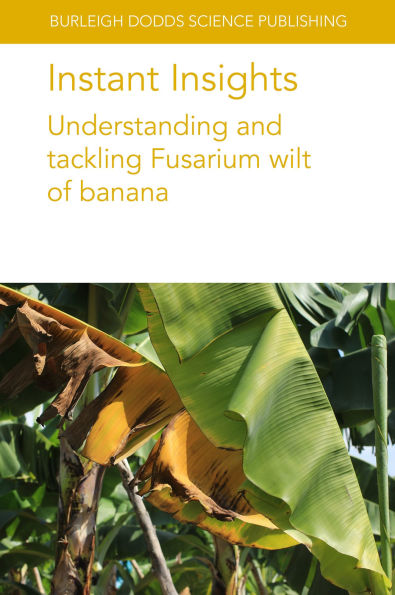
Instant Insights: Understanding and tackling Fusarium wilt of banana

This book features five peer-reviewed reviews on understanding and tackling Fusarium wilt in global banana production.

The first chapter examines the way in which monoculture has affected the banana industry and discusses the available banana varieties, the advent of the Cavendish variety and the need to develop new banana varieties.

The second chapter provides a comprehensive overview of the history, epidemiology and management of F. oxysporum forma specialis cubense Race 1 and 2 – the fungus which causes Fusarium wilt of banana.

The third chapter documents the spread of Tropical Race 4 throughout the major Cavendish banana-producing regions of the world and highlights the importance of breeding for resistance to diversify the banana crop for the export trade.

The fourth chapter reviews the potential of particular breeding technologies, such as genetic engineering and induced mutagenesis, to improve the performance of Cavendish cultivars and overcome current biological and environmental challenges.

The final chapter considers the challenges associated with developing hybrid banana varieties with improved properties and uses insights from Embrapa’s banana breeding programme in Brazil to highlight these challenges and how they could possibly be mitigated.
1146883757
Instant Insights: Understanding and tackling Fusarium wilt of banana

This book features five peer-reviewed reviews on understanding and tackling Fusarium wilt in global banana production.

The first chapter examines the way in which monoculture has affected the banana industry and discusses the available banana varieties, the advent of the Cavendish variety and the need to develop new banana varieties.

The second chapter provides a comprehensive overview of the history, epidemiology and management of F. oxysporum forma specialis cubense Race 1 and 2 – the fungus which causes Fusarium wilt of banana.

The third chapter documents the spread of Tropical Race 4 throughout the major Cavendish banana-producing regions of the world and highlights the importance of breeding for resistance to diversify the banana crop for the export trade.

The fourth chapter reviews the potential of particular breeding technologies, such as genetic engineering and induced mutagenesis, to improve the performance of Cavendish cultivars and overcome current biological and environmental challenges.

The final chapter considers the challenges associated with developing hybrid banana varieties with improved properties and uses insights from Embrapa’s banana breeding programme in Brazil to highlight these challenges and how they could possibly be mitigated.

49.99 In Stock
Instant Insights: Understanding and tackling Fusarium wilt of banana

Instant Insights: Understanding and tackling Fusarium wilt of banana

Instant Insights: Understanding and tackling Fusarium wilt of banana

Instant Insights: Understanding and tackling Fusarium wilt of banana

eBook

$49.99 

Available on Compatible NOOK devices, the free NOOK App and in My Digital Library.
WANT A NOOK?  Explore Now

Related collections and offers


Overview

This book features five peer-reviewed reviews on understanding and tackling Fusarium wilt in global banana production.

The first chapter examines the way in which monoculture has affected the banana industry and discusses the available banana varieties, the advent of the Cavendish variety and the need to develop new banana varieties.

The second chapter provides a comprehensive overview of the history, epidemiology and management of F. oxysporum forma specialis cubense Race 1 and 2 – the fungus which causes Fusarium wilt of banana.

The third chapter documents the spread of Tropical Race 4 throughout the major Cavendish banana-producing regions of the world and highlights the importance of breeding for resistance to diversify the banana crop for the export trade.

The fourth chapter reviews the potential of particular breeding technologies, such as genetic engineering and induced mutagenesis, to improve the performance of Cavendish cultivars and overcome current biological and environmental challenges.

The final chapter considers the challenges associated with developing hybrid banana varieties with improved properties and uses insights from Embrapa’s banana breeding programme in Brazil to highlight these challenges and how they could possibly be mitigated.


Product Details

ISBN-13: 9781835452615
Publisher: Burleigh Dodds Science Publishing
Publication date: 06/24/2025
Series: Burleigh Dodds Science: Instant Insights , #119
Sold by: Barnes & Noble
Format: eBook
Pages: 118
File size: 4 MB

About the Author

Dr André Drenth is Professor in Tropical Plant Pathology and Program Leader for crop protection in the Centre for Horticultural Science at the Queensland Alliance for Agriculture and Food Innovation (QAAFI), at the University of Queensland. He leads several projects on tropical plant diseases and he initiated and led a national Banana Plant Protection Programme set up to protect Australia’s banana industry from the impact of a range of pests and diseases.


Dr Gert H. J. Kema is Professor of Phytopathology and chair at the Laboratory for Phytopathology of Wageningen University, The Netherlands. He initiated and coordinated several international banana research programs focusing on Fusarium wilt of banana and black Sigatoka as well as interdisciplinary research projects and public-private-partnerships on other perennial crops. He is a cofounder of several spin-off companies focusing on banana improvement, disease management and bioprocessing.

Table of Contents

  • Chapter 1 - Understanding the banana industry: monoculture and beyond: Dan Koeppel, Independent Journalist and Researcher, USA;
    • 1 Introduction
    • 2 Banana varieties and the Cavendish monoculture
    • 3 The development of a banana monoculture
    • 4 The dynamics of the banana monoculture
    • 5 Post-war developments: business as usual?
    • 6 The Cavendish era
    • 7 Cavendish in crisis and a new paradigm
    • 8 The hunt for new varieties
    • 9 Future trends and conclusion
    • 10 Where to look for further information

Chapter taken from: Kema, G. H. J. and Drenth A. (ed.), Achieving sustainable cultivation of bananas Volume 1: Cultivation techniques, pp. 21-32, Burleigh Dodds Science Publishing, Cambridge, UK, 2018, (ISBN: 978 1 78676 156 9)

  • Chapter 2 - Fusarium wilt of banana: impact, epidemiology and management of Fusarium wilt Race 1 and 2 [Ed. 4]: Einar Martínez de la Parte, Wageningen University and Research, The Netherlands and Instituto de Investigaciones de Sanidad Vegetal (INISAV), Cuba; and Luis Pérez-Vicente, Instituto de Investigaciones de Sanidad Vegetal (INISAV), Cuba;
    • 1 Introduction
    • 2 Disease symptoms
    • 3 Pathogen characteristics
    • 4 Disease cycle and epidemiology
    • 5 Disease occurrence and impact
    • 6 Disease resistance: cultivar susceptibility and host resistance
    • 7 Management of the disease
    • 8 Conclusion and future trends
    • 9 Where to look for further information
    • 10 References

Chapter taken from: Drenth A. and Kema, G. H. J. (ed.), Achieving sustainable cultivation of bananas Volume 3: Diseases and pests, pp. 85-112, Burleigh Dodds Science Publishing, Cambridge, UK, 2024, (ISBN: 978 1 78676 981 7)

  • Chapter 3 - The past, present and future of Fusarium wilt of banana caused by Tropical Race 4 [Ed. 5]: Fernando García-Bastidas, KeyGene B.V., The Netherlands; André Drenth, The University of Queensland, Australia; and Gert H. J. Kema, Wageningen University, The Netherlands;
    • 1 Introduction
    • 2 Past: origins, spread and biology
    • 3 Present: detection, epidemiology and control
    • 4 Future: preventative/curative disease control and breeding
    • 5 Conclusion
    • 6 Where to look for further information
    • 7 Acknowledgements
    • 8 References

Chapter taken from: Drenth A. and Kema, G. H. J. (ed.), Achieving sustainable cultivation of bananas Volume 3: Diseases and pests, pp. 113-144, Burleigh Dodds Science Publishing, Cambridge, UK, 2024, (ISBN: 978 1 78676 981 7)

  • Chapter 4 - Targeted improvement of Cavendish clones: Eli Khayat, Rahan Meristem (1998) LTD., Israel;
    • 1 Introduction
    • 2 Genetic background of bananas and plantains
    • 3 In vitro mutagenesis: somaclonal variation
    • 4 Conclusion and future trends
    • 5 References

Chapter taken from: Kema, G. H. J. and Drenth A. (ed.), Achieving sustainable cultivation of bananas Volume 2: Germplasm and genetic improvement, pp. 307-321, Burleigh Dodds Science Publishing, Cambridge, UK, 2021, (ISBN: 978 1 78676 344 0)

  • Chapter 5 - Developing hybrid banana varieties with improved properties: Edson Perito Amorim, Vanusia Batista de Oliveira Amorim, Manassés dos Santos Silva, Fernando Haddad, Claudia Fortes Ferreira and Janay Almeida dos Santos Serejo, Embrapa, Brazil;
    • 1 Introduction
    • 2 Released hybrids
    • 3 Seeds as the basis of the genetic improvement program of Embrapa
    • 4 Improved diploids and their importance in the improvement of Musa spp.
    • 5 Phenotyping for resistance to Fusarium wilt race 1
    • 6 The Embrapa breeding cycle
    • 7 Alternatives to breeding based on crosses
    • 8 Future trends and conclusion
    • 9 References

Chapter taken from: Kema, G. H. J. and Drenth A. (ed.), Achieving sustainable cultivation of bananas Volume 2: Germplasm and genetic improvement, pp. 232-337, Burleigh Dodds Science Publishing, Cambridge, UK, 2021, (ISBN: 978 1 78676 344 0)

From the B&N Reads Blog

Customer Reviews